Introduction
Real-time analytics platforms enable organizations to process, analyze, and act on data instantly as it is generated. Instead of waiting hours or days for batch processing, these platforms allow businesses to monitor events, metrics, and user behavior in near real-time. In simple terms, they turn live data streams into actionable insights immediately, helping teams make faster and smarter decisions.
This category is increasingly important because modern businesses rely on instant insights for operations, customer experience, fraud detection, IoT monitoring, and AI-driven automation. With the rise of streaming data, microservices, and event-driven architectures, real-time analytics has become a core capability for competitive advantage. These platforms support use cases like live dashboards, anomaly detection, personalization, and operational monitoring.
Common use cases include:
- Real-time dashboards and KPI tracking
- Fraud detection and security monitoring
- Customer behavior and personalization
- IoT and sensor data analysis
- Operational and system monitoring
Buyers should evaluate:
- Streaming data processing capabilities
- Latency and performance
- Integration with data pipelines and sources
- Scalability and fault tolerance
- Ease of use and deployment
- Visualization and dashboarding support
- Security and compliance features
- Cost and pricing model
- API and extensibility
- Support and ecosystem
Best for: data engineers, platform teams, DevOps teams, analytics teams, and enterprises handling high-velocity data streams. Particularly valuable for finance, e-commerce, SaaS, and IoT-driven businesses.
Not ideal for: small teams with batch-only data needs. If real-time decision-making is not required, traditional BI tools may be sufficient.
Key Trends in Real-time Analytics Platforms
- Streaming-first architectures are becoming standard
- Integration with AI and ML models is increasing
- Low-latency processing is a key differentiator
- Cloud-native and serverless platforms dominate adoption
- Event-driven systems are replacing batch workflows
- Real-time dashboards are expected across industries
- Data pipelines and observability integration is growing
- Edge analytics is gaining traction for IoT use cases
- Cost optimization for streaming workloads is improving
- Security and compliance requirements are increasing
How We Chose These Real-time Analytics Platforms (Methodology)
We selected the Top 10 tools based on:
- Market adoption and industry relevance
- Real-time processing capabilities and latency
- Scalability and performance
- Integration ecosystem and data connectivity
- Ease of deployment and usability
- Security and compliance readiness
- Support for modern data architectures
- Innovation in streaming and analytics
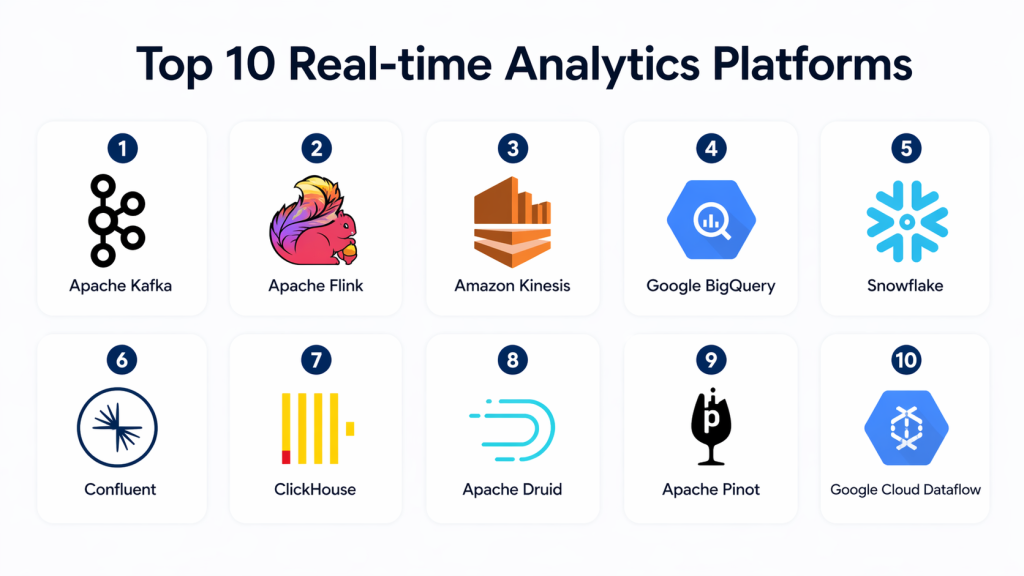
Top 10 Real-time Analytics Platforms
#1 — Apache Kafka
Short description : Apache Kafka is one of the most widely used distributed streaming platforms. It enables real-time data pipelines and event streaming across systems. Kafka is highly scalable and fault-tolerant, making it suitable for large-scale deployments. It is commonly used for building real-time applications and data pipelines. A foundational technology in modern streaming architectures.
Key Features
- Distributed event streaming
- High-throughput messaging
- Fault tolerance
- Real-time data pipelines
- Stream processing support
- Scalability
Pros
- Highly scalable
- Industry standard
- Strong ecosystem
Cons
- Complex setup
- Requires expertise
- Not a full analytics platform
Platforms / Deployment
Cloud / Self-hosted
Security & Compliance
Supports encryption, authentication, and access control.
Integrations & Ecosystem
Extensive integration with data systems and tools.
Support & Community
Large open-source community.
#2 — Apache Flink
Short description : Apache Flink is a powerful stream processing framework designed for real-time analytics. It provides low-latency data processing and supports complex event processing. Flink is widely used for streaming applications and analytics pipelines. It is suitable for large-scale data environments. A strong choice for real-time computation.
Key Features
- Stream processing
- Low-latency analytics
- Event-driven architecture
- Stateful computations
- Scalability
- Fault tolerance
Pros
- High performance
- Strong streaming capabilities
- Flexible architecture
Cons
- Requires expertise
- Complex deployment
- Limited UI
Platforms / Deployment
Cloud / Self-hosted
Security & Compliance
Supports enterprise security controls.
Integrations & Ecosystem
Works with Kafka and data pipelines.
Support & Community
Strong open-source community.
#3 — Google BigQuery
Short description : BigQuery is a serverless data warehouse that supports real-time analytics. It allows users to analyze large datasets with low latency. BigQuery integrates well with Google Cloud services. It is suitable for modern data analytics workloads. A strong cloud-native solution.
Key Features
- Serverless analytics
- Real-time query processing
- Scalability
- Integration with cloud services
- Data streaming support
- SQL-based querying
Pros
- Easy to use
- Highly scalable
- No infrastructure management
Cons
- Cost can increase
- Limited control
- Vendor lock-in
Platforms / Deployment
Cloud
Security & Compliance
Supports enterprise-grade security and compliance.
Integrations & Ecosystem
Deep Google Cloud integration.
Support & Community
Strong enterprise support.
#4 — Amazon Kinesis
Short description : Amazon Kinesis is a cloud-based streaming data platform. It enables real-time data ingestion and processing. Kinesis integrates with AWS services. It is suitable for large-scale streaming workloads. A key AWS streaming solution.
Key Features
- Real-time data streaming
- Scalable architecture
- Integration with AWS
- Data processing
- Event-driven workflows
- Monitoring tools
Pros
- Strong AWS integration
- Scalable
- Managed service
Cons
- AWS dependency
- Cost complexity
- Learning curve
Platforms / Deployment
Cloud
Security & Compliance
Supports AWS security standards.
Integrations & Ecosystem
Works within AWS ecosystem.
Support & Community
Strong AWS support.
#5 — Snowflake (Streaming)
Short description : Snowflake supports real-time analytics through streaming and data ingestion features. It combines data warehousing with real-time capabilities. Snowflake is widely used for analytics and reporting. It is suitable for modern data architectures. A popular cloud platform.
Key Features
- Real-time data ingestion
- Data warehousing
- Scalability
- SQL support
- Data sharing
- Integration capabilities
Pros
- Easy to use
- Scalable
- Strong ecosystem
Cons
- Cost management needed
- Not pure streaming tool
- Vendor lock-in
Platforms / Deployment
Cloud
Security & Compliance
Supports enterprise-grade security.
Integrations & Ecosystem
Works with modern data stacks.
Support & Community
Strong enterprise support.
#6 — Azure Stream Analytics
Short description : Azure Stream Analytics is a real-time analytics service from Microsoft. It processes streaming data from multiple sources. It integrates with Azure ecosystem. It is suitable for IoT and event processing. A strong cloud-based solution.
Key Features
- Stream processing
- Real-time analytics
- Integration with Azure
- SQL-like queries
- Event processing
- Scalability
Pros
- Easy integration with Azure
- Managed service
- Good for IoT
Cons
- Limited outside Azure
- Less flexibility
- Learning curve
Platforms / Deployment
Cloud
Security & Compliance
Supports enterprise security controls.
Integrations & Ecosystem
Works within Azure ecosystem.
Support & Community
Microsoft support.
#7 — ClickHouse
Short description : ClickHouse is a high-performance columnar database designed for real-time analytics. It provides fast query performance and scalability. It is widely used for analytics workloads. A strong open-source solution.
Key Features
- Columnar storage
- High-speed queries
- Real-time analytics
- Scalability
- Open-source
- Data compression
Pros
- Fast performance
- Open-source
- Scalable
Cons
- Requires expertise
- Limited UI
- Setup complexity
Platforms / Deployment
Cloud / Self-hosted
Security & Compliance
Supports standard security controls.
Integrations & Ecosystem
Works with analytics tools.
Support & Community
Strong community.
#8 — Druid
Short description : Apache Druid is a real-time analytics database designed for fast queries and ingestion. It is commonly used for dashboards and analytics. Druid supports streaming data ingestion. A strong analytics platform.
Key Features
- Real-time ingestion
- Fast queries
- Scalability
- Columnar storage
- Integration support
- Data indexing
Pros
- High performance
- Real-time analytics
- Good for dashboards
Cons
- Complex setup
- Requires expertise
- Maintenance overhead
Platforms / Deployment
Cloud / Self-hosted
Security & Compliance
Supports enterprise security controls.
Integrations & Ecosystem
Works with streaming tools.
Support & Community
Active community.
#9 — Rockset
Short description : Rockset is a real-time analytics database designed for fast queries on streaming data. It provides low-latency analytics. It is suitable for modern applications. A strong cloud-native platform.
Key Features
- Real-time indexing
- Low-latency queries
- Cloud-native
- Integration support
- SQL interface
- Scalability
Pros
- Fast queries
- Easy to use
- Modern platform
Cons
- Cost considerations
- Limited ecosystem
- Newer platform
Platforms / Deployment
Cloud
Security & Compliance
Supports modern security controls.
Integrations & Ecosystem
Works with modern data tools.
Support & Community
Growing adoption.
#10 — Confluent
Short description : Confluent is a commercial platform built on Kafka. It provides managed streaming services and tools. Confluent simplifies Kafka deployment and management. It is widely used for real-time data pipelines. A strong enterprise solution.
Key Features
- Managed Kafka
- Stream processing
- Data pipelines
- Integration support
- Monitoring tools
- Scalability
Pros
- Easier Kafka management
- Enterprise features
- Strong ecosystem
Cons
- Cost
- Vendor dependency
- Learning curve
Platforms / Deployment
Cloud / Hybrid
Security & Compliance
Supports enterprise security controls.
Integrations & Ecosystem
Extensive streaming ecosystem.
Support & Community
Enterprise support.
Comparison Table (Top 10)
| Tool Name | Best For | Platform(s) Supported | Deployment | Standout Feature | Public Rating |
|---|---|---|---|---|---|
| Apache Kafka | Streaming pipelines | Web | Cloud / Self-hosted | Event streaming | N/A |
| Apache Flink | Stream processing | Web | Cloud / Self-hosted | Low-latency processing | N/A |
| BigQuery | Cloud analytics | Web | Cloud | Serverless queries | N/A |
| Amazon Kinesis | AWS streaming | Web | Cloud | Managed streaming | N/A |
| Snowflake | Analytics | Web | Cloud | Data warehouse + streaming | N/A |
| Azure Stream Analytics | Azure users | Web | Cloud | Stream analytics service | N/A |
| ClickHouse | Fast queries | Web | Cloud / Self-hosted | Columnar database | N/A |
| Druid | Real-time dashboards | Web | Cloud / Self-hosted | Fast ingestion | N/A |
| Rockset | Real-time DB | Web | Cloud | Low-latency analytics | N/A |
| Confluent | Managed Kafka | Web | Cloud / Hybrid | Kafka platform | N/A |
Evaluation & Scoring of Real-time Analytics Platforms
| Tool Name | Core | Ease | Integrations | Security | Performance | Support | Value | Total |
|---|---|---|---|---|---|---|---|---|
| Kafka | 9.5 | 7.0 | 9.5 | 9.0 | 9.5 | 9.0 | 8.5 | 8.94 |
| Flink | 9.2 | 7.2 | 9.0 | 9.0 | 9.5 | 8.8 | 8.3 | 8.86 |
| BigQuery | 9.0 | 9.0 | 9.0 | 9.2 | 8.8 | 9.0 | 8.5 | 8.93 |
| Kinesis | 8.8 | 8.5 | 9.0 | 9.0 | 9.0 | 8.8 | 8.0 | 8.76 |
| Snowflake | 8.7 | 9.0 | 9.0 | 9.2 | 8.8 | 9.0 | 8.2 | 8.81 |
| Azure Stream | 8.5 | 8.5 | 8.8 | 9.0 | 8.7 | 8.8 | 8.2 | 8.64 |
| ClickHouse | 8.8 | 7.5 | 8.5 | 8.5 | 9.5 | 8.5 | 9.0 | 8.70 |
| Druid | 8.7 | 7.2 | 8.5 | 8.5 | 9.2 | 8.5 | 8.5 | 8.58 |
| Rockset | 8.5 | 8.8 | 8.5 | 8.5 | 9.0 | 8.5 | 8.0 | 8.57 |
| Confluent | 9.0 | 8.5 | 9.5 | 9.2 | 9.2 | 9.0 | 8.0 | 8.92 |
Which Real-time Analytics Platform Is Right for You?
Solo / Freelancer
Use managed tools like BigQuery.
SMB
Kinesis or Azure Stream.
Mid-Market
Snowflake, ClickHouse.
Enterprise
Kafka, Confluent, Flink.
Frequently Asked Questions (FAQs)
1. What is real-time analytics?
Real-time analytics refers to the process of analyzing data immediately as it is generated, without delays caused by batch processing. It enables organizations to monitor events, transactions, and user activities instantly. This allows teams to respond quickly to changes, anomalies, or opportunities. Real-time analytics is widely used in industries like finance, e-commerce, and IoT. It is a key capability for modern data-driven decision-making.
2. Why is real-time analytics important?
Real-time analytics is important because it allows businesses to make faster and more informed decisions. Instead of waiting for reports, teams can act on live data streams. This improves customer experience, operational efficiency, and risk management. It is especially critical for time-sensitive use cases like fraud detection or system monitoring. Overall, it provides a competitive advantage in fast-moving environments.
3. Who uses real-time analytics platforms?
These platforms are used by data engineers, data scientists, DevOps teams, and business analysts. Engineering teams use them to build and manage streaming pipelines, while analysts use them for live dashboards and insights. Businesses rely on them for monitoring operations and customer interactions. In larger organizations, dedicated data platform teams handle real-time systems. It supports both technical and business use cases.
4. Are real-time analytics platforms cloud-based?
Most modern real-time analytics platforms are cloud-based, offering scalability, flexibility, and easier integration with cloud data systems. However, some platforms also support self-hosted or hybrid deployments for organizations with strict security or compliance requirements. Cloud-based solutions reduce infrastructure management and enable faster deployment. They also support distributed and global data processing. The choice depends on organizational needs and architecture.
5. Are real-time analytics platforms expensive?
The cost of real-time analytics platforms varies depending on the technology, scale, and deployment model. Managed cloud services may charge based on data volume, processing power, or usage, which can increase costs at scale. Open-source tools may reduce licensing costs but require infrastructure and maintenance investment. Organizations should evaluate total cost of ownership carefully. Proper architecture and optimization can help control expenses.
6. Do real-time analytics platforms support AI and machine learning?
Yes, many real-time analytics platforms integrate with AI and machine learning models to enable predictive and automated decision-making. This allows businesses to detect anomalies, personalize experiences, and optimize processes in real time. AI models can be applied directly to streaming data. This combination enhances the value of real-time analytics significantly. It is a growing trend in modern data architectures.
7. Is setup complex for real-time analytics systems?
Setup complexity depends on the platform and the organization’s data architecture. Open-source tools like Kafka or Flink may require significant expertise and configuration. Managed services simplify deployment but still require careful planning. Real-time systems involve considerations like latency, scalability, and fault tolerance. A phased implementation approach can help reduce complexity.
8. Can real-time analytics platforms scale easily?
Yes, scalability is one of the core strengths of real-time analytics platforms. They are designed to handle high volumes of streaming data across distributed systems. Cloud-native platforms especially offer elastic scaling based on workload. This ensures consistent performance even during traffic spikes. Scalability is essential for enterprise and high-growth environments.
9. Are real-time analytics platforms secure?
Most platforms provide strong security features such as encryption, authentication, and access controls. Enterprise-grade solutions also include compliance and governance capabilities. Security depends on proper configuration and deployment practices. Organizations must ensure secure data pipelines and access management. Regular audits and monitoring improve overall security posture.
10. Which real-time analytics platform is best?
There is no single best platform, as the right choice depends on your use case, infrastructure, and team expertise. Tools like Kafka and Flink are ideal for large-scale streaming, while cloud platforms like BigQuery or Snowflake are easier to use. Managed services are better for teams wanting simplicity, while open-source tools offer flexibility. The best approach is to evaluate multiple tools and run pilot projects. Choose based on performance, integration, and scalability.
Conclusion
Real-time analytics platforms have become a critical foundation for modern data-driven organizations, enabling businesses to process and act on data instantly rather than relying on delayed batch insights. As digital systems generate massive volumes of streaming data, the ability to analyze events in real time is essential for improving customer experiences, optimizing operations, and managing risks. From fraud detection to live dashboards and AI-driven automation, these platforms empower organizations to respond faster and stay competitive in dynamic environments.
Choosing the right platform depends on your technical maturity, data scale, and business requirements. Open-source tools like Kafka and Flink provide flexibility and power for large-scale architectures, while managed cloud platforms like BigQuery, Snowflake, and Kinesis offer simplicity and faster deployment. Instead of selecting a single “best” tool, focus on your use case, integration needs, and operational capabilities. Start with a pilot, validate performance and scalability, and then expand gradually. This approach ensures a reliable, efficient, and future-ready real-time analytics ecosystem.
