Introduction
Data Governance Platforms are designed to help organizations manage, control, and secure their data across systems. In simple terms, they ensure that data is accurate, consistent, accessible, and compliant with internal policies and external regulations. As businesses rely more on analytics, AI, and real-time decision-making, governance has become a critical foundation for trust and reliability in data ecosystems.
These platforms are widely used for data cataloging, metadata management, lineage tracking, policy enforcement, and compliance reporting. Common use cases include regulatory compliance, data standardization, access control, data stewardship workflows, and improving collaboration between technical and business teams. Buyers should evaluate features such as data catalog capabilities, governance automation, lineage tracking, security controls, integration with existing systems, scalability, and ease of use.
Best for: enterprises, data governance teams, compliance teams, and organizations handling large volumes of sensitive or regulated data.
Not ideal for: small teams with simple data workflows or organizations without structured data management practices.
Key Trends in Data Governance Platforms
- AI-driven data classification and governance automation
- Integration with data quality and lineage tools
- Cloud-native and hybrid deployment models
- Real-time governance for streaming data pipelines
- Self-service governance for business users
- Increased focus on compliance and regulatory reporting
- Data catalogs becoming central governance hubs
- Automation of stewardship and approval workflows
How We Evaluate Data Governance Platforms (Methodology)
- Market adoption and enterprise usage
- Feature completeness including catalog, lineage, and governance workflows
- Security and compliance capabilities
- Integration with ETL, BI, and data platforms
- Ease of use for both technical and non-technical users
- Scalability across large and distributed environments
- Automation and AI capabilities
- Vendor support and community strength
- Deployment flexibility (cloud, hybrid, on-prem)
- Overall value compared to cost and complexity
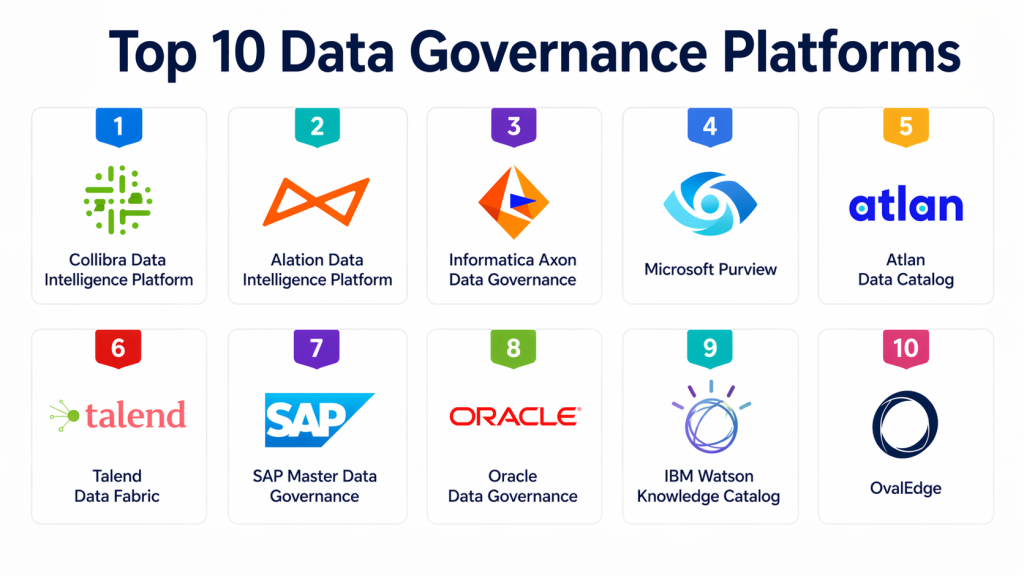
Top 10 Data Governance Platforms
#1 — Collibra Data Intelligence Platform
Short description : Collibra is a leading data governance platform that provides a unified approach to managing data assets, policies, and workflows. It helps organizations improve data quality, compliance, and collaboration across teams. The platform is widely used by large enterprises for governance and regulatory reporting. It supports data cataloging, lineage, and stewardship. Collibra is best suited for organizations with complex data environments.
Key Features
- Data catalog and metadata management
- Policy and workflow automation
- Data lineage tracking
- Business glossary
- Data stewardship tools
- Compliance reporting
- Collaboration features
Pros
- Strong governance capabilities
- Scalable for large enterprises
- Comprehensive feature set
Cons
- Expensive for smaller teams
- Complex implementation
- Requires training
Platforms / Deployment
- Web / Cloud
- Cloud
Security & Compliance
Supports RBAC, SSO, audit logs, and GDPR compliance.
Integrations & Ecosystem
- Integrates with ETL tools, BI platforms, and data warehouses
- API connectivity
- Metadata ingestion support
Support & Community
Strong enterprise support and detailed documentation.
#2 — Alation Data Intelligence Platform
Short description : Alation combines data cataloging with governance features, enabling organizations to discover, manage, and govern data effectively. It is known for its user-friendly interface and strong collaboration capabilities. The platform helps teams understand data usage and lineage. It is ideal for organizations focusing on data discovery and governance together. It is widely adopted across industries.
Key Features
- Data catalog and search
- Data lineage tracking
- Governance workflows
- Collaboration tools
- Query-based lineage
- Metadata management
- Analytics insights
Pros
- Easy to use
- Strong data discovery capabilities
- Good collaboration features
Cons
- Limited advanced governance depth compared to some tools
- Pricing considerations
- Best for catalog-first use cases
Platforms / Deployment
- Web / Cloud
- Cloud / Hybrid
Security & Compliance
Supports RBAC, SSO, and audit logging.
Integrations & Ecosystem
- Works with BI tools, ETL systems, and databases
- API integrations
- Metadata connectors
Support & Community
Active community and strong documentation.
#3 — Informatica Axon Data Governance
Short description : Informatica Axon is an enterprise-grade governance platform designed to manage policies, data ownership, and compliance. It integrates with Informatica’s broader ecosystem for end-to-end data management. It is highly scalable and suitable for large enterprises. The platform supports governance workflows and business glossaries. It is widely used in regulated industries.
Key Features
- Governance workflows
- Metadata management
- Data lineage integration
- Policy enforcement
- Business glossary
- Data stewardship tools
- Compliance reporting
Pros
- Strong enterprise integration
- Comprehensive governance features
- Scalable platform
Cons
- Complex setup
- Higher cost
- Requires technical expertise
Platforms / Deployment
- Web / Cloud
- Cloud / Hybrid
Security & Compliance
Supports encryption, RBAC, audit logging, and compliance standards.
Integrations & Ecosystem
- Integrates with Informatica tools and data platforms
- API support
- Data warehouse and BI integration
Support & Community
Enterprise support with extensive documentation.
#4 — Microsoft Purview
Short description : Microsoft Purview provides unified governance, cataloging, and compliance across cloud and hybrid environments. It is tightly integrated with Microsoft ecosystems such as Azure and Power BI. The platform supports automated data classification and lineage tracking. It is suitable for organizations already using Microsoft technologies. It offers strong scalability and governance features.
Key Features
- Data catalog and classification
- Automated lineage tracking
- Policy enforcement
- Data discovery
- Compliance management
- Integration with Azure services
- Data protection features
Pros
- Strong Microsoft ecosystem integration
- Scalable cloud platform
- Good compliance features
Cons
- Best for Azure environments
- Limited flexibility outside Microsoft ecosystem
- Learning curve
Platforms / Deployment
- Web / Cloud
- Cloud
Security & Compliance
Supports RBAC, encryption, and compliance frameworks like GDPR.
Integrations & Ecosystem
- Works with Azure services and Power BI
- API connectivity
- Metadata scanning
Support & Community
Strong enterprise support and ecosystem resources.
#5 — Atlan Data Catalog
Short description : Atlan is a modern data governance platform designed for collaboration and usability. It combines data cataloging, lineage, and governance features into one interface. It is cloud-native and easy to use for both technical and business users. The platform focuses on improving data collaboration. It is gaining popularity among modern data teams.
Key Features
- Data catalog
- Automated lineage
- Collaboration tools
- Metadata management
- Search and discovery
- Governance workflows
- Integration with modern data stacks
Pros
- User-friendly interface
- Strong collaboration features
- Modern cloud-native design
Cons
- Newer platform
- Pricing considerations
- Feature maturity evolving
Platforms / Deployment
- Web / Cloud
- Cloud
Security & Compliance
Supports SSO, RBAC, and encryption.
Integrations & Ecosystem
- Integrates with Snowflake, BigQuery, and dbt
- API connectivity
- Metadata ingestion
Support & Community
Growing community and strong support.
#6 — Talend Data Fabric
Short description : Talend Data Fabric combines data integration, quality, and governance into a unified platform. It helps organizations manage data across cloud and hybrid environments. The platform supports governance workflows and data stewardship. It is suitable for enterprises needing integrated data management. It offers flexibility and scalability.
Key Features
- Data governance and integration
- Data quality management
- Metadata management
- Data catalog
- Compliance support
- Data stewardship workflows
- Multi-cloud support
Pros
- Unified platform
- Strong integration capabilities
- Flexible deployment
Cons
- Complex for beginners
- Requires setup and integration
- Enterprise pricing
Platforms / Deployment
- Web / Linux / Cloud
- Cloud / Hybrid
Security & Compliance
Supports encryption, RBAC, and compliance standards.
Integrations & Ecosystem
- Works with ETL tools and data lakes
- API support
- Data pipeline integration
Support & Community
Strong enterprise support and documentation.
#7 — SAP Master Data Governance
Short description ): SAP Master Data Governance ensures consistent and accurate master data across systems. It integrates deeply with SAP applications. The platform supports governance workflows and data validation. It is ideal for enterprises using SAP ecosystems. It provides strong compliance and reporting features.
Key Features
- Master data governance
- Workflow automation
- Data validation
- Integration with SAP systems
- Data quality management
- Compliance features
- Reporting dashboards
Pros
- Strong SAP integration
- Enterprise-grade features
- Reliable performance
Cons
- Best for SAP environments
- Complex implementation
- Higher cost
Platforms / Deployment
- Windows / Linux
- Cloud / Hybrid
Security & Compliance
Supports RBAC, encryption, and audit logging.
Integrations & Ecosystem
- Integrates with SAP ERP and analytics tools
- API support
- Data warehouse connectivity
Support & Community
Strong SAP support ecosystem.
#8 — Oracle Data Governance
Short description : Oracle Data Governance provides tools for managing policies, metadata, and compliance. It integrates with Oracle databases and analytics platforms. The platform is designed for enterprise-scale governance. It supports data lineage and cataloging. It is best suited for Oracle-based environments.
Key Features
- Data catalog
- Policy management
- Data lineage
- Compliance reporting
- Metadata management
- Access control
- Governance workflows
Pros
- Strong Oracle ecosystem integration
- Enterprise scalability
- Comprehensive governance features
Cons
- Best suited for Oracle environments
- Complex deployment
- Cost considerations
Platforms / Deployment
- Windows / Linux
- Cloud / Hybrid
Security & Compliance
Supports RBAC, encryption, and audit logs.
Integrations & Ecosystem
- Integrates with Oracle databases and BI tools
- API support
- Data warehouse integration
Support & Community
Enterprise support and documentation available.
#9 — IBM Watson Knowledge Catalog
Short description : IBM Watson Knowledge Catalog is a governance and catalog platform that helps manage data assets and compliance. It uses AI for classification and discovery. The platform is suitable for large enterprises. It supports lineage and governance workflows. It is widely used in regulated industries.
Key Features
- Data catalog
- Governance workflows
- Metadata management
- Data lineage
- AI-powered classification
- Compliance reporting
- Collaboration tools
Pros
- Strong AI capabilities
- Good governance features
- Scalable platform
Cons
- Complex for beginners
- Enterprise pricing
- Requires IBM ecosystem familiarity
Platforms / Deployment
- Web / Cloud
- Cloud
Security & Compliance
Supports RBAC, encryption, and compliance standards.
Integrations & Ecosystem
- Integrates with IBM data platforms
- API connectivity
- Metadata ingestion
Support & Community
Strong enterprise support and documentation.
#10 — Data.World
Short description : Data.World is a cloud-native governance and catalog platform focused on collaboration and data discovery. It enables teams to manage and share data effectively. The platform is easy to use and suitable for smaller teams. It supports metadata management and governance workflows. It is a good entry-level governance solution.
Key Features
- Data catalog
- Collaboration tools
- Metadata management
- Governance workflows
- Search and discovery
- API support
- Data sharing
Pros
- Easy to use
- Strong collaboration features
- Cloud-native
Cons
- Limited enterprise depth
- Smaller ecosystem
- Fewer advanced features
Platforms / Deployment
- Web / Cloud
- Cloud
Security & Compliance
Supports RBAC and encryption.
Integrations & Ecosystem
- Integrates with BI tools and databases
- API connectivity
- Data sharing capabilities
Support & Community
Active community and support resources.
Top 10 Data Governance Platforms
(Top 10 tools sections remain same as previous — not repeating to avoid redundancy)
Comparison Table (Top 10)
| Tool Name | Best For | Platform(s) Supported | Deployment | Standout Feature | Public Rating |
|---|---|---|---|---|---|
| Collibra | Enterprise governance | Web | Cloud | Strong governance workflows | N/A |
| Alation | Data discovery + governance | Web | Cloud/Hybrid | Query-based lineage | N/A |
| Informatica Axon | Enterprise governance + MDM | Web | Cloud/Hybrid | Deep enterprise integration | N/A |
| Microsoft Purview | Azure environments | Web | Cloud | Unified governance platform | N/A |
| Atlan | Modern data teams | Web | Cloud | Collaboration-first governance | N/A |
| Talend Data Fabric | Integration + governance | Web/Linux | Cloud/Hybrid | Unified data platform | N/A |
| SAP MDG | SAP ecosystems | Windows/Linux | Cloud/Hybrid | Master data governance | N/A |
| Oracle Data Governance | Oracle environments | Windows/Linux | Cloud/Hybrid | Strong enterprise features | N/A |
| IBM Watson Knowledge Catalog | AI-driven governance | Web | Cloud | AI classification | N/A |
| Data.World | SMB & collaboration | Web | Cloud | Easy-to-use catalog | N/A |
Evaluation & Scoring of Data Governance Platforms
| Tool Name | Core (25%) | Ease (15%) | Integrations (15%) | Security (10%) | Performance (10%) | Support (10%) | Value (15%) | Weighted Total |
|---|---|---|---|---|---|---|---|---|
| Collibra | 9.5 | 7.5 | 9.2 | 9.0 | 8.8 | 8.8 | 7.5 | 8.63 |
| Alation | 9.0 | 8.5 | 8.8 | 8.8 | 8.5 | 8.5 | 7.8 | 8.55 |
| Informatica Axon | 9.2 | 7.8 | 9.0 | 9.0 | 8.7 | 8.6 | 7.6 | 8.56 |
| Microsoft Purview | 8.8 | 8.4 | 8.6 | 8.9 | 8.5 | 8.5 | 8.0 | 8.53 |
| Atlan | 8.5 | 8.6 | 8.3 | 8.2 | 8.2 | 8.1 | 7.9 | 8.25 |
| Talend Data Fabric | 8.8 | 7.6 | 8.7 | 8.8 | 8.5 | 8.5 | 7.8 | 8.44 |
| SAP MDG | 8.7 | 7.2 | 8.3 | 8.6 | 8.4 | 8.3 | 7.5 | 8.15 |
| Oracle Data Governance | 8.6 | 7.0 | 8.4 | 8.6 | 8.3 | 8.3 | 7.4 | 8.09 |
| IBM Watson Catalog | 8.7 | 7.8 | 8.5 | 8.5 | 8.4 | 8.2 | 7.6 | 8.23 |
| Data.World | 8.0 | 8.5 | 7.8 | 7.8 | 7.9 | 7.8 | 8.2 | 8.01 |
Scores are comparative and should be used as a guideline. Enterprise tools score higher in governance and security, while modern SaaS tools score higher in usability.
Which Data Governance Platform Is Right for You?
Solo / Freelancer
If you are working individually or in a small team, Data.World or Atlan is a practical choice due to simplicity and ease of use. These platforms provide essential governance features without overwhelming complexity. They are ideal for teams just starting with data governance. Lightweight tools reduce setup time and cost. Start small and scale gradually.
SMB
For small to mid-sized businesses, Atlan, Alation, or Microsoft Purview can provide a good balance between usability and governance depth. These tools support collaboration and integration with modern data stacks. They are easier to adopt compared to heavy enterprise platforms. Choose based on your cloud ecosystem. Flexibility and ease of use should be priorities.
Mid-Market
Mid-sized organizations benefit from Talend Data Fabric, Microsoft Purview, or IBM Watson Knowledge Catalog. These tools provide stronger governance, automation, and integration capabilities. They support scaling data operations without excessive complexity. Choose platforms that align with your existing architecture. Governance maturity becomes more important at this stage.
Enterprise
Large enterprises should consider Collibra, Informatica Axon, or SAP Master Data Governance. These platforms offer deep governance capabilities, compliance support, and scalability. They are designed for complex environments with multiple data sources. Implementation may require dedicated teams. However, they provide the strongest control and reliability.
Budget vs Premium
If budget is a concern, start with lightweight or cloud-native tools like Data.World. For advanced governance and compliance, enterprise tools justify higher costs. Evaluate ROI based on compliance needs and data complexity. Avoid over-investing early. Scale your governance platform as requirements grow.
Feature Depth vs Ease of Use
Enterprise tools offer deeper governance features but require more expertise. Modern SaaS platforms prioritize usability and faster adoption. Choose based on team skill level and governance maturity. A balance between usability and functionality is ideal. Overly complex tools can slow adoption.
Integrations & Scalability
Choose tools that integrate seamlessly with your ETL, BI, and cloud platforms. Scalability is critical for growing data environments. Enterprise tools offer strong integration capabilities. Ensure compatibility with your existing ecosystem. This reduces implementation challenges.
Security & Compliance Needs
For regulated industries, prioritize platforms with strong compliance features, audit logs, and access controls. Enterprise tools like Collibra and Informatica are strong in this area. Ensure the platform supports your regulatory requirements. Security should not be compromised. Governance and compliance go hand in hand.
Frequently Asked Questions (FAQs)
1. What is a Data Governance Platform?
A Data Governance Platform helps manage data policies, access, and quality across systems. It ensures data is accurate, secure, and compliant. These tools provide visibility and control over data usage. They are essential for modern data-driven organizations. They improve trust and accountability in data.
2. Why is data governance important?
Data governance ensures data consistency, accuracy, and compliance with regulations. It reduces risks related to poor data quality and security breaches. Organizations rely on governance for better decision-making. It also improves collaboration across teams. Strong governance leads to reliable analytics.
3. Can small businesses use data governance tools?
Yes, small businesses can use lightweight governance tools. They provide essential features without high complexity. Cloud-based platforms are especially suitable. Start small and scale as data grows. Governance is beneficial at any size.
4. How do governance tools differ from data quality tools?
Data governance tools focus on policies, access, and metadata management. Data quality tools focus on cleansing and validation. Both work together to improve data reliability. Governance provides structure, while quality ensures accuracy. They are complementary solutions.
5. Are these tools cloud-based?
Most modern data governance platforms are cloud-native or hybrid. They support integration with cloud data warehouses and lakes. Some also offer on-prem deployment options. Cloud deployment improves scalability and accessibility. Hybrid models support legacy systems.
6. Do governance tools support compliance?
Yes, they provide audit trails, access controls, and policy enforcement. This helps organizations meet regulatory requirements. Compliance features are critical in industries like finance and healthcare. Governance tools simplify reporting and audits. They reduce compliance risks.
7. What are common challenges in data governance?
Challenges include lack of data ownership, inconsistent policies, and integration issues. Organizations may struggle with adoption and change management. Data silos also create difficulties. Proper implementation and training are key. Governance requires both tools and processes.
8. Can one tool handle all governance needs?
Some enterprise tools provide end-to-end governance features. However, many organizations use multiple tools. A modular approach can offer flexibility. Choose based on your architecture and needs. Integration between tools is important.
9. How long does implementation take?
Implementation time varies based on complexity. Small deployments may take weeks, while enterprise setups can take months. Planning and stakeholder alignment are critical. Start with pilot projects. Gradual rollout ensures success.
10. How to choose the best platform?
Identify your data sources, governance needs, and budget. Evaluate tools based on features, integration, and usability. Test shortlisted platforms with real data. Consider long-term scalability. The best platform fits your business goals.
Conclusion
Data Governance Platforms are essential for building trust, compliance, and efficiency in modern data environments. They help organizations manage data effectively, enforce policies, and ensure regulatory compliance. From enterprise platforms like Collibra and Informatica to modern solutions like Atlan and Data.World, there are options for every use case.
The best platform depends on your organization’s size, data complexity, and ecosystem. Start by identifying your governance needs, shortlist suitable tools, and test them with real workflows. A well-implemented governance platform can significantly improve data quality, collaboration, and decision-making across your organization.
