Introduction
Fraud Detection Platforms help organizations identify, prevent, and respond to fraudulent activities across digital transactions, user behavior, and financial systems. These tools use advanced analytics, machine learning, and behavioral monitoring to detect anomalies and suspicious patterns in real time.
With the rapid growth of online payments, digital banking, e-commerce, and identity-based services, fraud has become more sophisticated and harder to detect using traditional methods. Modern fraud detection platforms leverage AI, risk scoring, and real-time decision engines to reduce fraud losses while maintaining a smooth user experience.
Common use cases include:
- Payment fraud detection and prevention
- Account takeover (ATO) detection
- Identity verification and risk scoring
- Transaction monitoring and anomaly detection
- Compliance with financial regulations
Key evaluation criteria:
- Real-time fraud detection capabilities
- Machine learning and AI models
- Accuracy and false positive rates
- Integration with payment systems and APIs
- Scalability and performance
- Reporting and analytics
- Compliance and regulatory support
- Ease of use and customization
Best for: Financial institutions, fintech companies, e-commerce platforms, and enterprises handling high-value transactions.
Not ideal for: Small businesses with minimal online transactions or low fraud risk.
Key Trends in Fraud Detection Platforms
- AI and machine learning-driven fraud detection models
- Real-time risk scoring and decision engines
- Behavioral biometrics and user profiling
- Integration with identity verification and KYC tools
- Cloud-based fraud detection platforms
- Automation of fraud investigation workflows
- Focus on reducing false positives
- Expansion into omnichannel fraud detection
- Use of big data and analytics
- Regulatory compliance and reporting enhancements
How We Evaluated Fraud Detection Platforms (Methodology)
- Assessed market adoption and enterprise usage
- Evaluated core fraud detection capabilities
- Reviewed AI and analytics features
- Considered integration ecosystem and scalability
- Assessed accuracy and false positive rates
- Evaluated ease of use and customization
- Considered performance and reliability
- Assessed fit across SMB, fintech, and enterprise use cases
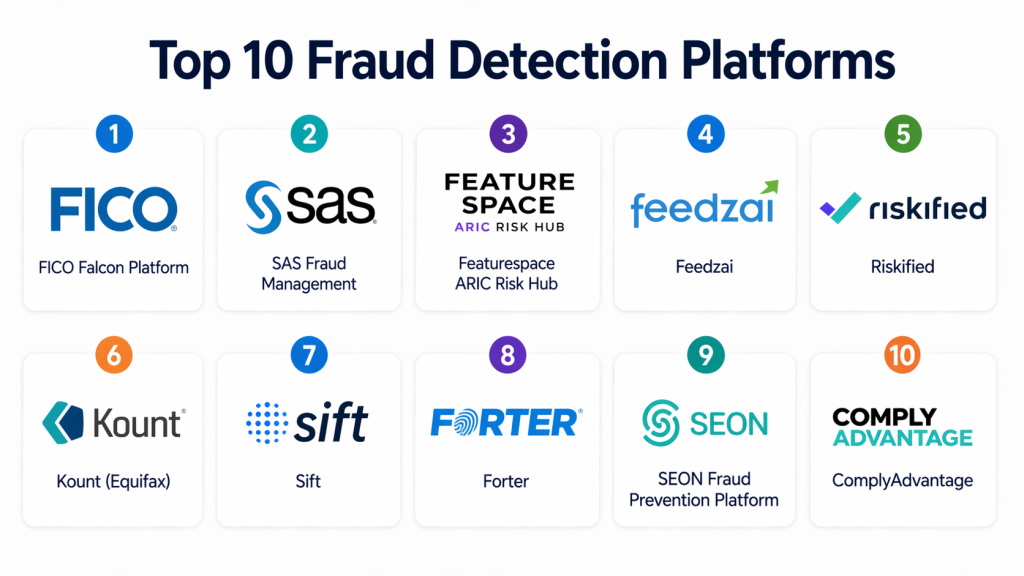
Top 10 Fraud Detection Platforms
#1 — FICO Falcon Platform
Short description: A leading fraud detection platform widely used in banking and financial services. Offers real-time analytics and AI-driven risk scoring. Known for high accuracy and scalability. Suitable for large enterprises and financial institutions.
Key Features
- Real-time fraud detection
- Risk scoring
- AI analytics
- Transaction monitoring
- Reporting
Pros
- High accuracy
- Strong industry adoption
Cons
- Expensive
- Complex setup
Platforms / Deployment
Cloud / On-prem
Security & Compliance
Encryption, audit logs (others not publicly stated)
Integrations & Ecosystem
- Banking systems
- APIs
- Enterprise tools
Support & Community
Enterprise support.
#2 — SAS Fraud Management
Short description: A comprehensive fraud detection solution offering advanced analytics and machine learning capabilities. Suitable for large enterprises and financial institutions.
Key Features
- Fraud analytics
- Machine learning
- Transaction monitoring
- Risk scoring
- Reporting
Pros
- Strong analytics
- Scalable
Cons
- Complex deployment
- High cost
Platforms / Deployment
Cloud / On-prem
Security & Compliance
Encryption, audit logs (others not publicly stated)
Integrations & Ecosystem
- Data platforms
- APIs
Support & Community
Enterprise support.
#3 — Featurespace ARIC Risk Hub
Short description: A fraud detection platform using adaptive behavioral analytics to detect anomalies. Known for reducing false positives. Suitable for financial services and fintech.
Key Features
- Behavioral analytics
- Real-time detection
- Risk scoring
- Machine learning
- Reporting
Pros
- Low false positives
- Adaptive models
Cons
- Limited ecosystem
- Premium pricing
Platforms / Deployment
Cloud
Security & Compliance
Encryption (others not publicly stated)
Integrations & Ecosystem
- Financial systems
- APIs
Support & Community
Good support.
#4 — Riskified
Short description: A fraud prevention platform focused on e-commerce transactions. Provides chargeback protection and risk analysis. Suitable for online retailers.
Key Features
- Fraud detection
- Chargeback protection
- Risk analysis
- Automation
- Reporting
Pros
- E-commerce focused
- Easy integration
Cons
- Limited outside e-commerce
- Pricing model complexity
Platforms / Deployment
Cloud
Security & Compliance
Encryption (others not publicly stated)
Integrations & Ecosystem
- E-commerce platforms
- APIs
Support & Community
Good support.
#5 — Kount (Equifax)
Short description: A fraud detection platform offering identity verification and risk scoring. Known for strong data insights and scalability. Suitable for enterprises and fintech.
Key Features
- Identity verification
- Risk scoring
- Fraud detection
- Analytics
- Reporting
Pros
- Strong data insights
- Scalable
Cons
- Complex setup
- Premium pricing
Platforms / Deployment
Cloud
Security & Compliance
Encryption, audit logs (others not publicly stated)
Integrations & Ecosystem
- Payment systems
- APIs
Support & Community
Enterprise support.
#6 — Sift
Short description: A modern fraud detection platform focused on machine learning and real-time analysis. Suitable for e-commerce and digital platforms.
Key Features
- Real-time detection
- Machine learning
- Risk scoring
- Analytics
- Automation
Pros
- Easy integration
- Strong ML models
Cons
- Limited enterprise features
- Pricing complexity
Platforms / Deployment
Cloud
Security & Compliance
Encryption (others not publicly stated)
Integrations & Ecosystem
- Digital platforms
- APIs
Support & Community
Good support.
#7 — Forter
Short description: A fraud prevention platform offering real-time decision-making and chargeback protection. Designed for e-commerce and digital businesses.
Key Features
- Fraud prevention
- Real-time decisions
- Chargeback protection
- Analytics
- Automation
Pros
- High accuracy
- Easy deployment
Cons
- E-commerce focused
- Premium pricing
Platforms / Deployment
Cloud
Security & Compliance
Encryption (others not publicly stated)
Integrations & Ecosystem
- E-commerce platforms
- APIs
Support & Community
Good support.
#8 — Stripe Radar
Short description: A fraud detection tool integrated within Stripe payments ecosystem. Offers real-time fraud detection and customization. Suitable for businesses using Stripe.
Key Features
- Fraud detection
- Risk scoring
- Real-time monitoring
- Custom rules
- Reporting
Pros
- Easy to use
- Integrated with payments
Cons
- Limited outside Stripe
- Basic advanced features
Platforms / Deployment
Cloud
Security & Compliance
Encryption (others not publicly stated)
Integrations & Ecosystem
- Stripe ecosystem
- APIs
Support & Community
Strong support.
#9 — Feedzai
Short description: An AI-driven fraud detection platform focusing on financial services. Offers real-time analytics and risk management. Suitable for large enterprises.
Key Features
- AI analytics
- Real-time detection
- Risk scoring
- Monitoring
- Reporting
Pros
- Advanced AI capabilities
- Scalable
Cons
- Complex setup
- High cost
Platforms / Deployment
Cloud
Security & Compliance
Encryption, audit logs (others not publicly stated)
Integrations & Ecosystem
- Financial systems
- APIs
Support & Community
Enterprise support.
#10 — SEON Fraud Prevention
Short description: A fraud detection platform focused on e-commerce and fintech. Offers strong data enrichment and analytics. Suitable for SMB and mid-market.
Key Features
- Data enrichment
- Fraud detection
- Risk scoring
- Analytics
- Reporting
Pros
- Easy to use
- Affordable
Cons
- Limited enterprise features
- Smaller ecosystem
Platforms / Deployment
Cloud
Security & Compliance
Encryption (others not publicly stated)
Integrations & Ecosystem
- Payment platforms
- APIs
Support & Community
SMB-focused support.
Comparison Table (Top 10)
| Tool Name | Best For | Platform(s) | Deployment | Standout Feature | Public Rating |
|---|---|---|---|---|---|
| FICO | Banking | Web | Cloud/On-prem | Risk scoring | N/A |
| SAS | Enterprise | Web | Cloud/On-prem | Analytics | N/A |
| Featurespace | Fintech | Web | Cloud | Behavioral AI | N/A |
| Riskified | E-commerce | Web | Cloud | Chargeback protection | N/A |
| Kount | Identity | Web | Cloud | Data insights | N/A |
| Sift | Digital apps | Web | Cloud | ML detection | N/A |
| Forter | E-commerce | Web | Cloud | Real-time decisions | N/A |
| Stripe Radar | Payments | Web | Cloud | Payment integration | N/A |
| Feedzai | Banking | Web | Cloud | AI analytics | N/A |
| SEON | SMB | Web | Cloud | Data enrichment | N/A |
Evaluation & Scoring of Fraud Detection Platforms
| Tool | Core | Ease | Integrations | Security | Performance | Support | Value | Total |
|---|---|---|---|---|---|---|---|---|
| FICO | 9 | 7 | 8 | 9 | 9 | 9 | 7 | 8.6 |
| SAS | 9 | 6 | 8 | 9 | 9 | 8 | 7 | 8.3 |
| Featurespace | 8 | 7 | 7 | 8 | 8 | 8 | 7 | 7.9 |
| Riskified | 8 | 8 | 7 | 7 | 8 | 8 | 8 | 8.0 |
| Kount | 8 | 7 | 8 | 8 | 8 | 8 | 7 | 7.9 |
| Sift | 8 | 8 | 8 | 7 | 8 | 7 | 8 | 8.0 |
| Forter | 8 | 8 | 7 | 7 | 8 | 7 | 8 | 7.9 |
| Stripe | 7 | 9 | 8 | 7 | 7 | 8 | 9 | 7.9 |
| Feedzai | 9 | 6 | 8 | 9 | 9 | 8 | 7 | 8.3 |
| SEON | 7 | 9 | 7 | 7 | 7 | 7 | 9 | 7.6 |
Interpretation:
Higher scores indicate stronger capabilities in fraud detection, analytics, and scalability. Enterprise tools excel in performance and security, while modern platforms offer better usability and value.
Which Fraud Detection Platform Is Right for You?
Solo / Freelancer
Stripe Radar or SEON are simple and effective.
SMB
SEON or Sift offer affordability and ease of use.
Mid-Market
Riskified or Forter provide balanced capabilities.
Enterprise
FICO, SAS, and Feedzai are top choices.
Budget vs Premium
- Budget: SEON
- Premium: FICO
Feature Depth vs Ease of Use
- Easy: Stripe Radar
- Advanced: SAS
Integrations & Scalability
- Best integrations: FICO, SAS
Security & Compliance
- High compliance: Feedzai, FICO
FAQs
1. What are fraud detection platforms?
Fraud detection platforms are tools that help identify and prevent fraudulent activities in real time. They analyze transactions, user behavior, and patterns to detect anomalies. These tools use AI and machine learning to improve accuracy over time. They are essential for financial institutions and online businesses.
2. Who should use fraud detection tools?
These tools are mainly used by banks, fintech companies, and e-commerce businesses. Any organization handling online transactions or sensitive data can benefit from them. They help reduce fraud losses and improve trust. Larger organizations rely heavily on them for risk management.
3. Are fraud detection platforms expensive?
Pricing varies depending on the platform, features, and scale of usage. Enterprise-grade solutions are typically expensive due to advanced capabilities. Some platforms offer flexible pricing based on transactions. Businesses should evaluate ROI based on fraud prevention.
4. How long does implementation take?
Implementation time depends on integration complexity and organization size. Cloud-based platforms can be deployed quickly within days or weeks. Larger enterprise deployments may take longer. Proper integration ensures better performance.
5. Do these tools use AI?
Yes, most modern fraud detection platforms use AI and machine learning. These technologies help identify patterns and predict fraudulent behavior. AI improves detection accuracy and reduces false positives. It also enables real-time decision-making.
6. Can fraud detection tools integrate with payment systems?
Yes, most platforms integrate with payment gateways and financial systems. APIs allow seamless integration and customization. This ensures real-time monitoring of transactions. Integration is a key feature for effectiveness.
7. Are fraud detection platforms secure?
Most platforms include strong security features such as encryption and access controls. They are designed to handle sensitive financial data. Security capabilities vary by vendor. Organizations should evaluate compliance requirements.
8. What are common challenges?
Common challenges include false positives, integration complexity, and tuning models. Proper configuration helps reduce these issues. Continuous monitoring and updates are required. Choosing the right platform improves results.
9. What are alternatives to fraud detection platforms?
Alternatives include manual monitoring or basic rule-based systems. However, they lack scalability and accuracy. Fraud detection platforms provide automated and intelligent analysis. They are more effective for modern businesses.
10. Do these platforms support compliance?
Yes, many platforms support regulatory compliance requirements. They help organizations meet financial and data protection standards. Compliance features vary by vendor. They are important for regulated industries.
Conclusion
Fraud Detection Platforms have become a critical component for organizations operating in digital ecosystems, especially with the rise of online transactions, fintech services, and e-commerce. These platforms leverage advanced technologies like AI, machine learning, and behavioral analytics to detect fraudulent activities in real time while minimizing false positives. By providing real-time insights, automated decision-making, and scalable infrastructure, they help businesses protect revenue, maintain customer trust, and comply with regulatory requirements.
Choosing the right fraud detection platform depends on your organization’s size, transaction volume, and risk tolerance. Enterprises may require robust solutions like FICO or SAS, while smaller businesses can benefit from cost-effective tools like SEON or Stripe Radar. The best approach is to shortlist a few platforms, test them in real-world scenarios, and ensure they align with your existing systems and fraud prevention strategy before making a final decision.
