Introduction
Threat Intelligence Platforms (TIPs) are cybersecurity solutions that collect, analyze, and operationalize threat data from multiple sources to help organizations proactively defend against cyber threats. These platforms aggregate intelligence from open sources, commercial feeds, and internal data to provide actionable insights.
In today’s evolving threat landscape, attackers are becoming more sophisticated and targeted. TIPs play a crucial role in enabling proactive security, faster threat detection, and informed decision-making. Modern platforms also leverage AI, automation, and real-time analytics to improve threat visibility and response.
Real-world use cases:
- Aggregating threat intelligence from multiple sources
- Identifying indicators of compromise (IOCs)
- Supporting incident response and threat hunting
- Enhancing SIEM and SOAR workflows
- Monitoring emerging cyber threats
What buyers should evaluate:
- Quality and sources of threat intelligence
- Automation and enrichment capabilities
- Integration with SIEM, EDR, SOAR
- Ease of use and dashboard visibility
- Threat analysis and reporting features
- Scalability and performance
- API and data ingestion capabilities
- Compliance and data handling
- Deployment flexibility
- Pricing and licensing
Best for: SOC teams, cybersecurity analysts, enterprises, and organizations with advanced security needs
Not ideal for: Small teams with limited security requirements
Key Trends in Threat Intelligence Platforms
- Increased use of AI and machine learning for threat analysis
- Integration with XDR, SIEM, and SOAR platforms
- Automation of threat enrichment and correlation
- Real-time threat intelligence feeds
- Focus on actionable intelligence instead of raw data
- Expansion into cloud and hybrid environments
- Threat intelligence sharing communities
- Integration with Zero Trust security models
- Enhanced visualization and dashboards
- Proactive threat hunting capabilities
How We Selected These Tools (Methodology)
- Market adoption and reputation
- Strength of threat intelligence capabilities
- Integration with security ecosystems
- Automation and analytics features
- Scalability and performance
- Ease of deployment and usability
- Vendor innovation and maturity
- Support and community strength
- Fit across SMB and enterprise environments
- Flexibility in deployment
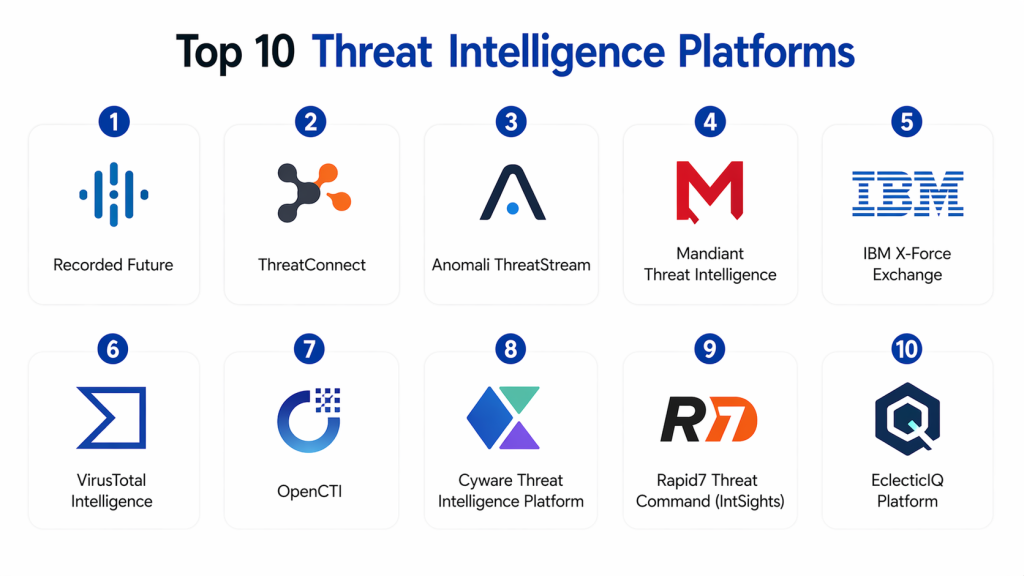
Top 10 Threat Intelligence Platforms
#1 — Recorded Future
Short description :
Recorded Future is a leading threat intelligence platform offering real-time intelligence from multiple sources. It uses AI and machine learning for analysis. It provides strong threat visibility. It is widely used by enterprises. It supports proactive security. It is scalable and powerful.
Key Features
- Real-time threat intelligence
- AI-based analysis
- Risk scoring
- Threat monitoring
- Integration
Pros
- Strong intelligence data
- Scalable
- Enterprise-ready
Cons
- Expensive
- Complex setup
Platforms / Deployment
- Cloud
Security & Compliance
- RBAC, encryption
- Compliance: Not publicly stated
Integrations & Ecosystem
- SIEM tools
- SOAR platforms
- APIs
Support & Community
- Enterprise support
#2 — ThreatConnect
Short description :
ThreatConnect provides a comprehensive threat intelligence platform with automation and analytics. It supports threat aggregation and enrichment. It integrates with security tools. It is scalable. It is suitable for enterprises. It offers strong visibility.
Key Features
- Threat aggregation
- Analytics
- Automation
- Integration
- Reporting
Pros
- Flexible
- Scalable
- Strong analytics
Cons
- Learning curve
- Cost
Platforms / Deployment
- Cloud
Security & Compliance
- RBAC
- Compliance: Not publicly stated
#3 — Anomali ThreatStream
Short description :
Anomali ThreatStream is a popular TIP for aggregating and analyzing threat data. It provides real-time intelligence. It supports automation. It integrates with enterprise systems. It is scalable. It offers strong analytics.
Key Features
- Threat aggregation
- Real-time feeds
- Analytics
- Automation
- Integration
Pros
- Strong data sources
- Scalable
- Flexible
Cons
- Complex
- Costly
Platforms / Deployment
- Cloud
Security & Compliance
- RBAC
- Compliance: Not publicly stated
#4 — Mandiant Threat Intelligence
Short description :
Mandiant Threat Intelligence provides deep insights into advanced threats. It offers threat intelligence and analysis. It is widely used in enterprises. It supports proactive defense. It is scalable. It provides strong visibility.
Key Features
- Threat intelligence
- Analysis
- Monitoring
- Reporting
- Integration
Pros
- High-quality intelligence
- Enterprise-ready
- Reliable
Cons
- Expensive
- Limited customization
Platforms / Deployment
- Cloud
Security & Compliance
- Encryption
- Compliance: Not publicly stated
#5 — IBM X-Force Exchange
Short description :
IBM X-Force Exchange provides threat intelligence sharing and analysis. It offers insights into threats. It integrates with IBM ecosystem. It is scalable. It supports enterprises. It provides strong analytics.
Key Features
- Threat intelligence
- Data sharing
- Analytics
- Monitoring
- Integration
Pros
- Strong analytics
- Scalable
- Integration
Cons
- Limited flexibility
- Complex
Platforms / Deployment
- Cloud
Security & Compliance
- RBAC
- Compliance: Not publicly stated
#6 — VirusTotal Intelligence
Short description :
VirusTotal Intelligence provides threat intelligence through malware analysis and data sharing. It offers insights into threats. It is widely used. It supports security teams. It is scalable. It provides strong detection capabilities.
Key Features
- Malware analysis
- Threat intelligence
- Data sharing
- Monitoring
- Reporting
Pros
- Easy to use
- Strong data
- Scalable
Cons
- Limited enterprise features
- Basic analytics
Platforms / Deployment
- Cloud
Security & Compliance
- Not publicly stated
#7 — OpenCTI
Short description :
OpenCTI is an open-source threat intelligence platform offering flexible threat data management. It supports analysis and sharing. It integrates with tools. It is scalable. It is suitable for developers. It provides customization.
Key Features
- Threat intelligence
- Data management
- Integration
- Analytics
- Open platform
Pros
- Open-source
- Flexible
- Customizable
Cons
- Requires expertise
- Setup complexity
Platforms / Deployment
- Self-hosted / Cloud
Security & Compliance
- RBAC
- Compliance: Not publicly stated
#8 — Cyware Threat Intelligence Platform
Short description :
Cyware TIP provides threat intelligence aggregation and automation. It integrates with security tools. It supports threat sharing. It is scalable. It is suitable for enterprises. It provides strong visibility.
Key Features
- Threat aggregation
- Automation
- Integration
- Data sharing
- Analytics
Pros
- Flexible
- Scalable
- Strong integration
Cons
- Complex
- Learning curve
Platforms / Deployment
- Cloud
Security & Compliance
- RBAC
- Compliance: Not publicly stated
#9 — IntSights (Rapid7 Threat Intelligence)
Short description :
IntSights provides threat intelligence focused on external threats. It offers monitoring and analysis. It integrates with Rapid7 ecosystem. It is scalable. It is suitable for enterprises. It provides strong insights.
Key Features
- Threat intelligence
- Monitoring
- Analytics
- Integration
- Reporting
Pros
- Strong insights
- Scalable
- Reliable
Cons
- Limited customization
- Cost
Platforms / Deployment
- Cloud
Security & Compliance
- RBAC
- Compliance: Not publicly stated
#10 — EclecticIQ Platform
Short description :
EclecticIQ provides threat intelligence with strong data analysis capabilities. It supports threat aggregation and sharing. It integrates with security tools. It is scalable. It is suitable for enterprises. It provides strong analytics.
Key Features
- Threat aggregation
- Analytics
- Data sharing
- Integration
- Reporting
Pros
- Strong analytics
- Flexible
- Scalable
Cons
- Complex
- Expensive
Platforms / Deployment
- Cloud / On-prem
Security & Compliance
- RBAC
- Compliance: Not publicly stated
Comparison Table
| Tool | Best For | Platform | Deployment | Feature | Rating |
|---|---|---|---|---|---|
| Recorded Future | Enterprise | Cloud | Cloud | AI intelligence | N/A |
| ThreatConnect | Enterprise | Cloud | Cloud | Automation | N/A |
| Anomali | Enterprise | Cloud | Cloud | Threat feeds | N/A |
| Mandiant | Enterprise | Cloud | Cloud | Intelligence | N/A |
| IBM | Enterprise | Cloud | Cloud | Sharing | N/A |
| VirusTotal | SMB | Cloud | Cloud | Malware | N/A |
| OpenCTI | Devs | Multi | Hybrid | Open-source | N/A |
| Cyware | Enterprise | Cloud | Cloud | Automation | N/A |
| IntSights | Enterprise | Cloud | Cloud | External threats | N/A |
| EclecticIQ | Enterprise | Multi | Hybrid | Analytics | N/A |
Evaluation & Scoring of Threat Intelligence Platforms
| Tool | Core | Ease | Integration | Security | Performance | Support | Value | Total |
|---|---|---|---|---|---|---|---|---|
| Recorded Future | 10 | 8 | 9 | 10 | 9 | 9 | 7 | 9.0 |
| ThreatConnect | 9 | 8 | 9 | 9 | 8 | 8 | 8 | 8.6 |
| Anomali | 9 | 7 | 9 | 9 | 8 | 8 | 7 | 8.4 |
| Mandiant | 9 | 7 | 8 | 9 | 9 | 9 | 7 | 8.5 |
| IBM | 8 | 7 | 8 | 9 | 8 | 8 | 7 | 8.1 |
| VirusTotal | 8 | 9 | 7 | 8 | 8 | 7 | 9 | 8.3 |
| OpenCTI | 8 | 7 | 9 | 8 | 8 | 7 | 9 | 8.2 |
| Cyware | 9 | 7 | 8 | 9 | 8 | 8 | 8 | 8.4 |
| IntSights | 8 | 8 | 8 | 8 | 8 | 8 | 8 | 8.2 |
| EclecticIQ | 9 | 7 | 8 | 9 | 8 | 8 | 7 | 8.3 |
Which Threat Intelligence Platform Is Right for You?
Solo / Freelancer
- VirusTotal
SMB
- OpenCTI
Mid-Market
- ThreatConnect, Cyware
Enterprise
- Recorded Future, Mandiant, Anomali
Budget vs Premium
- Budget → OpenCTI
- Premium → Recorded Future
Feature Depth vs Ease
- Easy → VirusTotal
- Advanced → Recorded Future
Integrations & Scalability
- Best → ThreatConnect
Security Needs
- High security → Mandiant
Frequently Asked Questions (FAQs)
1. What is a Threat Intelligence Platform (TIP)?
A Threat Intelligence Platform (TIP) is a system that collects and analyzes threat data from multiple sources. It helps organizations identify potential cyber threats and risks. TIPs provide actionable insights for security teams. They improve threat detection and response capabilities.
2. Why are Threat Intelligence Platforms important?
Threat Intelligence Platforms help organizations stay ahead of cyber threats by providing real-time insights. They improve decision-making and incident response. They also reduce the risk of attacks by identifying vulnerabilities early. This makes them essential for modern cybersecurity strategies.
3. How do Threat Intelligence Platforms work?
TIPs gather data from internal and external sources, including threat feeds and logs. They analyze and correlate this data to identify patterns and threats. The platform then provides alerts and insights. This helps security teams respond quickly to potential risks.
4. Who should use Threat Intelligence Platforms?
TIPs are mainly used by enterprises, SOC teams, and cybersecurity professionals. Organizations with large networks and sensitive data benefit the most. They are especially useful for industries like finance, healthcare, and government. Any company facing cyber threats can use them.
5. Are Threat Intelligence Platforms scalable?
Yes, most modern TIPs are highly scalable and can handle large volumes of data. Cloud-based platforms make scaling easier across multiple environments. This allows organizations to manage growing threat data efficiently. Scalability is a key feature of these tools.
6. Do TIPs integrate with other security tools?
Yes, TIPs are designed to integrate with SIEM, SOAR, EDR, and other security tools. This helps create a unified security ecosystem. Integration improves threat detection and response workflows. It allows organizations to act on intelligence more effectively.
7. Are Threat Intelligence Platforms secure?
Yes, TIPs are built with strong security measures such as encryption and access controls. They protect sensitive threat data from unauthorized access. Proper configuration is important to ensure maximum security. They also help improve overall cybersecurity posture.
8. Are TIPs difficult to implement?
Implementation complexity depends on the platform and organization size. Some tools are easy to deploy, especially cloud-based ones. However, advanced configurations may require expertise. Proper planning and integration help ensure smooth deployment.
9. What are alternatives to Threat Intelligence Platforms?
TIPs work alongside tools like SIEM, SOAR, and EDR. These tools focus on detection, response, and monitoring. They are not replacements but complementary solutions. Together, they provide a complete security framework.
10. Are Threat Intelligence Platforms expensive?
The cost of TIPs varies depending on features and scale. Enterprise solutions can be expensive due to advanced capabilities. Some open-source or lightweight tools are more affordable. Investing in TIPs helps reduce the risk of costly cyber incidents.
Conclusion
Threat Intelligence Platforms are a critical component of modern cybersecurity, enabling organizations to proactively identify, analyze, and respond to threats. By aggregating and operationalizing threat data, these platforms empower security teams to make informed decisions and strengthen their defenses.
The best TIP depends on your organization’s needs and scale. Enterprise solutions like Recorded Future and Mandiant provide advanced capabilities, while platforms like OpenCTI offer flexibility and cost-effectiveness. Organizations should evaluate their requirements, test solutions, and integrate TIPs into their broader security strategy.
