Introduction
DDoS (Distributed Denial-of-Service) Protection Tools are security solutions designed to detect, mitigate, and prevent large-scale traffic floods that attempt to disrupt websites, APIs, and online services. These attacks overwhelm infrastructure with malicious traffic, causing downtime, revenue loss, and reputational damage.
In today’s cloud-first, API-driven world, DDoS attacks are more frequent, automated, and sophisticated. Businesses now rely heavily on always-on digital services, making downtime unacceptable. Modern DDoS tools combine AI-driven detection, global traffic filtering, and real-time mitigation to ensure uninterrupted operations.
Common Use Cases
- Protecting eCommerce platforms during peak sales
- Securing SaaS applications and APIs
- Safeguarding financial services platforms
- Ensuring uptime for media and streaming services
- Preventing attacks on government systems
What Buyers Should Evaluate
- Detection speed and mitigation latency
- Global network capacity
- Layer 3, 4, and 7 protection
- Integration with CDN and WAF
- Automation and AI capabilities
- Scalability during attacks
- Ease of deployment
- Visibility and reporting
- Pricing flexibility
Best for: Enterprises, SaaS companies, fintech platforms, and high-traffic digital businesses
Not ideal for: Small static websites or businesses with minimal online dependency
Key Trends in DDoS Protection Tools
- AI-driven traffic analysis and anomaly detection
- Always-on protection replacing reactive models
- Edge-based mitigation using CDN networks
- API and microservices protection focus
- Multi-cloud and hybrid deployment support
- Automated response and playbooks
- Integration with SIEM and SOAR tools
- Real-time dashboards and analytics
- Usage-based pricing models
- Zero Trust security alignment
How We Selected These Tools (Methodology)
- Market adoption and brand trust
- Feature completeness across L3–L7
- Performance and uptime reliability
- Security capabilities
- Integration ecosystem
- Coverage for SMB to enterprise
- Global infrastructure strength
- Ease of deployment
- Cost vs value
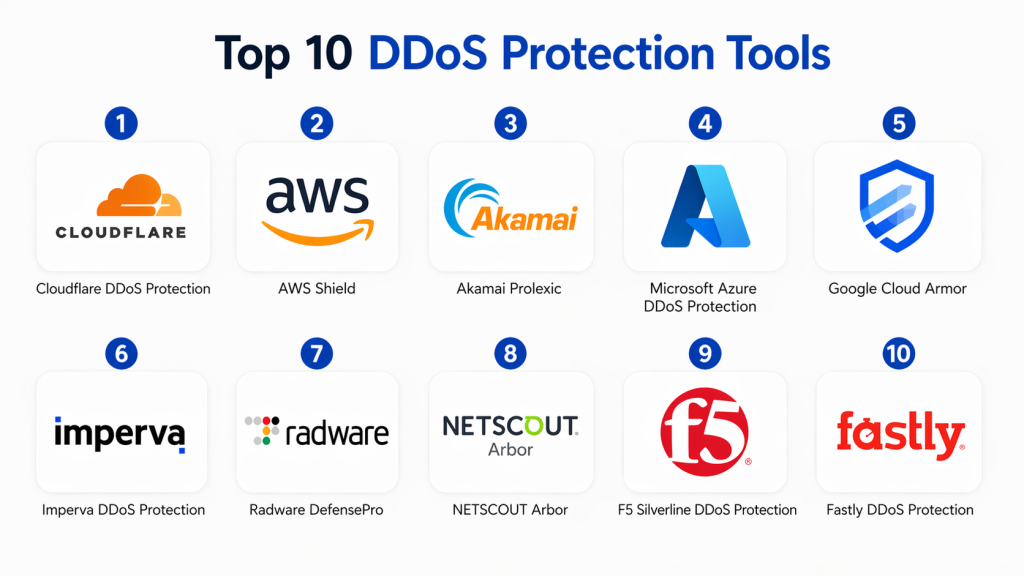
Top 10 DDoS Protection Tools
#1 — Cloudflare DDoS Protection
Short description :
Cloudflare provides always-on DDoS protection through its globally distributed edge network. It automatically absorbs large-scale traffic spikes without requiring manual intervention. The platform is widely used for websites, APIs, and SaaS applications. It combines CDN, WAF, and bot protection into one solution. It is suitable for both startups and enterprises. Ideal for businesses seeking simplicity with strong performance.
Key Features
- Always-on mitigation
- Global Anycast network
- Layer 3–7 protection
- Bot management
- Real-time analytics
- CDN integration
Pros
- Easy to deploy
- Strong global performance
Cons
- Advanced features cost more
- Limited customization in lower tiers
Platforms / Deployment
Cloud
Security & Compliance
SSO, MFA, RBAC, GDPR support
Integrations & Ecosystem
Integrates with modern cloud and DevOps environments
- AWS, Azure, GCP
- APIs
- CI/CD tools
Support & Community
Strong documentation and large community
#2 — AWS Shield
Short description :
AWS Shield is a managed DDoS protection service built into the AWS ecosystem. It offers automatic protection with both free and advanced tiers. The solution scales with AWS infrastructure and integrates seamlessly with other AWS services. It is ideal for organizations already operating within AWS. It provides real-time monitoring and attack mitigation. Best suited for cloud-native environments.
Key Features
- Automatic mitigation
- AWS-native integration
- Real-time monitoring
- Cost protection
- Layer 3–7 defense
Pros
- Seamless AWS integration
- Highly scalable
Cons
- Limited outside AWS
- Advanced tier expensive
Platforms / Deployment
Cloud
Security & Compliance
IAM, MFA, encryption
Integrations & Ecosystem
Deep AWS integration
- EC2
- CloudFront
- Route 53
Support & Community
Enterprise-level AWS support
#3 — Akamai Prolexic
Short description :
Akamai Prolexic is an enterprise-grade DDoS protection platform known for its massive global capacity. It is designed for high-risk industries such as banking and large-scale enterprises. The platform provides both always-on and on-demand protection. It offers deep analytics and visibility into traffic patterns. It is highly reliable and scalable. Best for mission-critical systems.
Key Features
- Global scrubbing centers
- High-capacity mitigation
- Layer 7 protection
- Real-time analytics
- Hybrid deployment
Pros
- Extremely reliable
- High capacity
Cons
- Expensive
- Complex setup
Platforms / Deployment
Cloud / Hybrid
Security & Compliance
Not publicly stated
Integrations & Ecosystem
Works with enterprise security systems
- SIEM tools
- Cloud platforms
Support & Community
Premium enterprise support
#4 — Microsoft Azure DDoS Protection
Short description :
Azure DDoS Protection is built for applications hosted on Microsoft Azure. It provides adaptive protection based on traffic patterns. The platform automatically detects and mitigates attacks. It integrates with Azure networking services. It offers strong visibility and reporting. Ideal for Azure-based organizations.
Key Features
- Adaptive detection
- Layer 3–4 protection
- Azure integration
- Real-time monitoring
- Automated mitigation
Pros
- Easy to deploy
- Native Azure integration
Cons
- Limited outside Azure
- Premium tier required
Platforms / Deployment
Cloud
Security & Compliance
Varies / Not publicly stated
Integrations & Ecosystem
Azure ecosystem
- Azure Firewall
- Azure Monitor
Support & Community
Strong Microsoft support
#5 — Google Cloud Armor
Short description :
Google Cloud Armor offers DDoS and application protection for cloud-native applications. It leverages Google’s global infrastructure. The platform enables policy-based filtering and traffic control. It integrates with Google services. It provides high scalability and performance. Best suited for GCP users.
Key Features
- Edge-based mitigation
- Layer 7 filtering
- Policy engine
- Load balancing integration
- Real-time analytics
Pros
- High scalability
- Flexible rules
Cons
- Requires GCP expertise
- Limited outside ecosystem
Platforms / Deployment
Cloud
Security & Compliance
Not publicly stated
Integrations & Ecosystem
GCP integrations
- Kubernetes
- Load balancers
Support & Community
Good enterprise support
#6 — Imperva DDoS Protection
Short description :
Imperva delivers multi-layer DDoS protection with strong application security features. It focuses heavily on API and web protection. The platform supports hybrid deployments. It offers behavioral analysis and real-time alerts. It is widely used by enterprises with strict compliance needs. Ideal for security-first organizations.
Key Features
- Multi-layer defense
- API protection
- Behavioral analytics
- Real-time alerts
- Hybrid support
Pros
- Strong security capabilities
- Flexible deployment
Cons
- Higher cost
- Complex setup
Platforms / Deployment
Cloud / Hybrid
Security & Compliance
Varies / Not publicly stated
Integrations & Ecosystem
Enterprise integrations
- SIEM
- APIs
Support & Community
Enterprise-grade support
#7 — Radware DefensePro
Short description :
Radware DefensePro provides real-time DDoS detection and mitigation. It supports on-prem and hybrid environments. The platform uses behavioral analysis to detect threats. It offers granular traffic control. It is designed for large enterprises. Best for advanced security teams.
Key Features
- Behavioral detection
- Real-time mitigation
- Layer 3–7 coverage
- Hybrid deployment
- Traffic visibility
Pros
- Strong detection
- Flexible setup
Cons
- Requires expertise
- Hardware dependency
Platforms / Deployment
Hybrid / On-prem
Security & Compliance
Not publicly stated
Integrations & Ecosystem
Enterprise integrations
- Firewalls
- SIEM
Support & Community
Strong enterprise support
#8 — NETSCOUT Arbor
Short description :
NETSCOUT Arbor provides carrier-grade DDoS protection for ISPs and enterprises. It offers deep network visibility and analytics. The platform is designed for high-volume environments. It supports real-time mitigation. It is widely used in telecom sectors. Best for infrastructure providers.
Key Features
- Carrier-grade protection
- Network visibility
- Traffic analytics
- Threat intelligence
- Real-time defense
Pros
- High scalability
- Deep insights
Cons
- Expensive
- Complex
Platforms / Deployment
On-prem / Hybrid
Security & Compliance
Not publicly stated
Integrations & Ecosystem
Telecom integrations
- Routers
- SIEM
Support & Community
Enterprise support
#9 — F5 Silverline DDoS Protection
Short description :
F5 Silverline is a cloud-based managed DDoS protection service. It provides 24/7 monitoring through a security operations center. The platform offers application-layer protection. It integrates with F5 solutions. It is suitable for enterprises needing managed services. Known for reliability.
Key Features
- Managed service
- 24/7 SOC
- Layer 7 protection
- Real-time mitigation
- Reporting
Pros
- Fully managed
- Strong support
Cons
- Expensive
- Less control
Platforms / Deployment
Cloud
Security & Compliance
Not publicly stated
Integrations & Ecosystem
F5 ecosystem
- WAF
- Load balancers
Support & Community
Premium support
#10 — Fastly DDoS Protection
Short description :
Fastly provides edge-based DDoS protection integrated with its CDN. It focuses on performance and developer flexibility. The platform offers real-time control via APIs. It is suitable for modern web applications. It provides strong visibility. Ideal for developer teams.
Key Features
- Edge protection
- API control
- CDN integration
- Real-time analytics
- Traffic filtering
Pros
- High performance
- Developer-friendly
Cons
- Learning curve
- Premium pricing
Platforms / Deployment
Cloud
Security & Compliance
Varies / Not publicly stated
Integrations & Ecosystem
API-driven integrations
- DevOps tools
- Cloud platforms
Support & Community
Good documentation
Comparison Table (Top 10)
| Tool Name | Best For | Platform | Deployment | Standout Feature | Public Rating |
|---|---|---|---|---|---|
| Cloudflare | SMB–Enterprise | Web | Cloud | Global edge network | N/A |
| AWS Shield | AWS users | Cloud | Cloud | Native AWS protection | N/A |
| Akamai | Enterprise | Web | Hybrid | High capacity mitigation | N/A |
| Azure | Azure users | Cloud | Cloud | Adaptive detection | N/A |
| Google Armor | GCP users | Cloud | Cloud | Policy-based filtering | N/A |
| Imperva | Security teams | Web | Hybrid | API protection | N/A |
| Radware | Enterprise | Network | Hybrid | Behavioral detection | N/A |
| NETSCOUT | ISPs | Network | Hybrid | Carrier-grade defense | N/A |
| F5 Silverline | Managed service | Web | Cloud | SOC monitoring | N/A |
| Fastly | Developers | Web | Cloud | Edge control | N/A |
Evaluation & Scoring of DDoS Protection Tools
| Tool | Core | Ease | Integrations | Security | Performance | Support | Value | Total |
|---|---|---|---|---|---|---|---|---|
| Cloudflare | 9 | 9 | 8 | 8 | 9 | 8 | 9 | 8.7 |
| AWS Shield | 9 | 8 | 9 | 8 | 9 | 8 | 7 | 8.4 |
| Akamai | 10 | 7 | 8 | 9 | 10 | 9 | 6 | 8.6 |
| Azure | 8 | 8 | 8 | 8 | 8 | 8 | 8 | 8.0 |
| Google Armor | 8 | 7 | 8 | 8 | 9 | 7 | 8 | 7.9 |
| Imperva | 9 | 7 | 8 | 9 | 8 | 8 | 7 | 8.1 |
| Radware | 9 | 6 | 7 | 8 | 9 | 8 | 6 | 7.9 |
| NETSCOUT | 10 | 6 | 7 | 9 | 10 | 8 | 5 | 8.0 |
| F5 | 8 | 8 | 7 | 8 | 8 | 9 | 7 | 7.9 |
| Fastly | 8 | 7 | 9 | 7 | 9 | 7 | 8 | 8.0 |
These scores are comparative and based on feature strength, usability, and performance. Higher scores indicate stronger overall capability. Enterprises may prioritize performance over cost, while SMBs may focus on value and simplicity.
Frequently Asked Questions (FAQs)
1. What is DDoS protection?
DDoS protection prevents malicious traffic from overwhelming systems. It filters bad traffic and allows legitimate users. It ensures uptime and availability. It uses global networks and AI detection. It is essential for modern digital services.
2. How fast can mitigation happen?
Most modern tools respond in seconds. Edge-based systems react instantly. Detection speed depends on traffic analysis. AI improves response times. Fast mitigation prevents downtime.
3. Is DDoS protection expensive?
Costs vary widely. Some tools offer free tiers. Enterprise tools are costly. Pricing depends on traffic and features. Usage-based pricing is common.
4. Can small businesses use these tools?
Yes, many tools support SMBs. Cloudflare is popular for small teams. Basic protection is often affordable. Even small sites benefit from protection.
5. Do these tools affect performance?
Most tools improve performance. CDN-based tools reduce latency. Proper configuration is important. Poor setup may cause delays.
6. Can APIs be protected?
Yes, modern tools protect APIs. They analyze request behavior. They block malicious traffic. API protection is critical today.
7. What are common mistakes?
Ignoring monitoring is a key mistake. Misconfigured rules can block real users. Not testing failover is risky. Lack of redundancy can cause issues.
8. Can these tools protect APIs?
Yes. Modern tools include API protection. They analyze request patterns. They block malicious API traffic. This is critical for microservices.
9. Can I switch providers easily?
Switching depends on architecture. Cloud-based tools are easier to switch. Migration planning is important. Testing is required.
10. Are there alternatives?
Alternatives include WAF and CDN solutions. However, they are not complete replacements. Dedicated DDoS tools provide deeper protection.
Conclusion
DDoS protection is now a critical requirement for any business operating online. With increasing attack complexity and frequency, relying on basic security measures is no longer enough. Modern tools provide automated detection, global mitigation, and real-time analytics to ensure uninterrupted service availability.
The right solution depends on your infrastructure, scale, and risk profile. While SMBs may prefer simple and cost-effective tools like Cloudflare, enterprises often require high-capacity solutions like Akamai or NETSCOUT. The best approach is to shortlist a few tools, test them in real-world scenarios, and evaluate their performance, integrations, and ease of use before making a final decision.
