Introduction
SD-WAN (Software-Defined Wide Area Network) Management Platforms are designed to simplify, optimize, and secure WAN connectivity across distributed environments such as branch offices, data centers, and cloud applications. Instead of relying on traditional MPLS-based networking, SD-WAN uses software intelligence to route traffic dynamically based on performance, cost, and policy.
With the rapid shift toward cloud-first architectures, hybrid work models, and SaaS adoption, SD-WAN has become a critical component of modern networking. Organizations now need centralized control, better visibility, and improved application performance—something traditional WANs struggle to deliver.
Real-World Use Cases
- Connecting branch offices securely to cloud applications
- Optimizing application performance (VoIP, SaaS, video conferencing)
- Reducing WAN costs by replacing MPLS with broadband
- Centralized policy management across distributed networks
- Secure remote access for hybrid workforce
What Buyers Should Evaluate
- Centralized management capabilities
- Application-aware routing and traffic optimization
- Integrated security features (firewall, zero trust)
- Multi-cloud and hybrid support
- Ease of deployment and scalability
- Automation and orchestration capabilities
- Vendor ecosystem and integrations
- Visibility and analytics dashboards
Best for: Enterprises, MSPs, distributed organizations, cloud-first companies, retail chains, and global businesses.
Not ideal for: Very small businesses with single-location networks or those without complex WAN requirements.
Key Trends in SD-WAN Management Platforms
- Convergence with SASE (Secure Access Service Edge) platforms
- AI-driven traffic optimization and anomaly detection
- Zero Trust Network Access (ZTNA) integration
- Cloud-native SD-WAN architectures
- Edge computing integration for low-latency applications
- Unified dashboards for network and security management
- Automation-first provisioning and orchestration
- Multi-cloud connectivity optimization
- Subscription-based pricing models replacing hardware-heavy setups
- API-first platforms enabling DevOps-style networking
How We Selected These Tools (Methodology)
- Strong market presence and enterprise adoption
- Comprehensive SD-WAN and management capabilities
- Proven performance in real-world deployments
- Advanced security integration (SASE, ZTNA, firewall)
- Robust analytics and visibility features
- Flexibility across cloud, hybrid, and on-prem environments
- Integration with network, security, and DevOps ecosystems
- Suitability across SMB to enterprise environments
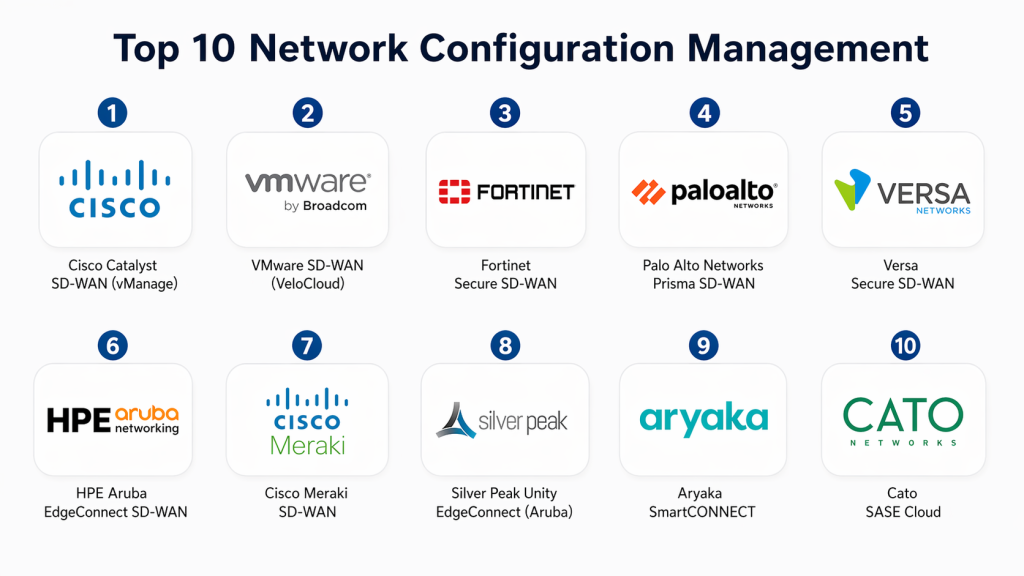
Banner Title -Top 10 Network Configuration Management
1 —SolarWinds Network Configuration Manager
ManageEngine Network Configuration Manager
Cisco DNA Center
Ansible (Red Hat)
NetBrain
RANCID
Oxidized
Infoblox NetMRI
Device42
BMC TrueSight Network Automation
note : do not add any other names and links note : do not add any other names and links note : do not add any other names and links and humanized image
i need all these tools in one banner or image
size of image 16:9 ratio
style of banner is proffessional and simple
background is must be simple and plain
#1 — Cisco Catalyst SD-WAN (vManage)
Short description :
Cisco Catalyst SD-WAN is a leading enterprise-grade platform offering centralized control and advanced automation. It enables intent-based networking with deep visibility and policy enforcement. Ideal for large enterprises already invested in Cisco infrastructure. It provides strong analytics and integrated security features. Designed for scalability and performance.
Key Features
- Centralized vManage dashboard
- Application-aware routing
- Policy-based automation
- Integrated security controls
- Real-time analytics
Pros
- Highly scalable
- Strong ecosystem
Cons
- Expensive
- Complex setup
Platforms / Deployment
Cloud / On-premise / Hybrid
Security & Compliance
RBAC, encryption, MFA
Integrations & Ecosystem
Integrates deeply with Cisco ecosystem and enterprise tools.
- APIs
- Network monitoring tools
- Security platforms
Support & Community
Strong enterprise support
#2 — VMware SD-WAN (VeloCloud)
Short description :
VMware SD-WAN provides cloud-first WAN optimization with strong performance capabilities. It simplifies deployment and improves application performance. Ideal for cloud-centric organizations. Known for ease of use and scalability.
Key Features
- Dynamic multipath optimization
- Cloud gateway architecture
- Centralized orchestration
- Application performance monitoring
Pros
- Easy deployment
- Strong cloud performance
Cons
- Premium pricing
- Limited customization
Platforms / Deployment
Cloud / Hybrid
Security & Compliance
Encryption, RBAC
Integrations & Ecosystem
- VMware ecosystem
- Cloud platforms
- APIs
Support & Community
Good enterprise support
#3 — Fortinet Secure SD-WAN
Short description :
Fortinet Secure SD-WAN combines networking and security in a single platform. It offers integrated firewall and threat protection. Ideal for security-focused organizations. Provides strong performance and centralized control.
Key Features
- Integrated security (firewall, IPS)
- WAN optimization
- Centralized management
- Application control
Pros
- Strong security
- Cost-effective
Cons
- Learning curve
- UI complexity
Platforms / Deployment
Cloud / On-premise
Security & Compliance
Firewall, encryption, RBAC
Integrations & Ecosystem
- Fortinet ecosystem
- APIs
Support & Community
Good vendor support
#4 — Palo Alto Networks Prisma SD-WAN
Short description :
Prisma SD-WAN focuses on performance and integrated security. It offers AI-driven optimization and visibility. Ideal for enterprises prioritizing security and cloud performance.
Key Features
- AI-based routing
- Integrated security
- Centralized control
- Application analytics
Pros
- Advanced security
- Strong analytics
Cons
- Expensive
- Complex configuration
Platforms / Deployment
Cloud / Hybrid
Security & Compliance
RBAC, encryption
Integrations & Ecosystem
- Security tools
- APIs
Support & Community
Enterprise support
#5 — Versa Secure SD-WAN
Short description :
Versa SD-WAN offers a unified platform combining networking and security. It supports SASE architecture. Ideal for enterprises seeking flexibility and scalability.
Key Features
- SASE integration
- Multi-tenant support
- Centralized orchestration
- Security features
Pros
- Flexible
- Scalable
Cons
- Complex setup
- Requires expertise
Platforms / Deployment
Cloud / Hybrid
Security & Compliance
RBAC, encryption
Integrations & Ecosystem
- APIs
- Cloud tools
Support & Community
Enterprise support
#6 — HPE Aruba EdgeConnect SD-WAN
Short description :
Aruba EdgeConnect provides application-aware SD-WAN with strong optimization features. Ideal for enterprises needing performance and reliability.
Key Features
- Application optimization
- WAN orchestration
- Centralized control
- Path conditioning
Pros
- Reliable performance
- Strong optimization
Cons
- Expensive
- Complex
Platforms / Deployment
Cloud / On-premise
Security & Compliance
Encryption, RBAC
Integrations & Ecosystem
- HPE ecosystem
- APIs
Support & Community
Strong suppor
#7 — Cisco Meraki SD-WAN
Short description :
Meraki SD-WAN offers cloud-managed simplicity with centralized dashboards. Ideal for SMBs and mid-market organizations. Easy to deploy and manage.
Key Features
- Cloud dashboard
- Auto VPN
- Traffic shaping
- Centralized control
Pros
- Easy to use
- Quick deployment
Cons
- Limited customization
- Subscription cost
Platforms / Deployment
Cloud
Security & Compliance
RBAC, encryption
Integrations & Ecosystem
- APIs
- Cloud tools
Support & Community
Strong support
#8 — Silver Peak Unity EdgeConnect (Aruba)
Short description :
A performance-focused SD-WAN platform designed for optimizing WAN traffic. Ideal for enterprises needing reliability and speed.
Key Features
- WAN optimization
- Traffic steering
- Centralized orchestration
Pros
- High performance
- Reliable
Cons
- Expensive
- Complex
Platforms / Deployment
Cloud / On-premise
Security & Compliance
Encryption
Integrations & Ecosystem
- APIs
- Network tools
Support & Community
Enterprise support
#9 — Aryaka SmartCONNECT
Short description :
Aryaka offers a fully managed SD-WAN service with global backbone infrastructure. Ideal for enterprises seeking managed networking.
Key Features
- Managed SD-WAN
- Global connectivity
- Performance optimization
Pros
- Fully managed
- Global reach
Cons
- Less control
- Premium pricing
Platforms / Deployment
Cloud
Security & Compliance
Encryption
Integrations & Ecosystem
- Cloud services
- APIs
Support & Community
Strong managed support
#10 — Cato SASE Cloud
Short description :
Cato SASE Cloud combines SD-WAN with security in a unified platform. It offers cloud-native networking and security services. Ideal for modern enterprises adopting SASE.
Key Features
- SASE architecture
- Global backbone
- Security integration
- Centralized management
Pros
- Unified platform
- Easy scalability
Cons
- Vendor lock-in
- Limited customization
Platforms / Deployment
Cloud
Security & Compliance
RBAC, encryption
Integrations & Ecosystem
- Cloud platforms
- APIs
Support & Community
Strong vendor support
Comparison Table (Top 10)
| Tool Name | Best For | Platform(s) | Deployment | Standout Feature | Public Rating |
|---|---|---|---|---|---|
| Cisco Catalyst | Enterprise | Web | Hybrid | Intent-based networking | N/A |
| VMware SD-WAN | Cloud-first orgs | Web | Cloud | Multipath optimization | N/A |
| Fortinet SD-WAN | Security-focused | Web | Hybrid | Integrated firewall | N/A |
| Prisma SD-WAN | Enterprises | Web | Hybrid | AI routing | N/A |
| Versa SD-WAN | Large enterprises | Web | Hybrid | SASE-ready | N/A |
| Aruba EdgeConnect | Performance | Web | Hybrid | WAN optimization | N/A |
| Cisco Meraki | SMB | Web | Cloud | Simplicity | N/A |
| Silver Peak | Enterprise | Web | Hybrid | High performance | N/A |
| Aryaka | Global orgs | Web | Cloud | Managed SD-WAN | N/A |
| Cato SASE | Modern enterprises | Web | Cloud | Unified SASE | N/ |
Evaluation & Scoring of SD-WAN Management Platforms
| Tool | Core | Ease | Integrations | Security | Performance | Support | Value | Total |
|---|---|---|---|---|---|---|---|---|
| Cisco Catalyst | 9 | 7 | 9 | 9 | 9 | 9 | 7 | 8.6 |
| VMware | 8 | 8 | 8 | 8 | 9 | 8 | 7 | 8.1 |
| Fortinet | 8 | 7 | 8 | 9 | 8 | 8 | 8 | 8.2 |
| Prisma | 9 | 6 | 8 | 9 | 9 | 8 | 6 | 8.0 |
| Versa | 8 | 6 | 8 | 8 | 8 | 7 | 7 | 7.6 |
| Aruba | 8 | 6 | 7 | 8 | 9 | 8 | 6 | 7.7 |
| Meraki | 7 | 9 | 7 | 7 | 8 | 8 | 8 | 7.9 |
| Silver Peak | 8 | 6 | 7 | 7 | 9 | 8 | 6 | 7.6 |
| Aryaka | 8 | 8 | 7 | 7 | 8 | 9 | 6 | 7.8 |
| Cato | 9 | 8 | 8 | 9 | 8 | 8 | 7 | 8.3 |
Interpretation:
These scores reflect relative strengths across enterprise requirements. Higher scores indicate better overall capability, but selection should depend on specific needs like security, cost, or ease of use.
Which SD-WAN Platform Is Right for You?
Solo / Freelancer
Not typically required unless managing distributed infrastructure.
SMB
Cisco Meraki is ideal for simplicity and fast deployment.
Mid-Market
VMware SD-WAN or Fortinet provide balanced performance and cost.
Enterprise
Cisco Catalyst, Prisma, or Cato SASE are strong choices.
Budget vs Premium
- Budget: Fortinet, Meraki
- Premium: Cisco, Prisma
Feature Depth vs Ease of Use
- Advanced: Cisco, Prisma
- Simple: Meraki
Integrations & Scalability
Choose API-driven platforms with cloud integrations.
Security & Compliance Needs
Go for SASE-enabled platforms like Cato or Prisma.
Frequently Asked Questions (FAQs)
1. What is SD-WAN?
SD-WAN is a software-defined approach to managing WAN networks. It uses intelligent routing to optimize traffic and improve performance. It replaces traditional WAN setups with more flexible and cost-effective solutions. It also enables centralized control and better visibility.
2. How is SD-WAN different from traditional WAN?
Traditional WAN relies on fixed routing and MPLS connections. SD-WAN dynamically routes traffic based on performance. It is more flexible and cost-efficient. It also integrates with cloud and modern applications.
3. Is SD-WAN secure?
Yes, most platforms include built-in security features like encryption and firewalls. Many also support Zero Trust models. Security depends on configuration and vendor capabilities.
4. How long does deployment take?
Deployment can range from a few days to several weeks. Cloud-based solutions are faster to deploy. Complexity depends on network size and integrations.
5. What industries benefit most from SD-WAN?
Retail, healthcare, finance, and enterprises with distributed locations benefit the most. It is also useful for cloud-first companies.
6. Can SD-WAN replace MPLS?
Yes, many organizations replace MPLS with SD-WAN. It reduces cost while maintaining performance. Some hybrid models still use MPLS.
7. Does SD-WAN support cloud applications?
Yes, it is designed for cloud and SaaS environments. It improves application performance and reliability.
8. Is training required?
Yes, especially for enterprise-grade platforms. Vendors provide training and documentation.
9. What are common mistakes?
Choosing the wrong platform, ignoring integration needs, and poor planning are common mistakes. Proper evaluation is critical.
10. How to choose the right SD-WAN platform?
Evaluate your network size, budget, and security needs. Test a few platforms before making a decision. Ensure scalability and integration support.
Conclusion
SD-WAN Management Platforms have transformed how organizations manage wide-area networks by bringing automation, intelligence, and security into a single layer. As businesses continue to move toward cloud-first and distributed architectures, SD-WAN becomes essential for maintaining performance, reducing costs, and ensuring secure connectivity. However, the right platform depends heavily on your specific use case—whether it’s simplicity for SMBs or deep control and security for enterprises. Instead of chasing the most feature-rich option, focus on alignment with your infrastructure, integration needs, and long-term scalability. The best next step is to shortlist a few platforms, run a pilot deployment, and validate performance, usability, and security before making a final decision.
