Introduction
Observability Platforms are tools that provide deep visibility into systems, applications, and infrastructure by collecting and analyzing metrics, logs, and traces. They help teams understand system behavior, diagnose issues, and optimize performance in real time. Unlike traditional monitoring, observability focuses on understanding why something is happening, not just what is happening.
In modern cloud-native environments with microservices and distributed architectures, observability is critical. Systems are more complex, and failures can occur across multiple layers. Observability platforms enable teams to troubleshoot faster, reduce downtime, and improve user experience.
Common real-world use cases:
- Monitoring application performance and uptime
- Troubleshooting incidents in distributed systems
- Analyzing logs and traces for root cause analysis
- Optimizing infrastructure and resource usage
- Supporting DevOps and SRE practices
What buyers should evaluate:
- Support for metrics, logs, and traces
- Integration with cloud and container platforms
- Real-time analytics and dashboards
- Scalability for large data volumes
- Alerting and incident management capabilities
- Ease of use and onboarding
- Cost and pricing model
- Security and compliance features
- Integration with DevOps tools
Best for: DevOps engineers, SRE teams, developers, and enterprises managing complex distributed systems.
Not ideal for: Small applications with minimal infrastructure complexity.
Key Trends in Observability Platforms
- Adoption of full-stack observability solutions
- Growth of OpenTelemetry-based instrumentation
- Integration with AI-driven anomaly detection
- Increased focus on real-time analytics and insights
- Expansion of cloud-native observability platforms
- Unified dashboards for logs, metrics, and traces
- Enhanced alerting and incident response automation
- Support for multi-cloud and hybrid environments
- Cost optimization for observability data
- Improved developer experience and usability
How We Selected These Tools (Methodology)
- Market adoption and industry reputation
- Coverage of metrics, logs, and traces
- Integration with cloud-native ecosystems
- Scalability and performance
- Ease of use and onboarding
- Security and compliance capabilities
- Flexibility in deployment models
- Innovation in analytics and automation
- Community and enterprise support
- Suitability across different team sizes
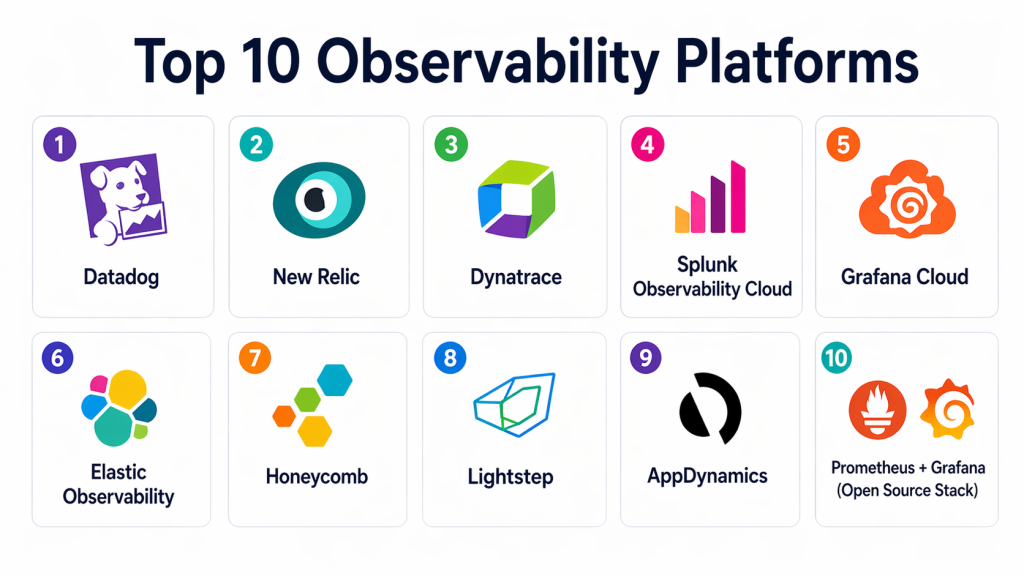
Top 10 Observability Platforms
#1 — Datadog
Short description: Datadog is a leading observability platform offering monitoring, logging, and tracing in a unified interface. It is widely used by enterprises for cloud-native monitoring and performance optimization.
Key Features
- Full-stack observability
- Metrics, logs, and traces
- Real-time dashboards
- AI-based anomaly detection
- Alerting and incident management
- Integration with cloud services
Pros
- Comprehensive feature set
- Strong integrations
Cons
- Expensive at scale
- Learning curve for beginners
Platforms / Deployment
- Cloud
Security & Compliance
- RBAC, audit logs
Integrations & Ecosystem
Extensive integration with modern infrastructure and tools.
- Cloud platforms
- CI/CD pipelines
- DevOps tools
Support & Community
Enterprise support with large user base.
#2 — New Relic
Short description: New Relic provides full-stack observability with powerful analytics and monitoring capabilities. It helps teams gain insights into application performance and infrastructure.
Key Features
- Application performance monitoring
- Distributed tracing
- Log management
- Real-time analytics
- Custom dashboards
Pros
- Strong analytics capabilities
- Easy onboarding
Cons
- Pricing complexity
- Data volume costs
Platforms / Deployment
- Cloud
Security & Compliance
- RBAC
Integrations & Ecosystem
Supports integration with development and cloud tools.
- Dev tools
- Cloud platforms
Support & Community
Strong documentation and support.
#3 — Dynatrace
Short description: Dynatrace is an AI-powered observability platform that provides automated monitoring and root cause analysis across complex environments.
Key Features
- AI-driven monitoring
- Distributed tracing
- Infrastructure monitoring
- Real-time insights
- Automated root cause analysis
Pros
- Advanced AI capabilities
- Strong automation
Cons
- Premium pricing
- Complex setup
Platforms / Deployment
- Cloud / Hybrid
Security & Compliance
- RBAC, audit logs
Integrations & Ecosystem
Works across enterprise and cloud environments.
- Cloud platforms
- DevOps tools
Support & Community
Enterprise-grade support.
#4 — Splunk Observability Cloud
Short description: Splunk provides observability solutions focused on logs, metrics, and real-time analytics, helping teams manage large-scale data and infrastructure.
Key Features
- Log analysis
- Metrics monitoring
- Real-time dashboards
- Alerting
- Data analytics
Pros
- Powerful analytics
- Scalable
Cons
- High cost
- Complex configuration
Platforms / Deployment
- Cloud
Security & Compliance
- RBAC
Integrations & Ecosystem
Integrates with enterprise systems and data platforms.
- DevOps tools
- Cloud services
Support & Community
Strong enterprise support.
#5 — Grafana Cloud
Short description: Grafana Cloud provides observability with dashboards, metrics, and logs, built on open-source technologies and widely used for monitoring modern systems.
Key Features
- Metrics visualization
- Log aggregation
- Distributed tracing
- Custom dashboards
- Open-source integrations
Pros
- Flexible and customizable
- Strong community
Cons
- Requires setup
- Learning curve
Platforms / Deployment
- Cloud / Self-hosted
Security & Compliance
- RBAC
Integrations & Ecosystem
Integrates with open-source and cloud-native tools.
- Prometheus
- Kubernetes
- Dev tools
Support & Community
Large open-source community.
#6 — Elastic Observability
Short description: Elastic Observability provides unified monitoring with logs, metrics, and traces, built on the Elastic Stack.
Key Features
- Log management
- Metrics monitoring
- APM capabilities
- Search and analytics
- Visualization tools
Pros
- Strong search capabilities
- Flexible deployment
Cons
- Complex setup
- Requires expertise
Platforms / Deployment
- Cloud / Self-hosted
Security & Compliance
- RBAC
Integrations & Ecosystem
Works with modern infrastructure and data tools.
- DevOps tools
- Cloud platforms
Support & Community
Strong community support.
#7 — Honeycomb
Short description: Honeycomb is designed for high-cardinality observability and debugging complex distributed systems with detailed tracing.
Key Features
- Distributed tracing
- High-cardinality data analysis
- Real-time debugging
- Event-based observability
- Custom queries
Pros
- Deep insights
- Developer-focused
Cons
- Niche use case
- Learning curve
Platforms / Deployment
- Cloud
Security & Compliance
- Not publicly stated
Integrations & Ecosystem
Integrates with modern observability stacks.
- Dev tools
- CI/CD pipelines
Support & Community
Growing community.
#8 — Lightstep
Short description: Lightstep provides observability with a focus on distributed tracing and performance insights for microservices.
Key Features
- Distributed tracing
- Performance monitoring
- Root cause analysis
- Real-time insights
- OpenTelemetry support
Pros
- Strong tracing capabilities
- Open standards support
Cons
- Limited log management
- Requires setup
Platforms / Deployment
- Cloud
Security & Compliance
- Not publicly stated
Integrations & Ecosystem
Works with modern DevOps ecosystems.
- OpenTelemetry
- Dev tools
Support & Community
Moderate support.
#9 — AppDynamics
Short description: AppDynamics provides application performance monitoring and observability with business insights for enterprise environments.
Key Features
- Application monitoring
- Business transaction tracking
- Real-time analytics
- Alerting
- Dashboard visualization
Pros
- Strong enterprise features
- Business insights
Cons
- Expensive
- Complex setup
Platforms / Deployment
- Cloud / Hybrid
Security & Compliance
- RBAC
Integrations & Ecosystem
Integrates with enterprise and cloud systems.
- DevOps tools
- Cloud platforms
Support & Community
Enterprise support.
#10 — Prometheus + Grafana (Open Source Stack)
Short description: Prometheus combined with Grafana provides a powerful open-source observability stack for monitoring metrics and visualizing system performance.
Key Features
- Metrics collection
- Time-series database
- Alerting
- Visualization dashboards
- Open-source ecosystem
Pros
- Free and flexible
- Strong community
Cons
- Requires setup
- Limited out-of-the-box features
Platforms / Deployment
- Self-hosted
Security & Compliance
- Not publicly stated
Integrations & Ecosystem
Works with cloud-native and DevOps tools.
- Kubernetes
- Dev tools
Support & Community
Very large open-source community.
Comparison Table (Top 10)
| Tool Name | Best For | Platform(s) Supported | Deployment | Standout Feature | Public Rating |
|---|---|---|---|---|---|
| Datadog | Enterprises | Web | Cloud | Full-stack monitoring | N/A |
| New Relic | Dev teams | Web | Cloud | Analytics | N/A |
| Dynatrace | Enterprises | Web | Hybrid | AI monitoring | N/A |
| Splunk | Data-heavy apps | Web | Cloud | Log analytics | N/A |
| Grafana Cloud | Open-source users | Web | Hybrid | Dashboards | N/A |
| Elastic | Flexible teams | Web | Hybrid | Search analytics | N/A |
| Honeycomb | Developers | Web | Cloud | High-cardinality | N/A |
| Lightstep | Microservices | Web | Cloud | Tracing | N/A |
| AppDynamics | Enterprises | Web | Hybrid | Business insights | N/A |
| Prometheus | Open-source | CLI/Web | Self-hosted | Metrics | N/A |
Evaluation & Scoring of Observability Platforms
| Tool Name | Core (25%) | Ease (15%) | Integrations (15%) | Security (10%) | Performance (10%) | Support (10%) | Value (15%) | Weighted Total (0–10) |
|---|---|---|---|---|---|---|---|---|
| Datadog | 9 | 8 | 10 | 9 | 9 | 9 | 7 | 8.8 |
| New Relic | 9 | 9 | 9 | 8 | 8 | 8 | 8 | 8.6 |
| Dynatrace | 9 | 7 | 9 | 9 | 9 | 9 | 7 | 8.7 |
| Splunk | 9 | 7 | 8 | 9 | 9 | 9 | 6 | 8.3 |
| Grafana | 8 | 7 | 9 | 7 | 8 | 8 | 9 | 8.1 |
| Elastic | 8 | 6 | 8 | 8 | 8 | 8 | 8 | 7.9 |
| Honeycomb | 8 | 7 | 7 | 7 | 8 | 7 | 8 | 7.7 |
| Lightstep | 8 | 7 | 8 | 7 | 8 | 7 | 8 | 7.8 |
| AppDynamics | 9 | 6 | 8 | 9 | 9 | 8 | 6 | 8.1 |
| Prometheus | 8 | 6 | 9 | 7 | 8 | 8 | 10 | 8.0 |
How to interpret scores:
These scores provide a comparative benchmark across platforms based on weighted criteria. Higher scores indicate stronger overall capabilities, but the best choice depends on your environment. Enterprise tools excel in automation and analytics, while open-source tools offer flexibility and cost efficiency. Always validate tools in real scenarios before selection.
Which Observability Platform Is Right for You?
Solo / Freelancer
Prometheus and Grafana are ideal due to their open-source nature and flexibility. They provide strong monitoring capabilities without high costs. However, they require setup and maintenance. Suitable for smaller environments.
SMB
New Relic and Grafana Cloud offer a balance of usability and features. They provide easy onboarding and scalability. These tools help teams gain visibility without complexity. SMBs benefit from their flexibility.
Mid-Market
Datadog and Elastic Observability provide strong integrations and scalability. They support growing infrastructure and DevOps practices. These tools help manage increasing complexity. Suitable for expanding teams.
Enterprise
Dynatrace, Splunk, and AppDynamics are best suited for large organizations. They offer advanced analytics, automation, and scalability. Enterprises benefit from their robust capabilities. These tools handle complex environments effectively.
Budget vs Premium
- Budget: Prometheus + Grafana
- Premium: Dynatrace, Datadog
Feature Depth vs Ease of Use
- Easy: New Relic
- Advanced: Dynatrace
Integrations & Scalability
Choose platforms that integrate with cloud and DevOps tools. Scalability is critical for large data volumes. Ensure the platform supports distributed systems. Integration flexibility is key.
Security & Compliance Needs
Prioritize tools with strong access control and audit logging. Compliance requirements vary by organization. Tools with monitoring and governance features provide better control. Continuous observability improves reliability.
Frequently Asked Questions (FAQs)
1. What is an observability platform?
An observability platform provides visibility into system performance using metrics, logs, and traces. It helps teams understand system behavior and diagnose issues. These platforms go beyond traditional monitoring by offering deeper insights. They are essential for modern distributed systems.
2. How is observability different from monitoring?
Monitoring focuses on predefined metrics and alerts, while observability provides deeper insights into system behavior. Observability helps answer unknown issues. It enables root cause analysis. This makes it more powerful for complex systems.
3. What are the key components of observability?
The three main components are metrics, logs, and traces. Metrics track performance, logs capture events, and traces show request flows. Together, they provide a complete view of systems. This helps teams diagnose issues effectively.
4. Can observability tools integrate with CI/CD pipelines?
Yes, most observability platforms integrate with CI/CD pipelines. This allows monitoring of deployments and performance changes. Integration helps detect issues early. It improves release reliability.
5. Are observability platforms expensive?
Costs vary depending on features and data usage. Enterprise platforms can be expensive, especially at scale. Open-source options provide cost-effective alternatives. Teams should evaluate based on needs.
6. Do observability tools support cloud environments?
Yes, most tools are designed for cloud-native environments. They support multi-cloud and hybrid deployments. This ensures visibility across infrastructure. It is essential for modern applications.
7. How difficult is implementation?
Implementation complexity depends on the platform. Some tools are easy to set up, while others require expertise. Proper planning helps simplify the process. Starting small is recommended.
8. Can observability improve performance?
Yes, observability helps identify bottlenecks and inefficiencies. Teams can optimize performance based on insights. This improves user experience. Continuous monitoring ensures stability.
9. What are common challenges in observability?
Challenges include data overload, high costs, and complexity. Managing large volumes of data can be difficult. Proper configuration helps address these issues. Choosing the right tool is important.
10. What are alternatives to observability platforms?
Alternatives include basic monitoring tools and manual debugging. However, these approaches lack depth and scalability. Observability platforms provide comprehensive insights. They are essential for modern systems.
Conclusion
Observability platforms are essential for managing modern, distributed systems by providing deep insights into application and infrastructure performance. They enable teams to detect issues faster, reduce downtime, and optimize system behavior. As environments become more complex, traditional monitoring is no longer sufficient, making observability a critical component of DevOps and SRE practices. Tools like Datadog and Dynatrace offer advanced enterprise capabilities, while open-source stacks like Prometheus and Grafana provide flexibility and cost efficiency. The best choice depends on your infrastructure, team size, and monitoring needs. Start by evaluating your observability requirements, test a few platforms, and implement the one that aligns best with your operational goals.
