Introduction
Secrets Management Tools are platforms designed to securely store, manage, and control access to sensitive information such as API keys, passwords, certificates, and encryption keys. Instead of hardcoding secrets into applications or configuration files, these tools centralize and protect them using encryption, access controls, and automated rotation.
In modern cloud-native and DevOps environments, where applications are distributed and highly dynamic, secrets management is critical. Poor handling of secrets is one of the leading causes of security breaches. These tools help reduce risk, enforce security policies, and ensure compliance across environments.
Common real-world use cases:
- Secure storage of API keys and credentials
- Automated secrets rotation and expiration
- Managing secrets across cloud and hybrid environments
- Protecting access to databases and services
- Enforcing security policies in CI/CD pipelines
What buyers should evaluate:
- Encryption standards and security controls
- Access management (RBAC, IAM integration)
- Secrets rotation and lifecycle management
- Integration with cloud platforms and DevOps tools
- Ease of deployment and scalability
- Audit logging and compliance support
- Multi-cloud and hybrid support
- Performance and latency
- Developer experience and usability
Best for: DevOps teams, security engineers, cloud architects, and enterprises managing sensitive data across distributed systems.
Not ideal for: Small projects with minimal secrets or teams that can safely manage credentials without centralized systems.
Key Trends in Secrets Management Tools
- Increasing adoption of zero trust security models
- Automated secrets rotation and expiration policies
- Deep integration with cloud-native platforms
- Expansion of identity-based access controls
- Support for multi-cloud and hybrid deployments
- Integration with Kubernetes and container ecosystems
- Enhanced audit logging and compliance tracking
- AI-assisted anomaly detection in access patterns
- Shift toward developer-friendly APIs and automation
- Policy-driven governance and secrets lifecycle management
How We Selected These Tools (Methodology)
- Industry adoption and credibility
- Strong encryption and security capabilities
- Integration with cloud and DevOps ecosystems
- Scalability across environments
- Ease of use and developer experience
- Support for secrets lifecycle management
- Compliance and audit capabilities
- Flexibility in deployment (cloud, self-hosted)
- Active development and innovation
- Community and enterprise support
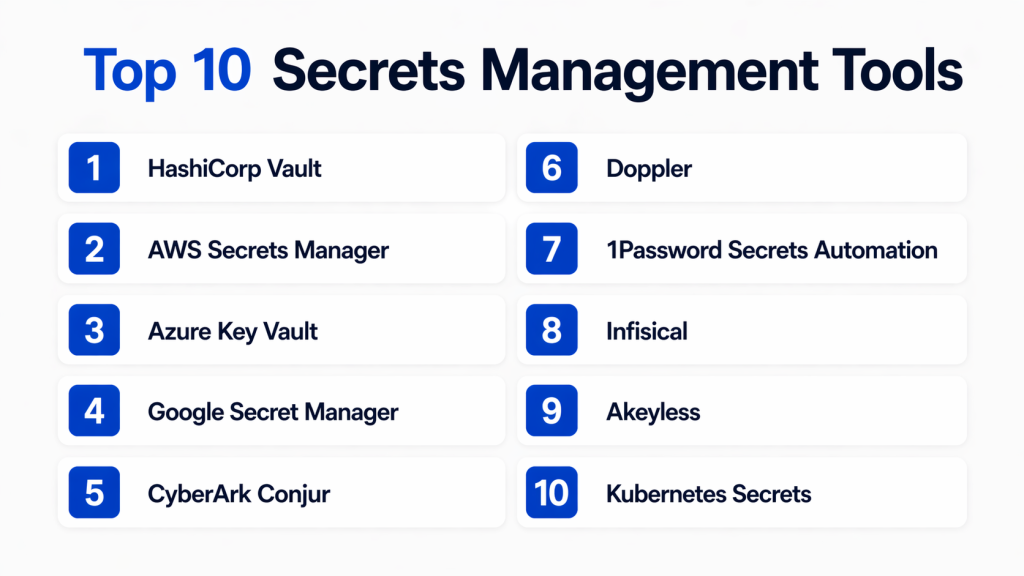
Top 10 Secrets Management Tools
#1 — HashiCorp Vault
Short description: HashiCorp Vault is one of the most widely used secrets management platforms. It provides secure storage, dynamic secrets, and encryption as a service, making it ideal for enterprises and cloud-native applications.
Key Features
- Dynamic secrets generation
- Encryption as a service
- Secrets rotation
- Access control policies
- Audit logging
- Multi-cloud support
Pros
- Highly secure and scalable
- Strong ecosystem integration
Cons
- Complex setup
- Requires operational expertise
Platforms / Deployment
- Cloud / Self-hosted
Security & Compliance
- RBAC, audit logs, encryption
Integrations & Ecosystem
Vault integrates deeply with modern infrastructure and DevOps tools.
- Kubernetes
- CI/CD pipelines
- Cloud platforms
Support & Community
Strong enterprise support with large open-source community.
#2 — AWS Secrets Manager
Short description: AWS Secrets Manager provides secure storage and automated rotation of secrets within AWS environments. It is ideal for organizations heavily invested in cloud infrastructure.
Key Features
- Automated secrets rotation
- Integration with AWS services
- Encryption using KMS
- Fine-grained access control
- Monitoring and logging
Pros
- Seamless AWS integration
- Scalable and managed service
Cons
- Limited outside AWS
- Cost can increase with usage
Platforms / Deployment
- Cloud
Security & Compliance
- IAM, encryption, audit logs
Integrations & Ecosystem
Deep integration with cloud services and infrastructure.
- Cloud services
- CI/CD pipelines
- Monitoring tools
Support & Community
Enterprise-grade support.
#3 — Azure Key Vault
Short description: Azure Key Vault is a cloud-based secrets management service designed for storing and controlling access to sensitive data in Microsoft environments.
Key Features
- Secret and key storage
- Certificate management
- Access policies
- Integration with Azure services
- Monitoring and logging
Pros
- Strong Azure integration
- Easy to use for Microsoft users
Cons
- Limited multi-cloud support
- Requires Azure ecosystem
Platforms / Deployment
- Cloud
Security & Compliance
- RBAC, encryption, audit logs
Integrations & Ecosystem
Works seamlessly within Microsoft cloud environments.
- Azure services
- DevOps pipelines
Support & Community
Enterprise support with strong documentation.
#4 — Google Secret Manager
Short description: Google Secret Manager provides secure storage and lifecycle management for secrets within Google Cloud environments.
Key Features
- Secret versioning
- IAM-based access control
- Encryption
- Integration with GCP services
- Monitoring and auditing
Pros
- Easy to use
- Strong cloud integration
Cons
- Limited outside GCP
- Vendor dependency
Platforms / Deployment
- Cloud
Security & Compliance
- IAM, encryption, audit logs
Integrations & Ecosystem
Deep integration with Google Cloud services.
- Cloud services
- CI/CD pipelines
Support & Community
Enterprise-level support.
#5 — CyberArk Conjur
Short description: CyberArk Conjur is an enterprise-grade secrets management solution focused on securing applications and DevOps environments.
Key Features
- Secrets storage
- Role-based access control
- Policy management
- Kubernetes integration
- Audit logging
Pros
- Strong enterprise security
- Good compliance capabilities
Cons
- Complex configuration
- Learning curve
Platforms / Deployment
- Cloud / Self-hosted
Security & Compliance
- RBAC, audit logs
Integrations & Ecosystem
Supports integration with enterprise systems and DevOps tools.
- Kubernetes
- CI/CD pipelines
Support & Community
Enterprise support with security focus.
#6 — Doppler
Short description: Doppler is a modern secrets management platform designed for developers. It simplifies secrets management across environments with a user-friendly interface.
Key Features
- Centralized secrets management
- Environment-based configuration
- Real-time updates
- Integration with development tools
- Access control
Pros
- Developer-friendly
- Easy setup
Cons
- Limited enterprise features
- Cloud dependency
Platforms / Deployment
- Cloud
Security & Compliance
- Not publicly stated
Integrations & Ecosystem
Integrates with modern development workflows.
- Dev tools
- CI/CD pipelines
Support & Community
Growing community with good documentation.
#7 — 1Password Secrets Automation
Short description: 1Password Secrets Automation extends traditional password management into DevOps workflows, enabling secure secrets sharing and automation.
Key Features
- Secrets storage
- Secure sharing
- Automation workflows
- Access control
- Audit logs
Pros
- Easy to use
- Strong user experience
Cons
- Limited advanced features
- Not enterprise-focused
Platforms / Deployment
- Cloud
Security & Compliance
- Not publicly stated
Integrations & Ecosystem
Works with development and productivity tools.
- CI/CD tools
- Dev platforms
Support & Community
Good documentation and support.
#8 — Infisical
Short description: Infisical is an open-source secrets management platform designed for modern development environments with strong encryption and developer workflows.
Key Features
- End-to-end encryption
- Secrets sharing
- Environment management
- Access control
- Open-source flexibility
Pros
- Open-source
- Developer-friendly
Cons
- Smaller ecosystem
- Limited enterprise features
Platforms / Deployment
- Cloud / Self-hosted
Security & Compliance
- Encryption, RBAC
Integrations & Ecosystem
Supports integration with development workflows.
- Dev tools
- CI/CD pipelines
Support & Community
Growing open-source community.
#9 — Akeyless
Short description: Akeyless provides secrets management with a focus on distributed environments and zero-trust architecture.
Key Features
- Secrets storage
- Encryption services
- Dynamic secrets
- Access control
- Zero trust architecture
Pros
- Strong security model
- Scalable architecture
Cons
- Learning curve
- Requires configuration
Platforms / Deployment
- Cloud / Hybrid
Security & Compliance
- Not publicly stated
Integrations & Ecosystem
Integrates with cloud and DevOps ecosystems.
- CI/CD tools
- Cloud platforms
Support & Community
Enterprise support available.
#10 — Kubernetes Secrets
Short description: Kubernetes Secrets provide built-in secrets management within Kubernetes clusters, allowing applications to securely access sensitive data.
Key Features
- Native Kubernetes integration
- Secret storage
- Access control
- Encryption support
- API-based access
Pros
- Built-in solution
- Easy integration with Kubernetes
Cons
- Limited advanced features
- Requires additional tools for scaling
Platforms / Deployment
- Kubernetes environments
Security & Compliance
- RBAC, encryption
Integrations & Ecosystem
Works within container orchestration ecosystems.
- Kubernetes
- DevOps pipelines
Support & Community
Strong community support.
Comparison Table (Top 10)
| Tool Name | Best For | Platform(s) Supported | Deployment | Standout Feature | Public Rating |
|---|---|---|---|---|---|
| HashiCorp Vault | Enterprises | Web/CLI | Hybrid | Dynamic secrets | N/A |
| AWS Secrets Manager | Cloud users | Web | Cloud | Automated rotation | N/A |
| Azure Key Vault | Microsoft users | Web | Cloud | Certificate management | N/A |
| Google Secret Manager | GCP users | Web | Cloud | Secret versioning | N/A |
| CyberArk Conjur | Enterprises | Web | Hybrid | Policy management | N/A |
| Doppler | Developers | Web | Cloud | Simplicity | N/A |
| 1Password | Small teams | Web | Cloud | Ease of use | N/A |
| Infisical | Open-source users | Web | Hybrid | Encryption | N/A |
| Akeyless | Zero trust teams | Web | Hybrid | Distributed secrets | N/A |
| Kubernetes Secrets | Container apps | API | Local | Native integration | N/A |
Evaluation & Scoring of Secrets Management Tools
| Tool Name | Core (25%) | Ease (15%) | Integrations (15%) | Security (10%) | Performance (10%) | Support (10%) | Value (15%) | Weighted Total (0–10) |
|---|---|---|---|---|---|---|---|---|
| Vault | 9 | 7 | 9 | 9 | 9 | 9 | 8 | 8.7 |
| AWS Secrets Manager | 8 | 9 | 9 | 9 | 8 | 8 | 7 | 8.3 |
| Azure Key Vault | 8 | 8 | 8 | 9 | 8 | 8 | 7 | 8.0 |
| Google Secret Manager | 8 | 8 | 8 | 9 | 8 | 8 | 7 | 8.0 |
| CyberArk | 9 | 6 | 8 | 9 | 8 | 8 | 6 | 7.9 |
| Doppler | 7 | 9 | 7 | 7 | 8 | 7 | 8 | 7.8 |
| 1Password | 7 | 9 | 7 | 7 | 7 | 7 | 8 | 7.6 |
| Infisical | 7 | 8 | 7 | 8 | 7 | 7 | 9 | 7.8 |
| Akeyless | 8 | 7 | 8 | 9 | 8 | 7 | 7 | 8.0 |
| Kubernetes Secrets | 7 | 7 | 8 | 7 | 8 | 7 | 8 | 7.5 |
How to interpret scores:
These scores compare tools across weighted criteria. Higher scores indicate stronger overall capabilities, but the best tool depends on your environment and needs. Enterprise tools focus on security and scalability, while developer-first tools prioritize ease of use. Always evaluate tools in real-world scenarios before selection.
Which Secrets Management Tool Is Right for You?
Solo / Freelancer
Tools like Doppler or 1Password are ideal due to simplicity and ease of use. They require minimal setup and provide quick access to secrets. These tools are cost-effective and suitable for smaller projects. They help maintain security without adding complexity.
SMB
Azure Key Vault and Google Secret Manager offer a balance between usability and features. They integrate well with cloud platforms and provide essential automation. These tools are scalable and easy to adopt. SMB teams benefit from their simplicity and reliability.
Mid-Market
Infisical and Akeyless provide more flexibility and control for growing teams. They support hybrid environments and advanced configurations. These tools help manage increasing complexity in infrastructure. They are ideal for teams expanding their DevOps practices.
Enterprise
HashiCorp Vault and CyberArk Conjur are best suited for large organizations with strict security requirements. They offer advanced access control, auditing, and scalability. Enterprises benefit from their robust architecture and compliance capabilities. These tools handle complex environments effectively.
Budget vs Premium
- Budget: Kubernetes Secrets, Infisical
- Premium: Vault, CyberArk
Feature Depth vs Ease of Use
- Easy: Doppler, 1Password
- Advanced: Vault, CyberArk
Integrations & Scalability
Choose tools that integrate with CI/CD pipelines and cloud platforms. Scalability is essential for handling growing workloads. Ensure the tool supports automation and distributed systems. Integration flexibility is key for long-term success.
Security & Compliance Needs
Prioritize tools with strong encryption, audit logs, and access control. Compliance requirements vary by industry, so choose accordingly. Tools with policy enforcement provide better governance. Continuous monitoring enhances security posture.
Frequently Asked Questions (FAQs)
1. What is a secrets management tool?
A secrets management tool securely stores and manages sensitive data like API keys, passwords, and certificates. It ensures that secrets are not exposed in code or configuration files. These tools use encryption and access controls to protect data. They are essential for modern DevOps and cloud environments.
2. Why is secrets management important?
Secrets management prevents unauthorized access to sensitive data, reducing the risk of breaches. It centralizes control and enforces security policies across systems. Without it, secrets can be easily exposed in code repositories or logs. Proper management improves overall security and compliance.
3. What types of secrets can be managed?
Secrets include API keys, database credentials, encryption keys, tokens, and certificates. These tools can manage any sensitive information used by applications. Centralized storage ensures consistent handling of all secrets. It also simplifies access control and auditing.
4. Can secrets management tools automate rotation?
Yes, many tools support automated rotation of secrets to enhance security. Rotation ensures that credentials are regularly updated and reduces the risk of compromise. Automation eliminates manual effort and ensures consistency. It is a critical feature for enterprise security.
5. Do these tools integrate with CI/CD pipelines?
Most secrets management tools integrate with CI/CD pipelines for secure automation. They allow pipelines to access secrets without exposing them. This ensures secure deployments and builds. Integration helps maintain continuous security practices.
6. Are open-source secrets management tools reliable?
Yes, open-source tools like Vault and Infisical are widely used and reliable. They offer flexibility and transparency. However, they may require more setup and maintenance. Organizations should evaluate their needs before choosing.
7. How difficult is it to implement secrets management?
Implementation complexity depends on the tool and environment. Some tools are easy to deploy, while others require configuration and expertise. Proper planning and documentation simplify the process. Starting small helps teams adopt gradually.
8. Can secrets management tools support multi-cloud environments?
Yes, many tools are designed to work across multiple cloud platforms. They provide centralized control regardless of infrastructure. This is important for organizations using hybrid or multi-cloud strategies. It ensures consistent security practices.
9. What are common mistakes in secrets management?
Common mistakes include hardcoding secrets, poor access control, and lack of rotation. These issues increase the risk of exposure and breaches. Using a centralized tool helps avoid these mistakes. Proper policies and monitoring are essential.
10. What are alternatives to secrets management tools?
Alternatives include environment variables or manual storage methods. However, these approaches lack security and scalability. Secrets management tools provide automation and centralized control. They are the preferred solution for modern applications.
Conclusion
Secrets management tools are a critical component of modern security architecture, helping organizations protect sensitive data and reduce the risk of breaches. As applications become more distributed and cloud-native, managing secrets manually is no longer practical. Tools like HashiCorp Vault and AWS Secrets Manager provide robust security and scalability, while developer-focused solutions offer simplicity and ease of use. The best tool depends on your infrastructure, team size, and security requirements. Start by identifying your key use cases, test a few tools in your environment, and evaluate how well they integrate with your workflows. A well-implemented secrets management strategy strengthens both security and operational efficiency.
