Introduction
Service Mesh Platforms are infrastructure layers designed to manage, secure, and monitor communication between microservices in distributed applications. They handle service-to-service networking concerns such as traffic routing, security, observability, and reliability without requiring changes to application code.
As microservices architectures become more complex, service meshes play a crucial role in ensuring consistent communication, enforcing security policies, and providing deep visibility into system behavior. They are widely used in Kubernetes-based environments and cloud-native systems.
Real-world use cases:
- Managing microservices communication
- Securing service-to-service traffic
- Observing application performance and latency
- Implementing traffic routing and load balancing
- Enforcing zero-trust security models
What buyers should evaluate:
- Ease of deployment and configuration
- Performance overhead and latency
- Security features (mTLS, policy enforcement)
- Observability and monitoring capabilities
- Integration with Kubernetes
- Scalability across clusters
- Traffic management features
- Community and ecosystem support
- Documentation and ease of use
Best for:
DevOps teams, platform engineers, cloud architects, and organizations running microservices at scale.
Not ideal for:
Applications with simple architectures or monolithic systems without service-to-service communication complexity.
Key Trends in Service Mesh Platforms
- Adoption of zero-trust networking with mTLS
- Integration with Kubernetes ecosystems
- Growth of multi-cluster service meshes
- Enhanced observability and tracing
- Lightweight service mesh implementations
- Integration with API gateways
- Automation of traffic routing and policies
- AI-driven monitoring and anomaly detection
- Expansion into edge and hybrid environments
How We Selected These Tools (Methodology)
- Market adoption and popularity
- Feature completeness and scalability
- Performance and resource efficiency
- Security capabilities and compliance
- Integration with Kubernetes and cloud platforms
- Ease of use and configuration
- Community support and ecosystem strength
- Monitoring and observability features
- Vendor reliability and innovation
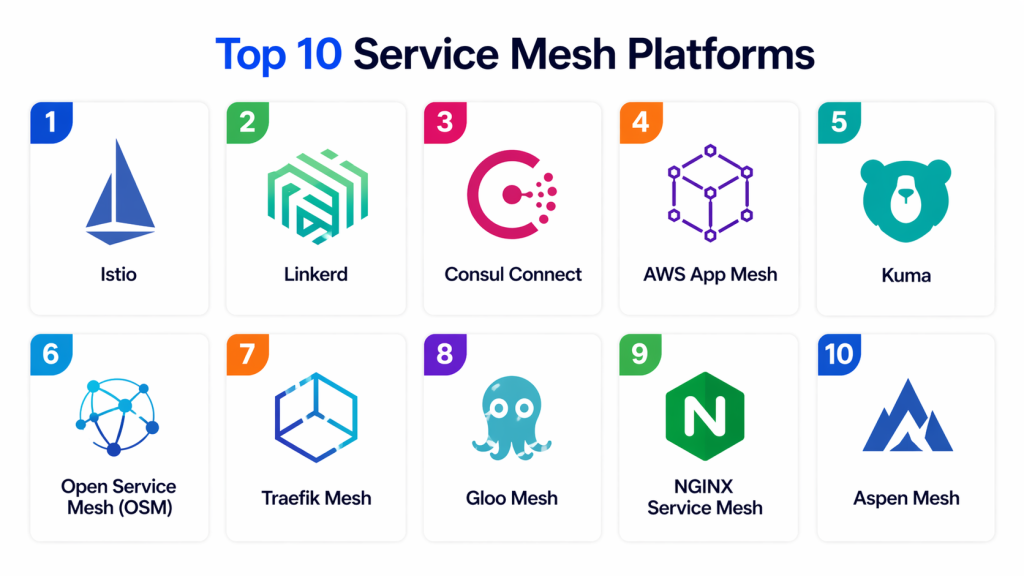
Top 10 Service Mesh Platforms
#1 — Istio
Short description:
Istio is one of the most popular service mesh platforms designed for managing microservices communication. It provides advanced traffic management, security, and observability features. Organizations use it for large-scale deployments. It is ideal for enterprises adopting Kubernetes.
Key Features
- Traffic management
- mTLS security
- Observability tools
- Policy enforcement
- Service discovery
Pros
- Feature-rich
- Strong community
Cons
- Complex setup
- Resource-intensive
Platforms / Deployment
Kubernetes / Cloud / On-premise
Security & Compliance
mTLS, RBAC
Integrations & Ecosystem
- Kubernetes tools
- DevOps platforms
Support & Community
Large open-source community
#2 — Linkerd
Short description:
Linkerd is a lightweight service mesh designed for simplicity and performance. It provides essential features like security and observability without complexity. Organizations use it for efficient microservices management. It is ideal for teams wanting a simple service mesh.
Key Features
- Lightweight architecture
- mTLS encryption
- Observability
- Traffic routing
- Easy deployment
Pros
- Simple to use
- Low overhead
Cons
- Limited advanced features
- Smaller ecosystem
Platforms / Deployment
Kubernetes / Cloud
Security & Compliance
mTLS
Integrations & Ecosystem
- Kubernetes ecosystem
Support & Community
Active community
#3 — Consul Connect
Short description:
Consul Connect is a service mesh platform focused on secure service communication. It provides service discovery, networking, and security features. Organizations use it for hybrid environments. It is ideal for enterprises managing distributed systems.
Key Features
- Service discovery
- Secure communication
- Traffic routing
- Multi-cloud support
- Health checks
Pros
- Flexible deployment
- Strong security
Cons
- Requires setup
- Learning curve
Platforms / Deployment
Cloud / On-premise / Hybrid
Security & Compliance
mTLS, encryption
Integrations & Ecosystem
- DevOps tools
- APIs
Support & Community
Strong support
#4 — AWS App Mesh
Short description:
AWS App Mesh is a managed service mesh platform for containerized applications. It simplifies service communication in cloud environments. Organizations use it for scalable applications. It is ideal for cloud-first businesses.
Key Features
- Managed service mesh
- Traffic routing
- Monitoring
- Integration with cloud tools
- Security features
Pros
- Easy to manage
- Scalable
Cons
- Cloud dependency
- Limited customization
Platforms / Deployment
Cloud
Security & Compliance
Encryption
Integrations & Ecosystem
- Cloud services
- APIs
Support & Community
Strong support
#5 — Kuma
Short description:
Kuma is a modern service mesh platform built for Kubernetes and virtual machines. It supports multi-cluster environments and simplifies operations. Organizations use it for flexible deployments. It is ideal for hybrid environments.
Key Features
- Multi-cluster support
- Traffic management
- Observability
- Security policies
- Easy setup
Pros
- Flexible
- Modern architecture
Cons
- Smaller ecosystem
- Limited enterprise features
Platforms / Deployment
Cloud / On-premise / Hybrid
Security & Compliance
mTLS
Integrations & Ecosystem
- Kubernetes tools
- APIs
Support & Community
Growing community
#6 — Open Service Mesh (OSM)
Short description:
Open Service Mesh is a lightweight service mesh focused on simplicity and Kubernetes integration. It provides essential features for secure communication. Organizations use it for smaller deployments. It is ideal for teams wanting simplicity.
Key Features
- Lightweight design
- Traffic routing
- Security policies
- Observability
- Kubernetes integration
Pros
- Easy to deploy
- Simple
Cons
- Limited features
- Smaller ecosystem
Platforms / Deployment
Kubernetes / Cloud
Security & Compliance
mTLS
Integrations & Ecosystem
- Kubernetes ecosystem
Support & Community
Active community
#7 — Traefik Mesh
Short description:
Traefik Mesh is a simple service mesh designed for ease of use and integration. It provides basic traffic management and observability. Organizations use it for lightweight deployments. It is ideal for SMBs and beginners.
Key Features
- Simple setup
- Traffic routing
- Observability
- Integration with Traefik
- Lightweight
Pros
- Easy to use
- Lightweight
Cons
- Limited advanced features
- Not for large-scale deployments
Platforms / Deployment
Kubernetes / Cloud
Security & Compliance
Basic security
Integrations & Ecosystem
- Traefik ecosystem
Support & Community
Moderate support
#8 — Gloo Mesh
Short description:
Gloo Mesh is an enterprise service mesh platform designed for multi-cluster management. It provides advanced traffic control and observability. Organizations use it for large deployments. It is ideal for enterprises.
Key Features
- Multi-cluster management
- Traffic control
- Observability
- Security policies
- API gateway integration
Pros
- Enterprise features
- Scalable
Cons
- Expensive
- Complex setup
Platforms / Deployment
Cloud / Hybrid
Security & Compliance
mTLS, policies
Integrations & Ecosystem
- APIs
- DevOps tools
Support & Community
Enterprise support
#9 — NGINX Service Mesh
Short description:
NGINX Service Mesh is a service mesh platform built for Kubernetes environments. It provides traffic management and observability features. Organizations use it for application networking. It is ideal for teams using NGINX tools.
Key Features
- Traffic management
- Observability
- Security features
- Integration with NGINX
- Kubernetes support
Pros
- Familiar ecosystem
- Reliable
Cons
- Limited advanced features
- Smaller ecosystem
Platforms / Deployment
Kubernetes / Cloud
Security & Compliance
Encryption
Integrations & Ecosystem
- NGINX ecosystem
Support & Community
Good support
#10 — Aspen Mesh
Short description:
Aspen Mesh is an enterprise service mesh platform built on Istio. It provides enhanced security and support features. Organizations use it for production environments. It is ideal for enterprises needing support and stability.
Key Features
- Istio-based platform
- Traffic management
- Observability
- Security features
- Enterprise support
Pros
- Enterprise-ready
- Strong support
Cons
- Expensive
- Dependent on Istio
Platforms / Deployment
Cloud / On-premise
Security & Compliance
mTLS
Integrations & Ecosystem
- Kubernetes tools
- DevOps tools
Support & Community
Enterprise support
Comparison Table (Top 10)
| Tool Name | Best For | Platform(s) Supported | Deployment | Standout Feature | Public Rating |
|---|---|---|---|---|---|
| Istio | Enterprise | Kubernetes | Hybrid | Feature-rich | N/A |
| Linkerd | SMB | Kubernetes | Cloud | Lightweight | N/A |
| Consul | Hybrid | Multi | Hybrid | Service discovery | N/A |
| AWS App Mesh | Cloud | Cloud | Cloud | Managed | N/A |
| Kuma | Hybrid | Multi | Hybrid | Multi-cluster | N/A |
| OSM | SMB | Kubernetes | Cloud | Simplicity | N/A |
| Traefik Mesh | SMB | Kubernetes | Cloud | Ease of use | N/A |
| Gloo Mesh | Enterprise | Multi | Hybrid | Advanced control | N/A |
| NGINX Mesh | Developers | Kubernetes | Cloud | Integration | N/A |
| Aspen Mesh | Enterprise | Kubernetes | Hybrid | Enterprise support | N/A |
Evaluation & Scoring of Service Mesh Platforms
| Tool Name | Core | Ease | Integrations | Security | Performance | Support | Value | Total |
|---|---|---|---|---|---|---|---|---|
| Istio | 10 | 6 | 9 | 9 | 9 | 9 | 7 | 8.6 |
| Linkerd | 8 | 9 | 7 | 8 | 8 | 7 | 9 | 8.0 |
| Consul | 9 | 7 | 8 | 9 | 8 | 8 | 8 | 8.3 |
| AWS App Mesh | 8 | 8 | 8 | 8 | 8 | 8 | 8 | 8.0 |
| Kuma | 8 | 8 | 7 | 8 | 8 | 7 | 8 | 8.0 |
| OSM | 7 | 9 | 6 | 8 | 7 | 7 | 9 | 7.8 |
| Traefik Mesh | 7 | 9 | 6 | 7 | 7 | 7 | 9 | 7.7 |
| Gloo Mesh | 9 | 7 | 9 | 9 | 9 | 9 | 7 | 8.5 |
| NGINX Mesh | 8 | 7 | 7 | 8 | 8 | 7 | 8 | 7.9 |
| Aspen Mesh | 9 | 7 | 8 | 9 | 9 | 9 | 7 | 8.4 |
Which Service Mesh Platform Is Right for You?
Solo / Freelancer
Service mesh is usually not required for simple applications.
SMB
Linkerd and Traefik Mesh provide simplicity and ease of use.
Mid-Market
Consul and Kuma offer flexibility and scalability.
Enterprise
Istio, Gloo Mesh, and OpenShift-based solutions are ideal.
Budget vs Premium
Open-source tools reduce cost; enterprise tools offer advanced features.
Feature Depth vs Ease of Use
Linkerd is simple; Istio is feature-rich.
Integrations & Scalability
Istio and Consul excel.
Security & Compliance Needs
Istio and Gloo Mesh provide strong security.
Frequently Asked Questions (FAQs)
1. What is a service mesh?
A service mesh manages communication between microservices. It handles networking, security, and observability. It simplifies distributed systems.
2. Why use a service mesh?
It improves security, reliability, and visibility. It reduces complexity in microservices environments.
3. Is Istio the best service mesh?
Istio is widely used and feature-rich. However, it may be complex for small teams.
4. Are service meshes secure?
Yes, they provide mTLS and policy enforcement. Proper configuration is essential.
5. Do all applications need a service mesh?
No, only complex microservices systems benefit the most.
6. What is mTLS?
mTLS encrypts communication between services. It ensures secure connections.
7. Are service meshes expensive?
Open-source options are free. Enterprise tools may have costs.
8. What are common challenges?
Complexity and performance overhead are common issues.
9. Can service meshes scale?
Yes, they are designed for scalable environments.
10. How do I choose the right platform?
Evaluate complexity, scalability, and security needs.
Conclusion
Service Mesh Platforms have become a critical component of modern microservices architectures, enabling secure, reliable, and observable communication between services. They help organizations manage complexity while ensuring consistent performance and strong security across distributed systems.
Each platform offers unique strengths, from lightweight simplicity to enterprise-grade scalability and advanced traffic control. The right choice depends on your infrastructure size, technical expertise, and operational requirements.
A practical approach is to evaluate a few platforms in real-world scenarios to understand their performance, ease of use, and integration capabilities. This ensures alignment with your existing systems and workflows.
Selecting the right service mesh platform will improve reliability, strengthen security, and support long-term scalability in cloud-native environments.
