Introduction
Container Platforms are systems that enable developers and IT teams to build, deploy, manage, and scale containerized applications efficiently. Containers package applications with their dependencies, ensuring consistency across development, testing, and production environments.
With the rise of microservices, DevOps, and cloud-native architectures, container platforms have become a foundational technology. They simplify application deployment, improve scalability, and enhance resource utilization across modern infrastructure.
Real-world use cases:
- Microservices-based application deployment
- DevOps and CI/CD pipelines
- Cloud-native application development
- Application scaling and orchestration
- Hybrid and multi-cloud deployments
What buyers should evaluate:
- Container orchestration capabilities
- Ease of deployment and management
- Integration with CI/CD tools
- Scalability and performance
- Security and isolation features
- Multi-cloud and hybrid support
- Monitoring and logging capabilities
- Automation and scheduling features
- Community and ecosystem
Best for:
Developers, DevOps teams, cloud engineers, enterprises, and organizations building scalable applications.
Not ideal for:
Users running simple applications without scalability or orchestration needs.
Key Trends in Container Platforms
- Rapid adoption of Kubernetes-based platforms
- Integration with serverless and cloud-native tools
- Increased focus on container security
- Automation in deployment and scaling
- Hybrid and multi-cloud container environments
- Observability and monitoring enhancements
- AI-driven resource optimization
- GitOps and Infrastructure-as-Code practices
- Growth of managed container services
How We Selected These Tools (Methodology)
- Market adoption and popularity
- Feature completeness and orchestration capabilities
- Integration with cloud and DevOps ecosystems
- Performance and scalability
- Security and compliance features
- Ease of use and deployment
- Community support and ecosystem strength
- Automation and management capabilities
- Vendor reliability and support
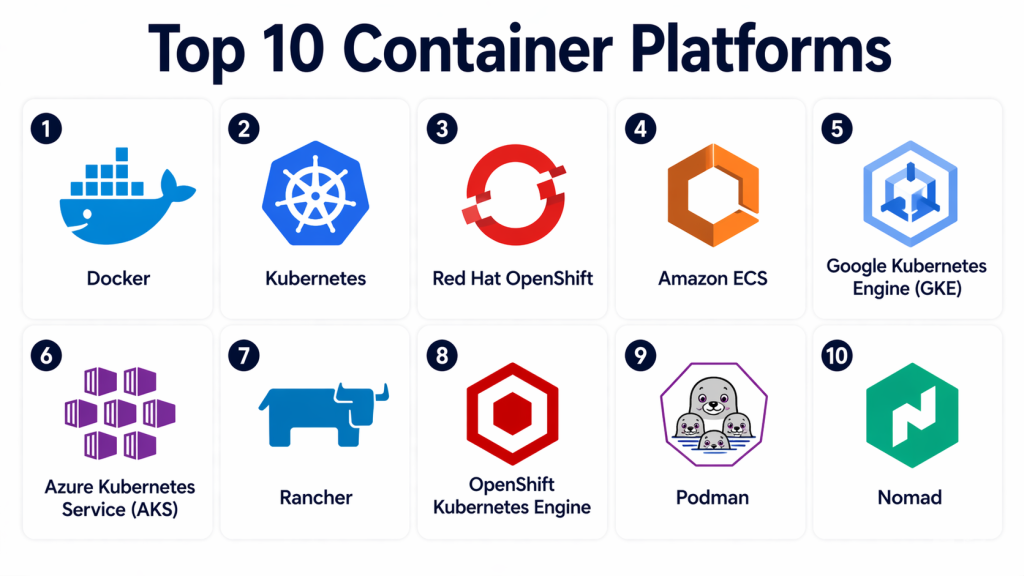
Top 10 Container Platforms
#1 — Docker
Short description:
Docker is the most widely used container platform for building and running containerized applications. It simplifies packaging applications with dependencies. Developers use it to ensure consistency across environments. It is ideal for individuals and enterprises starting with containers.
Key Features
- Container creation and management
- Image repository
- CLI tools
- Application packaging
- Integration with CI/CD
Pros
- Easy to use
- Large ecosystem
Cons
- Limited orchestration
- Requires additional tools
Platforms / Deployment
Windows / macOS / Linux — Cloud / On-premise
Security & Compliance
Isolation, image security
Integrations & Ecosystem
- CI/CD tools
- Cloud platforms
- Developer tools
Support & Community
Very large community
#2 — Kubernetes
Short description:
Kubernetes is an open-source container orchestration platform for managing containerized applications at scale. It automates deployment, scaling, and operations. Organizations use it for large-scale applications. It is ideal for enterprises and cloud-native environments.
Key Features
- Container orchestration
- Auto-scaling
- Self-healing
- Load balancing
- Service discovery
Pros
- Highly scalable
- Powerful automation
Cons
- Complex setup
- Requires expertise
Platforms / Deployment
Cloud / On-premise / Hybrid
Security & Compliance
RBAC, isolation
Integrations & Ecosystem
- Cloud platforms
- DevOps tools
- APIs
Support & Community
Massive open-source community
#3 — Red Hat OpenShift
Short description:
OpenShift is an enterprise Kubernetes platform that adds developer and operational tools. It simplifies container deployment and management. Businesses use it for secure and scalable environments. It is ideal for enterprises needing a complete solution.
Key Features
- Kubernetes-based orchestration
- Developer tools
- CI/CD integration
- Security controls
- Automation
Pros
- Enterprise-ready
- Strong security
Cons
- Expensive
- Learning curve
Platforms / Deployment
Cloud / On-premise / Hybrid
Security & Compliance
RBAC, compliance features
Integrations & Ecosystem
- Enterprise tools
- Cloud platforms
Support & Community
Strong enterprise support
#4 — Amazon ECS
Short description:
Amazon ECS is a managed container platform that simplifies running containers in the cloud. It integrates with cloud services for scalability. Organizations use it for application deployment. It is ideal for cloud-first businesses.
Key Features
- Managed containers
- Auto-scaling
- Integration with cloud services
- Monitoring
- Scheduling
Pros
- Easy to manage
- Scalable
Cons
- Cloud dependency
- Limited flexibility
Platforms / Deployment
Cloud
Security & Compliance
Encryption
Integrations & Ecosystem
- Cloud services
- APIs
Support & Community
Strong support
#5 — Google Kubernetes Engine (GKE)
Short description:
GKE is a managed Kubernetes service that simplifies deployment and scaling. It provides automated cluster management. Organizations use it for cloud-native applications. It is ideal for teams adopting Kubernetes without complexity.
Key Features
- Managed Kubernetes
- Auto-scaling
- Cluster management
- Monitoring
- Security tools
Pros
- Simplified Kubernetes
- High performance
Cons
- Cloud dependency
- Cost management
Platforms / Deployment
Cloud
Security & Compliance
RBAC, encryption
Integrations & Ecosystem
- Cloud tools
- DevOps platforms
Support & Community
Strong support
#6 — Azure Kubernetes Service (AKS)
Short description:
AKS is a managed Kubernetes platform provided by Microsoft. It enables easy deployment of containerized applications. Organizations use it for cloud-native development. It is ideal for Microsoft-based environments.
Key Features
- Managed Kubernetes
- Auto-scaling
- Integration with Azure
- Monitoring
- Security features
Pros
- Easy integration
- Scalable
Cons
- Cloud dependency
- Requires Azure ecosystem
Platforms / Deployment
Cloud
Security & Compliance
Encryption, RBAC
Integrations & Ecosystem
- Azure services
- DevOps tools
Support & Community
Strong support
#7 — Rancher
Short description:
Rancher is a container management platform that simplifies Kubernetes operations. It provides a unified interface for managing clusters. Organizations use it for multi-cluster environments. It is ideal for enterprises managing Kubernetes deployments.
Key Features
- Kubernetes management
- Multi-cluster support
- Monitoring tools
- Security controls
- Automation
Pros
- Easy Kubernetes management
- Multi-cluster support
Cons
- Requires Kubernetes knowledge
- Setup complexity
Platforms / Deployment
Cloud / On-premise
Security & Compliance
RBAC
Integrations & Ecosystem
- Kubernetes tools
- DevOps tools
Support & Community
Active community
#8 — OpenShift Kubernetes Engine
Short description:
OpenShift Kubernetes Engine is a lightweight version of OpenShift focused on Kubernetes orchestration. It provides essential features for container management. Organizations use it for streamlined deployments. It is ideal for Kubernetes-focused environments.
Key Features
- Kubernetes orchestration
- Automation
- Security controls
- Cluster management
- Resource optimization
Pros
- Lightweight
- Efficient
Cons
- Limited features
- Requires expertise
Platforms / Deployment
Cloud / On-premise
Security & Compliance
RBAC
Integrations & Ecosystem
- Kubernetes ecosystem
Support & Community
Strong support
#9 — Podman
Short description:
Podman is a container platform designed as an alternative to Docker. It allows users to manage containers without a daemon. Developers use it for secure and flexible environments. It is ideal for Linux users and developers.
Key Features
- Daemonless containers
- CLI tools
- Security features
- Image management
- Compatibility with Docker
Pros
- Secure
- Lightweight
Cons
- Limited ecosystem
- Learning curve
Platforms / Deployment
Linux / Cloud
Security & Compliance
Isolation
Integrations & Ecosystem
- Developer tools
- Linux ecosystem
Support & Community
Growing community
#10 — Nomad
Short description:
Nomad is a flexible workload orchestrator designed for container and non-container applications. It simplifies deployment and scaling. Organizations use it for distributed systems. It is ideal for DevOps teams seeking simplicity.
Key Features
- Workload orchestration
- Multi-environment support
- Scheduling
- Integration tools
- Scalability
Pros
- Simple design
- Flexible
Cons
- Smaller ecosystem
- Limited features compared to Kubernetes
Platforms / Deployment
Cloud / On-premise
Security & Compliance
Encryption
Integrations & Ecosystem
- DevOps tools
- APIs
Support & Community
Active community
Comparison Table (Top 10)
| Tool Name | Best For | Platform(s) Supported | Deployment | Standout Feature | Public Rating |
|---|---|---|---|---|---|
| Docker | Developers | Multi | Hybrid | Ease of use | N/A |
| Kubernetes | Enterprise | Multi | Hybrid | Scalability | N/A |
| OpenShift | Enterprise | Multi | Hybrid | Security | N/A |
| Amazon ECS | Cloud users | Cloud | Cloud | Managed service | N/A |
| GKE | Cloud-native | Cloud | Cloud | Automation | N/A |
| AKS | Microsoft users | Cloud | Cloud | Integration | N/A |
| Rancher | Multi-cluster | Multi | Hybrid | Management UI | N/A |
| OKE | Kubernetes users | Multi | Hybrid | Lightweight | N/A |
| Podman | Developers | Linux | Hybrid | Daemonless | N/A |
| Nomad | DevOps | Multi | Hybrid | Simplicity | N/A |
Evaluation & Scoring of Container Platforms
| Tool Name | Core | Ease | Integrations | Security | Performance | Support | Value | Total |
|---|---|---|---|---|---|---|---|---|
| Docker | 9 | 9 | 9 | 8 | 8 | 9 | 9 | 8.8 |
| Kubernetes | 10 | 6 | 10 | 9 | 9 | 9 | 8 | 8.9 |
| OpenShift | 9 | 7 | 9 | 9 | 9 | 9 | 7 | 8.5 |
| Amazon ECS | 8 | 8 | 8 | 8 | 8 | 8 | 8 | 8.0 |
| GKE | 9 | 8 | 9 | 9 | 9 | 8 | 8 | 8.6 |
| AKS | 9 | 8 | 9 | 9 | 8 | 8 | 8 | 8.5 |
| Rancher | 8 | 8 | 8 | 8 | 8 | 7 | 8 | 8.0 |
| OKE | 8 | 7 | 8 | 8 | 8 | 7 | 8 | 7.9 |
| Podman | 8 | 7 | 7 | 9 | 8 | 7 | 9 | 8.0 |
| Nomad | 8 | 8 | 7 | 8 | 8 | 7 | 9 | 8.0 |
Which Container Platform Is Right for You?
Solo / Freelancer
Docker is simple and easy to start with.
SMB
Docker and Rancher provide ease and flexibility.
Mid-Market
AKS and GKE offer scalability and managed services.
Enterprise
Kubernetes and OpenShift are best for large deployments.
Budget vs Premium
Open-source tools reduce cost; enterprise platforms offer advanced features.
Feature Depth vs Ease of Use
Docker is simple; Kubernetes is feature-rich.
Integrations & Scalability
Kubernetes and OpenShift excel.
Security & Compliance Needs
OpenShift and Podman provide strong security.
Frequently Asked Questions (FAQs)
1. What are container platforms?
Container platforms help manage containerized applications. They simplify deployment and scaling. They are essential for modern development.
2. Are containers secure?
Containers provide isolation, but security depends on configuration. Tools add extra protection layers.
3. What is Kubernetes?
Kubernetes is a container orchestration platform. It automates deployment and scaling.
4. What is the difference between Docker and Kubernetes?
Docker creates containers, while Kubernetes manages them. They are often used together.
5. Are container platforms expensive?
Open-source options are free, while managed services cost money.
6. Can containers replace virtual machines?
Containers are lighter but serve different purposes. VMs provide stronger isolation.
7. What industries use container platforms?
IT, finance, healthcare, and cloud providers use them widely.
8. What are common challenges?
Complex setup and security management are common challenges.
9. Can containers scale automatically?
Yes, orchestration tools enable auto-scaling.
10. How do I choose the right platform?
Evaluate scalability, integration, and ease of use.
Conclusion
Container Platforms are essential for building and managing modern applications in cloud-native environments. They enable scalability, flexibility, and efficient resource utilization, making them a core component of DevOps and microservices architectures.
Each platform offers unique strengths, from simplicity and ease of use to enterprise-grade orchestration and security. The right choice depends on your organization’s scale, technical expertise, and infrastructure requirements.
A practical approach is to shortlist a few platforms and test them in real-world scenarios. This helps ensure compatibility with your workflows and operational needs.
Selecting the right container platform will improve deployment efficiency, enhance scalability, and support long-term application growth.
