Introduction
Enterprise Mobility Management (EMM) tools help organizations manage, secure, and monitor mobile devices, applications, and content used by employees. EMM combines Mobile Device Management (MDM), Mobile Application Management (MAM), and Mobile Content Management (MCM) to ensure that mobile operations are secure and productive.
With increasing remote work, BYOD policies, and mobile workforce adoption, EMM platforms are essential for securing corporate data, enforcing policies, and managing applications across diverse devices. They also help IT teams maintain compliance and control over corporate mobility.
Common use cases include:
- Device enrollment, monitoring, and lifecycle management
- Application deployment and management
- Security policy enforcement and compliance
- Content management and secure data access
- Remote troubleshooting and support
What buyers should evaluate:
- Device, app, and content management capabilities
- Security and compliance enforcement
- Integration with ITSM, ITAM, and identity management
- Policy automation and enforcement
- Cross-platform support (iOS, Android, Windows, macOS)
- Reporting and analytics
- Scalability for global operations
- Ease of deployment and use
Best for: IT administrators, security teams, and organizations with large mobile workforces.
Not ideal for: Small organizations with minimal mobile device usage or limited IT resources.
Key Trends in EMM Tools
- Unified endpoint management (UEM) integrating desktops, mobile, and IoT
- Cloud-native deployment with remote management capabilities
- AI-driven threat detection and security analytics
- Automation of policy enforcement and patch management
- SaaS and BYOD management features
- Real-time analytics dashboards for device and app usage
- Zero-trust security policies and conditional access
- Enhanced mobile content management (MCM)
- Integration with identity and access management (IAM) systems
- Flexible subscription and SaaS-based pricing models
How We Selected These Tools (Methodology)
- Adoption across enterprise and mid-market organizations
- Comprehensive device, app, and content management features
- Security, compliance, and policy enforcement capabilities
- Integration with ITSM, ITAM, and identity management systems
- Ease of deployment and administration
- Cross-platform support and scalability
- Vendor support, documentation, and community presence
- Cloud, hybrid, and on-premise deployment flexibility
- Reporting and analytics capabilities
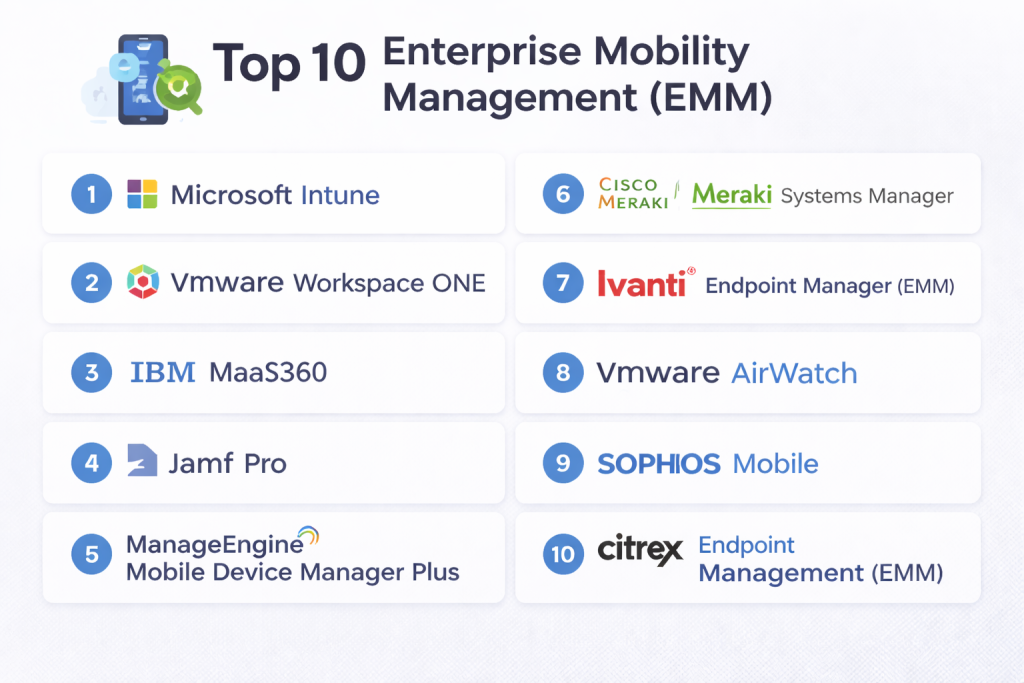
Top 10 Enterprise Mobility Management (EMM) Tools
#1 — Microsoft Intune
Short description
Microsoft Intune provides cloud-based management for mobile devices, apps, and content. It integrates with Azure Active Directory for identity-based policy enforcement and Microsoft 365 for seamless app management, making it ideal for organizations in the Microsoft ecosystem.
Key Features
- Mobile device and application management
- Policy enforcement and compliance
- App deployment and patching
- Remote device management
- Integration with Microsoft 365 and Azure AD
- Reporting and analytics
Pros
- Deep Microsoft ecosystem integration
- Cloud-native and scalable
Cons
- Setup complexity outside Microsoft environments
- Some features require additional licensing
Platforms / Deployment
Windows / macOS / iOS / Android
Cloud
Security & Compliance
MFA, RBAC, encryption; SOC 2, ISO 27001 for Microsoft services
Integrations & Ecosystem
Integrates with Microsoft 365, Azure AD, ITSM, and security platforms.
#2 — VMware Workspace ONE
Short description
Workspace ONE unifies mobile device, app, and content management into a single platform. It supports enrollment, application deployment, policy enforcement, and compliance monitoring for mobile and desktop devices.
Key Features
- Unified device and application management
- Patch deployment and policy enforcement
- Compliance monitoring
- Analytics and reporting
- IoT and mobile content management
Pros
- Comprehensive UEM/EMM capabilities
- Strong hybrid environment support
Cons
- Complex deployment
- Premium pricing
Platforms / Deployment
Windows / macOS / iOS / Android / Linux
Cloud / Hybrid
Security & Compliance
RBAC, encryption; certifications not publicly stated
Integrations & Ecosystem
ITSM, security platforms, APIs
#3 — IBM MaaS360
Short description
IBM MaaS360 is a cloud-based EMM solution with AI-driven analytics. It manages mobile devices, applications, and content, providing compliance, security, and operational insights for enterprises.
Key Features
- Device, app, and content management
- AI-driven threat detection and analytics
- Patch management
- Compliance monitoring
- Reporting dashboards
Pros
- Cloud-native and scalable
- AI insights for security
Cons
- Complexity for advanced configurations
- Learning curve for IT teams
Platforms / Deployment
Windows / macOS / iOS / Android
Cloud
Security & Compliance
MFA, encryption; certifications not publicly stated
Integrations & Ecosystem
ITSM tools, security platforms, APIs
#4 — Jamf Pro
Short description
Jamf Pro specializes in Apple device EMM. It supports macOS and iOS enrollment, app deployment, security policy enforcement, and content management, making it ideal for Apple-heavy organizations.
Key Features
- Apple device enrollment and configuration
- App deployment and patching
- Security and compliance policies
- Mobile content management
- Reporting dashboards
Pros
- Strong Apple ecosystem focus
- Robust compliance and security
Cons
- Limited Windows and Android support
- Higher cost per device
Platforms / Deployment
macOS / iOS
Cloud / Self-hosted
Security & Compliance
RBAC, encryption; certifications not publicly stated
Integrations & Ecosystem
Apple ecosystem integration, ITSM tools, APIs
#5 — ManageEngine Mobile Device Manager Plus
Short description
MDM Plus offers enterprise and SMB EMM capabilities for mobile devices and desktops. It supports app management, patching, compliance, and remote device management across platforms.
Key Features
- Device enrollment and monitoring
- App and patch management
- Compliance enforcement
- Remote troubleshooting
- Reporting and dashboards
Pros
- Affordable and multi-platform support
- Scalable for SMBs and enterprises
Cons
- Advanced enterprise features are limited
- User interface may feel dated
Platforms / Deployment
Windows / macOS / iOS / Android
Cloud / Self-hosted
Security & Compliance
RBAC, encryption; certifications not publicly stated
Integrations & Ecosystem
ITSM tools, security platforms, APIs
#6 — Cisco Meraki Systems Manager
Short description
Meraki Systems Manager provides cloud-based device, app, and content management. It emphasizes remote management, policy enforcement, and analytics for mobile and desktop devices in enterprise environments.
Key Features
- Device and app management
- Policy enforcement
- Compliance monitoring
- Remote troubleshooting
- Reporting dashboards
Pros
- Cloud-native and easy to manage
- Strong for Cisco networked devices
Cons
- Limited enterprise-depth features
- Cisco ecosystem-centric
Platforms / Deployment
Windows / macOS / iOS / Android
Cloud
Security & Compliance
RBAC, encryption; certifications not publicly stated
Integrations & Ecosystem
ITSM tools, Cisco network tools, APIs
#7 — Ivanti Endpoint Manager (EMM)
Short description
Ivanti Endpoint Manager combines EMM with endpoint management, security, and automation. It supports devices across platforms and enforces compliance and policies enterprise-wide.
Key Features
- Device and application management
- Patch deployment
- Security and compliance policies
- Remote troubleshooting
- Reporting and analytics
Pros
- Integrated security and management
- Enterprise scalability
Cons
- Deployment complexity
- Requires trained IT staff
Platforms / Deployment
Windows / macOS / iOS / Android
Cloud / Self-hosted
Security & Compliance
RBAC, encryption; certifications not publicly stated
Integrations & Ecosystem
ITSM tools, security platforms, APIs
#8 — VMware AirWatch
Short description
AirWatch focuses on mobile and desktop device management, integrating EMM and UEM features for enterprise environments. It supports enrollment, security, compliance, and application deployment.
Key Features
- Device enrollment and monitoring
- App deployment and patch management
- Security policy enforcement
- Compliance tracking
- Reporting and dashboards
Pros
- Enterprise-scale EMM
- Strong security features
Cons
- Premium pricing
- Complexity for setup
Platforms / Deployment
iOS / Android / Windows / macOS
Cloud / Hybrid
Security & Compliance
RBAC, encryption; certifications not publicly stated
Integrations & Ecosystem
ITSM, enterprise security platforms, APIs
#9 — Sophos Mobile
Short description
Sophos Mobile manages mobile devices with security, compliance, and policy enforcement. It integrates with the Sophos security suite to protect corporate data on devices.
Key Features
- Device enrollment
- Security and antivirus management
- Policy enforcement
- App deployment
- Reporting dashboards
Pros
- Strong security integration
- Easy endpoint management
Cons
- Limited advanced enterprise features
- Best for Sophos-focused environments
Platforms / Deployment
Windows / macOS / iOS / Android
Cloud / Self-hosted
Security & Compliance
Encryption, RBAC; certifications not publicly stated
Integrations & Ecosystem
ITSM tools, Sophos security suite, APIs
#10 — Citrix Endpoint Management (EMM)
Short description
Citrix Endpoint Management provides device, app, and content management for mobile and desktop endpoints. It integrates with Citrix Workspace to deliver secure enterprise mobility.
Key Features
- Device management
- App deployment
- Patch management
- Security and compliance policies
- Reporting
Pros
- Strong integration with Citrix Workspace
- Secure endpoint management
Cons
- Limited outside Citrix ecosystem
- Premium pricing
Platforms / Deployment
Windows / macOS / iOS / Android
Cloud / Self-hosted
Security & Compliance
RBAC, encryption; certifications not publicly stated
Integrations & Ecosystem
Citrix Workspace, ITSM, security tools
Comparison Table (Top 10 EMM)
| Tool Name | Best For | Platform(s) Supported | Deployment | Standout Feature | Public Rating |
|---|---|---|---|---|---|
| Microsoft Intune | Microsoft ecosystem | Windows/macOS/iOS/Android | Cloud | Azure AD integration | N/A |
| VMware Workspace ONE | Hybrid environments | Windows/macOS/iOS/Android/Linux | Cloud/Hybrid | UEM capabilities | N/A |
| IBM MaaS360 | AI-driven analytics | Windows/macOS/iOS/Android | Cloud | AI insights | N/A |
| Jamf Pro | Apple devices | macOS/iOS | Cloud/Self-hosted | Apple management | N/A |
| ManageEngine MDM Plus | SMB/Enterprise | Windows/macOS/iOS/Android | Cloud/Self-hosted | Multi-platform coverage | N/A |
| Cisco Meraki | Networked mobile devices | Windows/macOS/iOS/Android | Cloud | Cloud device management | N/A |
| Ivanti Endpoint Manager | Enterprise endpoints | Windows/macOS/iOS/Android | Cloud/Self-hosted | Integrated security | N/A |
| VMware AirWatch | Enterprise mobile | iOS/Android/Windows/macOS | Cloud/Hybrid | Enterprise MDM | N/A |
| Sophos Mobile | Security-focused | Windows/macOS/iOS/Android | Cloud/Self-hosted | Security integration | N/A |
| Citrix Endpoint Management | Citrix workspace users | Windows/macOS/iOS/Android | Cloud/Self-hosted | Citrix integration | N/A |
Conclusion
Enterprise Mobility Management tools are essential for managing mobile devices, applications, and corporate data in modern organizations. Microsoft Intune and VMware Workspace ONE provide broad device coverage and cloud-native management, while Jamf Pro specializes in Apple environments. SMBs and mid-market organizations may prefer ManageEngine MDM Plus for affordability and usability. The best tool depends on device types, IT ecosystem, and security/compliance requirements. Organizations should shortlist 2–3 EMM tools, pilot deployments, and validate device coverage, policy enforcement, and reporting before full-scale adoption.
