Introduction
Agile Project Management Tools help teams plan, prioritize, execute, and continuously improve projects using Agile methodologies such as Scrum, Kanban, SAFe, and hybrid Agile frameworks. These platforms are designed for iterative delivery, fast feedback cycles, sprint planning, backlog management, and cross-functional collaboration.
In the business environment, Agile tools are essential because organizations need faster releases, better adaptability, and stronger alignment between product, engineering, design, operations, and leadership teams. Modern Agile platforms now include AI planning assistants, predictive delivery insights, automation, and integrated documentation.
Common Real-World Use Cases
- Sprint planning and backlog management
- Product roadmap execution
- Software release coordination
- Marketing campaign sprints
- DevOps and engineering workflows
- Cross-functional innovation teams
- Continuous improvement programs
What Buyers Should Evaluate
- Scrum and Kanban support
- Sprint planning and backlog tools
- Ease of use for teams
- Reporting and burndown charts
- Automation capabilities
- Integrations with DevOps stack
- Resource and workload visibility
- Security and permissions
- Scalability for enterprises
- Pricing flexibility
Best for: Software teams, product managers, DevOps teams, startups, agile transformation leaders, remote teams, and enterprises managing fast-moving work.
Not ideal for: Teams with highly static waterfall-only projects, solo users needing basic to-do apps, or organizations that need ERP systems instead of Agile execution tools.
Key Trends in Agile Project Management Tools
- AI sprint planning assistants for prioritization and estimates
- Predictive delivery analytics for release confidence
- Integrated DevOps workflows across code to production
- Hybrid Agile + Waterfall support for enterprises
- No-code automations reducing admin effort
- Real-time collaboration hubs replacing fragmented tools
- Portfolio agility dashboards for leadership visibility
- Security-first enterprise controls with SSO and audit logs
- Template-driven Agile onboarding for fast adoption
- Cross-functional product operating systems emerging
How We Selected These Tools (Methodology)
We selected these top tools using:
- Market adoption and industry trust
- Strength of Agile feature set
- Ease of onboarding and daily use
- Reporting and sprint analytics quality
- Integration ecosystem depth
- Security posture signals
- Reliability and performance reputation
- Fit for SMB to enterprise teams
- Innovation in AI and automation
- Long-term relevance in modern Agile delivery
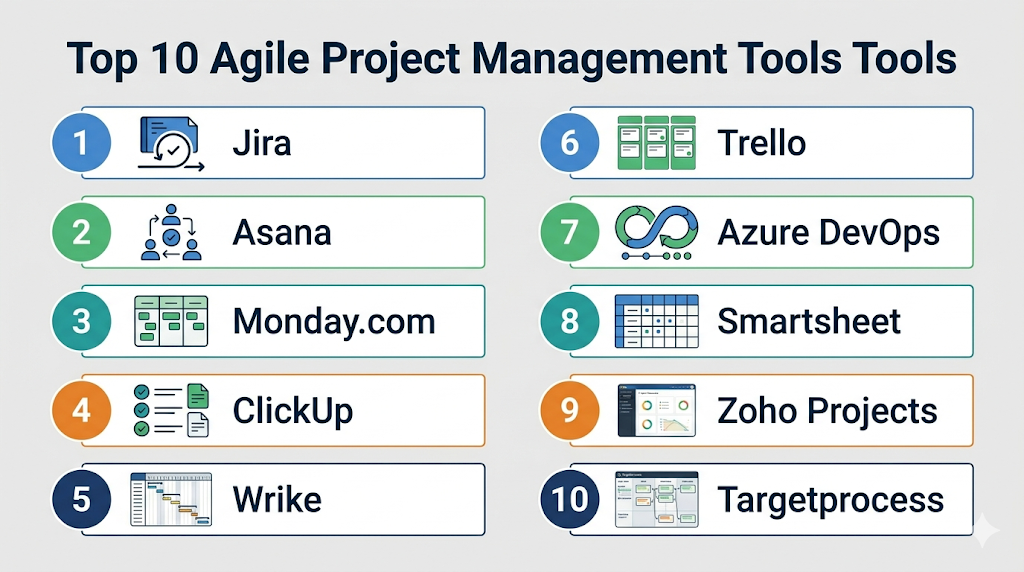
Top 10 Agile Project Management Tools Tools
Standalone Top 10 Tool Names
- Jira
- Asana
- Monday.com
- ClickUp
- Wrike
- Trello
- Azure DevOps
- Smartsheet
- Zoho Projects
- Targetprocess
#1 — Jira
Short description (2–3 lines): Jira is one of the most widely used Agile project management tools for software teams managing Scrum, Kanban, and scaled development workflows.
Key Features
- Scrum boards
- Kanban boards
- Sprint planning
- Backlog management
- Roadmaps
- Burndown reports
- DevOps integrations
Pros
- Best-in-class for engineering teams
- Deep Agile customization
- Huge ecosystem
Cons
- Learning curve for non-technical teams
- Can feel complex initially
Platforms / Deployment
Web / Windows / macOS / iOS / Android
Security & Compliance
SSO/SAML, permissions, audit controls, enterprise governance.
Integrations & Ecosystem
Strong developer ecosystem.
- Bitbucket
- GitHub
- Confluence
- Slack
- CI/CD tools
Support & Community
Massive global community and documentation base.
#2 — Asana
Short description (2–3 lines): Asana offers approachable Agile project management for cross-functional teams needing flexibility beyond engineering. Popular for marketing, product, and operations teams.
Key Features
- Boards and lists
- Timelines
- Sprint templates
- Goals and OKRs
- Workflow automation
- Dashboards
- Dependencies
Pros
- Excellent usability
- Great for mixed departments
- Strong collaboration
Cons
- Advanced Agile depth lower than Jira
- Premium tiers unlock more value
Platforms / Deployment
Web / Windows / macOS / iOS / Android
Security & Compliance
SSO, MFA, RBAC, enterprise controls.
Integrations & Ecosystem
- Slack
- Google Workspace
- Microsoft 365
- Salesforce
- Zapier
Support & Community
Strong onboarding and broad adoption.
#3 — Monday.com
Short description (2–3 lines): Monday.com provides highly visual Agile workflow management with customizable boards and cross-team planning.
Key Features
- Sprint boards
- Workload views
- Dashboards
- Automations
- Forms
- Custom workflows
- Portfolio views
Pros
- Very flexible platform
- Strong dashboards
- Great for hybrid teams
Cons
- Setup requires planning
- Pricing can rise at scale
Platforms / Deployment
Web / Windows / macOS / iOS / Android
Security & Compliance
SSO, permissions, enterprise admin tools.
Integrations & Ecosystem
- Teams
- Slack
- Zoom
- Gmail
- APIs
Support & Community
Strong vendor resources and templates.
#4 — ClickUp
Short description (2–3 lines): ClickUp combines Agile project management, docs, goals, dashboards, and chat in one platform.
Key Features
- Sprint management
- Backlogs
- Docs
- Whiteboards
- Goals
- Automation
- Multiple views
Pros
- Broad feature coverage
- Strong value pricing
- Good all-in-one option
Cons
- Can feel overwhelming
- Requires governance for large teams
Platforms / Deployment
Web / Windows / macOS / iOS / Android
Security & Compliance
Permissions, SSO on higher plans.
Integrations & Ecosystem
- GitHub
- Slack
- Google Drive
- Zoom
- Zapier
Support & Community
Growing user base and templates.
#5 — Wrike
Short description (2–3 lines): Wrike supports Agile execution plus enterprise resource planning and reporting for larger organizations.
Key Features
- Agile boards
- Gantt + Agile hybrid planning
- Resource management
- Request forms
- Reporting
- Automation
- Proofing tools
Pros
- Strong enterprise workflows
- Excellent reporting depth
- Good hybrid planning support
Cons
- More complex than lightweight tools
- Higher plans often preferred
Platforms / Deployment
Web / Windows / macOS / iOS / Android
Security & Compliance
Enterprise permissions, SSO, admin governance.
Integrations & Ecosystem
- Adobe
- Salesforce
- Slack
- Microsoft apps
- APIs
Support & Community
Strong enterprise support tiers.
#6 — Trello
Short description (2–3 lines): Trello is a lightweight Kanban tool ideal for simple Agile workflows, startups, and visual teams.
Key Features
- Kanban boards
- Cards and checklists
- Automation rules
- Templates
- Calendar view
- Comments
- Power-ups
Pros
- Extremely easy to adopt
- Great for lightweight Agile
- Fast setup
Cons
- Limited advanced Scrum depth
- Reporting is basic
Platforms / Deployment
Web / Windows / macOS / iOS / Android
Security & Compliance
Permissions, MFA, enterprise options.
Integrations & Ecosystem
- Jira
- Slack
- Google Drive
- Confluence
Support & Community
Very popular and easy to learn.
#7 — Azure DevOps
Short description (2–3 lines): Azure DevOps combines Agile planning with code repositories, pipelines, and release management for Microsoft-oriented engineering teams.
Key Features
- Boards
- Backlogs
- Repos
- Pipelines
- Test plans
- Dashboards
- Enterprise governance
Pros
- Strong DevOps integration
- Great for Microsoft environments
- Enterprise scalability
Cons
- More technical orientation
- Less friendly for non-dev teams
Platforms / Deployment
Web / Windows / macOS
Security & Compliance
Microsoft enterprise identity and security controls.
Integrations & Ecosystem
- GitHub
- Azure
- Teams
- Microsoft ecosystem
Support & Community
Strong enterprise support ecosystem.
#8 — Smartsheet
Short description (2–3 lines): Smartsheet blends spreadsheet planning with Agile workflows for operations-heavy teams.
Key Features
- Grid views
- Agile boards
- Gantt charts
- Dashboards
- Automation
- Forms
- Reporting
Pros
- Familiar for spreadsheet users
- Strong operational planning
Cons
- Less native Agile feel than Jira
- Pricing can increase with scale
Platforms / Deployment
Web / iOS / Android
Security & Compliance
Enterprise permissions, SSO support.
Integrations & Ecosystem
- Microsoft 365
- Google Workspace
- Slack
- Salesforce
Support & Community
Strong business support presence.
#9 — Zoho Projects
Short description (2–3 lines): Zoho Projects offers affordable Agile planning, milestones, and collaboration for SMBs.
Key Features
- Boards
- Task dependencies
- Time tracking
- Gantt charts
- Reports
- Automation
- Collaboration tools
Pros
- Strong SMB value
- Good feature breadth
Cons
- UI preferences vary
- Less enterprise depth
Platforms / Deployment
Web / iOS / Android
Security & Compliance
Permissions and admin controls vary by plan.
Integrations & Ecosystem
- Zoho apps
- Google Workspace
- Microsoft tools
- APIs
Support & Community
Good SMB support ecosystem.
#10 — Targetprocess
Short description (2–3 lines): Targetprocess focuses on enterprise Agile at scale with SAFe and portfolio planning capabilities.
Key Features
- Portfolio management
- SAFe support
- Sprint planning
- Roadmaps
- Dependencies
- Reporting
- Custom workflows
Pros
- Strong scaled Agile support
- Good for enterprise PMOs
Cons
- Less ideal for small teams
- More specialized setup
Platforms / Deployment
Web / Cloud
Security & Compliance
Varies / Not publicly stated.
Integrations & Ecosystem
- Jira
- DevOps tools
- APIs
Support & Community
Specialized enterprise support model.
Comparison Table (Top 10)
| Tool Name | Best For | Platform(s) Supported | Deployment | Standout Feature | Public Rating |
|---|---|---|---|---|---|
| Jira | Engineering teams | All major platforms | Cloud | Scrum depth | N/A |
| Asana | Cross-functional Agile | All major platforms | Cloud | Ease of use | N/A |
| Monday.com | Hybrid Agile teams | All major platforms | Cloud | Visual workflows | N/A |
| ClickUp | All-in-one teams | All major platforms | Cloud | Feature breadth | N/A |
| Wrike | Enterprises | All major platforms | Cloud | Reporting + hybrid PM | N/A |
| Trello | Lightweight Agile | All major platforms | Cloud | Kanban simplicity | N/A |
| Azure DevOps | DevOps teams | Web/Desktop | Cloud | Code-to-release flow | N/A |
| Smartsheet | Ops teams | Web/Mobile | Cloud | Spreadsheet planning | N/A |
| Zoho Projects | SMBs | Web/Mobile | Cloud | Affordable value | N/A |
| Targetprocess | Scaled Agile | Web | Cloud | SAFe portfolio planning | N/A |
Evaluation & Scoring of Agile Project Management Tools
| Tool Name | Core (25%) | Ease (15%) | Integrations (15%) | Security (10%) | Performance (10%) | Support (10%) | Value (15%) | Weighted Total |
|---|---|---|---|---|---|---|---|---|
| Jira | 10 | 6 | 9 | 9 | 8 | 9 | 8 | 8.45 |
| Asana | 8 | 9 | 9 | 8 | 8 | 9 | 8 | 8.35 |
| Monday.com | 8 | 8 | 8 | 8 | 8 | 8 | 7 | 7.95 |
| ClickUp | 9 | 7 | 8 | 8 | 8 | 8 | 9 | 8.20 |
| Wrike | 8 | 7 | 8 | 8 | 8 | 8 | 7 | 7.75 |
| Trello | 7 | 10 | 8 | 7 | 9 | 8 | 9 | 8.25 |
| Azure DevOps | 9 | 6 | 9 | 9 | 8 | 8 | 8 | 8.15 |
| Smartsheet | 7 | 7 | 8 | 8 | 8 | 8 | 7 | 7.45 |
| Zoho Projects | 7 | 8 | 7 | 7 | 8 | 7 | 9 | 7.65 |
| Targetprocess | 8 | 6 | 7 | 8 | 8 | 7 | 7 | 7.30 |
These scores are comparative, not absolute. Engineering teams often prioritize Jira or Azure DevOps, while business teams may prefer Asana or Monday.com. Adoption matters as much as raw features.
Which Agile Project Management Tools Is Right for You?
Solo / Freelancer
Choose Trello, ClickUp, or Asana.
SMB
Choose ClickUp, Zoho Projects, or Monday.com.
Mid-Market
Choose Asana, Jira, Wrike.
Enterprise
Choose Jira, Azure DevOps, Wrike, Targetprocess.
Budget vs Premium
- Budget-friendly: Trello, Zoho Projects, ClickUp
- Premium: Jira enterprise, Wrike, Monday.com
Feature Depth vs Ease of Use
- Deep features: Jira, Azure DevOps, Targetprocess
- Easy adoption: Trello, Asana, Monday.com
Integrations & Scalability
Choose Jira, Azure DevOps, Asana, ClickUp.
Security & Compliance Needs
Choose enterprise plans from Jira, Azure DevOps, Wrike, Asana.
Frequently Asked Questions (FAQs)
1. What is Agile project management software?
It helps teams run iterative projects using Scrum, Kanban, and similar frameworks.
2. Which tool is best for software development?
Jira remains one of the strongest choices for engineering teams.
3. Is Trello good for Agile?
Yes, especially for lightweight Kanban workflows.
4. Can non-technical teams use Agile tools?
Yes. Asana, Monday.com, and ClickUp work well for business teams.
5. Do these tools support sprint planning?
Most top Agile tools include sprint planning and backlog features.
6. Can they integrate with GitHub?
Many leading tools support GitHub and DevOps integrations.
7. Is free pricing available?
Several vendors offer free plans with limits.
8. Are mobile apps available?
Yes, most leading platforms support iOS and Android apps.
9. What is SAFe support?
It refers to scaled Agile planning for larger organizations.
10. How should I choose a tool?
Select based on team type, workflow complexity, integrations, and budget.
Conclusion
Agile project management tools are now core systems for teams that need speed, adaptability, and continuous delivery. The best platform depends on whether you prioritize engineering depth, business collaboration, enterprise governance, or simplicity. Jira and Azure DevOps lead technical environments, while Asana, ClickUp, and Monday.com excel for cross-functional execution. Trello remains excellent for lightweight Agile adoption. Shortlist two or three tools, test them with a real sprint, validate integrations and reporting, then scale the one your team actually embraces.
