Introduction
GraphQL Tooling refers to the software, platforms, IDEs, gateways, schema management tools, testing utilities, and developer frameworks used to build, manage, secure, and scale GraphQL APIs. Instead of relying only on raw GraphQL servers, modern teams use tooling to improve developer productivity, observability, governance, and API performance.
GraphQL matters even more now because teams are managing multi-platform applications, microservices, mobile apps, AI-driven products, and complex frontend experiences. Businesses need faster data access, better API flexibility, and fewer backend bottlenecks. GraphQL tooling helps teams ship reliable APIs while maintaining governance and security.
Common use cases include:
- Building unified APIs across multiple microservices
- Powering mobile apps with optimized data queries
- Managing federated schemas across teams
- Improving API performance with caching and analytics
- Accelerating frontend development with code generation
Buyers should evaluate:
- Schema management
- Federation support
- Security controls
- Performance optimization
- Developer experience
- Documentation quality
- Integrations
- Monitoring and analytics
- Pricing flexibility
- Scalability
Best for: SaaS companies, product teams, startups, enterprises, API-first organizations, frontend/backend engineering teams, and platform engineering teams.
Not ideal for: Very small static websites, simple CRUD apps, or organizations that only need REST APIs with minimal integration complexity.
Key Trends in GraphQL Tooling
- AI-assisted schema generation and query optimization
- Automated API governance and breaking-change detection
- Stronger zero-trust API security models
- GraphQL federation becoming mainstream for large enterprises
- Edge deployment for faster global query performance
- Low-code integrations with GraphQL backends
- Better observability with real-time tracing dashboards
- Multi-cloud deployment support
- Usage-based pricing replacing fixed-seat models
- Built-in compliance tooling for regulated industries
How We Selected These Tools (Methodology)
- Strong market recognition and developer adoption
- Feature depth across schema, gateway, and runtime needs
- Reliability in production environments
- Performance and scalability signals
- Security and governance capabilities
- Ecosystem maturity and integrations
- Suitability for startups through enterprise buyers
- Documentation and onboarding quality
- Community activity and roadmap momentum
- Balanced mix of commercial and open-source options
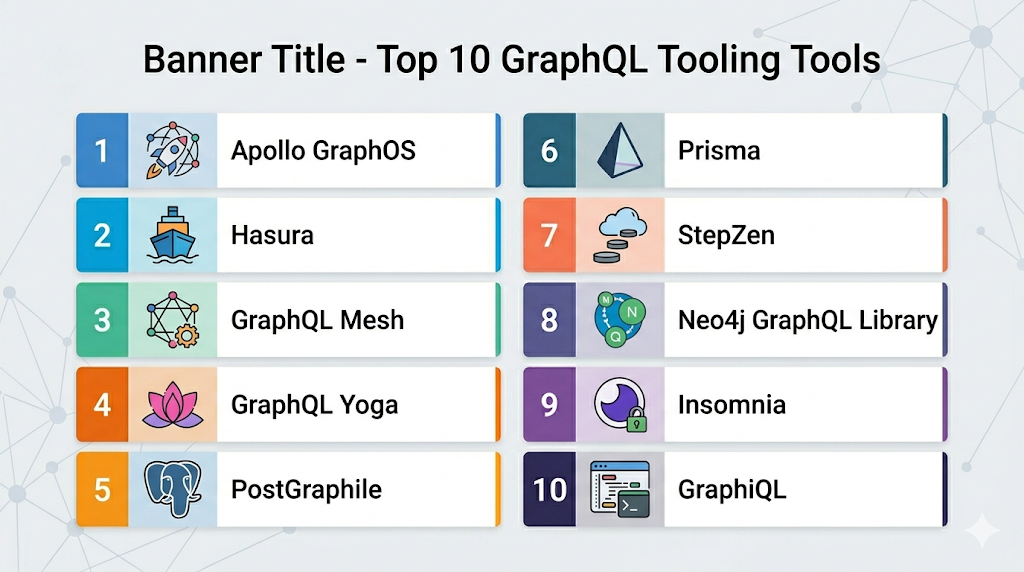
Top 10 GraphQL Tooling Tools
#1 — Apollo GraphOS
Short description (2–3 lines): Apollo GraphOS is one of the most recognized GraphQL platforms for schema management, federation, governance, and observability. Best for growing teams and enterprises.
Key Features
- Apollo Federation support
- Schema registry
- Query analytics
- Performance monitoring
- Managed router
- Contract testing
- Team collaboration tools
Pros
- Industry-leading federation ecosystem
- Excellent documentation
- Strong enterprise readiness
Cons
- Premium features can be expensive
- Learning curve for advanced federation
- Best value often at larger scale
Platforms / Deployment
Cloud / Hybrid
Security & Compliance
SSO/SAML, RBAC, audit controls, encryption. Other certifications vary by plan.
Integrations & Ecosystem
Works well with frontend frameworks, CI/CD pipelines, observability tools, and backend runtimes.
- GitHub
- GitLab
- Kubernetes
- Datadog
- Slack
Support & Community
Very strong community, mature docs, enterprise support available.
#2 — Hasura
Short description (2–3 lines): Hasura is a popular instant GraphQL engine that turns databases into APIs quickly. Ideal for rapid development teams.
Key Features
- Instant GraphQL APIs
- Database connectors
- Role-based access control
- Event triggers
- Actions for custom logic
- Metadata management
- Real-time subscriptions
Pros
- Fast implementation speed
- Great for startups and internal tools
- Strong developer productivity
Cons
- Complex enterprise architectures may need customization
- Deep tuning may require expertise
- Some advanced features depend on plans
Platforms / Deployment
Cloud / Self-hosted / Hybrid
Security & Compliance
RBAC, JWT auth, encryption. Other compliance varies.
Integrations & Ecosystem
Strong database ecosystem and cloud compatibility.
- PostgreSQL
- MySQL
- SQL Server
- AWS
- GCP
- Azure
Support & Community
Strong open-source community and commercial support options.
#3 — GraphQL Mesh
Short description (2–3 lines): GraphQL Mesh converts multiple APIs and data sources into one GraphQL endpoint. Great for integration-heavy teams.
Key Features
- Wrap REST into GraphQL
- Connect SOAP services
- Merge multiple schemas
- Resolver customization
- Schema transforms
- Open-source flexibility
- Developer extensibility
Pros
- Excellent for legacy modernization
- Reduces API fragmentation
- Highly flexible
Cons
- Requires technical setup
- Enterprise support depends on provider
- Can grow complex at scale
Platforms / Deployment
Cloud / Self-hosted
Security & Compliance
Varies / Not publicly stated.
Integrations & Ecosystem
Strong for connecting mixed environments.
- REST APIs
- SOAP
- GraphQL APIs
- Databases
- Serverless platforms
Support & Community
Good open-source ecosystem and technical documentation.
#4 — GraphQL Yoga
Short description (2–3 lines): GraphQL Yoga is a modern GraphQL server focused on performance and developer experience.
Key Features
- Fast server runtime
- Subscriptions support
- File uploads
- Middleware support
- TypeScript friendly
- Edge deployment ready
- Plugin ecosystem
Pros
- Lightweight and modern
- Strong TypeScript experience
- Good performance
Cons
- Less enterprise tooling than platforms
- Requires self-management
- Best for technical teams
Platforms / Deployment
Cloud / Self-hosted
Security & Compliance
Varies / N/A
Integrations & Ecosystem
Works with modern JavaScript stacks.
- Node.js
- Next.js
- Vercel
- Cloudflare Workers
Support & Community
Strong developer community.
#5 — PostGraphile
Short description (2–3 lines): PostGraphile generates GraphQL APIs directly from PostgreSQL schemas. Excellent for Postgres-first teams.
Key Features
- PostgreSQL-first architecture
- Auto-generated schemas
- Plugins
- Smart comments customization
- Security-aware design
- Performance optimized SQL generation
- CLI tooling
Pros
- Great for PostgreSQL users
- Strong performance
- Mature open-source option
Cons
- Best only with PostgreSQL
- Less ideal for multi-source environments
- Advanced custom logic may need effort
Platforms / Deployment
Self-hosted / Cloud
Security & Compliance
Database-level security compatible.
Integrations & Ecosystem
Best for database-centric systems.
- PostgreSQL
- Node.js
- Docker
- Kubernetes
Support & Community
Solid niche community.
#6 — Prisma
Short description (2–3 lines): Prisma is widely used as an ORM and backend data layer that often powers GraphQL APIs.
Key Features
- Type-safe ORM
- Schema migrations
- Developer-friendly queries
- TypeScript support
- Database connectors
- Strong docs
- Performance tooling
Pros
- Excellent developer experience
- Popular in startup ecosystems
- Strong TypeScript workflows
Cons
- Not a full GraphQL platform alone
- Requires additional server layer
- Some advanced scaling needs tuning
Platforms / Deployment
Cloud / Self-hosted
Security & Compliance
Varies / N/A
Integrations & Ecosystem
Commonly used with GraphQL frameworks.
- Apollo Server
- NestJS
- PostgreSQL
- MySQL
- MongoDB
Support & Community
Large active community.
#7 — StepZen
Short description (2–3 lines): StepZen helps developers build GraphQL APIs from REST, databases, and other services quickly.
Key Features
- Schema stitching
- REST to GraphQL conversion
- Managed hosting
- Caching
- Connectors
- Developer workflows
- Fast prototyping
Pros
- Great for rapid integration
- Lower operational overhead
- Useful for API modernization
Cons
- Smaller ecosystem than leaders
- Advanced enterprise needs may vary
- Pricing depends on usage
Platforms / Deployment
Cloud
Security & Compliance
Varies / Not publicly stated.
Integrations & Ecosystem
Useful for connected services.
- REST
- SQL
- SaaS APIs
- Serverless apps
Support & Community
Growing ecosystem.
#8 — Neo4j GraphQL Library
Short description (2–3 lines): Designed for graph databases, Neo4j GraphQL simplifies API creation for connected data models.
Key Features
- Auto-generated GraphQL APIs
- Graph relationship modeling
- Auth support
- Cypher integration
- High-performance graph queries
- Developer tooling
- Schema-first workflows
Pros
- Ideal for relationship-heavy apps
- Powerful search and graph use cases
- Strong Neo4j synergy
Cons
- Best mainly with Neo4j
- Specialized use case focus
- Requires graph database understanding
Platforms / Deployment
Cloud / Self-hosted
Security & Compliance
Varies by Neo4j environment.
Integrations & Ecosystem
Strong in graph data projects.
- Neo4j DB
- Node.js
- Cloud platforms
Support & Community
Good niche ecosystem.
#9 — Insomnia
Short description (2–3 lines): Insomnia is a popular API client with strong GraphQL testing and development capabilities.
Key Features
- GraphQL query testing
- Collections
- Environment variables
- Team collaboration
- Debugging tools
- Plugin support
- Multi-protocol API workflows
Pros
- Great developer productivity
- Useful for testing APIs
- Easy onboarding
Cons
- Not a runtime platform
- Limited governance features
- Primarily developer tooling
Platforms / Deployment
Web / Windows / macOS / Linux
Security & Compliance
Varies by plan.
Integrations & Ecosystem
Works with modern dev pipelines.
- Git
- CI tools
- REST APIs
- GraphQL endpoints
Support & Community
Well-known developer tool.
#10 — GraphiQL
Short description (2–3 lines): GraphiQL is the classic in-browser IDE for exploring and testing GraphQL APIs.
Key Features
- Query editor
- Schema explorer
- Auto-complete
- Docs browser
- Lightweight UI
- Easy embedding
- Open-source
Pros
- Free and familiar
- Great for learning and testing
- Fast setup
Cons
- Limited enterprise features
- Not full lifecycle tooling
- Requires external security controls
Platforms / Deployment
Web
Security & Compliance
N/A
Integrations & Ecosystem
Often embedded into developer portals and servers.
- Apollo
- Express
- Node.js
- Internal tools
Support & Community
Very strong historical community usage.
Comparison Table (Top 10)
| Tool Name | Best For | Platform(s) Supported | Deployment | Standout Feature | Public Rating |
|---|---|---|---|---|---|
| Apollo GraphOS | Enterprise GraphQL | Web | Cloud / Hybrid | Federation | N/A |
| Hasura | Fast API delivery | Web | Cloud / Hybrid | Instant GraphQL APIs | N/A |
| GraphQL Mesh | API unification | Web | Cloud / Self-hosted | Multi-source federation | N/A |
| GraphQL Yoga | Developers | Web | Cloud / Self-hosted | Lightweight server | N/A |
| PostGraphile | PostgreSQL teams | Web | Self-hosted | Postgres-native APIs | N/A |
| Prisma | App backends | Web | Cloud / Self-hosted | Type-safe data layer | N/A |
| StepZen | Integrations | Web | Cloud | REST to GraphQL | N/A |
| Neo4j GraphQL | Graph data apps | Web | Hybrid | Graph database APIs | N/A |
| Insomnia | Testing teams | Desktop/Web | SaaS | API testing | N/A |
| GraphiQL | Learning/testing | Web | Self-hosted | Browser IDE | N/A |
Evaluation & Scoring of GraphQL Tooling
| Tool Name | Core | Ease | Integrations | Security | Performance | Support | Value | Weighted Total |
|---|---|---|---|---|---|---|---|---|
| Apollo GraphOS | 10 | 8 | 10 | 9 | 9 | 9 | 7 | 8.95 |
| Hasura | 9 | 9 | 8 | 8 | 9 | 8 | 8 | 8.55 |
| GraphQL Mesh | 8 | 7 | 9 | 7 | 8 | 7 | 9 | 7.95 |
| GraphQL Yoga | 8 | 8 | 7 | 7 | 9 | 8 | 9 | 8.00 |
| PostGraphile | 8 | 7 | 7 | 8 | 9 | 7 | 9 | 7.95 |
| Prisma | 9 | 9 | 8 | 7 | 8 | 9 | 8 | 8.40 |
| StepZen | 8 | 8 | 8 | 7 | 8 | 7 | 8 | 7.85 |
| Neo4j GraphQL | 8 | 7 | 7 | 7 | 8 | 7 | 7 | 7.45 |
| Insomnia | 7 | 9 | 7 | 6 | 7 | 8 | 9 | 7.70 |
| GraphiQL | 6 | 9 | 6 | 5 | 7 | 8 | 10 | 7.10 |
These scores are comparative, not absolute. Higher totals usually indicate stronger all-around platforms. Lower totals may still be the best fit for niche use cases. Buyers should prioritize weighted categories based on their own needs. For example, startups may prioritize value and ease, while enterprises may prioritize governance and security.
Which GraphQL Tooling Tool Is Right for You?
Solo / Freelancer
Use GraphiQL, Insomnia, Prisma, or GraphQL Yoga for affordable and fast workflows.
SMB
Hasura and Prisma are strong for rapid delivery with smaller engineering teams.
Mid-Market
Apollo GraphOS, Hasura, and GraphQL Mesh offer stronger scaling paths.
Enterprise
Apollo GraphOS is the strongest enterprise-first choice. Hasura also fits many enterprise environments.
Budget vs Premium
Budget-friendly: GraphiQL, Yoga, Mesh, Prisma open-source flows.
Premium: Apollo GraphOS managed enterprise stack.
Feature Depth vs Ease of Use
Ease of use: Hasura, Prisma, Insomnia.
Feature depth: Apollo GraphOS, Mesh.
Integrations & Scalability
Mesh and StepZen shine in integration-heavy environments.
Security & Compliance Needs
Apollo GraphOS and Hasura are stronger options for governance-focused teams.
Frequently Asked Questions (FAQs)
What is GraphQL tooling?
GraphQL tooling includes platforms and utilities that help build, manage, test, secure, and scale GraphQL APIs.
Is GraphQL better than REST?
Not always. GraphQL is better for flexible client data needs, while REST can be simpler for basic services.
Which tool is best for beginners?
GraphiQL, Insomnia, and Hasura are beginner-friendly starting points.
Which tool is best for enterprises?
Apollo GraphOS is widely considered a leading enterprise option.
Is GraphQL expensive?
It depends. Many open-source tools are free, while enterprise platforms charge for advanced features.
Can I convert REST APIs into GraphQL?
Yes. Tools like GraphQL Mesh and StepZen help expose REST services as GraphQL.
Is GraphQL secure?
Yes, if implemented correctly with auth, rate limiting, query controls, and monitoring.
Which tool is best for PostgreSQL?
PostGraphile and Prisma are strong options for PostgreSQL teams.
How hard is migration to GraphQL?
Moderate. Complexity depends on data models, auth systems, and legacy APIs.
Do startups need enterprise tooling?
Usually not at first. Startups often benefit more from speed, ease, and lower cost tools.
Conclusion
GraphQL tooling has matured into a strategic layer for modern software delivery. The best option depends on whether you need speed, federation, integrations, database-first development, or enterprise governance. Apollo GraphOS leads for large-scale environments, while Hasura, Prisma, and Mesh are strong practical alternatives. Smaller teams may prefer lightweight tools such as Yoga, Insomnia, or GraphiQL. Start by shortlisting two or three tools, run a pilot project, and validate integrations, security, and long-term scalability before committing.
