Introduction
API Management Platforms help organizations create, secure, publish, monitor, and scale APIs from a centralized environment. These platforms are essential for businesses that rely on digital services, mobile apps, SaaS integrations, partner ecosystems, and microservices architectures. They simplify how APIs are exposed internally and externally while improving governance and performance.
As enterprises accelerate cloud adoption and connected services, API management has become a strategic requirement. Teams now need stronger security controls, analytics visibility, developer self-service portals, lifecycle automation, and multi-cloud support. Modern platforms also include AI-assisted monitoring, traffic intelligence, and policy automation to improve reliability.
Common use cases include:
- Managing public and private APIs
- Partner and developer portal programs
- Microservices traffic governance
- API monetization strategies
- Internal service integrations
- Security and rate limiting for APIs
What buyers should evaluate:
- Security controls and authentication support
- Gateway performance and scalability
- Developer portal quality
- Analytics and monitoring depth
- Multi-cloud / hybrid deployment support
- Ease of policy management
- Integration ecosystem
- Pricing model and licensing flexibility
- Support quality and enterprise readiness
Best for: Enterprises, SaaS companies, fintech, telecom, healthcare, retail, and technology teams managing multiple APIs at scale.
Not ideal for: Very small teams with only a few internal APIs that can be managed through lightweight gateways or direct cloud-native services.
Key Trends in API Management Platforms
- AI-driven anomaly detection and traffic insights
- API security posture management growth
- GraphQL and event-driven API support
- Multi-cloud and hybrid governance becoming standard
- Usage-based pricing expansion
- Low-code API workflow creation
- Stronger zero-trust access controls
- Developer experience becoming a buying priority
- Deeper observability integrations
- API monetization tools improving rapidly
How We Selected These Tools (Methodology)
- Market presence and brand credibility
- Feature completeness across lifecycle management
- Gateway performance and reliability signals
- Security posture and access controls
- Integration breadth and extensibility
- Fit for SMB to enterprise segments
- Documentation and community quality
- Innovation pace and roadmap relevance
- Operational simplicity and manageability
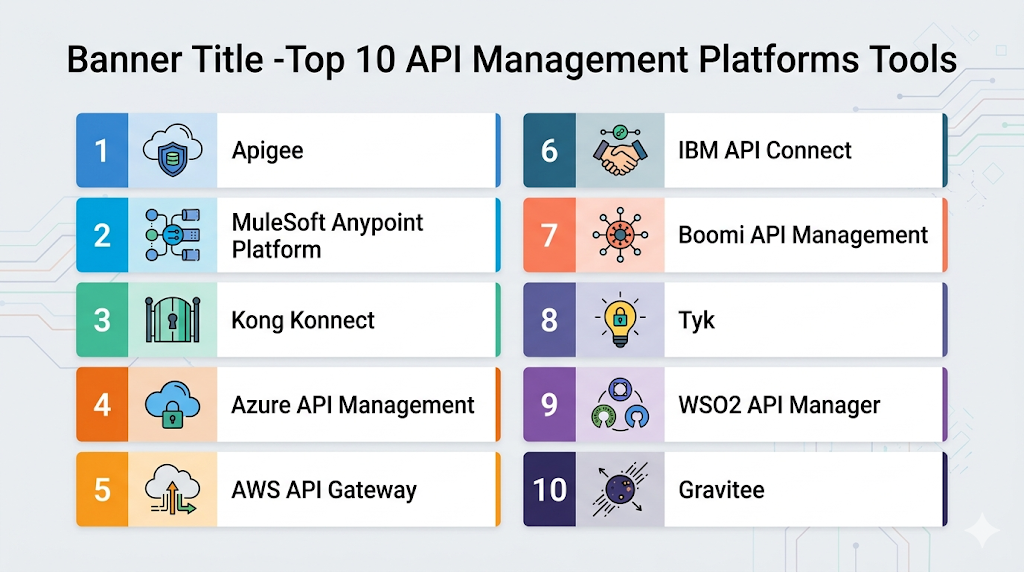
Top 10 API Management Platforms Tools
#1 — Apigee
Short description: Enterprise-grade API management platform widely used for securing, publishing, and analyzing APIs. Strong choice for large organizations and digital ecosystems.
Key Features
- Full API lifecycle management
- Advanced traffic management
- Developer portal capabilities
- Analytics dashboards
- Monetization options
- Multi-cloud deployment support
Pros
- Mature enterprise feature set
- Strong analytics and governance
- Good scalability
Cons
- Premium pricing
- Can be complex to implement
Platforms / Deployment
Cloud / Hybrid
Security & Compliance
SSO/SAML, RBAC, encryption, audit controls. Other certifications vary by deployment.
Integrations & Ecosystem
Broad enterprise ecosystem with cloud and backend integrations.
- CI/CD pipelines
- Identity providers
- Monitoring tools
- Databases
- Google Cloud services
Support & Community
Strong enterprise support, mature documentation, large user base.
#2 — MuleSoft Anypoint Platform
Short description: Unified integration and API platform focused on connecting applications, data, and APIs at enterprise scale.
Key Features
- API design and governance
- Integration connectors library
- Developer portal
- Monitoring and analytics
- Reusable assets exchange
- Hybrid deployment models
Pros
- Excellent integration capabilities
- Strong enterprise governance
- Large connector ecosystem
Cons
- High licensing cost
- Requires skilled administrators
Platforms / Deployment
Cloud / Self-hosted / Hybrid
Security & Compliance
SSO, RBAC, encryption, audit logging. Other compliance varies.
Integrations & Ecosystem
Known for broad enterprise system connectivity.
- ERP systems
- CRM systems
- Databases
- Messaging systems
- SaaS apps
Support & Community
Strong vendor support and active enterprise community.
#3 — Kong Konnect
Short description: Popular modern API gateway and management platform built for cloud-native and microservices environments.
Key Features
- High-performance gateway
- Plugin architecture
- API analytics
- Developer portal
- Service mesh support
- Multi-cloud controls
Pros
- Strong performance
- Flexible extensibility
- Good for Kubernetes environments
Cons
- Advanced setups need expertise
- Some enterprise features premium-tiered
Platforms / Deployment
Cloud / Self-hosted / Hybrid
Security & Compliance
MFA, RBAC, TLS, logging. Other certifications vary.
Integrations & Ecosystem
Strong DevOps and cloud-native ecosystem.
- Kubernetes
- CI/CD tools
- Observability platforms
- Identity providers
Support & Community
Strong open-source community plus commercial support.
#4 — Azure API Management
Short description: Microsoft’s managed API platform ideal for organizations invested in Azure ecosystems.
Key Features
- API gateway
- Developer portal
- Policy engine
- Monitoring integration
- Versioning and revisions
- Hybrid gateway options
Pros
- Seamless Azure integration
- Strong security controls
- Good enterprise fit
Cons
- Best value inside Azure ecosystem
- Pricing tiers can be confusing
Platforms / Deployment
Cloud / Hybrid
Security & Compliance
SSO, Azure identity controls, RBAC, encryption, audit features.
Integrations & Ecosystem
Strong native Microsoft ecosystem alignment.
- Azure services
- Power Platform
- DevOps pipelines
- Identity services
Support & Community
Strong documentation and enterprise support.
#5 — AWS API Gateway
Short description: Managed API service for REST, HTTP, and event-driven workloads tightly integrated with AWS.
Key Features
- Managed API gateway
- Serverless integrations
- Usage plans
- Rate limiting
- Monitoring integration
- IAM-based security controls
Pros
- Strong AWS-native experience
- Scalable pay-as-you-go model
- Good for serverless apps
Cons
- Best suited for AWS users
- Complex pricing at scale
Platforms / Deployment
Cloud
Security & Compliance
IAM, encryption, logging, access policies.
Integrations & Ecosystem
Excellent for AWS workloads.
- Lambda
- CloudWatch
- Cognito
- Databases
- Event services
Support & Community
Large community and broad documentation.
#6 — IBM API Connect
Short description: Enterprise API management platform with governance, security, and hybrid deployment strengths.
Key Features
- API lifecycle management
- Gateway controls
- Analytics
- Developer portal
- Security policies
- Hybrid support
Pros
- Strong governance features
- Good for regulated industries
Cons
- Can be resource-intensive
- Enterprise pricing model
Platforms / Deployment
Cloud / Self-hosted / Hybrid
Security & Compliance
SSO, RBAC, encryption, audit logs.
Integrations & Ecosystem
Good enterprise systems connectivity.
- Mainframes
- Middleware
- Databases
- Monitoring tools
Support & Community
Enterprise-focused support model.
#7 — Boomi API Management
Short description: API management layer integrated with Boomi’s broader integration platform.
Key Features
- API gateway
- Policy management
- Monitoring
- Lifecycle tools
- Integration workflows
- Developer access controls
Pros
- Good for integration-led organizations
- Easier than some enterprise suites
Cons
- Best value with broader Boomi stack
- Less mindshare than top-tier leaders
Platforms / Deployment
Cloud / Hybrid
Security & Compliance
RBAC, encryption, logging. Other details vary.
Integrations & Ecosystem
Strong iPaaS-style integrations.
- SaaS apps
- Databases
- ERP systems
- Workflow tools
Support & Community
Solid commercial support.
#8 — Tyk
Short description: Flexible API management platform popular with teams needing self-hosted and open deployment options.
Key Features
- API gateway
- Developer portal
- Analytics
- Rate limiting
- Identity integrations
- Self-hosted flexibility
Pros
- Strong deployment flexibility
- Good for privacy-conscious teams
Cons
- Smaller ecosystem than largest vendors
- Some advanced features require paid tiers
Platforms / Deployment
Cloud / Self-hosted / Hybrid
Security & Compliance
SSO, RBAC, encryption support.
Integrations & Ecosystem
Works well in modern infrastructure stacks.
- Kubernetes
- Identity providers
- CI/CD tools
- Logging systems
Support & Community
Growing community and commercial support.
#9 — WSO2 API Manager
Short description: Well-known API management platform with strong open-source roots and enterprise capabilities.
Key Features
- API gateway
- Publisher portal
- Analytics
- Access control policies
- Identity integrations
- Hybrid deployment support
Pros
- Strong feature depth
- Flexible deployment models
Cons
- Administration can be complex
- UI preferences vary by user
Platforms / Deployment
Cloud / Self-hosted / Hybrid
Security & Compliance
SSO, RBAC, encryption, audit support.
Integrations & Ecosystem
Good extensibility for technical teams.
- Identity tools
- Databases
- Containers
- Monitoring systems
Support & Community
Established technical community.
#10 — Gravitee
Short description: Modern API management platform emphasizing event-native APIs and flexible governance.
Key Features
- API gateway
- Event streaming support
- Developer portal
- Security policies
- Analytics
- Multi-environment management
Pros
- Strong modern architecture support
- Good developer experience
Cons
- Smaller market footprint
- Some enterprise depth depends on plan
Platforms / Deployment
Cloud / Self-hosted / Hybrid
Security & Compliance
RBAC, encryption, access policies.
Integrations & Ecosystem
Modern infrastructure integrations.
- Kafka ecosystems
- Kubernetes
- Identity systems
- Monitoring tools
Support & Community
Growing ecosystem with commercial backing.
Comparison Table (Top 10)
| Tool Name | Best For | Platform(s) Supported | Deployment | Standout Feature | Public Rating |
|---|---|---|---|---|---|
| Apigee | Large enterprises | Multi-platform | Cloud/Hybrid | Strong analytics | N/A |
| MuleSoft | Enterprise integrations | Multi-platform | Hybrid | Connector ecosystem | N/A |
| Kong Konnect | Cloud-native teams | Multi-platform | Hybrid | High-performance gateway | N/A |
| Azure API Management | Microsoft shops | Multi-platform | Cloud/Hybrid | Azure alignment | N/A |
| AWS API Gateway | AWS workloads | Multi-platform | Cloud | Serverless integration | N/A |
| IBM API Connect | Regulated sectors | Multi-platform | Hybrid | Governance depth | N/A |
| Boomi | Integration-led teams | Multi-platform | Hybrid | Unified integration + APIs | N/A |
| Tyk | Flexible hosting needs | Multi-platform | Hybrid | Self-hosted strength | N/A |
| WSO2 API Manager | Technical enterprises | Multi-platform | Hybrid | Open architecture | N/A |
| Gravitee | Event-driven teams | Multi-platform | Hybrid | Event-native support | N/A |
Evaluation & Scoring of API Management Platforms
| Tool Name | Core (25%) | Ease (15%) | Integrations (15%) | Security (10%) | Performance (10%) | Support (10%) | Value (15%) | Weighted Total |
|---|---|---|---|---|---|---|---|---|
| Apigee | 9 | 7 | 9 | 9 | 9 | 9 | 6 | 8.3 |
| MuleSoft | 9 | 7 | 10 | 9 | 8 | 9 | 5 | 8.1 |
| Kong Konnect | 9 | 8 | 8 | 8 | 9 | 8 | 8 | 8.4 |
| Azure API Management | 8 | 8 | 8 | 9 | 8 | 8 | 7 | 8.0 |
| AWS API Gateway | 8 | 7 | 8 | 9 | 9 | 8 | 8 | 8.1 |
| IBM API Connect | 8 | 6 | 8 | 9 | 8 | 8 | 6 | 7.6 |
| Boomi | 8 | 8 | 8 | 8 | 8 | 8 | 7 | 7.9 |
| Tyk | 8 | 7 | 7 | 8 | 8 | 7 | 8 | 7.7 |
| WSO2 API Manager | 8 | 6 | 8 | 8 | 8 | 7 | 8 | 7.6 |
| Gravitee | 8 | 7 | 7 | 8 | 8 | 7 | 8 | 7.7 |
These scores are comparative rather than absolute. A higher total suggests a balanced platform across multiple categories. Some buyers may prioritize integrations, while others care most about price or governance. Use the table to narrow options based on your priorities rather than selecting only the top score.
Which API Management Platform Is Right for You?
Solo / Freelancer
Choose lightweight cloud-native options like AWS API Gateway if already using AWS, or Tyk for flexibility.
SMB
Boomi, Kong Konnect, and Azure API Management provide strong features without the heaviest enterprise complexity.
Mid-Market
Kong Konnect, Azure API Management, and Apigee are strong choices for growth-stage governance.
Enterprise
Apigee, MuleSoft, IBM API Connect, and Azure API Management are strong enterprise candidates.
Budget vs Premium
- Budget-conscious: Tyk, WSO2 API Manager
- Premium enterprise: Apigee, MuleSoft, IBM API Connect
Feature Depth vs Ease of Use
- Deep feature sets: Apigee, MuleSoft, IBM
- Easier operations: Kong, Azure, AWS
Integrations & Scalability
- Best integrations: MuleSoft, Boomi, Azure
- Best scalability: Apigee, Kong, AWS
Security & Compliance Needs
- High-control environments: IBM, Apigee, Azure
- Modern secure defaults: Kong, AWS
Frequently Asked Questions (FAQs)
1. What is an API Management Platform?
It is software that helps organizations publish, secure, monitor, version, and scale APIs from a centralized control layer.
2. Do small businesses need API management?
Not always. Small teams with only a few APIs may use simpler gateways, but growth often increases the need quickly.
3. What is the difference between API gateway and API management?
A gateway handles traffic routing and policies, while API management includes lifecycle tools, analytics, portals, and governance.
4. Are cloud API platforms secure?
Many are highly secure when configured properly with authentication, encryption, logging, and least-privilege access.
5. Can these platforms support hybrid environments?
Yes, many leading vendors support cloud plus on-premise or multi-cloud deployments.
6. How do pricing models usually work?
Pricing may be based on API calls, environments, gateways, users, or enterprise licensing tiers.
7. What common mistake do buyers make?
Choosing only on price while underestimating governance, support, or scaling requirements.
8. Can I migrate later to another platform?
Yes, but policy models, integrations, and developer portals can make migration complex.
9. Do API management tools help with monetization?
Some platforms include plans, quotas, subscriptions, and billing support for commercial APIs.
10. What are alternatives to full API management suites?
Reverse proxies, lightweight gateways, service meshes, and cloud-native gateway services may work for simpler use cases.
Conclusion
API Management Platforms are now core infrastructure for modern digital businesses. They help teams secure services, streamline integrations, improve developer experience, and scale reliably across growing ecosystems. The right platform depends on your cloud strategy, budget, compliance requirements, and operational maturity. Enterprises may prefer governance-heavy suites, while fast-moving engineering teams may choose cloud-native or flexible options. Instead of chasing a universal winner, shortlist two or three platforms that align with your architecture and team skills. Run a focused pilot, validate integrations, review security controls, and test real traffic scenarios before committing long term.
