Introduction
Enterprise Search Platforms are advanced solutions that enable organizations to search, discover, and retrieve information from multiple internal and external data sources such as documents, emails, cloud apps, databases, and collaboration tools. Unlike traditional search systems, enterprise search unifies structured and unstructured data into a single intelligent search experience.
In today’s data-driven organizations, employees spend a significant amount of time searching for information across disconnected systems. Enterprise search platforms solve this problem by providing fast, AI-powered, and context-aware search results, improving productivity and decision-making across teams.
Common use cases include:
- Internal knowledge discovery across tools
- Customer support and help desk search
- Enterprise document retrieval
- E-commerce and product search optimization
- AI-powered assistants and workflows
What buyers should evaluate:
- Search relevance and accuracy
- AI and natural language processing capabilities
- Data connectors and integrations
- Security and access control
- Scalability and indexing performance
- Customization and APIs
- Deployment flexibility
- Analytics and insights
Best for: Mid-market and enterprise organizations, IT teams, and data-driven businesses with complex information systems.
Not ideal for: Small teams with limited data sources or basic document search needs.
Key Trends in Enterprise Search Platforms for the Future
- AI-powered semantic and vector search
- Conversational search interfaces (chat-style queries)
- Retrieval-Augmented Generation (RAG) architectures
- Knowledge graphs for contextual search
- Personalized results based on user roles
- Real-time indexing and streaming data
- API-first and composable architectures
- Integration with AI copilots and assistants
- Zero Trust security models
- Automation driven by search insights
How We Selected These Tools (Methodology)
- Evaluated market adoption and enterprise usage
- Assessed AI and semantic search capabilities
- Compared integration ecosystems
- Reviewed scalability and performance
- Considered security and governance features
- Analyzed developer flexibility and APIs
- Checked usability for both technical and non-technical users
- Included open-source, cloud-native, and enterprise solutions
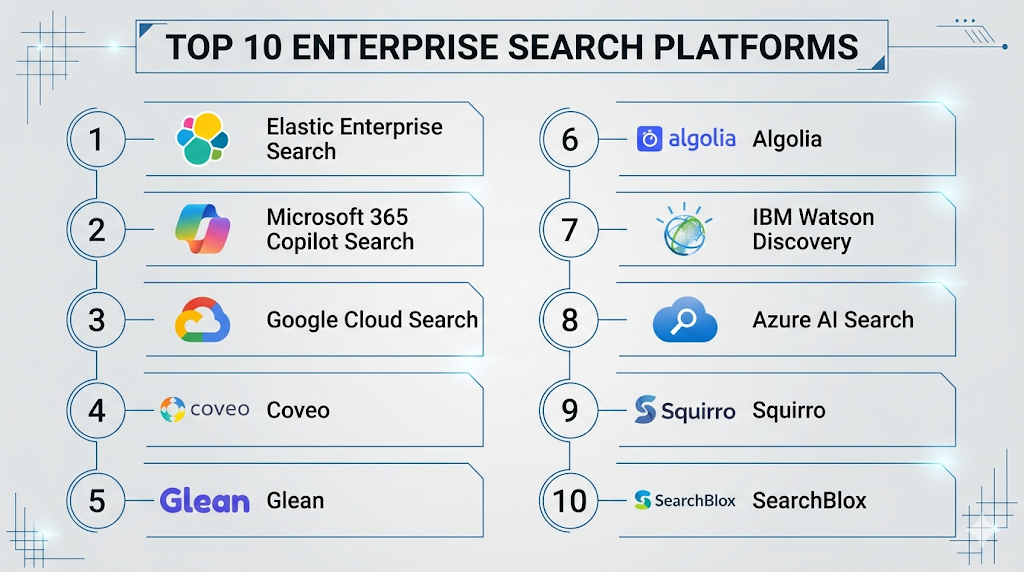
Top 10 Enterprise Search Platforms
#1 — Elastic Enterprise Search
Short description: Developer-focused search platform built on Elasticsearch, offering scalable and customizable enterprise search.
Key Features
- Full-text and vector search
- Real-time indexing
- Custom relevance tuning
- REST APIs and SDKs
- Analytics dashboards
- Workplace search capabilities
- Open-source foundation
Pros
- Highly scalable
- Flexible customization
Cons
- Requires technical expertise
- Setup complexity
Platforms / Deployment
Cloud / Self-hosted
Security & Compliance
RBAC, encryption (other details not publicly stated)
Integrations & Ecosystem
Extensive integrations via APIs and connectors.
- REST APIs
- Data connectors
- Elasticsearch ecosystem
Support & Community
Large developer community with strong documentation.
#2 — Microsoft 365 Copilot Search
Short description: AI-powered enterprise search integrated across Microsoft 365 applications.
Key Features
- AI-driven search results
- Natural language queries
- Context-aware recommendations
- Cross-app search (Teams, Outlook, SharePoint)
- Security trimming
- Copilot AI integration
- Microsoft Graph connectivity
Pros
- Seamless Microsoft integration
- Strong AI capabilities
Cons
- Limited outside Microsoft ecosystem
- Licensing complexity
Platforms / Deployment
Cloud
Security & Compliance
SSO, RBAC, enterprise-grade controls (details not publicly stated)
Integrations & Ecosystem
Deep integration within Microsoft ecosystem.
- Teams
- SharePoint
- Outlook
- APIs
Support & Community
Enterprise-level support.
#3 — Google Cloud Search
Short description: Enterprise search platform designed for Google Workspace environments.
Key Features
- Unified search across Google apps
- AI-powered suggestions
- Natural language queries
- Contextual search results
- Access control integration
- Real-time indexing
- Mobile support
Pros
- Familiar user experience
- Strong Workspace integration
Cons
- Limited external integrations
- Best suited for Google users
Platforms / Deployment
Cloud
Security & Compliance
Enterprise-grade controls (details not publicly stated)
Integrations & Ecosystem
Google Workspace integrations.
- Gmail
- Drive
- Docs
- Calendar
Support & Community
Strong enterprise support.
#4 — Coveo
Short description: AI-powered enterprise search platform focused on personalization and relevance.
Key Features
- AI relevance tuning
- Personalization engine
- Search analytics
- Machine learning models
- Omnichannel search
- Recommendations engine
- API-first architecture
Pros
- Advanced AI relevance
- Strong enterprise performance
Cons
- High cost
- Requires tuning
Platforms / Deployment
Cloud
Security & Compliance
Enterprise-grade controls (not publicly stated)
Integrations & Ecosystem
Wide enterprise integrations.
- CRM systems
- E-commerce platforms
- APIs
Support & Community
Enterprise-level support.
#5 — Glean
Short description: AI-powered workplace search platform for unified knowledge discovery.
Key Features
- Knowledge graph
- Personalized search results
- AI summaries
- Context-aware recommendations
- Role-based access
- Workflow automation
- 100+ integrations
Pros
- Fast deployment
- Strong AI personalization
Cons
- Limited customization
- Premium pricing
Platforms / Deployment
Cloud
Security & Compliance
RBAC, enterprise controls (details not publicly stated)
Integrations & Ecosystem
Extensive SaaS integrations.
- Slack
- Google Workspace
- Microsoft tools
- APIs
Support & Community
Growing enterprise adoption.
#6 — Algolia
Short description: Fast, developer-friendly search platform for apps and websites.
Key Features
- Instant search APIs
- AI relevance tuning
- Analytics
- Personalization
- Multi-language support
- UI components
- Scalable infrastructure
Pros
- Extremely fast
- Easy integration
Cons
- Pricing at scale
- Not full enterprise suite
Platforms / Deployment
Cloud
Security & Compliance
API security (other details not publicly stated)
Integrations & Ecosystem
Developer-focused ecosystem.
- APIs
- SDKs
- Frontend libraries
Support & Community
Strong developer community.
#7 — IBM Watson Discovery
Short description: AI-driven search and analytics platform using NLP for deep insights.
Key Features
- Natural language processing
- Document understanding
- AI insights extraction
- Knowledge graphs
- Data enrichment
- Search analytics
- Custom models
Pros
- Powerful AI capabilities
- Suitable for regulated industries
Cons
- Complex implementation
- Expensive
Platforms / Deployment
Cloud
Security & Compliance
Enterprise-grade governance (details not publicly stated)
Integrations & Ecosystem
IBM ecosystem integrations.
- APIs
- Data sources
- AI tools
Support & Community
Enterprise support.
#8 — Azure AI Search
Short description: Cloud-native enterprise search platform with AI enrichment capabilities.
Key Features
- AI enrichment pipelines
- Full-text and vector search
- Indexing services
- Scalability
- Integration with Azure services
- Security controls
- Data ingestion pipelines
Pros
- Strong cloud integration
- Scalable performance
Cons
- Azure dependency
- Learning curve
Platforms / Deployment
Cloud
Security & Compliance
Enterprise-grade Azure security
Integrations & Ecosystem
Azure ecosystem integrations.
- APIs
- AI services
- Data platforms
Support & Community
Strong Microsoft support.
#9 — Squirro
Short description: AI-driven enterprise search and insights platform for analytics-driven organizations.
Key Features
- Cognitive search
- Knowledge graphs
- AI insights
- Data integration
- NLP capabilities
- Dashboards
- Automation
Pros
- Strong analytics
- AI-driven insights
Cons
- Complex implementation
- Enterprise-focused
Platforms / Deployment
Cloud / Hybrid
Security & Compliance
Enterprise controls (not publicly stated)
Integrations & Ecosystem
Enterprise integrations.
- APIs
- Data platforms
Support & Community
Enterprise support.
#10 — SearchBlox
Short description: Enterprise search platform focused on indexing structured and unstructured data.
Key Features
- Content crawling
- Real-time indexing
- Advanced filtering
- Multi-language support
- Analytics
- Search customization
- Faceted navigation
Pros
- Easy deployment
- Strong indexing capabilities
Cons
- Limited AI features
- Smaller ecosystem
Platforms / Deployment
Cloud / On-premise
Security & Compliance
RBAC, authentication (other details not publicly stated)
Integrations & Ecosystem
Moderate integrations.
- APIs
- Data connectors
Support & Community
Moderate community.
Comparison Table (Top 10)
| Tool Name | Best For | Platform(s) Supported | Deployment | Standout Feature | Public Rating |
|---|---|---|---|---|---|
| Elastic Enterprise Search | Developers | Web | Cloud/Self-hosted | Open-source scalability | N/A |
| Microsoft 365 Copilot Search | Microsoft users | Web | Cloud | AI + ecosystem integration | N/A |
| Google Cloud Search | Google Workspace | Web | Cloud | Unified search | N/A |
| Coveo | Enterprises | Web | Cloud | AI personalization | N/A |
| Glean | Workplace search | Web | Cloud | Knowledge graph AI | N/A |
| Algolia | Developers | Web | Cloud | Fast APIs | N/A |
| IBM Watson Discovery | Regulated industries | Web | Cloud | NLP insights | N/A |
| Azure AI Search | Cloud users | Web | Cloud | AI enrichment | N/A |
| Squirro | Analytics-driven orgs | Web | Cloud/Hybrid | Cognitive search | N/A |
| SearchBlox | SMB/Enterprise | Web | Cloud/On-premise | Data indexing | N/A |
Evaluation & Scoring of Enterprise Search Platforms
| Tool Name | Core (25%) | Ease (15%) | Integrations (15%) | Security (10%) | Performance (10%) | Support (10%) | Value (15%) | Weighted Total |
|---|---|---|---|---|---|---|---|---|
| Elastic Enterprise Search | 9 | 6 | 9 | 8 | 9 | 8 | 7 | 8.2 |
| Microsoft 365 Copilot Search | 9 | 8 | 9 | 9 | 9 | 8 | 6 | 8.5 |
| Google Cloud Search | 8 | 8 | 7 | 8 | 8 | 8 | 7 | 7.9 |
| Coveo | 9 | 6 | 9 | 8 | 9 | 8 | 6 | 8.2 |
| Glean | 8 | 8 | 9 | 8 | 8 | 8 | 7 | 8.1 |
| Algolia | 8 | 9 | 8 | 7 | 9 | 7 | 7 | 8.0 |
| IBM Watson Discovery | 9 | 6 | 8 | 9 | 8 | 8 | 6 | 8.1 |
| Azure AI Search | 9 | 7 | 9 | 9 | 9 | 8 | 6 | 8.3 |
| Squirro | 8 | 6 | 8 | 8 | 8 | 7 | 6 | 7.7 |
| SearchBlox | 7 | 7 | 7 | 7 | 7 | 7 | 8 | 7.3 |
Interpretation:
Scores reflect relative strengths across features, usability, and value. Enterprise tools score higher in integrations and security, while simpler tools perform better in ease of use and cost efficiency. Always choose based on your organization’s ecosystem and data complexity.
Which Enterprise Search Platform Is Right for You?
Solo / Freelancer
- Not recommended
- Use basic search tools instead
SMB
- Best: SearchBlox, Algolia
- Focus on simplicity and cost
Mid-Market
- Best: Glean, Azure AI Search
- Balanced AI and integrations
Enterprise
- Best: Elastic, Coveo, Microsoft, IBM
- High scalability and security
Budget vs Premium
- Budget: SearchBlox, Elastic
- Premium: Coveo, IBM, Microsoft
Feature Depth vs Ease of Use
- Feature-heavy: Elastic, IBM
- Easy-to-use: Glean, Algolia
Integrations & Scalability
- Strong: Microsoft, Elastic, Azure
- Moderate: SearchBlox
Security & Compliance Needs
- Enterprise-grade: Microsoft, IBM, Azure
- Basic: Algolia, SearchBlox
Frequently Asked Questions (FAQs)
What is enterprise search?
Enterprise search is a system that allows organizations to search across all internal data sources from a single interface.
How does enterprise search work?
It indexes data from multiple systems and retrieves relevant results using AI and search algorithms.
What is AI in enterprise search?
AI improves search accuracy, personalization, and natural language understanding.
Is enterprise search necessary?
It is essential for organizations managing large volumes of data across multiple platforms.
What are the benefits of enterprise search?
Faster information retrieval, improved productivity, and better decision-making.
Can enterprise search integrate with SaaS tools?
Yes, most platforms support integrations with CRM, chat, and storage tools.
Is enterprise search secure?
Yes, with role-based access controls and enterprise-grade security.
What industries use enterprise search?
Technology, finance, healthcare, retail, and large enterprises.
What is the difference between enterprise search and web search?
Enterprise search focuses on internal data, while web search focuses on public internet content.
What is the future of enterprise search?
AI-driven, conversational, and deeply integrated with business workflows.
Conclusion
Enterprise search platforms have evolved into intelligent systems that enable organizations to unlock the full value of their data through fast, AI-driven discovery and unified access. As businesses continue to adopt more tools and generate massive volumes of information, the need for efficient and scalable search solutions becomes critical. Platforms like Microsoft 365 Copilot Search and Azure AI Search excel in ecosystem integration, while Elastic and Coveo offer flexibility and deep customization. The right choice depends on your infrastructure, data complexity, and AI requirements. To move forward, shortlist a few platforms, test their search relevance, validate integrations, and ensure alignment with your workflows and security standards before full deployment.
