3D rendering and ray tracing have become essential technologies in industries like gaming, animation, architecture, and product design. These tools simulate how light interacts with objects to create highly realistic images, whether in real-time or through advanced offline rendering. With the rise of GPU acceleration and real-time engines, creators now have more powerful and accessible options than ever before.
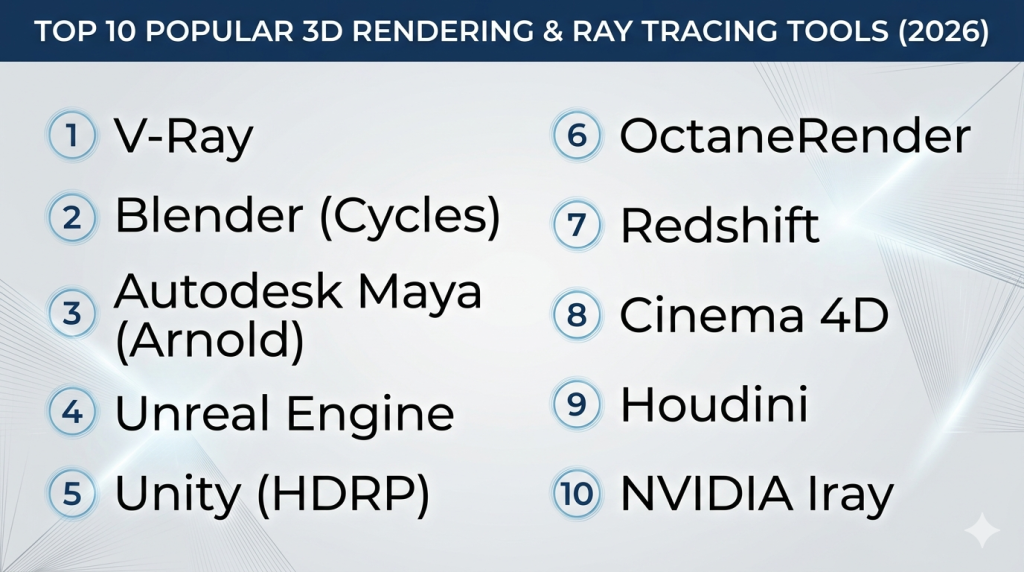
Here are the top 10 most popular 3D rendering and ray tracing tools used by professionals and beginners alike:
1. V-Ray
V-Ray is one of the most widely used rendering engines known for its photorealistic output. It supports both CPU and GPU rendering and is commonly used in architecture, product visualization, and film production.
2. Blender (Cycles)
Blender is a free and open-source 3D creation suite. Its Cycles engine uses path tracing to deliver realistic lighting and materials, making it a favorite among beginners and professionals.
3. Autodesk Maya (Arnold)
Autodesk Maya, combined with the Arnold renderer, is an industry-standard tool in film and animation. It provides highly accurate ray tracing for complex scenes and visual effects.
4. Unreal Engine
Unreal Engine is a powerful real-time engine that supports ray tracing through technologies like Lumen. It is widely used in game development, virtual production, and architectural visualization.
5. Unity (HDRP)
Unity’s High Definition Render Pipeline (HDRP) enables real-time ray tracing, making it suitable for games, simulations, and interactive experiences.
6. OctaneRender
OctaneRender is a GPU-based renderer known for its speed and unbiased rendering approach, delivering highly realistic results with real-time previews.
7. Redshift
Redshift is a high-performance GPU renderer that uses a biased rendering approach to achieve faster results, making it popular in production environments.
8. Cinema 4D
Cinema 4D is widely used in motion graphics and integrates well with rendering engines like Redshift, offering powerful visualization capabilities.
9. Houdini
Houdini is a procedural 3D software used heavily in VFX. Its rendering engines, such as Karma, provide advanced ray tracing capabilities for complex simulations.
10. NVIDIA Iray
NVIDIA Iray is a physically-based renderer that leverages GPU acceleration and AI denoising to produce realistic images efficiently.
Conclusion
Choosing the right 3D rendering and ray tracing tool depends on your needs. Beginners may prefer Blender for its accessibility, while professionals in film and VFX often rely on Maya or Houdini. For real-time applications like games, Unreal Engine and Unity are excellent choices. Understanding your workflow and goals will help you pick the best tool for your projects.
