Introduction
Physics engines are software components that simulate real-world physical behaviors—such as gravity, collision, motion, and fluid dynamics—within digital environments. In simple terms, they make objects in games, simulations, and virtual environments behave realistically. Whether it’s a bouncing ball, a crashing vehicle, or a flowing river, physics engines power the realism behind these interactions.
In , physics engines are more critical than ever due to the rise of immersive gaming, XR (AR/VR), robotics simulations, and AI-driven environments. Modern engines now combine traditional physics with machine learning, real-time ray tracing, and large-scale simulation capabilities.
Common use cases include:
- Game development (realistic movement, collisions, ragdoll physics)
- VR/AR simulations and training environments
- Robotics and autonomous systems testing
- Film and animation physics effects
- Engineering and scientific simulations
Key evaluation criteria for buyers:
- Accuracy and realism of simulation
- Performance and scalability
- Integration with game engines or frameworks
- Ease of use and documentation
- Support for 2D and/or 3D physics
- Real-time vs offline simulation capabilities
- AI/ML integration support
- Cross-platform compatibility
- Licensing and cost structure
- Community and ecosystem strength
Best for: Game developers, simulation engineers, robotics researchers, VFX artists, and XR developers working across industries like gaming, automotive, aerospace, education, and defense.
Not ideal for: Teams building static applications or simple visual experiences without interactive physics—basic animation tools may be sufficient in those cases.
Key Trends in Physics Engines
- AI-enhanced simulations: Physics engines increasingly incorporate AI to predict and optimize physical behaviors.
- Real-time large-scale simulations: Improved GPU acceleration allows massive environments with complex interactions.
- Integration with digital twins: Physics engines are now core components in industrial and IoT simulations.
- Cross-platform consistency: Ensuring identical physics behavior across devices is becoming a priority.
- Cloud-based simulation: Some engines support distributed simulations for large datasets.
- Hybrid physics models: Combining deterministic physics with probabilistic AI models.
- Improved soft-body and fluid simulations: More realistic deformation and fluid dynamics.
- XR-native physics: Optimized for AR/VR devices with spatial interaction support.
- Open-source adoption: Growing interest in customizable and transparent physics engines.
- Security considerations: Increased focus on IP protection and simulation integrity.
How We Selected These Tools (Methodology)
- Evaluated industry adoption and usage across gaming and simulation sectors
- Assessed core physics capabilities (rigid body, soft body, fluid dynamics)
- Reviewed performance benchmarks and scalability
- Considered integration with popular engines and frameworks
- Analyzed ease of implementation and developer experience
- Evaluated community support and documentation quality
- Reviewed cross-platform compatibility
- Considered flexibility for different use cases (games, robotics, VFX)
- Assessed pricing accessibility and licensing models
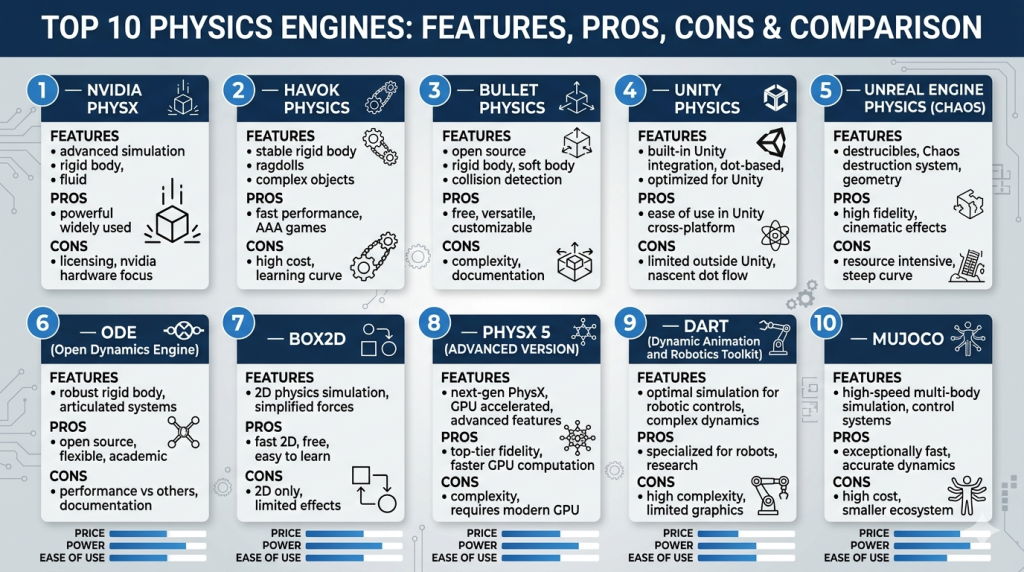
Top 10 Physics Engines Tools
#1 — NVIDIA PhysX
Short description: A widely used real-time physics engine optimized for high-performance simulations in games and simulations.
Key Features
- GPU-accelerated physics
- Rigid body dynamics
- Cloth and particle simulation
- Collision detection
- Real-time simulation
- Integration with major engines
- Scalable performance
Pros
- High performance with GPU support
- Industry-standard in many AAA games
Cons
- Requires NVIDIA hardware for full benefits
- Complex for beginners
Platforms / Deployment
- Windows / Linux / consoles
- Self-hosted
Security & Compliance
- Not publicly stated
Integrations & Ecosystem
PhysX integrates deeply into modern development pipelines.
- Unreal Engine
- Custom engines
- Simulation frameworks
- GPU computing tools
Support & Community
Strong industry adoption with solid documentation.
#2 — Havok Physics
Short description: A commercial physics engine used in AAA games and enterprise simulations.
Key Features
- Rigid body simulation
- Collision detection
- Character physics
- Destruction systems
- Cross-platform support
- High-performance engine
Pros
- Proven reliability in AAA games
- Highly optimized
Cons
- Commercial licensing required
- Limited public access
Platforms / Deployment
- Multi-platform
- Self-hosted
Security & Compliance
- Not publicly stated
Integrations & Ecosystem
- Game engines
- Custom pipelines
- Simulation tools
Support & Community
Enterprise-grade support; limited public community.
#3 — Bullet Physics
Short description: Open-source physics engine widely used in games, robotics, and simulations.
Key Features
- Rigid and soft body dynamics
- Collision detection
- Real-time simulation
- Open-source flexibility
- Multi-platform support
- Robotics simulation support
Pros
- Free and customizable
- Broad use across industries
Cons
- Requires manual setup
- Less polished tooling
Platforms / Deployment
- Windows / macOS / Linux
- Self-hosted
Security & Compliance
- Not publicly stated
Integrations & Ecosystem
- Game engines
- Robotics frameworks
- Simulation platforms
Support & Community
Strong open-source community.
#4 — Unity Physics
Short description: Built-in physics system within Unity optimized for real-time gameplay.
Key Features
- Real-time rigid body physics
- Collision detection
- DOTS-based performance
- Integration with Unity editor
- Cross-platform support
- ECS architecture
Pros
- Easy integration with Unity
- Scalable with DOTS
Cons
- Limited outside Unity
- Advanced features require expertise
Platforms / Deployment
- Multi-platform
- Self-hosted
Security & Compliance
- Not publicly stated
Integrations & Ecosystem
- Unity ecosystem
- Asset store
- AR/VR tools
Support & Community
Very strong community support.
#5 — Unreal Engine Physics (Chaos)
Short description: Unreal Engine’s physics system designed for high-end simulations and destruction.
Key Features
- Real-time rigid body physics
- Destruction simulation
- Cloth and fluid simulation
- Large-scale environments
- Integration with Unreal Engine
- High-performance rendering
Pros
- Advanced simulation features
- Great for cinematic effects
Cons
- Resource-intensive
- Complex setup
Platforms / Deployment
- Multi-platform
- Self-hosted
Security & Compliance
- Not publicly stated
Integrations & Ecosystem
- Unreal Engine tools
- Animation systems
- Rendering pipelines
Support & Community
Strong community and enterprise support.
#6 — ODE (Open Dynamics Engine)
Short description: Open-source engine focused on rigid body dynamics.
Key Features
- Rigid body simulation
- Collision detection
- Joint systems
- Lightweight design
- Cross-platform
Pros
- Lightweight and efficient
- Free to use
Cons
- Limited modern features
- Smaller ecosystem
Platforms / Deployment
- Multi-platform
- Self-hosted
Security & Compliance
- Not publicly stated
Integrations & Ecosystem
- Robotics tools
- Custom engines
Support & Community
Moderate open-source support.
#7 — Box2D
Short description: A popular 2D physics engine used in games and simulations.
Key Features
- 2D rigid body simulation
- Collision detection
- Joint systems
- Lightweight performance
- Cross-platform
Pros
- Excellent for 2D games
- Easy to integrate
Cons
- Limited to 2D
- Not suitable for complex 3D
Platforms / Deployment
- Multi-platform
- Self-hosted
Security & Compliance
- Not publicly stated
Integrations & Ecosystem
- Game engines
- Mobile frameworks
Support & Community
Very strong community.
#8 — PhysX 5 (Advanced Version)
Short description: Next-gen PhysX with improved simulation capabilities.
Key Features
- Advanced particle simulation
- GPU acceleration
- Soft body dynamics
- Real-time physics
- High scalability
Pros
- Cutting-edge features
- High performance
Cons
- Requires modern hardware
- Complexity
Platforms / Deployment
- Multi-platform
- Self-hosted
Security & Compliance
- Not publicly stated
Integrations & Ecosystem
- NVIDIA ecosystem
- Game engines
Support & Community
Strong support ecosystem.
#9 — DART (Dynamic Animation and Robotics Toolkit)
Short description: Physics engine focused on robotics and biomechanics simulations.
Key Features
- Multi-body dynamics
- Robotics simulation
- Collision detection
- Open-source
- High accuracy
Pros
- Great for robotics research
- Accurate simulations
Cons
- Not game-focused
- Complex setup
Platforms / Deployment
- Linux / macOS / Windows
- Self-hosted
Security & Compliance
- Not publicly stated
Integrations & Ecosystem
- Robotics frameworks
- Simulation tools
Support & Community
Academic and research-focused community.
#10 — MuJoCo
Short description: A physics engine designed for robotics and machine learning simulations.
Key Features
- High-precision simulation
- Contact dynamics
- Robotics support
- ML integration
- Fast computation
Pros
- Ideal for AI research
- High accuracy
Cons
- Not focused on games
- Requires expertise
Platforms / Deployment
- Multi-platform
- Self-hosted
Security & Compliance
- Not publicly stated
Integrations & Ecosystem
- ML frameworks
- Robotics systems
Support & Community
Growing research community.
Comparison Table (Top 10)
| Tool Name | Best For | Platform(s) Supported | Deployment | Standout Feature | Public Rating |
|---|---|---|---|---|---|
| NVIDIA PhysX | AAA games | Multi-platform | Self-hosted | GPU acceleration | N/A |
| Havok Physics | Enterprise games | Multi-platform | Self-hosted | AAA reliability | N/A |
| Bullet Physics | Open-source projects | Multi-platform | Self-hosted | Flexibility | N/A |
| Unity Physics | Unity developers | Multi-platform | Self-hosted | ECS performance | N/A |
| Unreal Chaos | Unreal projects | Multi-platform | Self-hosted | Destruction physics | N/A |
| ODE | Lightweight simulations | Multi-platform | Self-hosted | Simplicity | N/A |
| Box2D | 2D games | Multi-platform | Self-hosted | 2D physics | N/A |
| PhysX 5 | Advanced simulations | Multi-platform | Self-hosted | Next-gen physics | N/A |
| DART | Robotics | Multi-platform | Self-hosted | Accuracy | N/A |
| MuJoCo | AI/ML simulations | Multi-platform | Self-hosted | ML integration | N/A |
Evaluation & Scoring of Physics Engines
| Tool Name | Core | Ease | Integrations | Security | Performance | Support | Value | Weighted Total |
|---|---|---|---|---|---|---|---|---|
| NVIDIA PhysX | 9 | 7 | 9 | 6 | 9 | 8 | 8 | 8.2 |
| Havok Physics | 10 | 6 | 8 | 6 | 9 | 8 | 7 | 8.0 |
| Bullet Physics | 8 | 7 | 8 | 5 | 8 | 8 | 9 | 7.9 |
| Unity Physics | 8 | 8 | 9 | 5 | 8 | 9 | 8 | 8.1 |
| Unreal Chaos | 9 | 6 | 9 | 5 | 9 | 9 | 7 | 8.1 |
| ODE | 6 | 7 | 6 | 5 | 7 | 6 | 8 | 6.8 |
| Box2D | 7 | 9 | 7 | 5 | 7 | 9 | 9 | 7.8 |
| PhysX 5 | 9 | 6 | 9 | 6 | 9 | 8 | 7 | 8.1 |
| DART | 8 | 6 | 7 | 5 | 8 | 7 | 7 | 7.3 |
| MuJoCo | 9 | 6 | 8 | 5 | 9 | 7 | 7 | 7.9 |
How to interpret scores:
- Scores represent comparative positioning, not absolute quality.
- Higher scores indicate broader capabilities and flexibility.
- Weighting prioritizes core physics and value.
- Lower-scoring tools may still excel in niche scenarios.
- Always align tool selection with your specific use case.
Which Physics Engines Is Right for You?
Solo / Freelancer
Use Box2D or Bullet Physics for simplicity and affordability.
SMB
Unity Physics or Bullet offer balance between usability and performance.
Mid-Market
PhysX or Unreal Chaos provide scalability and advanced features.
Enterprise
Havok and PhysX are preferred for large-scale, high-performance simulations.
Budget vs Premium
- Budget: Bullet, Box2D, ODE
- Premium: Havok, PhysX
Feature Depth vs Ease of Use
- Feature depth: Havok, Unreal Chaos
- Ease of use: Unity Physics, Box2D
Integrations & Scalability
Choose engines with strong ecosystems like PhysX or Unity.
Security & Compliance Needs
Most tools list Not publicly stated, so internal validation is required.
Frequently Asked Questions (FAQs)
What is a physics engine?
A physics engine simulates real-world physics like motion, collisions, and forces in digital environments.
Are physics engines only for games?
No, they are used in robotics, simulations, and engineering.
What is the best physics engine?
It depends on your use case—PhysX for games, MuJoCo for AI, etc.
Are there free physics engines?
Yes, Bullet, Box2D, and ODE are open-source.
Do I need programming knowledge?
Yes, most engines require coding for integration.
Can physics engines run in real time?
Yes, many support real-time simulations.
What is GPU acceleration?
Using GPUs to speed up physics calculations.
Are physics engines cross-platform?
Most modern engines support multiple platforms.
Can I switch engines later?
Possible but difficult due to integration complexity.
How do I choose the right engine?
Match your needs: performance, platform, and use case.
Conclusion
Physics engines have evolved from simple simulation tools into foundational components of modern digital experiences, powering everything from immersive games and cinematic effects to robotics research and industrial simulations. As we move further into 2026 and beyond, the expectations around realism, scalability, and performance continue to rise, making the choice of a physics engine more strategic than ever before. The right engine can significantly impact not only the visual fidelity of your project but also its responsiveness, accuracy, and overall user experience. While industry leaders like NVIDIA PhysX and Havok dominate high-end use cases, open-source alternatives such as Bullet and Box2D provide accessible and flexible solutions for smaller teams and specialized projects. At the same time, niche tools like MuJoCo and DART are pushing boundaries in AI and robotics, reflecting how diverse this category has become. Ultimately, there is no one-size-fits-all solution—your decision should be guided by your specific goals, technical expertise, platform requirements, and long-term scalability needs. A practical approach is to identify two or three engines that align closely with your use case, experiment with prototypes, and validate how well they integrate into your development workflow. By doing so, you not only reduce risk but also ensure that your chosen physics engine can support both your current project demands and future innovation.
