Introduction
Identity Resolution Platforms help businesses connect customer, prospect, account, device, and behavioral data from different systems into a more complete identity graph or unified profile. In simple terms, these tools help answer: “Is this email address, mobile device, CRM contact, website visitor, and purchase record connected to the same person, household, or company?”
This matters now because customer journeys are fragmented across websites, apps, ads, email, offline stores, call centers, and partner channels. Privacy expectations are also stronger, third-party signals are less reliable, and marketing teams need cleaner first-party data to personalize experiences responsibly.
Real World Use Cases:
- Customer profile unification: Combine CRM, website, mobile app, email, and offline purchase data into a single customer view.
- Audience activation: Build more accurate segments for advertising, email, personalization, and lifecycle marketing.
- Attribution and measurement: Connect touchpoints across channels to understand what drives conversion.
- Fraud and duplicate reduction: Identify duplicate accounts, inconsistent records, or suspicious identity patterns.
- Data collaboration: Match customer records with partners in privacy-conscious environments.
Evaluation Criteria for Buyers:
- Match accuracy and confidence scoring
- First-party data support
- Real-time and batch processing
- Privacy, consent, and governance controls
- Identity graph flexibility
- Data warehouse and CDP integrations
- Activation channels and ecosystem reach
- Security and compliance posture
- Developer tools and APIs
- Pricing transparency and scalability
Best for: Marketing operations teams, data teams, growth teams, customer experience leaders, media teams, and enterprises that need cleaner customer data across many channels. It is especially useful for retail, financial services, media, travel, telecom, healthcare-adjacent engagement, and large digital businesses.
Not ideal for: Very small businesses with only one or two customer systems, teams that do not run personalized marketing, or organizations that only need basic contact deduplication inside a CRM. In those cases, a CRM cleanup tool, CDP-lite solution, or data quality platform may be enough.
Key Trends in Identity Resolution Platforms
- First-party data is becoming the foundation: Buyers are prioritizing platforms that can unify known customer data from owned channels rather than depending heavily on third-party identifiers.
- AI-assisted profile enrichment is growing: Platforms are using AI to detect duplicate identities, improve matching confidence, recommend segments, and surface customer insights.
- Privacy-first identity graphs are becoming essential: Consent management, data minimization, regional controls, and clean-room compatibility are becoming major buying factors.
- Real-time identity resolution is more important: Brands want to identify customers during live sessions so personalization, fraud checks, and service workflows can happen instantly.
- Warehouse-native workflows are gaining traction: More teams want identity resolution to work with Snowflake, BigQuery, Databricks, and other cloud data environments.
- Interoperability matters more than lock-in: Buyers prefer platforms that can connect with CRMs, CDPs, ad platforms, analytics tools, support platforms, and marketing automation systems.
- Cross-device and household matching remain valuable: Retail, media, and financial brands still need device, email, phone, address, and household-level matching where legally and ethically appropriate.
- Governance is moving closer to activation: Teams want rules that control which identities and attributes can be activated in specific channels.
- Composable CDP architectures are influencing buying: Some businesses prefer identity resolution as part of a broader CDP, while others want a focused identity layer connected to their data stack.
- Measurement and media activation are merging: Identity resolution is increasingly used not only for profile building but also for campaign measurement, suppression, personalization, and audience collaboration.
How We Selected These Tools
- Chose platforms with strong market recognition in identity resolution, CDP, customer data, data collaboration, and audience activation.
- Prioritized tools that support customer profile unification, identity graph creation, matching logic, and activation workflows.
- Considered enterprise readiness, including governance, security controls, admin features, and support for complex data environments.
- Included platforms that serve different buyer types, from marketing-led teams to data-led and privacy-sensitive organizations.
- Reviewed ecosystem strength, including integrations with CRMs, warehouses, marketing automation, advertising platforms, and analytics tools.
- Considered real-time and batch processing flexibility where publicly positioned.
- Favored tools that are relevant to modern first-party data strategies and privacy-conscious customer engagement.
- Avoided public ratings where not confidently verifiable and used “N/A” instead.
- Included a balanced mix of identity-specialist platforms, CDPs, data collaboration platforms, and enterprise marketing data platforms.
- Scored tools comparatively based on category fit, not as a universal ranking for every business.
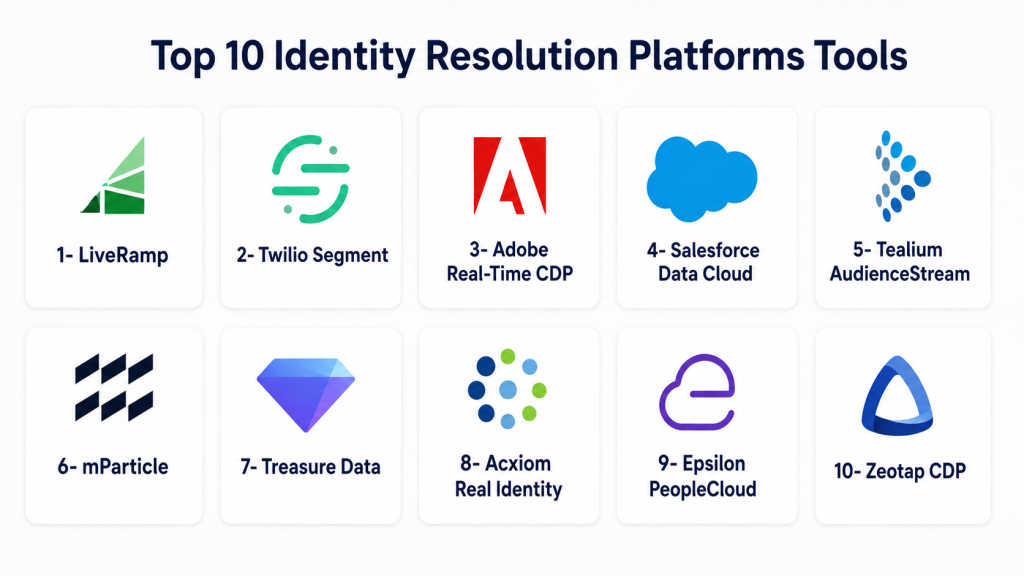
Top 10 Identity Resolution Platforms Tools
1- LiveRamp
Short description: LiveRamp is a widely recognized identity resolution and data collaboration platform used by enterprises for customer matching, audience activation, and privacy-conscious data connectivity. It is best suited for large brands, media companies, agencies, and data-driven marketing teams.
Key Features
- Identity graph and identity translation capabilities
- Person, household, and pseudonymous identifier matching
- Audience activation across marketing and media ecosystems
- Data collaboration and clean-room-oriented workflows
- Support for first-party data onboarding
- Measurement and analytics enablement
- Enterprise-focused privacy and governance controls
Pros
- Strong identity resolution focus with broad market recognition.
- Useful for large-scale audience activation and media workflows.
- Good fit for enterprises managing fragmented customer and media data.
Cons
- May be more complex than needed for smaller teams.
- Pricing and implementation can require enterprise-level planning.
- Best value depends on having mature data and activation use cases.
Platforms / Deployment
Web
Cloud / Hybrid
Security & Compliance
SSO/SAML, encryption, RBAC, audit-oriented enterprise controls
Compliance details vary by product and contract. Use “Not publicly stated” where specific certifications are required for procurement.
Integrations & Ecosystem
LiveRamp is designed to connect customer data with marketing, media, measurement, and partner ecosystems. It is especially relevant when identity resolution must support activation beyond owned channels.
- CDPs and customer data systems
- Marketing clouds
- Advertising platforms
- Data clean rooms
- Analytics and measurement tools
- Cloud data environments
Support & Community
LiveRamp provides enterprise onboarding and account support. Documentation and implementation guidance are available, but deployment success usually depends on clear data governance, defined use cases, and internal data team involvement.
2- Twilio Segment
Short description: Twilio Segment is a customer data platform with identity resolution capabilities that help businesses unify customer events, traits, and profiles across digital touchpoints. It is useful for product-led, growth, data, and marketing teams.
Key Features
- Customer profile unification
- Real-time event collection and routing
- Identity resolution rules and profile stitching
- Warehouse and downstream destination sync
- Source and destination ecosystem
- Audience segmentation and activation
- Developer-friendly APIs and SDKs
Pros
- Strong fit for digital businesses with many event sources.
- Developer-friendly data collection and routing.
- Useful for real-time personalization and lifecycle marketing.
Cons
- Identity setup requires careful planning to avoid profile merge issues.
- Advanced use cases may need technical support from data teams.
- Costs can rise as event volume and destinations grow.
Platforms / Deployment
Web
Cloud
Security & Compliance
SSO/SAML, MFA, encryption, RBAC, audit logs
SOC 2 and GDPR-related capabilities are commonly associated with enterprise SaaS posture, but buyers should validate current certifications during procurement.
Integrations & Ecosystem
Twilio Segment has a broad integration ecosystem for collecting, transforming, and activating customer data across business systems.
- Websites and mobile apps
- Data warehouses
- CRM platforms
- Marketing automation tools
- Analytics platforms
- Customer engagement tools
Support & Community
Twilio Segment offers documentation, developer resources, customer support, and enterprise support options. Its community is strong among product analytics, growth, and data engineering teams.
3- Adobe Real-Time CDP
Short description: Adobe Real-Time CDP helps enterprises create unified customer profiles, manage audiences, and activate data across Adobe and non-Adobe channels. It is best for large organizations already invested in Adobe Experience Cloud or enterprise personalization.
Key Features
- Real-time customer profile creation
- Identity graph and profile stitching capabilities
- Audience segmentation and activation
- Consent and governance controls
- Integration with Adobe Experience Cloud
- AI-assisted personalization and audience workflows
- Support for enterprise-scale data ingestion
Pros
- Strong fit for enterprise marketing and customer experience teams.
- Works well in Adobe-heavy environments.
- Supports complex segmentation, personalization, and activation.
Cons
- Implementation can be complex.
- Best suited for mature enterprise teams rather than small businesses.
- May require Adobe ecosystem expertise for full value.
Platforms / Deployment
Web
Cloud
Security & Compliance
SSO/SAML, encryption, RBAC, audit logs
Specific compliance details should be validated during procurement. Not publicly stated for every deployment context.
Integrations & Ecosystem
Adobe Real-Time CDP is deeply connected to the Adobe Experience Cloud ecosystem and can integrate with external data, marketing, and activation systems.
- Adobe Analytics
- Adobe Journey Optimizer
- Adobe Target
- Data warehouses
- CRM systems
- Advertising and activation destinations
Support & Community
Adobe offers enterprise documentation, implementation partners, customer success programs, and professional services. Support quality depends on contract tier and implementation complexity.
4- Salesforce Data Cloud
Short description: Salesforce Data Cloud helps businesses unify customer data across Salesforce and external systems to power profiles, segmentation, automation, and AI-driven customer experiences. It is best for organizations already using Salesforce CRM, Marketing Cloud, Service Cloud, or Commerce Cloud.
Key Features
- Customer data unification across Salesforce and external sources
- Identity resolution and profile matching
- Real-time segmentation
- Native Salesforce ecosystem integration
- AI and automation support through Salesforce platform capabilities
- Data model and governance features
- Activation into sales, service, marketing, and commerce workflows
Pros
- Strong option for Salesforce-first organizations.
- Useful for aligning sales, marketing, service, and commerce data.
- Supports enterprise customer experience workflows.
Cons
- Best value depends on Salesforce ecosystem maturity.
- Setup may require data modeling and admin expertise.
- Pricing and licensing can be complex.
Platforms / Deployment
Web
Cloud
Security & Compliance
SSO/SAML, MFA, encryption, RBAC, audit logs
Specific certifications and compliance coverage should be confirmed for the purchased Salesforce products and region.
Integrations & Ecosystem
Salesforce Data Cloud connects strongly with Salesforce products and can ingest data from external systems for unified customer profiles and activation.
- Salesforce CRM
- Marketing Cloud
- Service Cloud
- Commerce Cloud
- Data warehouses
- External APIs and connectors
Support & Community
Salesforce has extensive documentation, Trailhead learning, certified partners, professional services, and enterprise support options. Community strength is high, especially for Salesforce administrators and architects.
5- Tealium AudienceStream
Short description: Tealium AudienceStream is a customer data platform focused on real-time customer profiles, audience segmentation, and activation across digital channels. It is best for brands that need event-driven identity resolution and data governance.
Key Features
- Real-time customer profile building
- Visitor stitching and identity resolution
- Audience segmentation and activation
- Tag management and event data collection ecosystem
- Consent and privacy controls
- Data quality and enrichment workflows
- Integration with marketing and analytics tools
Pros
- Strong real-time data collection and activation capabilities.
- Good fit for web, mobile, and omnichannel marketing teams.
- Useful for teams that already use Tealium tag management.
Cons
- Implementation requires careful data layer planning.
- May be more advanced than small teams need.
- Full value depends on integration quality and governance setup.
Platforms / Deployment
Web
Cloud
Security & Compliance
SSO/SAML, encryption, RBAC, audit logs
Specific compliance certifications should be validated with the vendor for the selected deployment and plan.
Integrations & Ecosystem
Tealium has a strong ecosystem for data collection, enrichment, and activation across marketing, analytics, and customer experience systems.
- Analytics platforms
- Marketing automation tools
- Advertising platforms
- Data warehouses
- Consent management platforms
- Customer engagement systems
Support & Community
Tealium provides documentation, customer support, onboarding assistance, and partner services. Its community is strongest among digital analytics, tag management, and marketing operations teams.
6- mParticle
Short description: mParticle is a customer data platform used to collect, unify, and activate customer data across mobile, web, and connected experiences. It is especially relevant for app-first, subscription, media, retail, and digital product companies.
Key Features
- Customer data collection through SDKs and APIs
- Identity resolution and user profile management
- Audience segmentation
- Data quality controls
- Event forwarding and destination integrations
- Warehouse and analytics connectivity
- Real-time activation workflows
Pros
- Strong fit for mobile and app-centric businesses.
- Developer-friendly data collection capabilities.
- Helps teams manage customer data pipelines and activation.
Cons
- Requires technical implementation discipline.
- Advanced configurations may need data engineering support.
- Smaller teams may find it more robust than necessary.
Platforms / Deployment
Web
Cloud
Security & Compliance
SSO/SAML, encryption, RBAC
Specific compliance details should be validated during procurement. Not publicly stated for every plan or region.
Integrations & Ecosystem
mParticle connects customer data across product, marketing, analytics, and engagement systems, making it useful for teams that need structured customer data pipelines.
- Mobile apps and websites
- Analytics platforms
- Marketing automation tools
- Data warehouses
- Customer engagement platforms
- Advertising destinations
Support & Community
mParticle provides documentation, onboarding support, and enterprise support options. Its community is strongest among product analytics, mobile growth, and customer data teams.
7- Treasure Data
Short description: Treasure Data is an enterprise customer data platform that helps organizations unify large-scale customer data, build segments, and activate audiences across channels. It is well suited for large brands with complex data environments.
Key Features
- Enterprise customer data unification
- Identity resolution and profile creation
- Large-scale data ingestion and processing
- Segmentation and audience activation
- Data governance and access controls
- Analytics and customer intelligence workflows
- Integration with marketing and data platforms
Pros
- Strong for enterprise-scale data environments.
- Useful for complex omnichannel customer data use cases.
- Good fit for data-heavy marketing and analytics teams.
Cons
- May require significant implementation planning.
- Less suitable for very small teams.
- Advanced use cases may need technical and strategic support.
Platforms / Deployment
Web
Cloud
Security & Compliance
SSO/SAML, encryption, RBAC, audit logs
Specific compliance certifications should be validated during procurement.
Integrations & Ecosystem
Treasure Data connects with a wide range of enterprise data, marketing, analytics, and activation systems. It is often considered where customer data volume and complexity are high.
- Data warehouses
- CRM systems
- Marketing automation platforms
- Advertising platforms
- Analytics tools
- Business intelligence tools
Support & Community
Treasure Data offers enterprise support, documentation, customer success resources, and implementation assistance. Community strength is more enterprise-focused than open community driven.
8- Acxiom Real Identity
Short description: Acxiom Real Identity is an identity resolution and data solution designed to help brands connect people, households, and data signals across channels. It is best suited for enterprises that need identity matching, data enrichment, and marketing activation support.
Key Features
- Identity graph capabilities
- Person and household-level matching
- Customer data enrichment
- Offline and online data connectivity
- Audience creation and activation support
- Data quality and matching logic
- Enterprise services and consulting support
Pros
- Strong heritage in data, identity, and customer intelligence.
- Useful for brands with offline and online customer data.
- Good fit for enterprise identity and enrichment workflows.
Cons
- May require consulting-led implementation.
- Less suited for teams wanting a lightweight self-service tool.
- Pricing and solution scope can vary significantly.
Platforms / Deployment
Web
Cloud / Hybrid
Security & Compliance
Encryption, governance controls, enterprise data handling practices
Specific certifications and compliance coverage should be validated directly. Not publicly stated for every solution context.
Integrations & Ecosystem
Acxiom supports identity and data workflows across marketing, analytics, media, and enterprise data environments.
- CRM systems
- Marketing clouds
- Data warehouses
- Media and advertising platforms
- Analytics systems
- Partner data environments
Support & Community
Acxiom provides enterprise support, services, and consulting-led implementation assistance. Community resources are less open-community focused and more vendor or partner-led.
9- Epsilon PeopleCloud
Short description: Epsilon PeopleCloud is a marketing and identity platform focused on customer intelligence, personalization, audience activation, and media connectivity. It is best for large consumer brands that need identity-led marketing execution.
Key Features
- Customer identity and profile capabilities
- Audience segmentation and activation
- Personalization and campaign orchestration support
- Data enrichment and customer intelligence
- Media and advertising activation
- Measurement and insights workflows
- Enterprise marketing services support
Pros
- Strong fit for large-scale consumer marketing.
- Useful where identity, data, media, and activation must work together.
- Supports personalization across multiple engagement channels.
Cons
- May be too broad for buyers seeking only technical identity resolution.
- Implementation can be service-heavy.
- Pricing and scope vary by enterprise needs.
Platforms / Deployment
Web
Cloud
Security & Compliance
Encryption, access controls, enterprise governance capabilities
Specific certifications should be validated during procurement. Not publicly stated for every product scope.
Integrations & Ecosystem
Epsilon PeopleCloud connects identity, data, personalization, and media activation workflows for enterprise marketing teams.
- CRM and customer data systems
- Marketing platforms
- Media activation channels
- Analytics and measurement tools
- Data enrichment workflows
- Campaign management systems
Support & Community
Epsilon typically supports enterprise customers through account teams, managed services, and strategic consulting. Public community resources are limited compared with developer-first platforms.
10- Zeotap CDP
Short description: Zeotap CDP is a customer data platform that helps enterprises unify customer data, create segments, and activate audiences while focusing on privacy-conscious data usage. It is suitable for marketing, data, and customer experience teams.
Key Features
- Customer profile unification
- Identity resolution and matching workflows
- Audience segmentation
- Consent-aware activation support
- Data enrichment capabilities
- Connector-based integration model
- AI-assisted customer data use cases where available
Pros
- Strong fit for privacy-conscious customer data strategies.
- Useful for marketers needing audience activation and profile unification.
- Modular approach can suit enterprise data environments.
Cons
- Market presence may vary by region and industry.
- Advanced implementation may require vendor assistance.
- Pricing and feature availability can vary by package.
Platforms / Deployment
Web
Cloud
Security & Compliance
SSO/SAML, encryption, RBAC
Specific compliance certifications should be validated during procurement. Not publicly stated for every plan.
Integrations & Ecosystem
Zeotap CDP connects customer data sources with marketing, analytics, and activation destinations to support unified profiles and privacy-aware engagement.
- CRM platforms
- Marketing automation tools
- Advertising destinations
- Data warehouses
- Analytics systems
- Consent and privacy tools
Support & Community
Zeotap provides customer support, onboarding resources, and enterprise assistance. Community visibility is more vendor-led than open developer-community led.
Comparison Table
| Tool Name | Best For | Platform Supported | Deployment | Standout Feature | Public Rating |
|---|---|---|---|---|---|
| LiveRamp | Enterprise identity and media activation | Web | Cloud / Hybrid | Identity graph and audience connectivity | N/A |
| Twilio Segment | Product-led and digital businesses | Web | Cloud | Real-time profile unification and event routing | N/A |
| Adobe Real-Time CDP | Enterprise personalization teams | Web | Cloud | Adobe ecosystem profile activation | N/A |
| Salesforce Data Cloud | Salesforce-first organizations | Web | Cloud | Customer data unification across Salesforce workflows | N/A |
| Tealium AudienceStream | Real-time digital marketing teams | Web | Cloud | Event-driven customer profile stitching | N/A |
| mParticle | Mobile and app-first businesses | Web | Cloud | SDK-driven customer data pipelines | N/A |
| Treasure Data | Large enterprise data teams | Web | Cloud | Large-scale customer data unification | N/A |
| Acxiom Real Identity | Offline and online identity matching | Web | Cloud / Hybrid | Person and household-level identity resolution | N/A |
| Epsilon PeopleCloud | Enterprise consumer marketing | Web | Cloud | Identity-led personalization and media activation | N/A |
| Zeotap CDP | Privacy-conscious customer data teams | Web | Cloud | Consent-aware customer profile activation | N/A |
Evaluation & Scoring of Identity Resolution Platforms
| Tool Name | Core 25% | Ease 15% | Integrations 15% | Security 10% | Performance 10% | Support 10% | Value 15% | Weighted Total 0–10 |
| LiveRamp | 10 | 7 | 9 | 9 | 9 | 8 | 7 | 8.6 |
| Twilio Segment | 9 | 8 | 9 | 8 | 8 | 8 | 8 | 8.4 |
| Adobe Real-Time CDP | 9 | 7 | 9 | 9 | 8 | 8 | 7 | 8.2 |
| Salesforce Data Cloud | 9 | 7 | 9 | 9 | 8 | 8 | 7 | 8.2 |
| Tealium AudienceStream | 8 | 8 | 8 | 8 | 8 | 8 | 8 | 8.0 |
| mParticle | 8 | 8 | 8 | 8 | 8 | 7 | 8 | 7.9 |
| Treasure Data | 8 | 7 | 8 | 8 | 9 | 8 | 7 | 7.8 |
| Acxiom Real Identity | 9 | 6 | 8 | 8 | 8 | 8 | 7 | 7.8 |
| Epsilon PeopleCloud | 8 | 7 | 8 | 8 | 8 | 8 | 7 | 7.7 |
| Zeotap CDP | 8 | 8 | 7 | 8 | 8 | 7 | 8 | 7.7 |
These scores are comparative, not absolute. A higher total means the platform is broadly strong across the evaluation model, but it does not automatically mean it is the best choice for every organization. A lower score may still be the right fit if the tool aligns with your ecosystem, region, budget, or compliance needs. Buyers should treat this scoring as a shortlist guide and validate each platform through demos, proof-of-concept testing, data samples, integration checks, and procurement review.
Which Identity Resolution Platforms Tool Is Right for You?
Solo / Freelancer
Solo professionals usually do not need a full enterprise identity resolution platform. If you only manage a small email list, a basic CRM, analytics tool, or marketing automation platform may be enough. Full identity resolution becomes useful only when you manage multiple data sources, paid media audiences, or client-side customer data projects.
For consultants supporting enterprise clients, Twilio Segment, Tealium, or mParticle may be useful to understand because they fit modern data stack and digital product workflows.
SMB
Small and medium businesses should focus on ease of implementation, transparent data flows, and practical activation. A full enterprise identity graph may be unnecessary unless the company has high customer volume, multiple channels, or complex personalization needs.
Good-fit options may include Twilio Segment, mParticle, Tealium AudienceStream, or Zeotap CDP depending on data maturity. SMBs should avoid overbuying and start with clear use cases such as duplicate reduction, unified profiles, email personalization, and audience syncing.
Mid-Market
Mid-market companies often need stronger identity resolution because customer data is spread across CRM, website analytics, mobile apps, email platforms, support systems, and advertising channels. This is where CDP-based identity resolution becomes valuable.
Twilio Segment, Tealium AudienceStream, mParticle, Salesforce Data Cloud, and Zeotap CDP can be strong choices depending on the existing ecosystem. If the business already uses Salesforce heavily, Salesforce Data Cloud may reduce integration friction. If the company is app-first, mParticle deserves attention.
Enterprise
Enterprises should prioritize accuracy, governance, scalability, privacy controls, partner ecosystem, and activation reach. Large organizations often need both deterministic and probabilistic matching, household-level logic, regional controls, and clean-room compatibility.
LiveRamp, Adobe Real-Time CDP, Salesforce Data Cloud, Treasure Data, Acxiom Real Identity, and Epsilon PeopleCloud are especially relevant for enterprise scenarios. The right choice depends on whether the main use case is media activation, customer experience, data collaboration, personalization, or unified analytics.
Budget vs Premium
Budget-sensitive teams should avoid buying a broad platform before defining high-value use cases. Start with data cleanup, CRM deduplication, and basic CDP capabilities if needs are simple. Premium platforms make sense when identity resolution directly supports revenue, retention, personalization, measurement, or compliance.
LiveRamp, Adobe, Salesforce, Acxiom, and Epsilon are more enterprise-oriented. Twilio Segment, Tealium, mParticle, and Zeotap may offer more modular paths depending on package and usage.
Feature Depth vs Ease of Use
If your team wants depth, enterprise governance, and broad activation, LiveRamp, Adobe Real-Time CDP, Salesforce Data Cloud, and Treasure Data are strong candidates. If your team wants developer-friendly implementation and faster digital data routing, Twilio Segment and mParticle are strong options.
Tealium is a good fit when real-time web and event data workflows are central. Zeotap may suit teams looking for privacy-aware CDP capabilities with customer profile and activation use cases.
Integrations & Scalability
Integration strategy should drive vendor selection. Salesforce-heavy teams should evaluate Salesforce Data Cloud. Adobe-heavy teams should consider Adobe Real-Time CDP. Product and engineering-led companies should evaluate Twilio Segment and mParticle. Media activation-heavy brands should consider LiveRamp, Acxiom, or Epsilon.
Scalability is not only about user count. It also includes data volume, identity graph complexity, activation destinations, consent rules, real-time needs, and internal data governance.
Security & Compliance Needs
Security-focused buyers should ask vendors about encryption, SSO, access controls, audit logs, data retention, consent handling, regional processing, and customer data deletion workflows. Do not rely only on marketing claims.
Regulated or privacy-sensitive organizations should prioritize vendors with strong governance controls, contractual clarity, and transparent data processing documentation. LiveRamp, Salesforce, Adobe, Tealium, Treasure Data, and similar enterprise platforms are usually better suited for rigorous procurement reviews than lightweight tools.
Frequently Asked Questions
1- What is an identity resolution platform?
An identity resolution platform connects customer data from different sources into a unified profile or identity graph. It helps businesses understand whether multiple identifiers belong to the same person, household, account, or customer record.
2- How is identity resolution different from a CDP?
A CDP collects and activates customer data, while identity resolution is the matching layer that connects records across systems. Many CDPs include identity resolution, but some businesses use dedicated identity platforms for deeper matching and activation.
3- What pricing models are common for identity resolution platforms?
Pricing often depends on data volume, number of profiles, identity graph usage, activation destinations, and enterprise support needs. Many vendors use custom pricing, so buyers should ask for clear usage assumptions before signing.
4- How long does implementation usually take?
Implementation can range from a few weeks to several months depending on data quality, source systems, integrations, consent rules, and activation complexity. Enterprise deployments usually require data mapping, testing, governance review, and stakeholder alignment.
5- What are common mistakes when choosing a platform?
Common mistakes include buying before defining use cases, ignoring data quality, underestimating consent requirements, and assuming identity matching will be perfect. Teams should validate match rates with sample data before scaling.
6- Are identity resolution platforms secure?
Enterprise platforms usually include security controls such as encryption, access management, and administrative governance. However, buyers should verify certifications, data handling terms, retention policies, and regional compliance needs directly with the vendor.
7- Can identity resolution work in real time?
Many modern platforms support real-time or near-real-time profile updates, especially for digital events, personalization, and customer engagement. Some matching and enrichment workflows may still run in batch depending on the platform and data source.
8- What integrations matter most?
Important integrations include CRM, data warehouse, marketing automation, analytics, advertising platforms, consent management, customer support, and mobile or web data sources. The best tool should fit your existing stack instead of forcing unnecessary migration.
9- Is switching identity resolution platforms difficult?
Switching can be difficult if identity rules, profile IDs, audience logic, and activation workflows are deeply embedded. Teams should document identity rules, exportable data structures, consent mappings, and downstream dependencies before migration.
10- What are alternatives to identity resolution platforms?
Alternatives include CRM deduplication tools, customer data platforms, data quality platforms, master data management tools, warehouse-native modeling, and marketing automation systems. These may be enough for smaller businesses with simpler customer data needs.
Conclusion
Identity Resolution Platforms are becoming a core part of modern customer data strategy because businesses need a trusted way to connect fragmented signals into usable customer profiles. The best platform depends on your existing stack, data maturity, privacy requirements, activation channels, and internal technical capability. LiveRamp is strong for enterprise identity and media activation, Twilio Segment and mParticle fit digital and product-led teams, Adobe and Salesforce work well inside their broader ecosystems, and tools like Tealium, Treasure Data, Acxiom, Epsilon, and Zeotap serve more specialized enterprise needs. The smartest next step is to shortlist two or three platforms, test them with real data samples, compare match quality, validate security and consent controls, and run a focused pilot before expanding across the organization.
