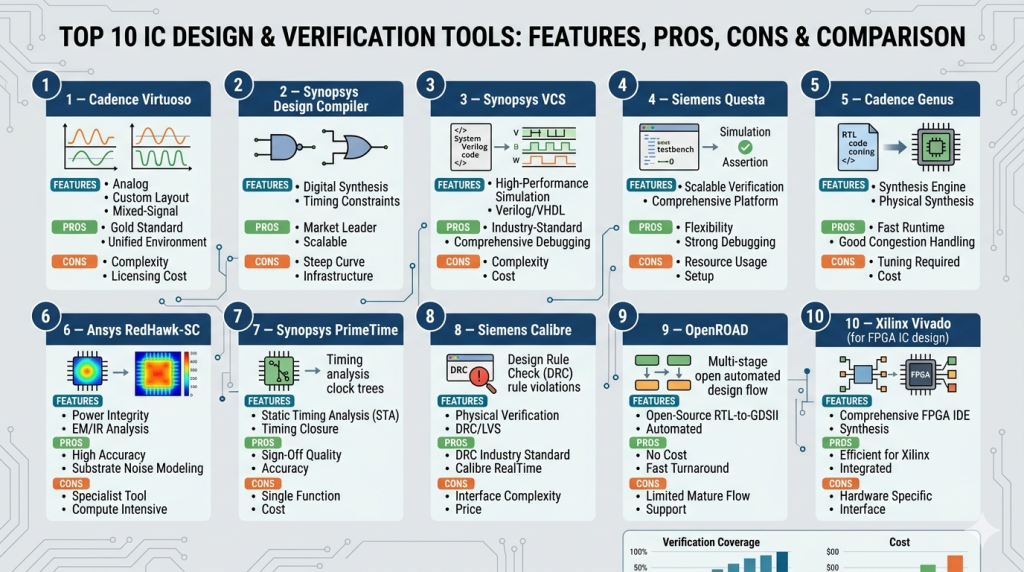
Introduction
IC (Integrated Circuit) Design & Verification tools are specialized software platforms used to design, simulate, validate, and prepare semiconductor chips for manufacturing. In simple terms, these tools help engineers create everything from microprocessors and GPUs to custom ASICs and SoCs with precision and reliability.
In today’s hardware-driven world, IC complexity is growing exponentially due to AI workloads, automotive electronics, 5G infrastructure, and IoT expansion. This makes robust design and verification workflows essential—not just for performance, but also for power efficiency, reliability, and security. Modern IC tools now incorporate AI-assisted automation, cloud-based simulation, and early-stage verification to reduce costly design errors.
Common use cases include:
- Designing ASICs and SoCs for AI, mobile, and embedded systems
- Functional and formal verification of digital designs
- Analog and mixed-signal circuit simulation
- Timing, power, and signal integrity analysis
- RTL-to-GDSII design flows for chip manufacturing
Key evaluation criteria for buyers:
- Digital, analog, and mixed-signal design capabilities
- Verification depth (functional, formal, timing, power)
- Performance for large-scale chip designs
- AI-assisted automation features
- Integration with foundries and IP ecosystems
- Ease of use and onboarding complexity
- Deployment flexibility (cloud vs on-premise)
- Security and IP protection mechanisms
- Vendor support and ecosystem maturity
Best for: Semiconductor companies, chip designers, hardware engineers, and R&D teams working on ASIC, FPGA, and SoC development across industries like automotive, telecom, AI, and consumer electronics.
Not ideal for: Non-specialized teams or those working only on basic PCB-level designs. For simpler workflows, PCB-focused EDA tools are more appropriate.
Key Trends in IC Design & Verification Tools for 2026 and Beyond
- AI-driven verification and optimization: Machine learning is increasingly used to detect bugs, optimize timing, and improve layout efficiency.
- Shift-left verification strategies: Verification is happening earlier in the design cycle to reduce late-stage failures.
- Cloud-native simulation environments: High-performance simulations are moving to scalable cloud infrastructure.
- Chiplet and heterogeneous integration: Tools are evolving to support modular chip design approaches.
- Formal verification adoption: Growing reliance on mathematical proofs for correctness in safety-critical systems.
- Hardware security integration: Built-in capabilities to detect vulnerabilities and ensure secure design practices.
- Integration with software workflows: Closer alignment with CI/CD pipelines and DevOps practices.
- Open-source IC design movement: Increasing interest in tools like OpenROAD for cost-efficient design.
- Advanced node support: Tools optimized for sub-5nm and emerging semiconductor processes.
- Collaborative design environments: Improved support for distributed engineering teams.
How We Selected These Tools (Methodology)
The tools in this list were selected using a structured evaluation approach:
- High industry adoption and recognition among semiconductor companies
- Comprehensive feature coverage across IC design and verification workflows
- Proven reliability in handling complex chip designs
- Performance benchmarks for large-scale simulations
- Strong integration with foundries, IP vendors, and manufacturing ecosystems
- Availability of APIs and automation capabilities
- Vendor support quality and ecosystem maturity
- Suitability across different company sizes and use cases
- Alignment with modern trends such as AI and cloud computing
- Documentation quality and community support
Top 10 IC Design & Verification Tools Tools
#1 — Cadence Virtuoso
Short description: A leading platform for analog, mixed-signal, and custom IC design, widely used in advanced semiconductor development.
Key Features
- Analog and mixed-signal design environment
- Custom layout and schematic tools
- Simulation integration (Spectre)
- AI-assisted design optimization
- Advanced node support
- Layout-versus-schematic (LVS) verification
Pros
- Industry-standard for analog design
- Strong integration across Cadence ecosystem
Cons
- Complex learning curve
- Expensive licensing
Platforms / Deployment
Linux
Self-hosted / Hybrid
Security & Compliance
Not publicly stated
Integrations & Ecosystem
Cadence Virtuoso integrates deeply with simulation and verification tools.
- Spectre simulation engine
- Integration with Cadence digital tools
- Foundry PDK compatibility
- Scripting via SKILL language
Support & Community
Strong enterprise support with extensive training resources.
#2 — Synopsys Design Compiler
Short description: A widely used synthesis tool for converting RTL designs into gate-level implementations.
Key Features
- RTL-to-gate synthesis
- Timing and power optimization
- Multi-voltage and low-power design support
- Integration with verification tools
- Advanced node support
Pros
- Industry-standard synthesis engine
- High-performance optimization
Cons
- Complex configuration
- Expensive for small teams
Platforms / Deployment
Linux
Self-hosted / Hybrid
Security & Compliance
Not publicly stated
Integrations & Ecosystem
- Integration with Synopsys verification tools
- Foundry compatibility
- Automation via scripting
- CI/CD pipeline integration
Support & Community
Enterprise-grade documentation and support.
#3 — Synopsys VCS
Short description: A high-performance simulation tool for functional verification of digital designs.
Key Features
- SystemVerilog simulation
- Debugging and waveform analysis
- Coverage-driven verification
- High-speed simulation engine
- Integration with verification frameworks
Pros
- Fast simulation performance
- Strong verification ecosystem
Cons
- Steep learning curve
- Licensing cost
Platforms / Deployment
Linux
Self-hosted / Hybrid
Security & Compliance
Not publicly stated
Integrations & Ecosystem
- Integration with UVM frameworks
- Debugging tools
- Automation APIs
- Verification toolchain support
Support & Community
Widely adopted with strong enterprise support.
#4 — Siemens Questa
Short description: A comprehensive verification platform supporting simulation, formal verification, and debugging.
Key Features
- Functional and formal verification
- Coverage analysis
- Debugging tools
- UVM support
- Scalable simulation
Pros
- Strong formal verification capabilities
- Scalable for large designs
Cons
- Complex interface
- Requires expertise
Platforms / Deployment
Linux / Windows
Self-hosted / Hybrid
Security & Compliance
Not publicly stated
Integrations & Ecosystem
- Integration with Siemens EDA tools
- UVM and SystemVerilog support
- APIs for automation
- Debugging ecosystem
Support & Community
Enterprise support with extensive documentation.
#5 — Cadence Genus
Short description: A modern synthesis tool for digital IC design, optimized for performance and power efficiency.
Key Features
- RTL synthesis
- Power and timing optimization
- Multi-corner analysis
- Integration with Cadence tools
- Advanced node support
Pros
- High optimization accuracy
- Strong performance
Cons
- Requires expertise
- Premium pricing
Platforms / Deployment
Linux
Self-hosted / Hybrid
Security & Compliance
Not publicly stated
Integrations & Ecosystem
- Cadence digital flow integration
- Foundry support
- Automation APIs
- Verification tool integration
Support & Community
Enterprise-level support and training.
#6 — Ansys RedHawk-SC
Short description: A specialized tool for power integrity and reliability analysis in IC designs.
Key Features
- Power integrity analysis
- Electrostatic discharge (ESD) simulation
- Reliability analysis
- Multiphysics simulation
- Scalable architecture
Pros
- High accuracy for power analysis
- Essential for advanced nodes
Cons
- Not a full design tool
- Requires specialized knowledge
Platforms / Deployment
Linux
Cloud / Hybrid
Security & Compliance
Not publicly stated
Integrations & Ecosystem
- Integration with design tools
- HPC environments
- APIs for scripting
- Simulation workflows
Support & Community
Strong enterprise support.
#7 — Synopsys PrimeTime
Short description: A leading static timing analysis (STA) tool for verifying timing closure in digital designs.
Key Features
- Static timing analysis
- Multi-corner timing validation
- Power analysis
- Signoff verification
- Advanced node support
Pros
- Industry-standard STA tool
- High accuracy
Cons
- Complex workflows
- High cost
Platforms / Deployment
Linux
Self-hosted / Hybrid
Security & Compliance
Not publicly stated
Integrations & Ecosystem
- Integration with synthesis tools
- Foundry compatibility
- Automation scripts
- Verification workflows
Support & Community
Strong enterprise ecosystem.
#8 — Siemens Calibre
Short description: A widely used physical verification tool for DRC, LVS, and signoff checks.
Key Features
- Design rule checking (DRC)
- Layout vs schematic (LVS)
- Parasitic extraction
- Signoff verification
- Foundry rule integration
Pros
- Industry-standard verification
- Highly accurate
Cons
- Complex setup
- Expensive
Platforms / Deployment
Linux
Self-hosted / Hybrid
Security & Compliance
Not publicly stated
Integrations & Ecosystem
- Foundry integration
- Design tool compatibility
- Automation APIs
- Verification workflows
Support & Community
Strong enterprise adoption.
#9 — OpenROAD
Short description: An open-source toolchain for automated digital IC design, gaining traction in research and startups.
Key Features
- RTL-to-GDS flow
- Open-source architecture
- Scriptable workflows
- Integration with open PDKs
- Automated placement and routing
Pros
- Free and flexible
- Growing innovation
Cons
- Limited enterprise support
- Not suitable for all production use cases
Platforms / Deployment
Linux
Self-hosted
Security & Compliance
Not publicly stated
Integrations & Ecosystem
- Open-source toolchains
- APIs and scripting
- Academic collaborations
- PDK compatibility
Support & Community
Active open-source community.
#10 — Xilinx Vivado (for FPGA IC design)
Short description: A design suite for FPGA-based IC development, including synthesis, simulation, and debugging.
Key Features
- FPGA synthesis and implementation
- Simulation and debugging
- IP integration
- Hardware/software co-design
- Timing and power analysis
Pros
- Strong FPGA ecosystem
- Integrated workflow
Cons
- Limited for ASIC design
- Resource-heavy
Platforms / Deployment
Windows / Linux
Self-hosted
Security & Compliance
Not publicly stated
Integrations & Ecosystem
- FPGA IP libraries
- Embedded toolchains
- Simulation tools
- Hardware debugging tools
Support & Community
Large user base and strong documentation.
Comparison Table (Top 10)
| Tool Name | Best For | Platform(s) Supported | Deployment | Standout Feature | Public Rating |
|---|---|---|---|---|---|
| Cadence Virtuoso | Analog IC design | Linux | Hybrid | Mixed-signal design | N/A |
| Synopsys Design Compiler | RTL synthesis | Linux | Hybrid | High-performance synthesis | N/A |
| Synopsys VCS | Simulation | Linux | Hybrid | Fast verification | N/A |
| Siemens Questa | Verification | Windows, Linux | Hybrid | Formal verification | N/A |
| Cadence Genus | Digital synthesis | Linux | Hybrid | Optimization accuracy | N/A |
| Ansys RedHawk | Power analysis | Linux | Cloud/Hybrid | Power integrity | N/A |
| Synopsys PrimeTime | Timing analysis | Linux | Hybrid | STA accuracy | N/A |
| Siemens Calibre | Physical verification | Linux | Hybrid | DRC/LVS signoff | N/A |
| OpenROAD | Open-source IC design | Linux | Self-hosted | Free RTL-to-GDS | N/A |
| Xilinx Vivado | FPGA design | Windows, Linux | Self-hosted | FPGA ecosystem | N/A |
Evaluation & Scoring of IC Design & Verification Tools
| Tool Name | Core (25%) | Ease (15%) | Integrations (15%) | Security (10%) | Performance (10%) | Support (10%) | Value (15%) | Weighted Total |
|---|---|---|---|---|---|---|---|---|
| Cadence Virtuoso | 10 | 6 | 9 | 7 | 10 | 9 | 6 | 8.45 |
| Synopsys Design Compiler | 10 | 6 | 9 | 7 | 10 | 9 | 5 | 8.30 |
| Synopsys VCS | 9 | 6 | 9 | 7 | 10 | 9 | 6 | 8.15 |
| Siemens Questa | 9 | 6 | 8 | 7 | 9 | 8 | 6 | 7.85 |
| Cadence Genus | 9 | 6 | 8 | 7 | 9 | 8 | 6 | 7.85 |
| Ansys RedHawk | 8 | 5 | 7 | 7 | 9 | 8 | 6 | 7.30 |
| Synopsys PrimeTime | 10 | 5 | 8 | 7 | 10 | 9 | 5 | 8.10 |
| Siemens Calibre | 10 | 5 | 8 | 7 | 10 | 9 | 5 | 8.10 |
| OpenROAD | 6 | 5 | 6 | 5 | 7 | 5 | 10 | 6.65 |
| Xilinx Vivado | 8 | 7 | 8 | 6 | 8 | 8 | 7 | 7.65 |
How to interpret these scores:
- Scores are relative comparisons, not absolute measures.
- Enterprise tools excel in performance and feature depth but may score lower in value.
- Open-source tools provide strong value but may lack support and advanced capabilities.
- Use scores to shortlist tools based on your priorities.
- Always validate with real-world testing before final selection.
Which IC Design & Verification Tools Tool Is Right for You?
Solo / Freelancer
- Recommended: OpenROAD, Vivado (for FPGA)
- Focus on cost, accessibility, and flexibility.
SMB
- Recommended: Vivado, selective use of Synopsys tools
- Balance between cost and capability.
Mid-Market
- Recommended: Siemens Questa, Cadence Genus
- Need scalable verification and synthesis workflows.
Enterprise
- Recommended: Cadence Virtuoso, Synopsys Suite, Siemens Calibre
- Require full-stack IC design, verification, and signoff tools.
Budget vs Premium
- Budget: OpenROAD
- Premium: Cadence, Synopsys
Feature Depth vs Ease of Use
- Deep features: Synopsys, Cadence
- Easier workflows: FPGA tools like Vivado
Integrations & Scalability
- Strong ecosystems: Cadence, Synopsys
- Flexible/open: OpenROAD
Security & Compliance Needs
- Enterprise tools typically offer better IP protection features.
- Open-source tools require internal governance.
Frequently Asked Questions (FAQs)
What are IC design and verification tools used for?
They are used to design, simulate, and validate semiconductor chips before manufacturing.
Are these tools expensive?
Yes, enterprise tools can be very expensive. Open-source tools are free but less feature-rich.
How long does it take to learn these tools?
Learning can take weeks to months depending on complexity and prior experience.
Do these tools support cloud deployment?
Many modern tools support cloud or hybrid environments.
What is verification in IC design?
Verification ensures that the chip design behaves as intended before fabrication.
Are open-source IC tools reliable?
They are improving rapidly but may not yet match enterprise-grade reliability.
What programming languages are used?
Commonly used languages include Verilog, VHDL, and SystemVerilog.
Can these tools integrate with CI/CD?
Yes, many support automation and pipeline integration.
Is security important in IC design?
Yes, especially for protecting intellectual property and preventing vulnerabilities.
What is the biggest challenge in IC design?
Managing complexity, ensuring correctness, and meeting performance targets.
Conclusion
IC Design & Verification tools are essential for building modern semiconductor systems. As chip complexity increases, these tools enable engineers to design efficiently, verify thoroughly, and deliver reliable products.
There is no universal “best” tool:
- Enterprise teams should focus on comprehensive ecosystems like Cadence and Synopsys.
- Mid-sized teams should balance scalability and cost with tools like Siemens Questa.
- Startups and individuals can explore OpenROAD and FPGA-based solutions.
