Introduction
Healthcare Interoperability APIs (HL7/FHIR) enable seamless exchange of healthcare data across systems such as EHR, EMR, laboratory, and patient management platforms. These APIs standardize communication, improve data accuracy, and support regulatory compliance. With the growing complexity of healthcare ecosystems, interoperable APIs are crucial for real-time patient care, population health management, and analytics.
Real-world use cases include:
- Exchanging patient records between hospitals and clinics
- Integrating laboratory results with EHR systems
- Enabling patient access to their health data
- Supporting clinical research and data aggregation
- Streamlining revenue cycle management and billing data
What buyers should evaluate:
- Support for HL7 v2, v3, and FHIR standards
- Ease of integration with EHR, EMR, and other health IT systems
- Real-time data exchange capabilities
- Security, encryption, and access control
- Scalability for enterprise or multi-site deployment
- Analytics and logging for compliance
- Versioning and backward compatibility
- Workflow automation support
Best for: Hospitals, health systems, laboratories, payer organizations, and healthcare IT teams focused on interoperability and patient data exchange.
Not ideal for: Small clinics or practices with minimal system complexity where manual data sharing may suffice.
Key Trends in Healthcare Interoperability APIs
- Widespread adoption of FHIR for standardized data exchange
- Cloud-native API platforms for global accessibility
- AI-assisted mapping and validation of healthcare data
- Real-time patient data exchange across multiple EHRs
- Enhanced security features including OAuth2 and JWT authentication
- API analytics for monitoring usage and compliance
- Support for patient access APIs for telehealth and mobile apps
- Integration with health information exchanges (HIEs)
- Workflow automation for clinical, administrative, and billing data
- Modular and subscription-based pricing for flexible adoption
How We Selected These Tools (Methodology)
- Evaluated market adoption among healthcare organizations
- Assessed feature completeness, including HL7 and FHIR support
- Reviewed performance and reliability in production environments
- Verified security and compliance capabilities for healthcare data
- Checked integration flexibility with EHR, EMR, and laboratory systems
- Prioritized tools supporting multi-site or enterprise-scale deployments
- Evaluated real-time data exchange and analytics capabilities
- Considered vendor support, documentation, and developer community
- Balanced cost against interoperability, scalability, and compliance features
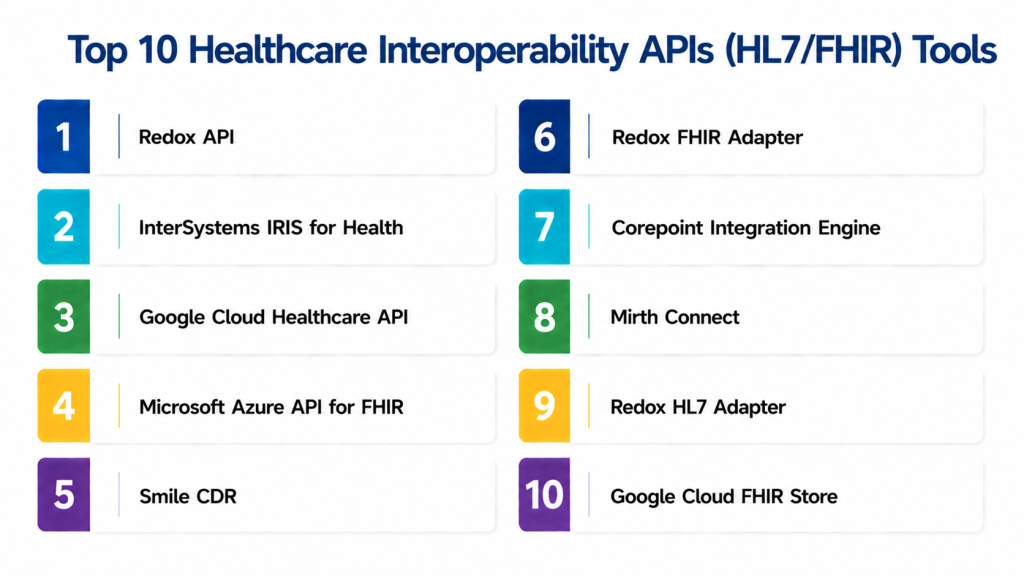
Top 10 Healthcare Interoperability APIs (HL7/FHIR) Tools
1- Redox API
Short description: Redox provides cloud-based HL7/FHIR integration APIs for seamless healthcare data exchange between EHRs, labs, and applications.
Key Features
- HL7 v2, v3, and FHIR support
- Real-time data exchange
- Cloud-native API platform
- Developer sandbox and testing
- Analytics dashboards
- Security and compliance monitoring
- Workflow automation for data routing
Pros
- Rapid integration with multiple EHRs
- Cloud-first and scalable
Cons
- Premium pricing for enterprise features
- Some onboarding effort required
Platforms / Deployment
- Web / iOS / Android
- Cloud
Security & Compliance
- Encryption, role-based access, audit logs
Integrations & Ecosystem
EHRs, labs, telehealth apps
- FHIR resource libraries
- HL7 v2 adapters
Support & Community
Developer support and documentation
2- InterSystems IRIS for Health
Short description: InterSystems IRIS provides interoperability and API management for healthcare, supporting HL7 and FHIR standards at scale.
Key Features
- HL7 and FHIR integration
- API management and monitoring
- Data normalization and validation
- Real-time event processing
- Analytics and dashboards
- Multi-site deployment
- Security and compliance tools
Pros
- Enterprise-grade performance
- Strong interoperability and analytics
Cons
- Requires technical expertise
- Higher cost for SMBs
Platforms / Deployment
- Web / Windows / Linux
- Cloud / On-premises / Hybrid
Security & Compliance
- SOC 2, encryption, SSO
Integrations & Ecosystem
EHR, EMR, clinical research systems
- HL7 v2/v3 and FHIR
- Custom APIs
Support & Community
Enterprise support and developer community
3- Google Cloud Healthcare API
Short description: Google Cloud Healthcare API provides FHIR and HL7 API endpoints for secure storage, retrieval, and exchange of healthcare data.
Key Features
- FHIR and HL7 support
- Data storage and retrieval
- Cloud-native API endpoints
- Real-time streaming of healthcare data
- Security and audit logging
- Analytics integration with BigQuery
- Workflow automation support
Pros
- Cloud-native scalability
- Strong analytics capabilities
Cons
- Cloud dependency
- Requires familiarity with Google Cloud
Platforms / Deployment
- Web / Cloud
- Cloud-native
Security & Compliance
- HIPAA, encryption, audit logging
Integrations & Ecosystem
EHRs, labs, analytics platforms
- FHIR and HL7 interfaces
- Google Cloud ecosystem
Support & Community
Developer support and documentation
4- Microsoft Azure API for FHIR
Short description: Azure API for FHIR provides healthcare interoperability APIs for managing clinical data in compliance with FHIR standards.
Key Features
- FHIR-based APIs
- Integration with Azure services
- Real-time data exchange
- Security and compliance monitoring
- Analytics dashboards
- Multi-tenant support
- Workflow automation
Pros
- Scalable cloud infrastructure
- Enterprise security compliance
Cons
- Requires Azure expertise
- Premium pricing for enterprise tiers
Platforms / Deployment
- Web / Cloud
- Cloud-native
Security & Compliance
- HIPAA, encryption, audit logging
Integrations & Ecosystem
EHRs, EMR, telehealth applications
- FHIR resources
- Azure ecosystem services
Support & Community
Developer support and community resources
5- Smile CDR
Short description: Smile CDR provides FHIR-based APIs for healthcare interoperability, supporting real-time data exchange and integration across health systems.
Key Features
- FHIR API server
- HL7 v2/v3 support
- API management and logging
- Security and compliance tools
- Analytics dashboards
- Integration with EHRs and EMRs
- Workflow automation
Pros
- Open FHIR implementation
- Flexible deployment options
Cons
- Setup complexity
- Enterprise pricing
Platforms / Deployment
- Web / iOS / Android
- Cloud / On-premises / Hybrid
Security & Compliance
- Encryption, audit logs, role-based access
Integrations & Ecosystem
EHRs, clinical research systems
- HL7 and FHIR connectors
Support & Community
Developer support and documentation
6- Redox FHIR Adapter
Short description: Redox FHIR Adapter enables existing healthcare systems to communicate via FHIR APIs, ensuring interoperability without replacing EHRs.
Key Features
- FHIR-based interoperability
- Real-time data translation
- Analytics dashboards
- Workflow integration
- Security and audit logs
- Developer sandbox
- HL7 bridging
Pros
- Minimal disruption to existing systems
- Cloud-scalable
Cons
- Technical onboarding required
- Premium cost
Platforms / Deployment
- Web / Cloud
- Cloud-native
Security & Compliance
- Encryption, audit logs
Integrations & Ecosystem
EHRs, labs, research databases
- FHIR and HL7 bridges
- API connectors
Support & Community
Developer support and documentation
7- Corepoint Integration Engine
Short description: Corepoint Integration Engine supports HL7, FHIR, and other healthcare APIs to manage interoperability between systems.
Key Features
- HL7 and FHIR support
- Real-time API translation
- Workflow automation
- Analytics dashboards
- Exception alerts
- Security monitoring
- Integration with EHRs
Pros
- Broad standard support
- Workflow and automation features
Cons
- Enterprise deployment complexity
- Requires training
Platforms / Deployment
- Web / Windows / Linux
- Cloud / On-premises / Hybrid
Security & Compliance
- Encryption, access controls
Integrations & Ecosystem
EHRs, EMR, labs
- HL7 and FHIR connectors
Support & Community
Vendor support and documentation
8- Mirth Connect
Short description: Mirth Connect is an open-source integration engine providing HL7/FHIR connectivity for healthcare data interoperability.
Key Features
- HL7 and FHIR connectivity
- Data transformation and routing
- API management
- Analytics dashboards
- Workflow automation
- Open-source extensibility
- Exception handling
Pros
- Open-source flexibility
- Supports multiple healthcare standards
Cons
- Requires technical expertise
- Limited enterprise support
Platforms / Deployment
- Web / Windows / Linux
- Cloud / On-premises
Security & Compliance
- Not publicly stated
Integrations & Ecosystem
EHRs, EMR, labs
- HL7 and FHIR adapters
Support & Community
Open-source community support
9- Redox HL7 Adapter
Short description: Redox HL7 Adapter enables traditional HL7 systems to connect with modern FHIR APIs for interoperability.
Key Features
- HL7 v2/v3 support
- FHIR mapping
- Real-time data translation
- Workflow integration
- Analytics dashboards
- Security and compliance tools
- Developer sandbox
Pros
- Bridges legacy and modern systems
- Cloud-based scalability
Cons
- Technical onboarding required
- Premium cost
Platforms / Deployment
- Web / Cloud
- Cloud-native
Security & Compliance
- Encryption, audit logs
Integrations & Ecosystem
EHRs, labs, research systems
- HL7 to FHIR bridging
- API connectors
Support & Community
Developer support
10- Google Cloud FHIR Store
Short description: Google Cloud FHIR Store provides secure storage and standardized FHIR APIs for healthcare interoperability and analytics.
Key Features
- FHIR-based API access
- Real-time data exchange
- Analytics integration with BigQuery
- Security and audit logs
- Mobile access
- Workflow automation
- Multi-site support
Pros
- Cloud-native and scalable
- Strong analytics integration
Cons
- Requires Google Cloud expertise
- Enterprise pricing
Platforms / Deployment
- Web / Cloud
- Cloud-native
Security & Compliance
- HIPAA, encryption, audit logs
Integrations & Ecosystem
EHRs, EMR, research apps
- FHIR and HL7 bridges
- BigQuery analytics
Support & Community
Developer support and documentation
Comparison Table (Top 10)
| Tool Name | Best For | Platform(s) Supported | Deployment | Standout Feature | Public Rating |
|---|---|---|---|---|---|
| Redox API | Hospitals & labs | Web, iOS, Android | Cloud | Cloud HL7/FHIR integration | N/A |
| InterSystems IRIS | Enterprise healthcare | Web, Windows, Linux | Cloud / On-prem / Hybrid | Enterprise interoperability | N/A |
| Google Cloud Healthcare | Cloud-first hospitals | Web / Cloud | Cloud-native | Analytics integration | N/A |
| Azure API for FHIR | Cloud healthcare apps | Web / Cloud | Cloud-native | Enterprise FHIR APIs | N/A |
| Smile CDR | EHR & research systems | Web, iOS, Android | Cloud / Hybrid | FHIR server implementation | N/A |
| Redox FHIR Adapter | Existing EHR systems | Web / Cloud | Cloud-native | FHIR bridging | N/A |
| Corepoint | Multi-standard integration | Web, Windows, Linux | Cloud / On-prem / Hybrid | HL7/FHIR translation | N/A |
| Mirth Connect | Open-source healthcare | Web, Windows, Linux | Cloud / On-prem / Hybrid | Open-source integration | N/A |
| Redox HL7 Adapter | Legacy system bridging | Web / Cloud | Cloud-native | HL7 to FHIR mapping | N/A |
| Google Cloud FHIR Store | Cloud healthcare | Web / Cloud | Cloud-native | FHIR-based API storage | N/A |
Evaluation & Scoring of Healthcare Interoperability APIs
| Tool Name | Core (25%) | Ease (15%) | Integrations (15%) | Security (10%) | Performance (10%) | Support (10%) | Value (15%) | Weighted Total (0–10) |
|---|---|---|---|---|---|---|---|---|
| Redox API | 9 | 7 | 8 | 8 | 9 | 8 | 7 | 8.2 |
| InterSystems IRIS | 9 | 7 | 8 | 8 | 9 | 8 | 7 | 8.2 |
| Google Cloud Healthcare | 8 | 7 | 8 | 8 | 8 | 7 | 7 | 7.7 |
| Azure API for FHIR | 8 | 7 | 8 | 8 | 8 | 7 | 7 | 7.7 |
| Smile CDR | 8 | 7 | 8 | 7 | 8 | 7 | 7 | 7.5 |
| Redox FHIR Adapter | 8 | 7 | 8 | 7 | 8 | 7 | 7 | 7.5 |
| Corepoint | 8 | 7 | 7 | 7 | 8 | 7 | 7 | 7.3 |
| Mirth Connect | 7 | 7 | 7 | 7 | 7 | 7 | 7 | 7.0 |
| Redox HL7 Adapter | 8 | 7 | 8 | 7 | 8 | 7 | 7 | 7.5 |
| Google Cloud FHIR Store | 8 | 7 | 8 | 8 | 8 | 7 | 7 | 7.7 |
Which Healthcare Interoperability API Tool Is Right for You?
Solo / Freelancer
Mirth Connect or Redox HL7 Adapter provides open-source or lightweight FHIR integration for small clinics.
SMB
Smile CDR or Redox API offers cloud APIs and interoperability with EHRs for mid-sized organizations.
Mid-Market
Corepoint or Azure API for FHIR balances standard support and analytics for multi-site healthcare organizations.
Enterprise
InterSystems IRIS, Google Cloud Healthcare, or Redox FHIR Adapter deliver enterprise-grade, cloud-first interoperability for global health systems.
Budget vs Premium
Budget: Mirth Connect or Redox HL7 Adapter for open-source or lightweight deployments
Premium: Redox API or InterSystems IRIS for full enterprise integration and scalability
Feature Depth vs Ease of Use
Enterprise APIs provide rich features but require technical onboarding; open-source options offer flexibility but need development expertise.
Integrations & Scalability
Prioritize platforms supporting EHR, EMR, labs, and research databases for consistent real-time interoperability.
Security & Compliance Needs
Select tools with HIPAA, encryption, audit logs, access control, and compliance with FHIR/HL7 standards.
Frequently Asked Questions (FAQs)
1. What pricing models are offered?
Most platforms offer subscription or license-based pricing depending on users, APIs, and deployment scale.
2. How long does implementation take?
Cloud-first APIs deploy quickly; enterprise integrations may take weeks or months for complex EHRs.
3. Can these tools integrate with multiple EHRs and EMRs?
Yes, top platforms support HL7 and FHIR standards for multi-system interoperability.
4. Do they support real-time data exchange?
Yes, real-time API endpoints enable immediate data sharing across health systems.
5. Is technical expertise required?
Some open-source tools require development expertise; cloud-based APIs simplify implementation.
6. Can these APIs support patient access?
Yes, FHIR-based APIs enable secure patient-facing data exchange.
7. Are these APIs suitable for small clinics?
Mirth Connect or Redox HL7 Adapter can be used by small or mid-sized clinics.
8. What are common mistakes in adoption?
Neglecting security, not validating FHIR resources, or failing to test integrations can reduce success.
9. How do analytics help?
Analytics monitor API usage, performance, and data integrity to improve interoperability.
10. Can these tools support compliance with regulations?
Yes, HIPAA, GDPR, and FHIR/HL7 compliance are supported by leading API platforms.
Conclusion
Healthcare Interoperability APIs (HL7/FHIR) are critical for enabling seamless data exchange, improving patient care, and supporting compliance. SMBs can start with Smile CDR or Redox HL7 Adapter, while enterprises benefit from InterSystems IRIS, Redox API, or Google Cloud Healthcare for robust interoperability and analytics. Begin by shortlisting running pilot integrations, and validating security and compliance before full deployment to ensure reliable healthcare data exchange.
