Introduction
Game Development IDEs (Integrated Development Environments) are specialized software tools that help developers write, test, debug, and optimize code for games in a single unified workspace. Unlike generic code editors, these IDEs are tailored for performance-heavy applications, real-time rendering pipelines, and integration with game engines.
In , game development IDEs have become more intelligent and collaborative. With built-in AI copilots, cloud-based workflows, and real-time debugging across distributed systems, they are essential for modern game production—from indie projects to AAA titles. As games become more complex and multi-platform, the IDE becomes a central productivity layer for engineering teams.
Common use cases include:
- Writing gameplay logic in C++, C#, or scripting languages
- Debugging performance issues in real time
- Integrating with engines like Unity or Unreal
- Managing large-scale game codebases
- Collaborating across remote development teams
What buyers should evaluate:
- Language support (C++, C#, Python, JavaScript, etc.)
- Integration with game engines and toolchains
- Debugging and profiling capabilities
- AI-assisted development features
- Performance with large projects
- Plugin ecosystem and extensibility
- Version control integration
- Cross-platform compatibility
- Ease of onboarding and developer experience
- Pricing and licensing flexibility
Best for: Professional game developers, studios (indie to enterprise), simulation engineers, and technical teams building complex interactive applications.
Not ideal for: Non-technical users or designers who rely on visual scripting or no-code tools—game engines or visual editors are better suited for those workflows.
Key Trends in Game Development IDEs
- AI-native development workflows: AI copilots now assist with code generation, bug detection, and optimization directly inside IDEs.
- Cloud-based IDE adoption: Browser-based development environments are reducing setup time and enabling distributed teams.
- Real-time collaboration: Pair programming and shared debugging sessions are becoming standard for remote teams.
- Deep engine-level integration: IDEs are tightly integrated with Unity, Unreal, and other engines for seamless debugging and profiling.
- Advanced profiling tools: Built-in GPU, CPU, and memory profilers help optimize performance-heavy game applications.
- Multi-language support expansion: Support for Rust, TypeScript, and modern scripting languages is increasing.
- DevSecOps integration: Security scanning and CI/CD pipelines are embedded into development workflows.
- Plugin ecosystems maturing: IDEs are becoming platforms with thousands of extensions for customization.
- Cross-device debugging: Developers can debug across mobile, console, and desktop from a single interface.
- Flexible pricing models: Freemium, subscription, and enterprise licensing models are evolving for different team sizes.
How We Selected These Tools (Methodology)
We evaluated the top game development IDEs based on:
- Strong adoption across game development communities
- Feature completeness for coding, debugging, and profiling
- Proven reliability in handling large-scale game projects
- Integration with major game engines and toolchains
- Availability of AI-assisted development features
- Plugin ecosystem and extensibility
- Cross-platform support and flexibility
- Developer productivity enhancements
- Quality of documentation and community support
- Suitability across indie, SMB, and enterprise use cases
Top 10 Game Development IDEs Tools
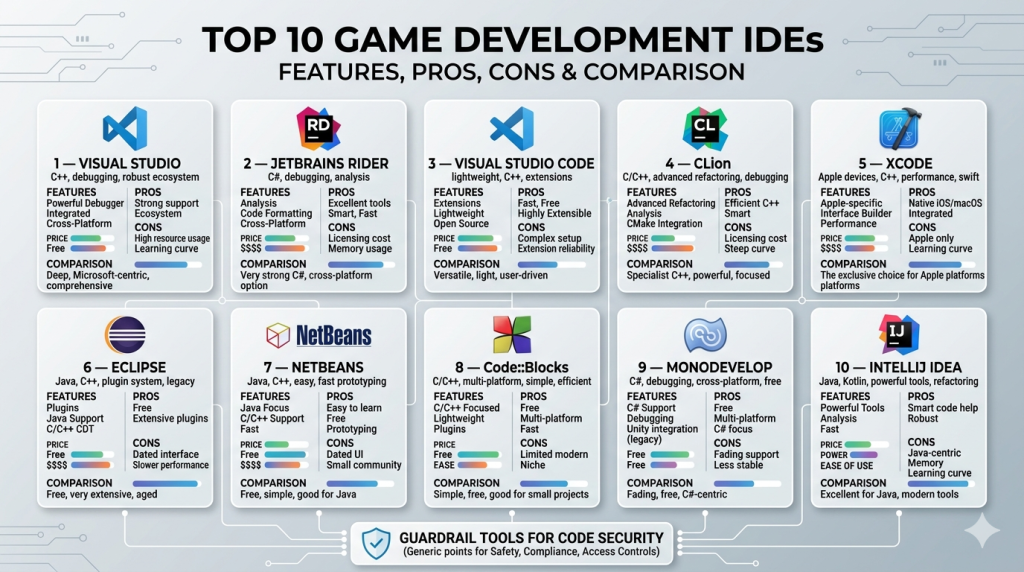
#1 — Visual Studio
Short description: A full-featured enterprise-grade IDE widely used for game development, especially with Unity and Unreal Engine.
Key Features
- Advanced debugging and performance profiling
- IntelliSense code completion
- Deep Unity and Unreal integration
- Built-in Git and version control tools
- AI-assisted coding features
- Multi-language support (C++, C#, etc.)
- Enterprise-grade tooling
Pros
- Industry-standard for professional game development
- Powerful debugging and diagnostics
- Strong ecosystem and integrations
Cons
- Resource-intensive on lower-end machines
- Complex for beginners
- Licensing costs for advanced editions
Platforms / Deployment
Windows / macOS
Security & Compliance
SSO and enterprise access controls supported via integrations; other details not publicly stated
Integrations & Ecosystem
Visual Studio integrates deeply with enterprise and development ecosystems.
- Unity and Unreal Engine
- Azure DevOps pipelines
- GitHub and Git integrations
- Extensions marketplace
- Build and testing frameworks
Support & Community
Extensive documentation, enterprise support tiers, and one of the largest developer communities globally.
#2 — JetBrains Rider
Short description: A cross-platform IDE optimized for .NET and Unity developers with strong performance and code intelligence.
Key Features
- Unity-specific debugging and profiling
- Intelligent code analysis and suggestions
- Cross-platform support
- Fast indexing and performance
- Built-in version control
- AI coding assistance
- Refactoring tools
Pros
- Excellent for Unity workflows
- Fast and responsive performance
- High-quality code analysis
Cons
- Subscription-based pricing
- Less optimized for C++ workflows
- Smaller ecosystem than Visual Studio
Platforms / Deployment
Windows / macOS / Linux
Security & Compliance
Not publicly stated
Integrations & Ecosystem
Rider integrates well with modern development workflows.
- Unity integration
- Git and version control systems
- JetBrains plugin ecosystem
- CI/CD pipelines
Support & Community
Strong documentation and active developer base, especially among Unity developers.
#3 — Visual Studio Code
Short description: A lightweight, extensible code editor widely used for scripting and flexible game development workflows.
Key Features
- Lightweight and fast performance
- Massive extension marketplace
- Multi-language support
- Integrated terminal
- Git integration
- AI extensions support
- Debugging capabilities
Pros
- Free and highly customizable
- Works across many languages and frameworks
- Large global community
Cons
- Requires setup for full IDE functionality
- Debugging not as advanced as full IDEs
- Extension overload can reduce performance
Platforms / Deployment
Windows / macOS / Linux
Security & Compliance
Not publicly stated
Integrations & Ecosystem
Extremely flexible and extensible environment.
- Unity and Unreal extensions
- GitHub integration
- Docker and cloud tools
- Language servers
Support & Community
Massive community with extensive tutorials and documentation.
#4 — CLion
Short description: A JetBrains IDE focused on C and C++ development for performance-critical game systems.
Key Features
- Advanced C++ code intelligence
- Integrated debugger
- CMake support
- Refactoring tools
- Cross-platform development
- Plugin ecosystem
Pros
- Excellent for performance-critical code
- Strong debugging tools
- High code quality support
Cons
- Paid license required
- Limited non-C++ support
- Steeper learning curve
Platforms / Deployment
Windows / macOS / Linux
Security & Compliance
Not publicly stated
Integrations & Ecosystem
CLion integrates with modern C++ workflows.
- Version control systems
- Build tools (CMake)
- Debugging frameworks
- Plugins
Support & Community
Backed by JetBrains with strong documentation and user support.
#5 — Xcode
Short description: Apple’s official IDE for developing games and apps within the Apple ecosystem.
Key Features
- Swift and Objective-C support
- Integrated simulators
- Performance profiling tools
- Metal graphics support
- Debugging tools
- Interface builder
Pros
- Essential for iOS/macOS game development
- Strong performance tools
- Free for Apple developers
Cons
- Limited to Apple ecosystem
- Not suitable for cross-platform projects
- Interface can be complex
Platforms / Deployment
macOS / iOS
Security & Compliance
Not publicly stated
Integrations & Ecosystem
Tightly integrated with Apple development tools.
- Apple SDKs
- Metal framework
- Device testing tools
Support & Community
Strong official documentation and active Apple developer community.
#6 — Eclipse
Short description: A modular open-source IDE with support for multiple languages via plugins.
Key Features
- Plugin-based architecture
- Java and C++ support
- Debugging tools
- Cross-platform compatibility
- Version control integration
Pros
- Free and highly extensible
- Large plugin ecosystem
- Flexible configuration
Cons
- Outdated UI
- Performance issues with large projects
- Requires manual setup
Platforms / Deployment
Windows / macOS / Linux
Security & Compliance
Not publicly stated
Integrations & Ecosystem
Extensive plugin ecosystem allows customization.
- Git integration
- Language plugins
- Build tools
Support & Community
Large but declining community compared to newer IDEs.
#7 — NetBeans
Short description: An open-source IDE supporting multiple languages with a focus on simplicity.
Key Features
- Multi-language support
- Built-in debugging tools
- Project management features
- Plugin support
- Cross-platform
Pros
- Easy to set up
- Free and open-source
- Stable performance
Cons
- Limited advanced features
- Smaller ecosystem
- Less focus on game dev
Platforms / Deployment
Windows / macOS / Linux
Security & Compliance
Not publicly stated
Integrations & Ecosystem
Moderate plugin ecosystem.
- Version control systems
- Build tools
- Extensions
Support & Community
Moderate community and documentation.
#8 — Code::Blocks
Short description: A lightweight IDE primarily used for C++ learning and simple game projects.
Key Features
- C++ focused
- Lightweight performance
- Plugin architecture
- Debugging tools
- Customizable interface
Pros
- Free and fast
- Beginner-friendly
- Easy setup
Cons
- Limited advanced features
- Outdated interface
- Smaller ecosystem
Platforms / Deployment
Windows / macOS / Linux
Security & Compliance
Not publicly stated
Integrations & Ecosystem
Basic ecosystem for simple workflows.
- Compiler integrations
- Debug tools
- Build systems
Support & Community
Smaller but consistent community support.
#9 — MonoDevelop
Short description: An open-source IDE for .NET and Unity-focused development.
Key Features
- C# support
- Unity integration
- Debugging tools
- Cross-platform support
- Extensible architecture
Pros
- Free and open-source
- Good for Unity workflows
- Lightweight
Cons
- Limited ongoing development
- Smaller ecosystem
- Fewer advanced features
Platforms / Deployment
Windows / macOS / Linux
Security & Compliance
Not publicly stated
Integrations & Ecosystem
Focused on .NET development.
- Unity support
- Plugins
- Version control
Support & Community
Niche community with limited updates.
#10 — IntelliJ IDEA
Short description: A powerful IDE for JVM-based languages, often used in game backend and tooling development.
Key Features
- Advanced code analysis
- Refactoring tools
- Plugin ecosystem
- Multi-language support
- Version control integration
Pros
- High productivity for backend systems
- Strong plugin ecosystem
- Reliable performance
Cons
- Not game-engine focused
- Paid version for full features
- Resource-heavy
Platforms / Deployment
Windows / macOS / Linux
Security & Compliance
Not publicly stated
Integrations & Ecosystem
Strong ecosystem for backend services.
- Git integration
- Plugins
- Build tools
Support & Community
Large and active developer community.
Comparison Table (Top 10)
| Tool Name | Best For | Platform(s) Supported | Deployment | Standout Feature | Public Rating |
|---|---|---|---|---|---|
| Visual Studio | Enterprise game dev | Windows/macOS | Hybrid | Advanced debugging | N/A |
| Rider | Unity dev | Multi-platform | Hybrid | Smart analysis | N/A |
| VS Code | Flexible scripting | Multi-platform | Hybrid | Extensibility | N/A |
| CLion | C++ dev | Multi-platform | Hybrid | C++ intelligence | N/A |
| Xcode | Apple dev | macOS/iOS | Self-hosted | Apple ecosystem | N/A |
| Eclipse | Plugin-based dev | Multi-platform | Self-hosted | Extensibility | N/A |
| NetBeans | General dev | Multi-platform | Self-hosted | Simplicity | N/A |
| Code::Blocks | Beginners | Multi-platform | Self-hosted | Lightweight | N/A |
| MonoDevelop | Unity C# dev | Multi-platform | Self-hosted | .NET focus | N/A |
| IntelliJ IDEA | Backend systems | Multi-platform | Hybrid | Productivity tools | N/A |
Evaluation & Scoring of Game Development IDEs
| Tool Name | Core | Ease | Integrations | Security | Performance | Support | Value | Weighted Total |
|---|---|---|---|---|---|---|---|---|
| Visual Studio | 10 | 7 | 9 | 7 | 9 | 9 | 7 | 8.5 |
| Rider | 8 | 8 | 8 | 6 | 8 | 8 | 7 | 7.8 |
| VS Code | 7 | 9 | 9 | 6 | 8 | 9 | 10 | 8.4 |
| CLion | 8 | 7 | 7 | 6 | 9 | 8 | 6 | 7.6 |
| Xcode | 7 | 6 | 7 | 6 | 8 | 8 | 9 | 7.4 |
| Eclipse | 6 | 6 | 7 | 5 | 6 | 7 | 9 | 6.7 |
| NetBeans | 6 | 7 | 6 | 5 | 6 | 6 | 9 | 6.6 |
| Code::Blocks | 5 | 8 | 5 | 5 | 7 | 6 | 10 | 6.6 |
| MonoDevelop | 6 | 7 | 6 | 5 | 6 | 5 | 9 | 6.4 |
| IntelliJ IDEA | 7 | 7 | 8 | 6 | 8 | 9 | 6 | 7.5 |
How to interpret the scores:
- Scores are relative comparisons across tools.
- Higher totals indicate better overall balance.
- Choose based on your priority (performance, ease, integrations).
- Enterprise teams should weigh integrations and security more.
- Indie developers may prioritize cost and ease of use.
Which Game Development IDEs Is Right for You?
Solo / Freelancer
Choose Visual Studio Code or Code::Blocks for low cost, flexibility, and ease of setup.
SMB
JetBrains Rider or Visual Studio offer a strong balance of productivity and scalability.
Mid-Market
Visual Studio and CLion are suitable for teams handling larger and more complex codebases.
Enterprise
Visual Studio remains the top choice for enterprise-scale game development with deep integrations.
Budget vs Premium
- Budget: VS Code, Code::Blocks, NetBeans
- Premium: Rider, Visual Studio, CLion
Feature Depth vs Ease of Use
- Feature depth: Visual Studio, CLion
- Ease of use: VS Code, NetBeans
Integrations & Scalability
- Strong integrations: Visual Studio, VS Code
- Scalable workflows: Rider, CLion
Security & Compliance Needs
Most IDEs rely on external infrastructure for compliance. Enterprises should integrate secure CI/CD pipelines and access controls.
Frequently Asked Questions (FAQs)
What is a game development IDE?
It is a tool that helps developers write, debug, and manage code for building games efficiently.
Do I need an IDE to build games?
While not mandatory, IDEs significantly improve productivity and debugging capabilities.
Which IDE is best for Unity?
Visual Studio and JetBrains Rider are commonly preferred.
Can beginners use IDEs?
Yes, but beginners may prefer simpler tools like VS Code or Code::Blocks.
Are IDEs free?
Some are free (VS Code), while others require paid subscriptions (Rider, Visual Studio Enterprise).
Do IDEs support AI tools?
Many modern IDEs include AI-powered coding assistance features.
Can IDEs handle large projects?
Yes, especially enterprise-grade IDEs like Visual Studio and CLion.
How do IDEs integrate with game engines?
Through plugins, SDKs, and debugging interfaces.
Can I switch IDEs easily?
Yes, but configuration and workflow adjustments may be required.
What are alternatives to IDEs?
Text editors, cloud development environments, or engine-native scripting tools.
Conclusion
Game development IDEs have become foundational tools in modern game production, enabling developers to manage complex codebases, optimize performance, and collaborate effectively across teams. From lightweight editors like VS Code to enterprise-grade platforms like Visual Studio, the ecosystem offers a wide range of options tailored to different needs.
The right choice depends on your workflow, preferred programming language, and level of project complexity. Indie developers may prioritize simplicity and cost, while enterprise teams need deep integrations and scalability.
A practical next step is to shortlist two or three IDEs that align with your game engine and language stack, test them in real-world scenarios, and evaluate how they impact developer productivity, debugging efficiency, and overall workflow before making a long-term commitment.
