Introduction
Digital Twin Platforms are software systems that create virtual replicas of physical assets, processes, or systems. These “digital twins” continuously receive real-world data from sensors, IoT devices, and systems, allowing organizations to simulate, monitor, and optimize performance in real time.
In today’s data-driven environment, digital twins are becoming critical across industries such as manufacturing, smart cities, energy, healthcare, and automotive. As systems grow more complex and interconnected, organizations need better ways to predict failures, improve efficiency, and reduce operational risks. Digital twin platforms enable this by combining simulation, analytics, and real-time data.
Common use cases include:
- Predictive maintenance for industrial equipment
- Smart city planning and infrastructure monitoring
- Supply chain and logistics optimization
- Energy grid management and simulation
- Product lifecycle management and testing
Key evaluation criteria for buyers:
- Real-time data ingestion and processing capabilities
- Simulation and modeling accuracy
- AI/ML integration for predictive analytics
- Scalability across assets and systems
- Integration with IoT platforms and enterprise systems
- Ease of deployment and usability
- Security and data governance features
- Visualization and dashboard capabilities
- Vendor ecosystem and industry support
Best for: Enterprises, industrial operators, engineers, IT teams, and data scientists working in manufacturing, energy, infrastructure, and smart systems.
Not ideal for: Small teams without IoT or data infrastructure, or use cases that don’t require real-time simulation or predictive modeling.
Key Trends in Digital Twin Platforms for 2026 and Beyond
- AI-powered predictive modeling: Increasing use of machine learning for forecasting failures and optimizing performance.
- Edge + cloud hybrid architectures: Real-time processing at the edge combined with cloud-based analytics.
- Standardization of digital twin frameworks: Industry efforts to standardize data models and interoperability.
- Integration with IoT ecosystems: Seamless connection with sensors, devices, and industrial control systems.
- Digital twin for sustainability: Used for energy optimization, carbon tracking, and environmental impact modeling.
- Real-time 3D visualization: Enhanced simulation environments with immersive and interactive dashboards.
- Cross-domain digital twins: Combining mechanical, electrical, and software systems into unified models.
- Security-first design: Stronger focus on protecting operational technology (OT) and critical infrastructure.
- Low-code/no-code interfaces: Making digital twin creation more accessible to non-developers.
- Subscription and usage-based pricing: More flexible pricing aligned with data usage and scale.
How We Selected These Tools (Methodology)
The tools listed below were selected using a structured evaluation framework:
- Strong market presence and enterprise adoption
- Comprehensive capabilities for modeling, simulation, and analytics
- Proven scalability in large, real-world deployments
- Integration with IoT platforms and enterprise systems
- Availability of AI and advanced analytics features
- Flexibility in deployment (cloud, on-premise, hybrid)
- Vendor ecosystem strength and partner network
- Documentation quality and developer support
- Industry-specific use case coverage
- Alignment with modern trends such as edge computing and AI
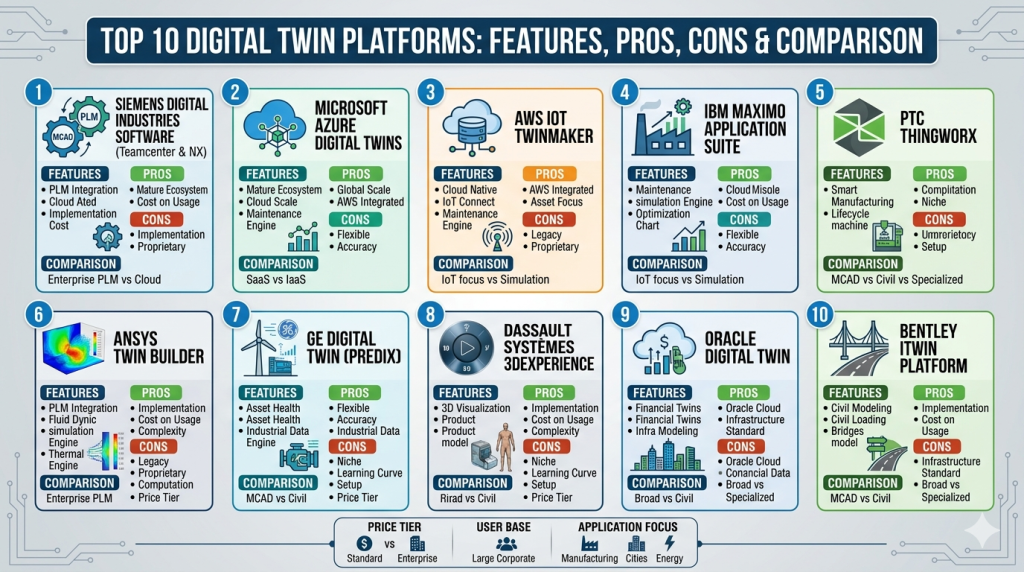
Top 10 Digital Twin Platforms Tools
#1 — Siemens Digital Industries Software (Teamcenter & NX)
Short description: A comprehensive digital twin platform for product lifecycle management, simulation, and industrial design, widely used in manufacturing and engineering.
Key Features
- Product lifecycle management (PLM) integration
- Advanced simulation and modeling tools
- Real-time data integration
- Digital twin for manufacturing processes
- Multi-domain simulation capabilities
- Industrial IoT integration
Pros
- Strong end-to-end lifecycle management
- Deep industry expertise
Cons
- Complex implementation
- High cost
Platforms / Deployment
Windows / Linux
Cloud / Hybrid
Security & Compliance
Not publicly stated
Integrations & Ecosystem
- Integration with PLM systems
- Industrial IoT platforms
- APIs for customization
- CAD and simulation tools
Support & Community
Enterprise-grade support with strong industry presence.
#2 — Microsoft Azure Digital Twins
Short description: A cloud-based platform for modeling environments and systems using real-time IoT data, suitable for scalable enterprise deployments.
Key Features
- Real-time IoT data integration
- Graph-based modeling
- Scalable cloud infrastructure
- AI and analytics integration
- API-driven architecture
Pros
- Highly scalable
- Strong cloud ecosystem
Cons
- Requires cloud expertise
- Dependency on Azure ecosystem
Platforms / Deployment
Web
Cloud
Security & Compliance
SSO, RBAC, encryption (varies by Azure services)
Integrations & Ecosystem
- Integration with IoT Hub
- Data analytics tools
- APIs and SDKs
- Cloud services ecosystem
Support & Community
Strong documentation and global developer community.
#3 — AWS IoT TwinMaker
Short description: A digital twin service that integrates IoT data with 3D models and analytics, designed for AWS-based environments.
Key Features
- Real-time IoT data ingestion
- 3D visualization tools
- Integration with AWS analytics services
- Data connectors
- Scalable architecture
Pros
- Flexible and scalable
- Strong AWS ecosystem
Cons
- Requires AWS expertise
- Setup complexity
Platforms / Deployment
Web
Cloud
Security & Compliance
Not publicly stated
Integrations & Ecosystem
- AWS IoT services
- Data analytics tools
- APIs and SDKs
- Visualization tools
Support & Community
Extensive documentation and enterprise support.
#4 — IBM Maximo Application Suite
Short description: A platform combining asset management and digital twin capabilities for industrial operations.
Key Features
- Asset lifecycle management
- Predictive maintenance
- AI-driven analytics
- IoT data integration
- Workflow automation
Pros
- Strong asset management features
- Integrated AI analytics
Cons
- Complex setup
- Enterprise-focused pricing
Platforms / Deployment
Web / Linux
Cloud / Hybrid
Security & Compliance
Not publicly stated
Integrations & Ecosystem
- Integration with enterprise systems
- APIs for automation
- IoT connectivity
- Analytics tools
Support & Community
Enterprise support with industry expertise.
#5 — PTC ThingWorx
Short description: An industrial IoT platform with digital twin capabilities for manufacturing and connected products.
Key Features
- IoT connectivity
- Real-time analytics
- Digital twin modeling
- AR integration
- Application development tools
Pros
- Strong IoT integration
- Flexible application development
Cons
- Learning curve
- Cost considerations
Platforms / Deployment
Web
Cloud / Hybrid
Security & Compliance
Not publicly stated
Integrations & Ecosystem
- IoT device integration
- APIs and SDKs
- AR/VR tools
- Enterprise systems
Support & Community
Active enterprise user base and documentation.
#6 — Ansys Twin Builder
Short description: A simulation-focused digital twin platform for engineering systems and product design.
Key Features
- Physics-based simulation
- System-level modeling
- Real-time analytics
- Integration with engineering tools
- Predictive maintenance
Pros
- High simulation accuracy
- Strong engineering focus
Cons
- Not a full IoT platform
- Requires technical expertise
Platforms / Deployment
Windows / Linux
Cloud / Hybrid
Security & Compliance
Not publicly stated
Integrations & Ecosystem
- Integration with simulation tools
- APIs for modeling
- Engineering workflows
- Data analytics
Support & Community
Strong technical documentation and support.
#7 — GE Digital Twin (Predix)
Short description: A platform designed for industrial digital twins in energy, aviation, and heavy industries.
Key Features
- Industrial asset modeling
- Predictive analytics
- Real-time monitoring
- IoT data integration
- Industry-specific solutions
Pros
- Strong industrial focus
- Proven use cases
Cons
- Limited outside core industries
- Complexity
Platforms / Deployment
Web
Cloud / Hybrid
Security & Compliance
Not publicly stated
Integrations & Ecosystem
- Industrial systems
- IoT platforms
- APIs
- Data analytics
Support & Community
Enterprise support with industry specialization.
#8 — Dassault Systèmes 3DEXPERIENCE
Short description: A platform combining simulation, design, and digital twin capabilities for product development.
Key Features
- 3D modeling and simulation
- Product lifecycle management
- Real-time collaboration
- Digital twin environments
- Multi-domain integration
Pros
- Strong design and simulation tools
- Collaborative environment
Cons
- Expensive
- Complex interface
Platforms / Deployment
Web / Windows
Cloud / Hybrid
Security & Compliance
Not publicly stated
Integrations & Ecosystem
- CAD tools
- PLM systems
- APIs
- Simulation tools
Support & Community
Strong enterprise support and global user base.
#9 — Oracle Digital Twin
Short description: A cloud-based platform for asset monitoring and predictive analytics within Oracle’s ecosystem.
Key Features
- Asset monitoring
- Predictive maintenance
- IoT data integration
- Analytics dashboards
- Cloud scalability
Pros
- Strong cloud integration
- Enterprise-ready
Cons
- Oracle ecosystem dependency
- Limited customization
Platforms / Deployment
Web
Cloud
Security & Compliance
Not publicly stated
Integrations & Ecosystem
- Oracle cloud services
- IoT tools
- APIs
- Analytics platforms
Support & Community
Enterprise-level support.
#10 — Bentley iTwin Platform
Short description: A digital twin platform focused on infrastructure and construction projects.
Key Features
- Infrastructure modeling
- Real-time data integration
- Visualization tools
- Asset lifecycle management
- Collaboration tools
Pros
- Strong for infrastructure projects
- High-quality visualization
Cons
- Niche focus
- Learning curve
Platforms / Deployment
Web / Windows
Cloud / Hybrid
Security & Compliance
Not publicly stated
Integrations & Ecosystem
- Infrastructure tools
- APIs
- Data integration
- Visualization tools
Support & Community
Growing community and enterprise support.
Comparison Table (Top 10)
| Tool Name | Best For | Platform(s) Supported | Deployment | Standout Feature | Public Rating |
|---|---|---|---|---|---|
| Siemens | Manufacturing | Windows, Linux | Hybrid | PLM integration | N/A |
| Azure Digital Twins | Cloud scalability | Web | Cloud | Graph-based modeling | N/A |
| AWS TwinMaker | AWS users | Web | Cloud | 3D visualization | N/A |
| IBM Maximo | Asset management | Web, Linux | Hybrid | Predictive maintenance | N/A |
| PTC ThingWorx | IoT platforms | Web | Hybrid | IoT connectivity | N/A |
| Ansys Twin Builder | Simulation | Windows, Linux | Hybrid | Physics-based modeling | N/A |
| GE Digital Twin | Industrial use | Web | Hybrid | Industry-specific models | N/A |
| Dassault 3DEXPERIENCE | Product design | Web, Windows | Hybrid | Collaborative design | N/A |
| Oracle Digital Twin | Enterprise cloud | Web | Cloud | Asset analytics | N/A |
| Bentley iTwin | Infrastructure | Web, Windows | Hybrid | Infrastructure modeling | N/A |
Evaluation & Scoring of Digital Twin Platforms
| Tool Name | Core | Ease | Integrations | Security | Performance | Support | Value | Weighted Total |
|---|---|---|---|---|---|---|---|---|
| Siemens | 10 | 6 | 9 | 7 | 9 | 9 | 6 | 8.35 |
| Azure Digital Twins | 9 | 7 | 10 | 8 | 9 | 9 | 7 | 8.55 |
| AWS TwinMaker | 9 | 7 | 9 | 7 | 9 | 9 | 7 | 8.30 |
| IBM Maximo | 9 | 6 | 8 | 7 | 9 | 8 | 6 | 7.95 |
| PTC ThingWorx | 8 | 7 | 9 | 7 | 8 | 8 | 7 | 7.95 |
| Ansys Twin Builder | 9 | 6 | 7 | 7 | 9 | 8 | 6 | 7.80 |
| GE Digital Twin | 8 | 6 | 8 | 7 | 8 | 8 | 6 | 7.65 |
| Dassault | 9 | 6 | 8 | 7 | 9 | 8 | 6 | 7.90 |
| Oracle | 8 | 7 | 8 | 7 | 8 | 8 | 7 | 7.80 |
| Bentley iTwin | 8 | 7 | 8 | 7 | 8 | 7 | 7 | 7.65 |
How to interpret these scores:
- Scores reflect relative strengths across categories.
- Cloud-native platforms score higher in integrations and scalability.
- Simulation-heavy tools excel in core features but may lag in ease of use.
- Value scores vary based on pricing flexibility and feature access.
- Always validate tools through real-world pilots before final selection.
Which Digital Twin Platforms Tool Is Right for You?
Solo / Freelancer
- Limited applicability; consider lightweight simulation tools instead
SMB
- Recommended: PTC ThingWorx, Bentley iTwin
- Focus on manageable deployment and cost
Mid-Market
- Recommended: Azure Digital Twins, AWS TwinMaker
- Need scalability and integration flexibility
Enterprise
- Recommended: Siemens, IBM Maximo, Dassault
- Require full lifecycle and complex system modeling
Budget vs Premium
- Budget: Cloud-native entry-level tiers
- Premium: Siemens, Dassault
Feature Depth vs Ease of Use
- Deep features: Siemens, Ansys
- Easier: Azure, AWS
Integrations & Scalability
- Strong ecosystems: Azure, AWS
- Specialized: Bentley, GE
Security & Compliance Needs
- Enterprise cloud providers offer stronger security controls (varies).
- Industrial deployments require strict governance.
Frequently Asked Questions (FAQs)
What is a digital twin platform?
A digital twin platform creates a virtual representation of physical systems using real-time data for monitoring and simulation.
How do digital twins work?
They connect physical assets with sensors and data systems to simulate behavior in a virtual environment.
Are digital twin platforms expensive?
Costs vary widely depending on scale, features, and deployment model.
Do digital twins require IoT devices?
Yes, most implementations rely on IoT sensors for real-time data.
Can digital twins improve efficiency?
Yes, they help identify inefficiencies and predict failures.
Are these platforms cloud-based?
Many are cloud or hybrid, though some support on-premise deployments.
How long does implementation take?
It can range from weeks to months depending on complexity.
Are digital twins secure?
Security depends on the platform and implementation practices.
What industries use digital twins?
Manufacturing, energy, healthcare, smart cities, and infrastructure.
Can small businesses use digital twins?
Yes, but adoption depends on data infrastructure and use case complexity.
Conclusion
Digital Twin Platforms are transforming how organizations design, monitor, and optimize physical systems. By combining real-time data, simulation, and analytics, they enable smarter decisions and more efficient operations.
There is no single best platform:
- Enterprises should focus on comprehensive solutions like Siemens or IBM.
- Cloud-first teams benefit from Azure or AWS.
- Industry-specific users should consider specialized platforms like Bentley or GE.
