Data clean rooms help organizations collaborate on sensitive customer, campaign, audience, retail, media, and partner data without exposing raw user-level information. They are increasingly important for brands, publishers, retail media networks, ad platforms, financial services firms, and enterprise data teams that need privacy-preserving analytics, measurement, activation, and partner collaboration. A strong data clean room should provide controlled joins, permissioned access, aggregation rules, privacy-enhancing technologies, auditability, governance workflows, and integration with the cloud or marketing stack already used by the business. Industry definitions commonly describe data clean rooms as secure environments where multiple parties can analyze shared datasets without exposing raw data to one another.
Real-world use cases include:
- Retail media measurement: Brands and retailers can analyze campaign performance while protecting shopper-level data.
- Audience overlap analysis: Publishers, advertisers, and partners can understand shared audiences without exchanging raw files.
- Privacy-safe attribution: Marketing teams can measure campaign impact across platforms with governed outputs.
- Data monetization: Enterprises can create controlled data collaboration products for partners.
- Partner analytics: Multiple organizations can run approved queries on joined datasets without moving sensitive data.
- Customer enrichment: Teams can gain aggregate insights from trusted partner data while limiting exposure.
Evaluation Criteria for Buyers:
- Privacy architecture: Look for controls such as aggregation thresholds, query restrictions, differential privacy, encryption, or confidential computing.
- Deployment model: Decide whether you need cloud-native, SaaS, hybrid, decentralized, or warehouse-native architecture.
- Data movement: Prefer platforms that reduce unnecessary copying of sensitive datasets.
- Governance controls: Review permissions, approval workflows, audit logs, policy controls, and output review.
- Identity and matching: Check whether the platform supports deterministic matching, privacy-safe identifiers, or partner identity integrations.
- Interoperability: Consider whether it works across AWS, Google Cloud, Snowflake, Databricks, ad platforms, and BI tools.
- Ease of use: Business users may need templates, clean UI, prebuilt workflows, and campaign measurement reports.
- Scalability: Large enterprises need strong query performance, multi-party collaboration, and enterprise-grade administration.
- Compliance readiness: Validate security, privacy, and data residency requirements directly with the vendor.
- Activation support: Some teams need analytics only, while others need audience activation and campaign workflows.
Best for: Data clean rooms are best for enterprises, retailers, publishers, media networks, advertisers, data teams, and regulated organizations that need secure data collaboration without direct raw-data sharing. They are especially useful where first-party data, partner data, and privacy obligations must be balanced carefully.
Not ideal for: Data clean rooms are not ideal for teams that lack clean first-party data, defined partner use cases, governance maturity, or analytics resources. They are also not a replacement for consent management, data quality, identity strategy, or privacy/legal review.
Key Trends in Data Clean Rooms
- First-party data collaboration is becoming more important as organizations reduce reliance on third-party identifiers and need trusted partner analytics.
- Retail media networks are a major adoption driver because brands and retailers need privacy-safe measurement and audience insights.
- Cloud-native clean rooms are growing as AWS, Google, Snowflake, and other cloud ecosystems add governed collaboration capabilities.
- Interoperability is a major buyer concern because advertisers, publishers, retailers, and agencies often operate across multiple clouds and media environments.
- Privacy-enhancing technologies are becoming a differentiator with confidential computing, differential privacy, encryption, federated workflows, and output controls gaining more attention.
- Business-user workflows are improving through templates, approval flows, packaged measurement use cases, and low-code interfaces.
- Data clean rooms are expanding beyond advertising into financial services, healthcare research, supply chain collaboration, data monetization, and enterprise analytics.
- Governance and auditability matter more than dashboards because privacy teams need visibility into who queried what, when, and under which rules.
- Activation is becoming part of the value chain as some platforms connect insights to campaign targeting, suppression, measurement, and reporting workflows.
- Neutral clean rooms are gaining attention for cases where no single data owner or cloud provider should control the collaboration environment.
Methodology
This list focuses on widely used, credible, and enterprise-relevant data clean room platforms across cloud-native, marketing, retail media, decentralized, and privacy-enhancing technology use cases. Tools were evaluated using practical buyer criteria rather than marketing claims.
Selection factors included:
- Breadth of data collaboration use cases
- Privacy and governance architecture
- Cloud, warehouse, and marketing ecosystem fit
- Suitability for enterprise data teams
- Support for audience, campaign, retail media, and partner analytics
- Availability of clean room workflows or templates
- Identity, matching, and activation options
- Security and compliance transparency
- Ease of onboarding for technical and business teams
- Long-term fit for privacy-first data strategy
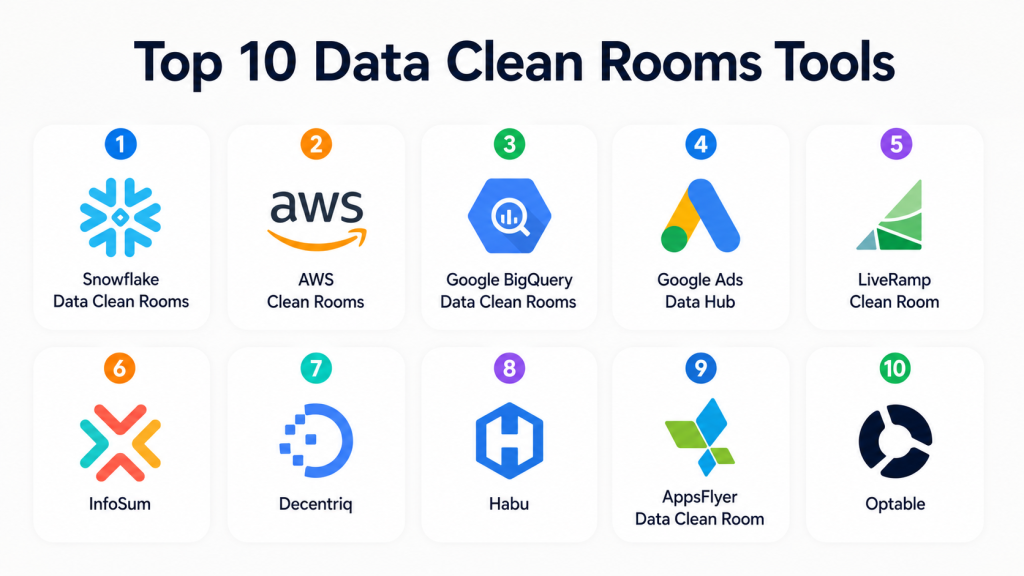
Top 10 Data Clean Rooms Tools
1- Snowflake Data Clean Rooms
Short description
Snowflake Data Clean Rooms is a warehouse-native clean room option designed for organizations already using Snowflake’s data cloud ecosystem. It supports secure collaboration between data providers and consumers while helping teams reduce raw-data movement. Snowflake positions its clean room capability as a native app-based environment for privacy-preserving collaboration on the Snowflake AI Data Cloud.
Key Features
- Warehouse-native data collaboration
- Clean room templates for common use cases
- Controlled joins and governed query workflows
- Strong fit for Snowflake customers and data teams
- Marketplace and partner collaboration potential
- Support for analytics, measurement, and data sharing
- Integration with broader Snowflake data governance workflows
Pros
- Strong fit for enterprises already using Snowflake
- Reduces friction for teams with Snowflake-based data assets
- Good option for secure data collaboration and partner analytics
- Supports business and technical clean room workflows
Cons
- Best value is strongest inside the Snowflake ecosystem
- May require Snowflake skills and architecture planning
- Cross-platform workflows may need additional setup
- Cost depends on Snowflake usage and configuration
Platforms / Deployment
Cloud-native and Snowflake-native deployment. Availability and configuration may vary by region, account setup, and enterprise agreement.
Security & Compliance
Snowflake has strong enterprise security positioning, but specific compliance mappings for each clean room implementation should be verified directly with the vendor. Use Not publicly stated where a certification is not confirmed for the exact deployment.
Integrations & Ecosystem
Snowflake Data Clean Rooms benefits from Snowflake’s broader data ecosystem, including warehouse, marketplace, data sharing, governance, and partner integrations.
Common ecosystem fit includes:
- Snowflake AI Data Cloud
- Snowflake Marketplace
- BI and analytics tools
- Marketing and media partners
- Data sharing workflows
- Enterprise governance tools
Support & Community
Enterprise support is available through Snowflake. Community resources, documentation, partner ecosystem support, and implementation services are also commonly available.
2- AWS Clean Rooms
Short description
AWS Clean Rooms is a cloud-native data collaboration service for organizations that want to collaborate securely with partners while keeping data controlled inside AWS. It is well suited for teams already using AWS data, analytics, advertising, retail, or partner collaboration infrastructure. AWS Clean Rooms is often selected by technical teams that want scalable clean room workflows close to existing AWS data pipelines.
Key Features
- AWS-native clean room collaboration
- Controlled multi-party data analysis
- Integration with AWS analytics services
- Query controls and collaboration configuration
- Support for advertising, measurement, and partner analytics
- Scalable infrastructure for enterprise data workloads
- Good fit for teams already standardized on AWS
Pros
- Strong option for AWS-first organizations
- Useful for technical teams with existing AWS pipelines
- Scales well for enterprise analytics workloads
- Can reduce data movement inside AWS environments
Cons
- Requires AWS skills for setup and management
- Less friendly for non-technical business users without enablement
- Best fit depends on existing AWS adoption
- Some partner workflows may require additional integration work
Platforms / Deployment
AWS cloud-native deployment.
Security & Compliance
AWS provides broad cloud security capabilities, but buyers should verify which compliance requirements apply to AWS Clean Rooms in their own region and configuration. Use Varies / N/A where requirements depend on customer setup.
Integrations & Ecosystem
AWS Clean Rooms fits naturally into the AWS ecosystem.
Common ecosystem fit includes:
- AWS analytics services
- Amazon S3
- AWS Glue
- Amazon Athena
- Advertising and retail media workflows
- Partner data collaboration
- Enterprise cloud governance
Support & Community
AWS support options vary by customer plan. Documentation, solution architects, partners, and AWS professional services may support implementation.
3- Google BigQuery Data Clean Rooms
Short description
Google BigQuery Data Clean Rooms are designed for secure data sharing and privacy-aware analysis inside the Google Cloud ecosystem. They are useful for organizations that already use BigQuery for analytics and want governed collaboration with partners. BigQuery clean room capabilities are often considered by data teams that need cloud-native analytics, strong query performance, and integration with Google Cloud governance.
Key Features
- BigQuery-native analytics environment
- Secure data sharing and governed collaboration
- Strong fit for Google Cloud customers
- Integration with Google Cloud identity and governance tools
- Useful for media, retail, analytics, and enterprise data collaboration
- Supports scalable query workloads
- Works well for technical data teams
Pros
- Strong fit for Google Cloud and BigQuery users
- High-performance analytics foundation
- Useful for large-scale data collaboration
- Can connect clean room workflows with broader Google Cloud architecture
Cons
- Best value is strongest for Google Cloud customers
- Requires technical setup and governance planning
- Business-user workflows may need additional layers
- Partner collaboration depends on ecosystem alignment
Platforms / Deployment
Google Cloud and BigQuery-native deployment.
Security & Compliance
Google Cloud provides enterprise security controls, but specific clean room compliance requirements should be validated for each deployment. Use Not publicly stated when exact certifications are not confirmed.
Integrations & Ecosystem
Google BigQuery Data Clean Rooms fit well with Google Cloud data and analytics workflows.
Common ecosystem fit includes:
- BigQuery
- Google Cloud Analytics Hub
- Looker
- Google Cloud IAM
- Data governance tools
- Marketing analytics workflows
- Partner data sharing models
Support & Community
Support depends on Google Cloud plan and enterprise agreement. Documentation, cloud partners, and professional services can help with implementation.
4- Google Ads Data Hub
Short description
Google Ads Data Hub is a clean room-style analytics environment focused on Google media measurement and advertising insights. It is especially relevant for advertisers and agencies that need to analyze Google campaign performance while working within privacy controls. It is not a general-purpose enterprise clean room in the same way as some cloud or neutral platforms, but it is very important for Google advertising measurement.
Key Features
- Google advertising measurement focus
- Privacy-safe campaign analytics
- Strong fit for YouTube and Google Ads measurement
- Query-based analysis environment
- Audience and campaign performance insights
- Controlled reporting outputs
- Integration with Google media ecosystem
Pros
- Strong choice for Google media measurement
- Useful for advertisers, agencies, and analytics teams
- Works well for campaign performance analysis
- Built around privacy-safe advertising workflows
Cons
- Narrower use case than general enterprise clean rooms
- Primarily focused on Google media environments
- Requires technical and analytics skills
- Not ideal for broad multi-cloud partner collaboration alone
Platforms / Deployment
Google advertising and analytics ecosystem.
Security & Compliance
Privacy controls are central to the platform, but buyers should validate exact compliance needs with Google and internal legal teams.
Integrations & Ecosystem
Google Ads Data Hub is most useful inside Google’s advertising ecosystem.
Common ecosystem fit includes:
- Google Ads
- YouTube advertising
- Google Marketing Platform
- BigQuery
- Campaign analytics
- Media measurement workflows
Support & Community
Support depends on Google account structure, advertising relationship, and available enterprise support channels.
5- LiveRamp Clean Room
Short description
LiveRamp Clean Room is designed for privacy-first data collaboration, identity-enabled analytics, and partner measurement. It is often considered by advertisers, publishers, retailers, and media networks that need controlled collaboration across data partners. LiveRamp documentation describes its clean room as enabling analytics from controlled datasets while protecting consumer privacy and data-owner rights.
Key Features
- Privacy-first data collaboration
- Identity and matching capabilities
- Partner analytics and measurement workflows
- Governed joins and controlled outputs
- Strong fit for media, retail, and advertising use cases
- Connectivity with walled gardens and partner environments
- Support for clean room partner workflows
Pros
- Strong fit for marketing and media collaboration
- Useful where identity resolution and partner matching matter
- Mature ecosystem for advertisers and publishers
- Supports governed collaboration across partners
Cons
- May be more marketing and media oriented than general enterprise analytics
- Pricing and setup can vary by use case
- Requires careful identity and consent governance
- Technical complexity depends on integrations
Platforms / Deployment
SaaS and partner-connected deployment options. Cloud and partner environment support may vary by implementation.
Security & Compliance
Privacy and governance are central to the platform, but buyers should verify exact certifications, regions, and compliance requirements directly.
Integrations & Ecosystem
LiveRamp has a strong ecosystem around identity, media, advertising, and data collaboration.
Common ecosystem fit includes:
- Media partners
- Advertisers and publishers
- Retail media networks
- Walled garden connections
- Campaign measurement workflows
- Data collaboration partners
- BI and analytics workflows
Support & Community
LiveRamp provides enterprise support and partner implementation guidance. Support depth may vary by contract and use case.
6- InfoSum
Short description
InfoSum is a privacy-focused data clean room platform known for decentralized collaboration models. It is designed to help organizations collaborate without moving or exposing raw data. InfoSum is often considered by media owners, advertisers, data providers, and enterprises that want strong privacy architecture and partner collaboration without centralizing sensitive datasets.
Key Features
- Decentralized clean room architecture
- Privacy-safe data collaboration
- Audience overlap and partner analytics
- Data collaboration without raw-data sharing
- Strong fit for media and advertising ecosystems
- Governance and access controls
- Multi-party collaboration support
Pros
- Strong privacy-first positioning
- Useful for organizations that want to avoid central data pooling
- Good fit for partner collaboration and audience analytics
- Strong relevance for media and advertising use cases
Cons
- May require partner onboarding and ecosystem coordination
- Business value depends on partner network availability
- Technical architecture may require education for buyers
- Pricing is not always simple to compare
Platforms / Deployment
SaaS and decentralized collaboration model. Specific deployment details vary by customer and partner setup.
Security & Compliance
Privacy architecture is a core differentiator, but compliance details should be verified directly. Use Not publicly stated where exact certifications are not confirmed.
Integrations & Ecosystem
InfoSum is suited for data collaboration across partner ecosystems.
Common ecosystem fit includes:
- Publishers
- Advertisers
- Agencies
- Data providers
- Retail media partners
- Audience analytics workflows
- Measurement use cases
Support & Community
Enterprise support and onboarding are typically needed for partner collaboration programs.
7- Decentriq
Short description
Decentriq is a privacy-enhancing technology focused data clean room platform with emphasis on high-security collaboration. It is often relevant for regulated industries, sensitive data partnerships, and organizations that need stronger privacy controls than basic aggregated reporting. Decentriq’s own comparison content highlights evaluation areas such as privacy architecture, deployment model, governance controls, interoperability, and multi-party capability.
Key Features
- Privacy-enhancing technology focus
- High-security data collaboration
- Multi-party analytics support
- Strong governance and control orientation
- Useful for regulated and sensitive-data workflows
- Data collaboration without unnecessary raw-data exposure
- Suitable for advanced privacy use cases
Pros
- Strong fit for privacy-sensitive use cases
- Relevant for regulated industries and enterprise collaboration
- Good option when privacy architecture is a top priority
- Supports advanced data collaboration models
Cons
- May require technical and privacy expertise
- Less familiar to some marketing-only teams
- Partner onboarding may take planning
- Fit depends on use case complexity and governance maturity
Platforms / Deployment
SaaS and secure collaboration environment. Exact deployment options should be validated with the vendor.
Security & Compliance
Security and privacy are central to Decentriq’s positioning, but certifications and compliance requirements should be checked directly for the buyer’s region and use case.
Integrations & Ecosystem
Decentriq is commonly evaluated for secure collaboration across organizations and regulated environments.
Common ecosystem fit includes:
- Enterprise data teams
- Regulated data collaboration
- Partner analytics
- Secure multi-party analysis
- Research and analytics workflows
- Privacy-enhancing technology programs
Support & Community
Enterprise implementation support is typically important due to the platform’s security and governance depth.
8- Habu
Short description
Habu is a data clean room and data collaboration platform focused on helping brands, agencies, media companies, and enterprises collaborate across fragmented data ecosystems. It is known for orchestration and interoperability across different clean room and cloud environments. Habu is often a good fit for teams that need practical marketing use cases, business-user workflows, and multi-cloud collaboration.
Key Features
- Data clean room orchestration
- Multi-cloud and partner collaboration focus
- Marketing analytics and measurement workflows
- Audience overlap and campaign insights
- Business-friendly clean room workflows
- Partner ecosystem connectivity
- Support for brands, agencies, and media companies
Pros
- Strong fit for marketing and media teams
- Useful where interoperability is important
- More approachable for business users than some cloud-native options
- Helps operationalize clean room use cases
Cons
- Best value depends on partner ecosystem and use case maturity
- May overlap with cloud-native clean room tools
- Technical architecture should be reviewed carefully
- Pricing and packaging may vary
Platforms / Deployment
SaaS and orchestration-oriented deployment. Multi-cloud support may depend on customer configuration and partner environment.
Security & Compliance
Security details should be validated directly. Use Not publicly stated for certifications or controls that are not confirmed in a buyer’s exact contract.
Integrations & Ecosystem
Habu is designed for cross-ecosystem collaboration.
Common ecosystem fit includes:
- Cloud data warehouses
- Advertising platforms
- Media partners
- Retail media networks
- Agency workflows
- Analytics and reporting tools
- Campaign measurement pipelines
Support & Community
Enterprise support and onboarding are important for aligning partners, datasets, permissions, and measurement use cases.
9- AppsFlyer Data Clean Room
Short description
AppsFlyer Data Clean Room is focused on privacy-first collaboration for mobile, app marketing, retail media, and performance measurement use cases. It is suitable for organizations that already use AppsFlyer or need secure collaboration around app attribution, mobile audiences, and partner performance insights. AppsFlyer describes its clean room as part of a broader data collaboration platform with permission-based controls, aggregated insights, and privacy-enhancing technologies.
Key Features
- Privacy-first data collaboration
- Strong fit for app and mobile marketing use cases
- Permission-based controls
- Aggregated insights
- Retail media and performance measurement support
- Audience and partner collaboration workflows
- Integration with AppsFlyer measurement ecosystem
Pros
- Strong option for mobile-first companies
- Useful for app marketers and performance teams
- Good fit where attribution and partner measurement matter
- Can connect clean room workflows to mobile marketing analytics
Cons
- Less general-purpose than cloud-native clean room platforms
- Best value is strongest for AppsFlyer-related ecosystems
- Not ideal for all enterprise data collaboration use cases
- Buyer should validate non-mobile use case fit carefully
Platforms / Deployment
SaaS and AppsFlyer data collaboration ecosystem.
Security & Compliance
AppsFlyer emphasizes secure and privacy-first collaboration, but buyers should verify specific compliance needs, certifications, and contractual controls directly.
Integrations & Ecosystem
AppsFlyer Data Clean Room fits best into app marketing and measurement workflows.
Common ecosystem fit includes:
- AppsFlyer measurement suite
- Mobile marketing partners
- Retail media networks
- Audience activation workflows
- App attribution reporting
- Performance analytics
- Partner collaboration
Support & Community
Support depends on AppsFlyer plan, enterprise agreement, and implementation scope.
10- Optable
Short description
Optable is a data collaboration and clean room platform built for advertising, media, and audience collaboration use cases. It is often relevant for publishers, media owners, ad tech teams, and brands that need privacy-safe audience planning, activation, and measurement. Optable can be a practical option for organizations that want clean room capabilities without building a full cloud-native system internally.
Key Features
- Privacy-safe data collaboration
- Audience planning and activation support
- Clean room workflows for media and advertising
- Publisher and media owner use cases
- Partner collaboration capabilities
- Identity and audience matching support
- Campaign measurement and segmentation workflows
Pros
- Strong fit for publishers and media companies
- Useful for audience collaboration and campaign planning
- More focused than broad enterprise cloud clean rooms
- Good option for advertising-driven use cases
Cons
- Not as broad as general cloud data platforms
- Best fit depends on media and advertising workflows
- Enterprise data teams may need integration planning
- Pricing and deployment details may vary
Platforms / Deployment
SaaS deployment. Exact hosting, integration, and data workflow options should be verified with the vendor.
Security & Compliance
Privacy-safe collaboration is central to the platform, but exact certifications and compliance coverage should be validated directly.
Integrations & Ecosystem
Optable fits media, publisher, and advertising collaboration environments.
Common ecosystem fit includes:
- Publishers
- Media owners
- Advertisers
- Ad tech platforms
- Audience planning tools
- Campaign measurement workflows
- Partner data collaboration
Support & Community
Vendor support and onboarding are important for partner collaboration, audience setup, and campaign workflows.
Comparison Table
| Tool Name | Best For | Platforms Supported | Deployment | Standout Strength | Watch-Out | Public Rating |
|---|---|---|---|---|---|---|
| Snowflake Data Clean Rooms | Snowflake users and enterprise data teams | Snowflake ecosystem | Cloud-native | Warehouse-native collaboration | Strongest inside Snowflake | N/A |
| AWS Clean Rooms | AWS-first data teams | AWS | Cloud-native | Scalable AWS analytics collaboration | Requires AWS skills | N/A |
| Google BigQuery Data Clean Rooms | Google Cloud analytics teams | Google Cloud | Cloud-native | BigQuery-native secure sharing | Best for Google Cloud users | N/A |
| Google Ads Data Hub | Google media measurement | Google Ads ecosystem | Cloud-based | Google campaign analytics | Narrower advertising focus | N/A |
| LiveRamp Clean Room | Identity-enabled marketing collaboration | Multi-partner ecosystem | SaaS / partner-connected | Identity and partner measurement | Requires governance maturity | N/A |
| InfoSum | Decentralized collaboration | Multi-party ecosystems | SaaS / decentralized | Privacy-first non-movement model | Partner onboarding required | N/A |
| Decentriq | High-security collaboration | Enterprise environments | SaaS / secure collaboration | Privacy-enhancing technology depth | May need technical expertise | N/A |
| Habu | Marketing clean room orchestration | Multi-cloud and partner ecosystems | SaaS | Interoperability and orchestration | Depends on partner ecosystem | N/A |
| AppsFlyer Data Clean Room | Mobile and app marketing | AppsFlyer ecosystem | SaaS | App attribution and mobile measurement fit | Less general-purpose | N/A |
| Optable | Publisher and media collaboration | Media and ad ecosystems | SaaS | Audience collaboration and activation | Media-focused fit | N/A |
Evaluation and Scoring
Scoring is based on practical buyer evaluation, not public star ratings. Scores are directional and should be validated against your internal requirements.
| Tool | Core 25% | Ease 15% | Integrations 15% | Security 10% | Performance 10% | Support 10% | Value 15% | Weighted Total |
|---|---|---|---|---|---|---|---|---|
| Snowflake Data Clean Rooms | 9 | 7 | 9 | 9 | 9 | 8 | 8 | 8.45 |
| AWS Clean Rooms | 9 | 6 | 8 | 9 | 9 | 8 | 8 | 8.15 |
| Google BigQuery Data Clean Rooms | 8 | 7 | 8 | 9 | 9 | 8 | 8 | 8.10 |
| Google Ads Data Hub | 8 | 6 | 8 | 9 | 8 | 8 | 8 | 7.80 |
| LiveRamp Clean Room | 9 | 7 | 9 | 9 | 8 | 8 | 7 | 8.15 |
| InfoSum | 9 | 7 | 8 | 10 | 8 | 8 | 8 | 8.25 |
| Decentriq | 8 | 7 | 7 | 10 | 8 | 8 | 8 | 8.00 |
| Habu | 8 | 8 | 9 | 8 | 8 | 8 | 8 | 8.20 |
| AppsFlyer Data Clean Room | 7 | 8 | 8 | 9 | 8 | 8 | 8 | 7.90 |
| Optable | 7 | 8 | 8 | 8 | 8 | 8 | 8 | 7.75 |
Scoring Interpretation
- Best cloud-native fit: Snowflake Data Clean Rooms, AWS Clean Rooms, Google BigQuery Data Clean Rooms
- Best advertising measurement fit: Google Ads Data Hub, LiveRamp Clean Room, AppsFlyer Data Clean Room
- Best decentralized privacy model: InfoSum
- Best high-security collaboration fit: Decentriq
- Best orchestration fit: Habu
- Best publisher and media fit: Optable
Which Data Clean Rooms Tool Is Right for You?
For Snowflake-first enterprises
Choose Snowflake Data Clean Rooms if your customer, transaction, product, or marketing data already lives in Snowflake. It is a practical choice when your data team wants governed collaboration without moving data into a separate platform.
For AWS-first enterprises
Choose AWS Clean Rooms if your data lake, analytics pipelines, and partner workflows are already built on AWS. It is best for technical teams that want cloud-native control, scale, and integration with AWS services.
For Google Cloud analytics teams
Choose Google BigQuery Data Clean Rooms if BigQuery is already your analytics foundation. It is a strong fit for enterprises that want secure collaboration close to existing Google Cloud data workflows.
For Google advertising measurement
Choose Google Ads Data Hub if your main goal is privacy-safe analysis of Google advertising performance. It is not the broadest clean room, but it is highly relevant for Google media analytics.
For media, identity, and partner measurement
Choose LiveRamp Clean Room if identity, match quality, partner measurement, and media collaboration are central to your strategy. It is strong for advertisers, retailers, publishers, and data collaboration partnerships.
For decentralized data collaboration
Choose InfoSum if you want to collaborate without centralizing raw datasets. It is especially useful when partners do not want to move data or expose sensitive customer information.
For high-security or regulated use cases
Choose Decentriq if privacy-enhancing technology, secure analytics, and sensitive-data collaboration are top priorities. It is a good fit for advanced privacy teams and regulated industries.
For marketing orchestration
Choose Habu if you need to coordinate clean room use cases across multiple clouds, partners, and marketing environments. It is useful when interoperability and business-user workflows matter.
For app and mobile measurement
Choose AppsFlyer Data Clean Room if your business is mobile-first and needs privacy-safe attribution, retail media, or app ecosystem collaboration.
For publishers and media owners
Choose Optable if you need audience planning, media collaboration, and privacy-safe activation workflows designed for publishers and advertising teams.
Common Mistakes to Avoid
- Starting without a clear use case: Data clean rooms work best when the business question is specific.
- Assuming clean rooms solve consent problems: You still need proper consent, contracts, privacy review, and data governance.
- Ignoring data quality: Poor identity resolution, inconsistent fields, and messy first-party data reduce value.
- Choosing only based on brand name: The best platform depends on your cloud, partners, and use case.
- Overlooking partner readiness: Clean rooms require both sides to prepare data, permissions, and workflows.
- Underestimating technical effort: Even business-friendly tools need data modeling, governance, and testing.
- Forgetting output controls: Aggregation thresholds, query rules, and result approvals are critical.
- Not involving legal and privacy teams early: Privacy review should happen before onboarding data.
- Treating clean rooms as dashboards: They are secure collaboration environments, not just reporting tools.
- Failing to plan activation: Analytics is useful, but many teams also need audience activation or campaign optimization.
- Ignoring cost structure: Cloud compute, data storage, partner fees, and vendor pricing can all affect total cost.
- Skipping pilot measurement: A small pilot helps validate match rates, query value, and operational complexity.
Frequently Asked Questions
1- What is a data clean room?
A data clean room is a secure environment where two or more organizations can analyze combined datasets without directly exposing raw customer-level data. It uses controls such as permissions, aggregation, query limits, and privacy rules. The goal is to enable useful insights while reducing privacy and data leakage risks.
2- Why are data clean rooms important?
Data clean rooms are important because companies need to collaborate on data while meeting privacy, consent, and governance expectations. They help brands, publishers, retailers, and partners measure performance, understand audiences, and improve campaigns without sending raw files back and forth.
3- Are data clean rooms only for advertising?
No. Advertising and retail media are common use cases, but data clean rooms can also support financial services, healthcare research, supply chain collaboration, data monetization, and enterprise partner analytics. The best use case depends on the data, partners, and privacy requirements.
4- Do data clean rooms replace consent management?
No. A clean room does not replace consent management, privacy notices, contracts, or legal review. It is a technical and governance environment that supports safer collaboration, but companies still need proper rights and policies for the data they use.
5- What is the difference between a cloud clean room and a neutral clean room?
A cloud clean room is usually built inside a cloud or warehouse ecosystem such as AWS, Google Cloud, or Snowflake. A neutral clean room is often designed to work across partners, platforms, or decentralized environments where no single party wants to centralize all data.
6- Which data clean room is best for Snowflake users?
Snowflake Data Clean Rooms is usually the most natural starting point for companies that already keep major datasets in Snowflake. It helps reduce data movement and works well with Snowflake’s broader data governance and collaboration ecosystem.
7- Which data clean room is best for AWS users?
AWS Clean Rooms is a strong choice for organizations already using AWS analytics, storage, and data processing services. It is especially suitable for technical teams that want clean room workflows close to their existing AWS infrastructure.
8- Which data clean room is best for marketing teams?
Marketing teams may consider LiveRamp, Habu, Google Ads Data Hub, AppsFlyer, Optable, or Snowflake depending on their use case. The best choice depends on whether the goal is identity matching, media measurement, app attribution, retail media analytics, or broader partner collaboration.
9- What should buyers check before choosing a data clean room?
Buyers should check privacy controls, deployment model, data movement, partner compatibility, query governance, identity matching, activation options, integrations, compliance needs, support quality, and pricing structure. A pilot project is strongly recommended before scaling.
10- Are data clean rooms expensive?
Costs vary widely based on vendor, cloud usage, data volume, number of partners, query workloads, implementation support, and activation needs. Some platforms are priced as SaaS, while cloud-native tools may involve compute and storage costs. Buyers should estimate total cost, not just license cost.
Conclusion
Data clean rooms are becoming a core part of privacy-first data collaboration because they help organizations analyze, measure, and activate partner data without exposing raw sensitive information. The best platform depends on your existing data stack, partner ecosystem, privacy expectations, and business use case. Snowflake, AWS, and Google BigQuery are strong choices for cloud-native teams, while LiveRamp, Habu, InfoSum, Decentriq, AppsFlyer, and Optable serve more specialized collaboration, identity, media, mobile, and privacy-focused needs. Start by defining one high-value use case, shortlist two or three tools, run a controlled pilot, validate privacy and legal requirements, measure match quality and insight value, and then scale only after governance, cost, and partner workflows are proven.
