Introduction
AR/VR development platforms are software tools and frameworks that enable developers to create immersive augmented reality (AR) and virtual reality (VR) experiences. These platforms provide everything from 3D rendering engines and spatial computing tools to device compatibility layers and SDKs for building interactive environments.
AR/VR is no longer limited to gaming. It’s becoming a core part of enterprise workflows, training simulations, healthcare visualization, retail experiences, and industrial design. With the rise of spatial computing and AI-assisted content creation, businesses are increasingly investing in robust development platforms to build scalable immersive applications.
Common use cases include:
- Training simulations for manufacturing, aviation, and healthcare
- Virtual product demos and retail experiences
- Remote collaboration in 3D environments
- Architectural visualization and digital prototyping
- Gaming and entertainment experiences
What buyers should evaluate:
- Cross-platform compatibility (headsets, mobile, web)
- Rendering quality and performance
- Ease of development and learning curve
- Integration with existing tools (CAD, IoT, cloud)
- AI and automation capabilities
- Security and enterprise readiness
- Community and support ecosystem
- Licensing and pricing model
Best for: Developers, game studios, enterprise IT teams, product designers, and training organizations looking to build immersive, interactive applications at scale.
Not ideal for: Teams with no 3D or development expertise, or businesses needing simple visualization tools—lighter no-code or 3D viewers may be more suitable.
Key Trends in AR/VR Development Platforms for 2026 and Beyond
- AI-assisted development: Platforms increasingly offer AI tools for asset generation, scene building, and code suggestions.
- Cross-platform standardization: Tools are moving toward unified frameworks supporting VR headsets, AR glasses, mobile, and web.
- Web-based AR/VR (WebXR): Growing adoption of browser-based immersive experiences without app installs.
- Enterprise digital twin integration: AR/VR tools are merging with IoT and digital twin ecosystems.
- Low-code/no-code builders: Visual scripting tools are reducing reliance on heavy programming.
- Cloud rendering and streaming: High-fidelity experiences delivered via cloud infrastructure.
- Real-time collaboration: Multi-user environments for design reviews and training simulations.
- Security-first design: Increased focus on identity management, encryption, and compliance.
- Hardware ecosystem expansion: Support for new-generation headsets and spatial computing devices.
- Subscription and usage-based pricing: Shift from perpetual licenses to flexible pricing models.
How We Selected These Tools (Methodology)
- Evaluated market adoption and developer mindshare across industries
- Assessed feature completeness, including rendering, SDKs, and device support
- Considered performance and reliability in real-world deployments
- Reviewed security posture signals where publicly available
- Analyzed integration capabilities with cloud, CAD, and enterprise systems
- Examined developer experience, documentation, and ease of onboarding
- Included a mix of enterprise-grade, developer-first, and open-source tools
- Prioritized platforms with active ecosystems and community support
- Considered scalability across small teams to large enterprises
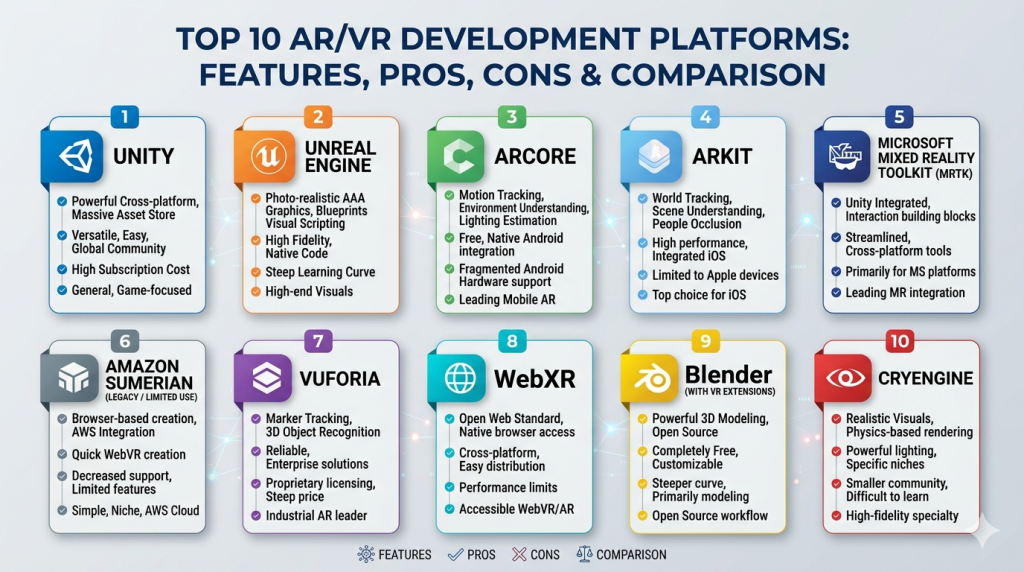
Top 10 AR/VR Development Platforms Tools
#1 — Unity
Short description: A widely used real-time 3D development platform for AR/VR, popular among game developers and enterprises building immersive applications.
Key Features
- Cross-platform AR/VR deployment
- Real-time 3D rendering engine
- XR Interaction Toolkit
- Visual scripting tools
- Asset Store ecosystem
- AI-assisted workflows
- Multiplayer support
Pros
- Large developer community
- Extensive documentation and plugins
- Supports many devices
Cons
- Licensing changes can impact cost
- Performance optimization requires expertise
Platforms / Deployment
Windows / macOS / Linux
Cloud / Self-hosted
Security & Compliance
Not publicly stated
Integrations & Ecosystem
Unity integrates with cloud services, 3D modeling tools, and analytics platforms.
- CAD tools
- Cloud platforms
- Version control systems
- AR SDKs
Support & Community
Strong global community, extensive tutorials, and enterprise support options.
#2 — Unreal Engine
Short description: High-fidelity real-time engine known for photorealistic rendering in AR/VR applications.
Key Features
- Advanced rendering (Nanite, Lumen)
- Blueprint visual scripting
- VR/AR framework
- Real-time physics simulation
- Cinematic tools
- Multi-user collaboration
Pros
- Exceptional visual quality
- Powerful for enterprise simulations
Cons
- Steeper learning curve
- Resource-intensive
Platforms / Deployment
Windows / macOS / Linux
Cloud / Self-hosted
Security & Compliance
Not publicly stated
Integrations & Ecosystem
- CAD and design tools
- Film and animation pipelines
- Cloud rendering services
Support & Community
Strong developer ecosystem and enterprise adoption.
#3 — ARCore
Short description: Google’s platform for building AR experiences on Android devices.
Key Features
- Motion tracking
- Environmental understanding
- Light estimation
- Cloud anchors
- Depth API
Pros
- Strong Android integration
- Free to use
Cons
- Limited to supported devices
- Not a full 3D engine
Platforms / Deployment
Android
Cloud / Hybrid
Security & Compliance
Not publicly stated
Integrations & Ecosystem
- Android SDK
- Unity and Unreal support
- Google Cloud services
Support & Community
Well-documented with strong developer support.
#4 — ARKit
Short description: Apple’s AR development framework for iOS and spatial computing devices.
Key Features
- Face tracking
- Scene reconstruction
- Object detection
- RealityKit integration
- Motion capture
Pros
- High-quality AR performance
- Tight Apple ecosystem integration
Cons
- Limited to Apple devices
- Requires macOS development environment
Platforms / Deployment
iOS / macOS
Hybrid
Security & Compliance
Not publicly stated
Integrations & Ecosystem
- Apple developer tools
- Swift and Xcode
- Unity support
Support & Community
Strong Apple developer ecosystem.
#5 — Microsoft Mixed Reality Toolkit (MRTK)
Short description: Open-source toolkit for building mixed reality apps, especially for enterprise use.
Key Features
- Pre-built UI components
- Input system for spatial interaction
- Cross-device support
- OpenXR compatibility
- Spatial mapping
Pros
- Enterprise-ready
- Open-source flexibility
Cons
- Requires integration with other engines
- Learning curve for beginners
Platforms / Deployment
Windows / Cloud / Hybrid
Security & Compliance
Not publicly stated
Integrations & Ecosystem
- Azure services
- Unity integration
- IoT platforms
Support & Community
Active open-source community.
#6 — Amazon Sumerian (Legacy / Limited Use)
Short description: A cloud-based platform for building AR/VR applications, now with limited active development.
Key Features
- Browser-based development
- 3D scene creation
- AI avatars
- AWS integration
Pros
- Easy to get started
- Cloud-native
Cons
- Limited updates
- Smaller ecosystem
Platforms / Deployment
Web / Cloud
Security & Compliance
Not publicly stated
Integrations & Ecosystem
- AWS services
- AI tools
- Voice services
Support & Community
Limited compared to leading platforms.
#7 — Vuforia
Short description: Enterprise-focused AR platform known for industrial and manufacturing use cases.
Key Features
- Image and object recognition
- Model targets
- IoT integration
- AR content authoring
- Industrial use-case support
Pros
- Strong enterprise capabilities
- Reliable tracking
Cons
- Licensing costs
- Less suited for gaming
Platforms / Deployment
Android / iOS / Windows
Cloud / Hybrid
Security & Compliance
Not publicly stated
Integrations & Ecosystem
- CAD tools
- IoT platforms
- Enterprise systems
Support & Community
Good enterprise support.
#8 — WebXR
Short description: Web standard for building AR/VR experiences directly in browsers.
Key Features
- Browser-based deployment
- Cross-device compatibility
- No app installation
- JavaScript APIs
- Lightweight experiences
Pros
- Easy distribution
- Platform-independent
Cons
- Limited performance vs native apps
- Browser compatibility issues
Platforms / Deployment
Web
Cloud
Security & Compliance
Not publicly stated
Integrations & Ecosystem
- JavaScript frameworks
- Web engines
- Cloud hosting
Support & Community
Growing developer community.
#9 — Blender (with VR extensions)
Short description: Open-source 3D creation tool with VR capabilities for modeling and content creation.
Key Features
- 3D modeling and animation
- VR scene editing
- Rendering engine
- Open-source flexibility
- Plugin ecosystem
Pros
- Free and open-source
- Powerful design capabilities
Cons
- Not a full AR/VR deployment platform
- Requires integration
Platforms / Deployment
Windows / macOS / Linux
Self-hosted
Security & Compliance
Not publicly stated
Integrations & Ecosystem
- Game engines
- Rendering tools
- Plugins
Support & Community
Very strong open-source community.
#10 — CryEngine
Short description: High-performance engine known for realistic environments and VR support.
Key Features
- Real-time rendering
- VR support
- Physics engine
- Sandbox editor
- Visual scripting
Pros
- High-quality visuals
- Flexible licensing
Cons
- Smaller community than Unity/Unreal
- Learning curve
Platforms / Deployment
Windows / Linux
Self-hosted
Security & Compliance
Not publicly stated
Integrations & Ecosystem
- Game development tools
- Asset pipelines
- Plugins
Support & Community
Moderate community support.
Comparison Table (Top 10)
| Tool Name | Best For | Platform(s) Supported | Deployment | Standout Feature | Public Rating |
|---|---|---|---|---|---|
| Unity | Cross-platform development | Windows, macOS, Linux | Hybrid | Massive ecosystem | N/A |
| Unreal Engine | High-fidelity visuals | Windows, macOS | Hybrid | Photorealistic rendering | N/A |
| ARCore | Android AR apps | Android | Hybrid | Motion tracking | N/A |
| ARKit | iOS AR apps | iOS, macOS | Hybrid | Apple ecosystem | N/A |
| MRTK | Enterprise MR apps | Windows | Hybrid | OpenXR support | N/A |
| Amazon Sumerian | Cloud AR/VR | Web | Cloud | AWS integration | N/A |
| Vuforia | Industrial AR | Multi-platform | Hybrid | Object recognition | N/A |
| WebXR | Browser AR/VR | Web | Cloud | No install needed | N/A |
| Blender | 3D creation | Multi-platform | Self-hosted | Open-source | N/A |
| CryEngine | Realistic VR apps | Windows | Self-hosted | High performance | N/A |
Evaluation & Scoring of AR/VR Development Platforms
| Tool Name | Core | Ease | Integrations | Security | Performance | Support | Value | Weighted Total |
|---|---|---|---|---|---|---|---|---|
| Unity | 9 | 8 | 9 | 7 | 9 | 9 | 7 | 8.4 |
| Unreal Engine | 9 | 7 | 8 | 7 | 10 | 8 | 7 | 8.3 |
| ARCore | 7 | 8 | 7 | 6 | 8 | 7 | 9 | 7.6 |
| ARKit | 8 | 8 | 7 | 7 | 9 | 8 | 7 | 8.0 |
| MRTK | 8 | 7 | 8 | 7 | 8 | 7 | 8 | 7.8 |
| Vuforia | 8 | 7 | 8 | 7 | 8 | 7 | 7 | 7.7 |
| WebXR | 7 | 9 | 7 | 6 | 7 | 7 | 9 | 7.6 |
| Blender | 7 | 6 | 8 | 6 | 7 | 9 | 10 | 7.5 |
| CryEngine | 8 | 6 | 7 | 6 | 9 | 6 | 7 | 7.4 |
| Sumerian | 6 | 8 | 7 | 6 | 6 | 6 | 7 | 6.7 |
How to interpret:
- Scores are comparative across tools in this category.
- Higher scores reflect stronger overall capability, not suitability for every use case.
- Enterprise tools may score high in performance but lower in ease of use.
- Always align scoring with your specific project requirements.
Which AR/VR Development Platforms Tool Is Right for You?
Solo / Freelancer
- Best choices: Unity, WebXR, Blender
- Focus on low cost, ease of learning, and flexibility.
SMB
- Best choices: Unity, Vuforia
- Balance between cost, scalability, and integration.
Mid-Market
- Best choices: Unreal Engine, MRTK
- Need performance and enterprise features.
Enterprise
- Best choices: Unreal Engine, Vuforia, MRTK
- Prioritize scalability, integration, and support.
Budget vs Premium
- Budget: Blender, WebXR
- Premium: Unreal Engine, Vuforia
Feature Depth vs Ease of Use
- Deep features: Unreal Engine, CryEngine
- Ease of use: Unity, WebXR
Integrations & Scalability
- Strong integrations: Unity, MRTK
- Scalable cloud options: WebXR, Sumerian
Security & Compliance Needs
- Enterprise-focused tools like MRTK and Vuforia are better suited
- Most platforms: “Not publicly stated” for certifications
Frequently Asked Questions (FAQs)
What is an AR/VR development platform?
It’s a software framework used to build immersive augmented and virtual reality applications across devices.
Are these tools free?
Some offer free tiers (Unity, Blender), while others use licensing or subscription models.
Which platform is best for beginners?
Unity and WebXR are generally easier to start with.
Do I need coding skills?
Most platforms require coding, though some offer visual scripting tools.
Can AR/VR apps run in browsers?
Yes, using WebXR.
How long does development take?
Depends on complexity—simple apps may take weeks, enterprise solutions months.
Are these platforms secure?
Security varies; most enterprise features are “Not publicly stated.”
Can I switch platforms later?
Yes, but migration can be complex and resource-intensive.
What industries use AR/VR?
Gaming, healthcare, manufacturing, education, and retail.
Do these tools support AI?
Many platforms are integrating AI for automation and content creation.
Conclusion
AR/VR development platforms are evolving rapidly, driven by advances in AI, spatial computing, and enterprise adoption. While Unity and Unreal Engine dominate in flexibility and performance, specialized tools like Vuforia and MRTK offer strong enterprise capabilities.
There is no single “best” platform—your ideal choice depends on your use case, technical expertise, and budget. Start by shortlisting 2–3 tools, test them with a pilot project, and validate integration, performance, and scalability before committing.
