Introduction
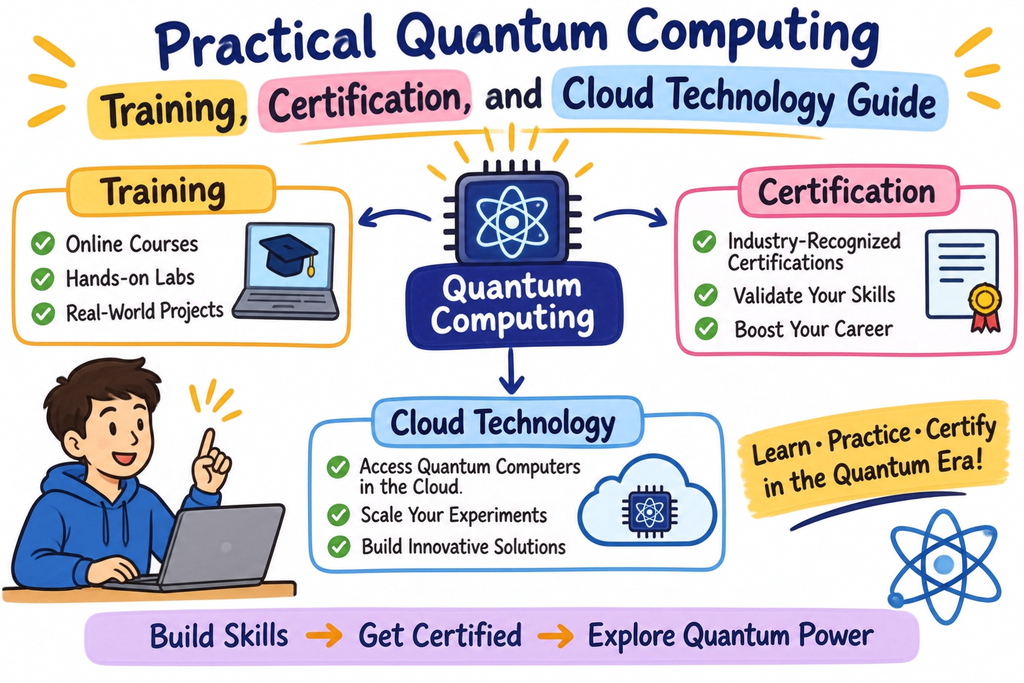
Quantum computing uses quantum mechanics to process information differently from traditional computers, relying on qubits that can hold combinations of states and interact through interference and entanglement rather than classical bits fixed at zero or one. Research teams, cloud engineers, software developers, system architects, and IT managers are exploring these capabilities because certain complex problems challenge classical processors alone, making practical readiness essential for understanding real capabilities and limits. Rather than replacing existing infrastructure, quantum systems are emerging as a specialized complement for targeted workloads, and QuantumOps School supports learners and organizations through practical quantum computing education, role-based training tracks, certification programs, and consulting guidance.
Introduction: Why Quantum Computing Is Becoming Important
Quantum computing attracts growing interest across technology and research because it opens a different way to explore large search spaces, model physical and chemical interactions, and test specialized algorithms alongside conventional compute. Traditional computers run everyday software, databases, and enterprise systems with high speed and reliability, while quantum computers target specific mathematical structures where quantum mechanics provides a distinct approach. Software engineers, cloud engineers, architects, researchers, and IT managers benefit from learning early so they can evaluate tools realistically without hype, and QuantumOps School offers a specialized platform focused on quantum computing education, professional training, certification, and consulting support.
Understanding Quantum Computing in Simple Terms
Quantum computing becomes much easier to grasp when core ideas are explained through everyday intuition rather than heavy physics math, starting with how qubits differ from classical bits and how circuits manipulate states before reading results. Quantum computers are not faster than classical computers for every task because routine data processing and standard applications run far better on classical hardware, so any potential advantage depends on the specific problem and algorithm used.
- Classical bits
- Qubits
- Quantum gates
- Superposition
- Entanglement
- Quantum measurement
- Quantum circuits
- Quantum algorithms
Quantum Computing vs Classical Computing
Comparing classical computing and quantum computing highlights how each system represents data, executes operations, handles errors, and fits into real infrastructure without replacing everyday computing. Classical processors remain essential for deterministic speed, high throughput, and cost-effective operations, while classical and quantum systems can work together in combined workflows where classical machines handle orchestration and data preparation.
| Dimension | Classical Computing | Quantum Computing |
|---|---|---|
| Information representation | Classical bits in state 0 or 1 | Qubits supporting superposition and entanglement |
| Processing methods | Boolean logic gates and deterministic pipelines | Unitary quantum gates, interference, and probabilistic sampling |
| Hardware design | CMOS transistors, CPUs, GPUs, and memory buses | Quantum processors with cryogenics, lasers, or microwave control |
| Programming approaches | Imperative, object-oriented, functional, and parallel code | Quantum circuits, gate sequences, and hybrid control loops |
| Error handling | High reliability via parity, checksums, and redundancy | Sensitive to noise and decoherence; requires quantum error correction |
| Practical applications | Databases, web apps, enterprise ERP, AI training, daily compute | Specialized simulation, optimization research, and algorithm testing |
| Infrastructure requirements | Standard data centers, racks, and cloud virtual machines | Specialized physical labs or cloud-connected quantum hardware |
- Information representation
- Processing methods
- Hardware design
- Programming approaches
- Error handling
- Practical applications
- Infrastructure requirements
Quantum Cloud Computing: Accessing Quantum Technology Through the Cloud
Quantum cloud computing training helps professionals learn how to work with quantum software and hardware remotely through cloud services without buying or maintaining physical quantum hardware on site. Ecosystems such as IBM Quantum, AWS Braket, and Azure Quantum allow learners and engineers to run simulators, submit circuit jobs, manage cloud permissions, and practice hands-on workflows across shared quantum resources.
- Cloud-based quantum access
- Quantum hardware availability
- Quantum simulators
- Quantum circuit execution
- Job submission
- Workload management
- Cloud integration
- Access permissions
- Resource limitations
Quantum Programming: Tools and Frameworks to Learn
Quantum programming involves building quantum circuits, testing them on simulators or supported hardware backends, and analyzing measurement results using dedicated software tools and SDKs. Learning programming frameworks helps traditional software developers connect abstract quantum concepts to working code, though each framework has its own design, syntax, simulation options, and cloud connections rather than working in the exact same way.
- Qiskit
- Cirq
- Microsoft Quantum Development Kit
- AWS Braket SDK
- IBM Quantum tools
- Azure Quantum development tools
Qiskit Programming Course: Learning Practical Quantum Development
A Qiskit programming course teaches developers how to use Python to build quantum circuits, apply gates, run simulations, and interpret measurement counts from quantum states. For example, applying a Hadamard gate followed by a CNOT gate on two qubits illustrates correlated outcomes in simulation, and hands-on practice is essential for building intuition while QuantumOps School covers Qiskit without guaranteeing personal career outcomes.
- Setting up the development environment
- Creating quantum circuits
- Working with qubits
- Applying quantum gates
- Measuring quantum states
- Running circuit simulations
- Understanding circuit results
- Exploring basic quantum algorithms
AWS Braket Training: Exploring Quantum Computing on AWS
AWS Braket training helps learners and engineers build quantum circuits, run simulators, and submit tasks through Amazon Braket while connecting quantum experiments to familiar AWS workflows, storage, permissions, and cost controls. Educational cloud practice supports hands-on exploration, though cloud access does not guarantee access to every quantum device or unlimited computing resources.
- Understanding the Amazon Braket environment
- Exploring quantum simulators
- Creating quantum circuits
- Submitting quantum tasks
- Understanding supported quantum hardware
- Managing cloud-based workloads
- Reviewing execution results
- Understanding service costs and resource limitations
Quantum Computing for Software Engineers
Quantum computing for software engineers shows how developers can add quantum circuit and cloud skills onto existing programming and problem-solving strengths without abandoning conventional software engineering. A practical learning path starts with Python, basic linear algebra and probability, and simulator experiments, complementing classical development rather than replacing everyday software systems.
- Programming fundamentals
- Python
- Algorithms
- Data structures
- Quantum circuits
- Quantum programming frameworks
- Cloud computing
- Mathematical foundations
- Software testing
- Problem-solving
Quantum Computing Architecture: Understanding the Main Components
A quantum computing architecture course explains how physical quantum processors, control and measurement electronics, compilers, error handling, and cloud management layers work together inside a complete system. Understanding architecture helps engineers and system designers distinguish physical quantum hardware design from the software and cloud layers that schedule jobs and manage workloads.
- Qubits and quantum processors
- Quantum gates
- Control systems
- Measurement systems
- Quantum circuits
- Classical control systems
- Quantum software layers
- Cloud access layers
- Error correction methods
- Hardware limitations
Hybrid Quantum-Classical Computing: Combining Two Computing Approaches
Hybrid quantum classical computing training focuses on workflows where classical computers and quantum processors operate together in iterative loops, such as classical preprocessing and optimization paired with quantum circuit execution. Hybrid approaches are central to current experimentation in areas like variational optimization and early quantum machine learning research, though they do not always outperform classical methods.
- Classical preprocessing
- Quantum circuit execution
- Classical optimization
- Result evaluation
- Iterative computation
- Workload coordination
- Cloud-based execution
Quantum Computing Certification: Building Professional Knowledge
A structured quantum computing certification course gives learners a clear sequence of topics, hands-on exercises, assessments, and applied projects to build verifiable technical familiarity. Learners should evaluate any program’s syllabus, lab practice, exam process, instructor experience, and credential recognition before enrolling, since a certificate does not guarantee employment or universal recognition.
- Quantum fundamentals
- Quantum programming
- Quantum algorithms
- Quantum hardware
- Cloud quantum platforms
- Quantum architecture
- Hybrid computing
- Practical exercises
- Technical assessments
- Applied projects
QuantumOps Certification: Understanding the Four Professional Learning Tracks
QuantumOps certification covers the four role-focused training and certification tracks offered by QuantumOps School—Architect, Engineer, Manager, and Professional—designed around different technical, operational, and leadership needs. Prospective learners should review the published curriculum, exam details, and credential rules directly before enrolling, as these offerings are not presented as independently accredited or universally recognized credentials.
- QuantumOps Architect
- QuantumOps Engineer
- QuantumOps Manager
- QuantumOps Professional
Quantum Computing for IT Managers: Planning Technology Adoption
Quantum computing for IT managers helps leaders evaluate real business problems, technical readiness, cloud platforms, budgets, team skills, security, and vendor claims before committing resources. Focusing on practical value, research needs, and realistic expectations prevents teams from adopting quantum tools simply because they are emerging.
- Understanding business problems
- Evaluating possible use cases
- Identifying technical requirements
- Assessing cloud platforms
- Planning budgets
- Managing technical teams
- Reviewing security considerations
- Evaluating vendor capabilities
- Understanding research and development needs
- Setting realistic expectations
Quantum Computing Use Cases Across Different Industries
Across sectors, quantum computing is primarily explored through research, simulations, and early experiments rather than proven commercial replacement of classical systems, so potential use cases must be separated from established production deployments. Real-world adoption remains tied to problem fit, algorithmic progress, hardware maturity, and economic viability, without guaranteed business outcomes today.
- Finance
- Healthcare
- Pharmaceuticals
- Logistics
- Research Institutions
- Technology Companies
Quantum Computing Consulting Services: Helping Organizations Explore Adoption
Quantum computing consulting services help organizations assess feasibility, cloud integration, algorithm research, hybrid workflows, security, and phased roadmaps before making major investments. Starting with a clear problem and benchmarking against classical approaches keeps planning practical, while QuantumOps School advertises consulting and specialist support without implying guaranteed outcomes.
- Quantum technology assessments
- Quantum cloud integration
- Quantum algorithm development
- Workload optimization
- Hybrid quantum-classical systems
- Cloud security considerations
- Implementation planning
- Technical feasibility evaluation
- Research and development guidance
Skills Required for a Career in Quantum Computing
Building skills for quantum computing roles combines core math, programming, cloud familiarity, and system thinking with hands-on circuit practice so developers, cloud engineers, architects, and researchers can build on existing strengths. Beginners can start with math, Python, and simulator exercises while experienced professionals map new concepts onto current skills, without any promise of specific salaries, placements, or guaranteed career outcomes.
- Mathematics
- Linear algebra
- Probability
- Python programming
- Algorithms
- Quantum mechanics fundamentals
- Quantum programming frameworks
- Cloud computing
- Problem-solving
- Research skills
- System architecture
How QuantumOps School Supports Practical Quantum Learning
QuantumOps School offers structured education, certification tracks, and consulting support built around instructor-led sessions, practical labs, simulators, exercises, case studies, assessments, and capstone projects. Covering tools such as Qiskit, Cirq, Microsoft Quantum Development Kit, AWS Braket, IBM Quantum, and Azure Quantum across Architect, Engineer, Manager, and Professional tracks with online and classroom options in India, it supports practical skill-building without claiming unverified metrics, accreditation, or guaranteed results.
- Instructor-led training
- Practical labs
- Quantum simulations
- Technical exercises
- Case studies
- Technical assessments
- Capstone projects
- Professional learning tracks
How to Choose the Right Quantum Computing Training Program
Choosing a training program works best when you compare curriculum depth, hands-on labs, cloud access, framework coverage, assessments, support, format, and fee or refund terms against your goals and schedule. Matching the program to your current skills and available time helps ensure you learn what you need without overcomplicating your starting point.
- Course curriculum
- Quantum fundamentals
- Programming exercises
- Cloud platform access
- Practical laboratories
- Instructor guidance
- Framework coverage
- Assessment methods
- Capstone projects
- Certification requirements
- Credential recognition
- Learning support
- Course format
- Fees and refund policies, where publicly available
Common Challenges When Learning Quantum Computing
New learners often face hurdles around math, quantum concepts, SDK differences, hardware queues, noise, error correction, cloud quotas, and spotting practical use cases. Steady practice with simulators, structured courses, official documentation, and small circuits helps learners work through these challenges gradually.
- Mathematical complexity
- Understanding qubits
- Learning quantum gates
- Understanding superposition and entanglement
- Programming framework differences
- Limited hardware access
- Quantum noise
- Error correction complexity
- Cloud resource limitations
- Identifying practical use cases
Frequently Asked Questions About Quantum Computing Training
1. What is quantum cloud computing training?
It teaches hands-on circuit building, simulation, and cloud job submission over remote quantum platforms without owning physical hardware.
2. What should a quantum computing certification course include?
It should cover quantum fundamentals, programming, algorithms, hardware, cloud platforms, practical labs, assessments, and applied projects.
3. What is QuantumOps certification?
It refers to the Architect, Engineer, Manager, and Professional training and certification tracks offered by QuantumOps School.
4. Is a Qiskit programming course suitable for beginners?
Yes, if the learner has basic Python skills and is ready to review foundational linear algebra and probability alongside hands-on labs.
5. What can learners do with AWS Braket training?
Learners can build circuits, run simulators, submit tasks on AWS, inspect results, and learn cloud quotas, costs, and hardware limits.
6. Why should software engineers learn quantum computing?
It broadens technical versatility, connects with cloud workflows, and prepares engineers for future hybrid or specialized quantum routines.
7. What does a quantum computing architecture course teach?
It covers qubits, control and measurement systems, compilation, software and cloud layers, error handling, and hardware limits.
8. What is hybrid quantum-classical computing?
It pairs classical processors and quantum processors in iterative workflows such as classical optimization with quantum circuit execution.
9. When do businesses need quantum computing consulting services?
Businesses benefit when assessing feasibility, cloud integration, hybrid workflows, or realistic research and learning roadmaps.
10. Why should IT managers understand quantum computing?
It helps leaders evaluate use cases, budgets, teams, security, and realistic timelines rather than reacting to hype.
Final Thoughts
Quantum computing is increasingly relevant for software developers, cloud engineers, architects, researchers, and IT managers who want practical familiarity with quantum fundamentals, programming frameworks, cloud platforms, and hybrid workflows. Maintaining realistic expectations about current capabilities and limitations—and using resources from QuantumOps School where helpful—supports steady, informed preparation for the future.
