Bangalore, now widely called Bengaluru, is more than India’s technology city.
The city has a rich cultural side. Visitors can enjoy festivals, theatre, music, dance, art, food, and local traditions.
Some events come from old Karnataka traditions. Others show the city’s modern creative side.
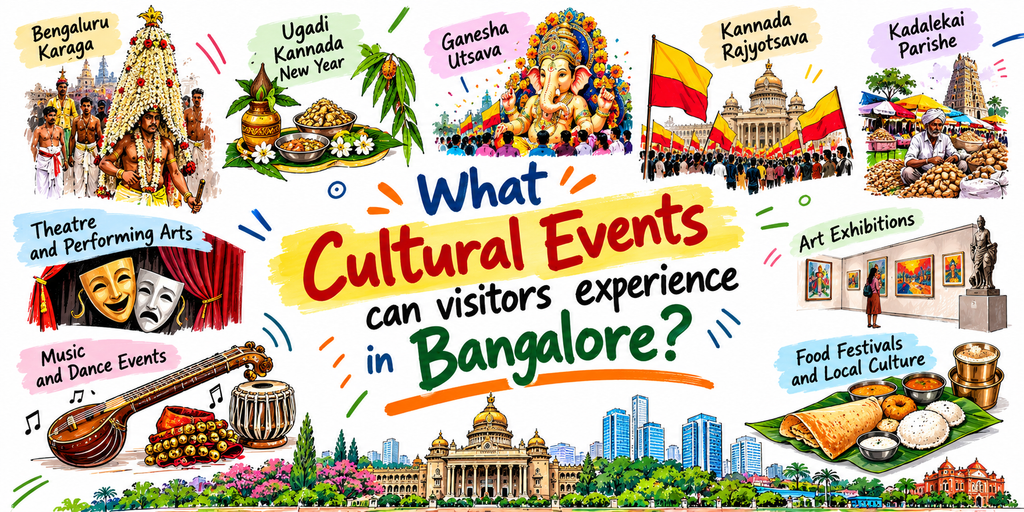
Bengaluru Karaga brings an old folk tradition into the city. Ugadi celebrates the Kannada New Year. Kannada Rajyotsava celebrates Karnataka’s identity. The city also hosts theatre festivals, art events, music shows, and cultural workshops.
This guide explains the main cultural experiences visitors can enjoy in Bangalore. It also shows when these events usually happen and how travelers can plan around them.
Why Should Travelers Explore Bangalore’s Cultural Events?
Cultural events can show a side of Bangalore that normal sightseeing may miss.
A famous building can tell you about the city’s past. A festival can show how people celebrate today.
Visitors can also enjoy local food, music, dance, crafts, stories, and theatre. These experiences can make a Bangalore trip more personal.
The Bengaluru Urban district lists many festivals across the year. These include Karaga, Ugadi, Ganesha Chathurthi, Deepavali, Kannada Rajyotsava, and Kadalekai Parishe.
Bangalore Cultural Events at a Glance
| Event or Experience | Usual Period | Main Cultural Experience |
|---|---|---|
| Makara Sankranti | January | Traditional festival |
| Maha Shivaratri | February | Religious and cultural celebrations |
| Bengaluru Karaga | March or April | Folk tradition and procession |
| Ugadi | March or April | Kannada New Year |
| Sri Rama Navami | April | Music and religious traditions |
| Ganesha Utsava | Around August or September | Community celebrations |
| Deepavali | October or November | Lights and family traditions |
| Kannada Rajyotsava | November | Kannada and Karnataka culture |
| Kadalekai Parishe | November or December | Traditional groundnut fair |
| Theatre events | Throughout the year | Plays and performing arts |
| Art exhibitions | Throughout the year | Painting and visual arts |
| Music events | Throughout the year | Classical and modern music |
Dates can change each year. Travelers should check the official event page before making plans.
Step 1: Experience Bengaluru Karaga
Bengaluru Karaga is one of the city’s oldest and best-known cultural traditions.
The festival takes place around the Dharmaraya Swamy Temple in the Nagarathpete area. Karnataka Tourism describes it as a nine-day folk festival linked with Draupadi.
The main procession is the key part of the event.
A priest carries a decorated floral structure on his head. Traditional participants accompany the procession.
The event has deep links with local history and religious tradition.
What Makes Karaga Special?
The festival is not simply a public show.
It is a living tradition. Local communities continue to take part in it.
The procession also follows a long-standing custom of visiting the tomb of an 18th-century Muslim saint. Karnataka Tourism notes this tradition as a symbol of Hindu-Muslim unity.
Karaga Travel Guide
| Detail | Information |
|---|---|
| Event | Bengaluru Karaga |
| Area | Nagarathpete |
| Main temple | Dharmaraya Swamy Temple |
| Usual period | March or April |
| Main attraction | Traditional procession |
| Best for | Culture and history lovers |
| Travel tip | Expect crowds |
The exact date changes because the festival follows the Hindu calendar.
So, check the latest schedule before visiting.
Step 2: Celebrate Ugadi in Bangalore
Ugadi marks the beginning of the Kannada New Year.
The festival usually falls in March or April. The exact date changes each year.
The Bengaluru Urban district describes Ugadi as the beginning of the Kannada New Year and the arrival of spring.
During Ugadi, families prepare special food and follow traditional customs.
Markets can also become lively. People buy flowers, mango leaves, sweets, and other festive items.
What Can Visitors Experience?
Visitors may see:
- Traditional decorations
- Rangoli designs
- Family gatherings
- Temple activities
- Festive food
- Cultural programmes
- Kannada traditions
Karnataka Tourism also notes that cultural groups and communities in Bengaluru organize activities around Ugadi.
A Simple Ugadi Experience
Morning: See festive decorations and local markets.
Afternoon: Try traditional Karnataka food.
Evening: Look for a cultural programme or music event.
Ugadi can be a good time to learn about local traditions without visiting a formal museum.
Step 3: Watch Kannada Theatre
Bangalore has a strong theatre culture.
Visitors can watch plays in Kannada, English, Hindi, and other languages.
One of the city’s major theatre spaces is Ranga Shankara in JP Nagar.
Karnataka Tourism describes Ranga Shankara as a major performing arts space. It hosts more than 400 performances each year across several languages.
The theatre also runs festivals.
Its Ranga Shankara Theatre Festival brings together Indian theatre productions around selected themes.
What Can You Watch?
| Theatre Experience | Suitable For |
|---|---|
| Kannada plays | Visitors interested in local culture |
| English plays | International visitors |
| Hindi plays | Hindi-speaking visitors |
| Children’s theatre | Families |
| Theatre festivals | Performing arts lovers |
| Experimental plays | Visitors seeking new experiences |
You do not need to understand every Kannada word.
The acting, music, costumes, movement, and story can still help you understand the culture.
Step 4: Explore Traditional Dance and Music
Bangalore hosts many music and dance events.
These can include Indian classical music, classical dance, folk performances, and modern performances.
The city’s cultural centres also host talks and workshops around music and performing arts.
For example, the Bangalore International Centre regularly lists events under categories such as dance, music, performing arts, film, culture, literature, and workshops.
This gives visitors many choices beyond large festivals.
Cultural Performance Options
| Performance | What You May Learn |
|---|---|
| Carnatic music | South Indian classical music |
| Hindustani music | North Indian classical tradition |
| Bharatanatyam | Classical Indian dance |
| Kathak | Indian classical dance |
| Folk performance | Local traditions |
| Storytelling | Indian stories and literature |
| Contemporary dance | Modern artistic ideas |
Event schedules change often.
Check the venue’s current calendar before visiting.
Step 5: Visit Bangalore International Centre Events
The Bangalore International Centre, often called BIC, is another useful place for culture lovers.
BIC hosts talks, films, performances, workshops, exhibitions, and discussions.
Its event calendar includes subjects such as culture, dance, film, food, heritage, history, literature, music, theatre, visual arts, and workshops.
This makes BIC useful for travelers who want a more modern cultural experience.
Examples of Cultural Activities
Visitors may find:
- Music performances
- Dance events
- Art discussions
- Film screenings
- Poetry events
- Heritage talks
- Craft workshops
- Storytelling
- Literature programmes
Unlike a large public festival, these events can offer a smaller setting.
That can help visitors focus on the art and the people behind it.
Step 6: Explore Karnataka’s Art Scene
Bangalore has a strong visual arts community.
The Karnataka Chitrakala Parishath is an important art institution in the city.
The Bengaluru Urban government lists it as a major fine arts institution. It hosts exhibitions, folk theatre, photography exhibitions, puppet shows, musical recitals, and other activities.
Visitors interested in art can explore galleries and exhibitions.
Art Experiences in Bangalore
| Experience | What Visitors Can See |
|---|---|
| Painting exhibitions | Indian and modern art |
| Photography shows | Local and global subjects |
| Folk art | Traditional artistic styles |
| Sculpture | Three-dimensional artwork |
| Puppet shows | Traditional storytelling |
| Art workshops | Hands-on creative activities |
Art events can change from week to week.
So, check the current exhibition schedule before you visit.
Step 7: Experience Ganesha Utsava
Ganesha Utsava is another important cultural event in Bangalore.
The festival celebrates Lord Ganesha.
Karnataka Tourism notes that celebrations across Bengaluru include decorated idols, devotional music, community activities, traditional sweets, and cultural programmes.
The festival can give visitors a look at community life.
Different neighborhoods may have their own celebrations.
What Can Visitors See?
- Decorated Ganesha idols
- Traditional decorations
- Devotional music
- Community programmes
- Local food
- Festive gatherings
Because celebrations can happen across different areas, visitors should check local schedules.
Crowds can also be large around popular celebrations.
Step 8: Celebrate Kannada Rajyotsava
Kannada Rajyotsava takes place on 1 November.
The day marks the formation of Karnataka as a state.
The Bengaluru Urban government lists Kannada Rajyotsava among the city’s annual cultural celebrations.
You may see Kannada flags, cultural programmes, music, speeches, and public celebrations.
For visitors, this can be a useful time to learn more about Karnataka’s language and identity.
Why Is It Interesting for Travelers?
The event connects language with culture.
You can see how Kannada remains an important part of public life in Karnataka.
It also gives visitors a chance to explore local music, food, literature, and traditions.
Step 9: Visit Kadalekai Parishe
Kadalekai Parishe is a traditional groundnut fair held in the Basavanagudi area.
The Bengaluru Urban government describes it as an annual fair linked with the first groundnut harvest.
The event combines religious tradition with a local market atmosphere.
Visitors can see groundnut sellers, food stalls, decorations, and community activities.
Kadalekai Parishe Experience
| Feature | Visitor Experience |
|---|---|
| Groundnuts | Traditional local produce |
| Fair | Busy local atmosphere |
| Food | Local snacks |
| Temple | Religious traditions |
| Market | Small local shopping |
| Culture | Traditional community event |
The event usually takes place around November or December.
Check the latest local schedule before visiting.
Step 10: Enjoy Deepavali in Bangalore
Deepavali is celebrated in Bangalore with lights, family gatherings, food, prayers, and decorations.
The Bengaluru Urban government lists Deepavali among the city’s annual festivals.
Visitors may notice decorated homes and markets.
Local shopping areas can also become more active during the festival period.
If you visit during Deepavali, respect local customs.
Also, check local rules about fireworks before taking part.
Step 11: Explore Food as Part of Culture
Food is also a cultural experience.
Bangalore has a mix of Karnataka food and cuisines from many parts of India.
Travelers can try local dishes such as:
- Bisi bele bath
- Ragi mudde
- Masala dosa
- Idli
- Vada
- Mysore pak
- Obbattu
- Filter coffee
Food can become part of your cultural trip.
For example, you can visit a local market during a festival. Then try a traditional dish nearby.
This creates a stronger connection between food and local culture.
Step 12: Explore Cultural Workshops
Workshops offer a more active cultural experience.
Instead of only watching a performance, you can learn something yourself.
Bangalore International Centre lists workshops in areas such as traditional crafts, music, movement, and other cultural subjects.
Ranga Shankara also runs creative programmes and workshops for children and young people.
Workshop Ideas
| Workshop Type | Possible Experience |
|---|---|
| Traditional craft | Learn a local craft |
| Music | Learn basic music skills |
| Dance | Try traditional movement |
| Storytelling | Hear Indian stories |
| Theatre | Learn stage skills |
| Art | Create your own artwork |
| Food | Learn local cooking methods |
Workshops can be especially useful for families.
They can also help children connect with local culture.
Step 13: Plan Your Cultural Trip by Month
Bangalore’s cultural calendar changes throughout the year.
This simple guide can help you plan.
| Period | Cultural Experiences |
|---|---|
| January | Sankranti events and cultural programmes |
| February | Shivaratri and performing arts |
| March | Karaga and Ugadi-related activities |
| April | Ugadi and cultural programmes |
| May | Theatre and indoor cultural events |
| June | Theatre and creative workshops |
| July | Music, dance, theatre, and art |
| August | Ganesha-related preparations and events |
| September | Ganesha Utsava and cultural programmes |
| October | Deepavali-related activities and arts |
| November | Kannada Rajyotsava |
| December | Kadalekai Parishe and year-end cultural events |
This is a general planning guide.
Exact festival dates and event schedules can change each year.
Step 14: Choose Events Based on Your Interests
Not every cultural event will suit every traveler.
Use your interests to choose.
| If You Like… | Try These Experiences |
|---|---|
| History | Karaga and heritage events |
| Theatre | Ranga Shankara |
| Music | Classical and live music events |
| Dance | Classical and folk performances |
| Art | Chitrakala Parishath and galleries |
| Food | Festivals and local food events |
| Family activities | Workshops and children’s theatre |
| Kannada culture | Rajyotsava and Ugadi |
| Local traditions | Karaga and Kadalekai Parishe |
| Modern culture | BIC events and contemporary arts |
Step 15: How Should Visitors Attend Cultural Events?
Good planning can make cultural events much easier.
Check the Date
Festival dates can change each year.
Some events follow lunar calendars.
Always check the latest official information.
Check the Venue
Some events take place in busy neighborhoods.
Others take place inside theatres or cultural centres.
Know the location before you leave.
Arrive Early
Popular events can attract many people.
Arriving early gives you more time to find the venue.
Respect Local Customs
Some cultural events also have religious meaning.
Dress with care when visiting temples or religious spaces.
Follow local instructions during processions.
Keep Your Belongings Safe
Large festivals can become crowded.
Keep your phone, wallet, and bag secure.
Use Public Transport When Practical
Parking can become difficult during major events.
Plan your transport before leaving.
A Simple 3-Day Cultural Bangalore Plan
Day 1: Traditional Bangalore
Start with a local temple or heritage area.
Then explore a traditional food spot.
If a festival is taking place, attend a local celebration in the evening.
Focus: Local traditions, food, and community life.
Day 2: Theatre and Art
Visit an art space during the day.
Then attend a theatre performance in the evening.
Ranga Shankara is one option for visitors interested in theatre.
Focus: Art, theatre, and creative culture.
Day 3: Modern Cultural Bangalore
Look for a workshop, music performance, film event, or discussion.
Bangalore International Centre is one place to check for current programmes.
Finish the day with local food.
Focus: Modern arts, ideas, music, and food.
Cultural Events vs Regular Sightseeing
Cultural events offer a different type of travel experience.
| Regular Sightseeing | Cultural Events |
|---|---|
| See famous places | Meet local traditions |
| Take photographs | Watch live performances |
| Learn history | Experience living culture |
| Follow a fixed route | Join local activities |
| Short visits | Events may last several hours |
| Mostly visual | Often involve music, food, and people |
Both can work well together.
A good Bangalore trip can include famous places and cultural experiences.
Important Things to Remember
Cultural events are not always tourist shows.
Many events have deep meaning for local communities.
Visitors should watch respectfully.
Avoid blocking processions for photographs.
Do not enter restricted areas.
Follow instructions from organizers and local authorities.
Also, avoid assuming that every event happens on the same date each year.
Festival calendars can change.
Why Cultural Events Make a Bangalore Trip Better
Bangalore has changed quickly over the years.
The city has become a major technology and business centre. Yet local traditions remain part of everyday life.
That contrast makes cultural travel interesting.
You can watch a theatre play in the evening. You can visit an old festival the next day.
You can also explore modern art, traditional music, local food, and Kannada literature.
This mix gives visitors a broader view of Bangalore.
Final Thoughts
Bangalore offers many ways to experience culture.
Visitors can join traditional festivals such as Bengaluru Karaga, Ugadi, Ganesha Utsava, Deepavali, Kannada Rajyotsava, and Kadalekai Parishe.
They can also watch theatre, music, dance, art shows, films, and cultural workshops.
The best approach is to plan around your interests.
Check the latest dates first. Then choose events that fit your travel plan.
Most importantly, take time to understand what you are seeing.
A cultural event can do more than entertain you. It can help you understand the people, history, language, art, and traditions that make Bangalore unique.
Quick Cultural Travel Checklist
☐ Check the current event calendar
☐ Confirm the event date
☐ Check the venue
☐ Book tickets when needed
☐ Arrive early
☐ Respect local customs
☐ Dress suitably for religious places
☐ Keep belongings secure
☐ Plan transport
☐ Try local food
☐ Ask before taking close-up photographs
☐ Enjoy the event without rushing
Useful Official Sources
For current cultural events, travelers can check the Bengaluru Urban government festival pages, Karnataka Tourism, Ranga Shankara, and Bangalore International Centre. Their schedules can change, so checking before travel is useful.
Hashtags
#BangaloreCulture · #BangaloreTravel · #BengaluruEvents · #KarnatakaCulture · #BangaloreTourism · #BengaluruKaraga · #KannadaCulture · #TravelIndia
