Introduction
Threat Hunting Platforms are specialized tools that allow cybersecurity teams to proactively search for hidden threats, malware, and malicious activity across enterprise networks and endpoints. Unlike reactive security tools, these platforms focus on actively identifying potential breaches before they cause damage, helping organizations strengthen their security posture.
With increasingly sophisticated attacks and multi-vector threats, threat hunting has become critical for organizations in regulated industries, cloud-first enterprises, and large IT environments. Modern platforms often leverage AI, machine learning, and behavioral analytics to detect anomalies and uncover advanced persistent threats (APTs).
Real-world use cases include:
- Identifying lateral movement and suspicious activity in enterprise networks
- Detecting unknown malware and zero-day exploits
- Investigating abnormal user behavior in cloud and on-prem systems
- Enhancing SIEM alerts with threat context
- Supporting regulatory compliance through documented threat investigations
What buyers should evaluate:
- Real-time analytics and anomaly detection capabilities
- Integration with SIEM, endpoint, and network monitoring tools
- Automation and AI-assisted threat detection
- Data visualization and investigative dashboards
- Collaboration features for SOC teams
- Scalability across global enterprise environments
- Threat intelligence feeds and enrichment support
- Security compliance and data privacy adherence
- Ease of use and training requirements
- Licensing, cost, and deployment flexibility
Best for: Security Operations Centers (SOC), cybersecurity analysts, threat intelligence teams, enterprises handling sensitive data or critical infrastructure
Not ideal for: Small teams with minimal infrastructure or low cybersecurity risk, where basic EDR or antivirus solutions may suffice
Key Trends in Threat Hunting Platforms
- Integration with SIEM and SOAR platforms for automated alert enrichment
- Use of AI/ML to detect unknown threats and suspicious behavior
- Cloud-native threat hunting for hybrid and multi-cloud environments
- Behavioral analytics and user/entity behavior analytics (UEBA)
- Automated incident prioritization and root cause identification
- Collaboration features for distributed SOC teams
- Real-time visualization of attack paths and anomalies
- Integration with threat intelligence feeds for context
- Subscription-based SaaS models alongside on-prem deployments
- Focus on proactive threat prevention rather than reactive response
How We Selected These Tools (Methodology)
- Evaluated market adoption and organizational mindshare
- Assessed feature completeness: detection, analytics, hunting, reporting
- Considered integration breadth with SIEM, endpoint, and cloud monitoring tools
- Reviewed AI/ML capabilities for proactive threat detection
- Examined scalability and deployment flexibility for large enterprises
- Verified security posture: encryption, authentication, audit logging
- Checked collaboration and workflow support for SOC teams
- Assessed usability, documentation, and onboarding support
- Considered vendor support, community engagement, and training options
- Balanced innovation, ease of use, and cost-effectiveness
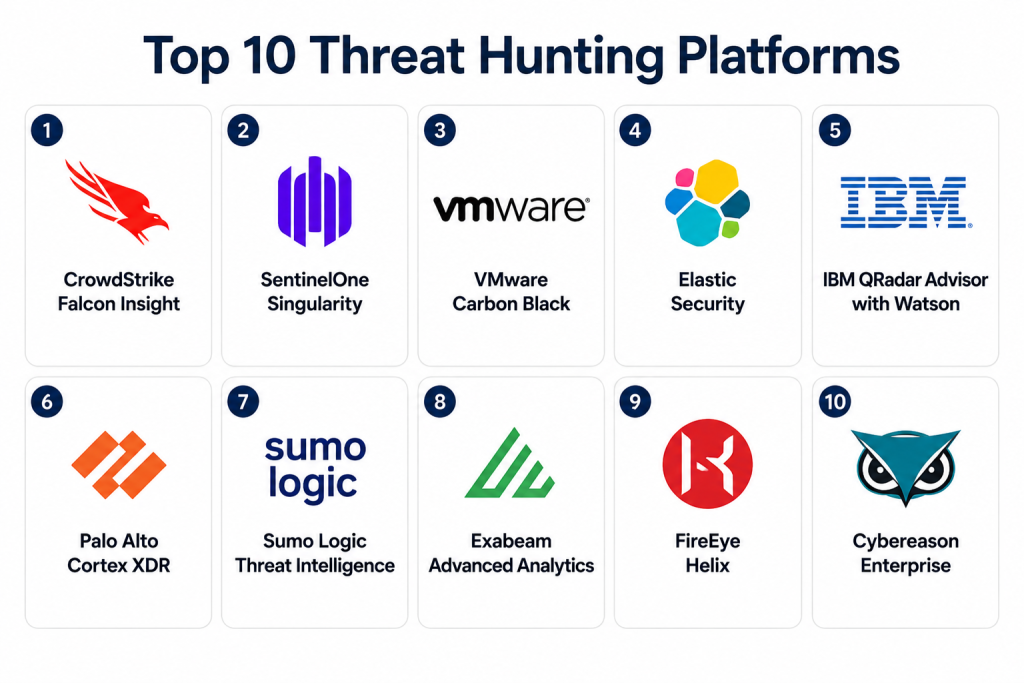
Top 10 Threat Hunting Platforms
1- CrowdStrike Falcon Insight
Short description: Falcon Insight provides endpoint threat detection and proactive hunting across cloud and on-prem environments
Key Features
- Real-time endpoint monitoring
- AI-powered anomaly detection
- Threat intelligence integration
- Automated hunting queries
- Centralized dashboards and reporting
Pros
- Strong AI-driven detection
- Cloud-native scalability
Cons
- Premium pricing
- Requires trained analysts for full capabilities
Platforms / Deployment
- Windows, macOS, Linux
- Cloud
Security & Compliance
- SSO/SAML, MFA, encryption, audit logs
- SOC 2, ISO 27001, GDPR
Integrations & Ecosystem
- SIEM integration: Splunk, ArcSight
- Threat intelligence feeds
- API for custom hunting queries
- EDR and cloud platforms
Support & Community
- 24/7 enterprise support, knowledge base, active community
2- SentinelOne Singularity
Short description: Singularity platform combines endpoint detection with automated threat hunting and AI-assisted analysis
Key Features
- Behavioral AI detection
- Automated response workflows
- Threat intelligence enrichment
- Real-time dashboards
- Hunting across endpoints and cloud assets
Pros
- Autonomous threat detection and response
- AI-assisted root cause identification
Cons
- Complex initial deployment
- Pricing scales with enterprise size
Platforms / Deployment
- Windows, macOS, Linux
- Cloud / Hybrid
Security & Compliance
- SSO/SAML, MFA, encryption
- SOC 2, ISO 27001
Integrations & Ecosystem
- SIEM connectors
- EDR/EDR integrations
- Cloud infrastructure monitoring
Support & Community
- Enterprise support, documentation, community forums
3- VMware Carbon Black
Short description: Carbon Black provides endpoint threat hunting and behavioral analytics for advanced threat detection
Key Features
- Endpoint event recording
- Behavioral threat analysis
- Threat hunting dashboards
- Automated alert correlation
- Integration with SIEM
Pros
- Detailed forensic data
- Strong analytics for advanced threats
Cons
- Onboarding requires expertise
- Limited automation compared to newer AI-first platforms
Platforms / Deployment
- Windows, macOS, Linux
- Cloud / Hybrid
Security & Compliance
- SSO/SAML, MFA, encryption
- SOC 2, ISO 27001
Integrations & Ecosystem
- SIEM integration: Splunk, QRadar
- Threat intelligence feeds
- API access for custom automation
Support & Community
- Enterprise support, knowledge base
4- Elastic Security
Short description: Elastic Security integrates SIEM and endpoint detection with proactive threat hunting capabilities
Key Features
- Unified SIEM and endpoint analytics
- Behavioral detection and anomaly hunting
- Dashboard visualization and alerts
- Threat intelligence integration
- Automated playbooks
Pros
- Flexible and open-source foundation
- Strong analytics and visualization
Cons
- Requires technical expertise to configure
- Cloud integrations may need setup
Platforms / Deployment
- Windows, Linux, macOS
- Cloud / Self-hosted / Hybrid
Security & Compliance
- SSO/SAML, MFA
- Varies / N/A
Integrations & Ecosystem
- Integrates with Elastic Stack
- SIEM and log management tools
- APIs for custom detection
Support & Community
- Community support, commercial tiers
5- IBM QRadar Advisor with Watson
Short description: QRadar Advisor combines SIEM with AI-assisted threat hunting to identify root causes and attack paths
Key Features
- AI-assisted root cause analysis
- Threat intelligence enrichment
- Integration with IBM QRadar SIEM
- Forensic dashboards
- Automated alert correlation
Pros
- AI-driven insights for complex incidents
- Strong SIEM integration
Cons
- Enterprise-focused with higher cost
- Requires trained analysts
Platforms / Deployment
- Windows, Linux
- Cloud / On-prem
Security & Compliance
- SSO/SAML, MFA, encryption
- SOC 2, ISO 27001
Integrations & Ecosystem
- QRadar SIEM
- Threat intelligence feeds
- API support for automation
Support & Community
- Enterprise support, training, community
6- Palo Alto Cortex XDR
Short description: Cortex XDR provides integrated threat hunting across endpoints, network, and cloud with behavioral analytics
Key Features
- AI/ML-based threat detection
- Cross-data source analytics
- Automated alert correlation
- Hunting dashboards and workflows
- Incident investigation tools
Pros
- Unified view across multiple data sources
- Strong automation and AI insights
Cons
- Premium pricing
- Setup complexity for full feature utilization
Platforms / Deployment
- Windows, macOS, Linux
- Cloud / Hybrid
Security & Compliance
- SSO/SAML, MFA, encryption
- SOC 2, ISO 27001
Integrations & Ecosystem
- SIEM, firewall, endpoint tools
- Cloud security platforms
- APIs for custom hunting
Support & Community
- Enterprise support, knowledge base
7- Sumo Logic Threat Intelligence
Short description: Sumo Logic provides cloud-native threat hunting with analytics and machine learning
Key Features
- Log-based threat hunting
- AI-assisted anomaly detection
- Real-time dashboards
- Threat intelligence enrichment
- Incident investigation
Pros
- Cloud-native and scalable
- ML-powered insights
Cons
- Limited endpoint data collection
- Relies on logs and integration setup
Platforms / Deployment
- Web, Windows, Linux
- Cloud
Security & Compliance
- SSO/SAML, MFA
- SOC 2
Integrations & Ecosystem
- Cloud services monitoring
- SIEM integration
- API access for automation
Support & Community
- Documentation, support tiers
8- Exabeam Advanced Analytics
Short description: Exabeam provides user and entity behavior analytics with integrated threat hunting workflows
Key Features
- UEBA for anomaly detection
- Threat hunting dashboards
- Automated incident investigation
- Behavioral analytics for users and devices
- Integration with SIEM and log sources
Pros
- Strong behavioral insights
- Automated workflow and investigation
Cons
- Costly for smaller teams
- Learning curve for complex analytics
Platforms / Deployment
- Windows, Linux
- Cloud / Hybrid
Security & Compliance
- SSO/SAML, MFA
- SOC 2, ISO 27001
Integrations & Ecosystem
- SIEM integration
- Cloud monitoring
- APIs for custom workflows
Support & Community
- Enterprise support, documentation
9- FireEye Helix
Short description: Helix provides integrated threat hunting, SIEM, and response capabilities with AI-assisted analytics
Key Features
- Threat hunting and detection
- Incident response workflows
- Security analytics dashboards
- Threat intelligence integration
- Automated alert correlation
Pros
- Comprehensive threat management
- AI-assisted root cause analysis
Cons
- Premium enterprise pricing
- Deployment complexity
Platforms / Deployment
- Windows, Linux, macOS
- Cloud / Hybrid
Security & Compliance
- SSO/SAML, MFA
- SOC 2, ISO 27001
Integrations & Ecosystem
- SIEM and endpoint integrations
- Cloud security platforms
- Threat intelligence feeds
Support & Community
- Enterprise support, knowledge base
10- Cybereason Enterprise
Short description: Cybereason offers endpoint-focused threat hunting with AI-driven detection and automated response
Key Features
- Behavioral AI detection
- Automated root cause analysis
- Endpoint and network visibility
- Threat intelligence enrichment
- Dashboards for investigation
Pros
- Endpoint-focused with strong AI
- Automated hunting and alerting
Cons
- Enterprise-focused pricing
- Requires trained analysts
Platforms / Deployment
- Windows, macOS, Linux
- Cloud / Hybrid
Security & Compliance
- SSO/SAML, MFA, encryption
- SOC 2, ISO 27001
Integrations & Ecosystem
- SIEM integration
- EDR and network monitoring
- API access for automation
Support & Community
- Enterprise support, documentation
Comparison Table
| Tool Name | Best For | Platform(s) Supported | Deployment | Standout Feature | Public Rating |
|---|---|---|---|---|---|
| CrowdStrike Falcon Insight | Cloud endpoints | Windows, macOS, Linux | Cloud | AI-powered hunting | N/A |
| SentinelOne Singularity | Hybrid IT | Windows, macOS, Linux | Cloud / Hybrid | Autonomous detection | N/A |
| Carbon Black | Enterprise endpoints | Windows, macOS, Linux | Cloud / Hybrid | Behavioral analytics | N/A |
| Elastic Security | Open-source SIEM | Windows, Linux, macOS | Cloud / Self-hosted / Hybrid | SIEM integration | N/A |
| IBM QRadar Advisor | Enterprise SIEM | Windows, Linux | Cloud / On-prem | AI root cause | N/A |
| Palo Alto Cortex XDR | Multi-source | Windows, macOS, Linux | Cloud / Hybrid | Cross-source analytics | N/A |
| Sumo Logic | Cloud-native | Web, Windows, Linux | Cloud | ML-driven insights | N/A |
| Exabeam | UEBA-focused | Windows, Linux | Cloud / Hybrid | Behavioral analytics | N/A |
| FireEye Helix | Enterprise | Windows, Linux, macOS | Cloud / Hybrid | Integrated threat management | N/A |
| Cybereason | Endpoint-focused | Windows, macOS, Linux | Cloud / Hybrid | AI detection & response | N/A |
Evaluation & Scoring
| Tool Name | Core (25%) | Ease (15%) | Integrations (15%) | Security (10%) | Performance (10%) | Support (10%) | Value (15%) | Weighted Total |
|---|---|---|---|---|---|---|---|---|
| Falcon Insight | 9 | 8 | 9 | 9 | 9 | 8 | 7 | 8.7 |
| Singularity | 9 | 7 | 8 | 9 | 8 | 8 | 6 | 8.1 |
| Carbon Black | 8 | 7 | 8 | 9 | 8 | 8 | 6 | 8.0 |
| Elastic Security | 8 | 6 | 7 | 7 | 8 | 7 | 7 | 7.4 |
| QRadar Advisor | 9 | 7 | 8 | 9 | 8 | 8 | 6 | 8.1 |
| Cortex XDR | 9 | 7 | 8 | 9 | 9 | 8 | 6 | 8.3 |
| Sumo Logic | 8 | 7 | 7 | 8 | 8 | 7 | 6 | 7.6 |
| Exabeam | 8 | 7 | 7 | 8 | 8 | 7 | 6 | 7.6 |
| FireEye Helix | 8 | 6 | 7 | 8 | 8 | 7 | 6 | 7.5 |
| Cybereason | 8 | 7 | 7 | 8 | 8 | 7 | 6 | 7.6 |
Which Threat Hunting Platform Is Right for You?
Solo / Freelancer
Lightweight cloud-native tools such as Sumo Logic or Elastic Security provide cost-effective threat hunting for small security teams
SMB
SentinelOne, Cybereason, or Carbon Black offer scalable hunting and automated response capabilities suitable for growing teams
Mid-Market
Falcon Insight, Cortex XDR, and QRadar Advisor combine AI-powered detection with integration to existing SOC workflows
Enterprise
IBM QRadar, CrowdStrike Falcon, and FireEye Helix provide enterprise-scale threat hunting, cross-source analytics, and compliance reporting
Budget vs Premium
Open-source or lightweight tools like Elastic Security and Sumo Logic are budget-friendly; Falcon Insight, Cortex XDR, and QRadar are premium options
Feature Depth vs Ease of Use
Enterprise tools offer advanced AI-assisted analysis but require trained staff; cloud-native tools prioritize ease of use and fast onboarding
Integrations & Scalability
Falcon Insight, QRadar, and Cortex XDR integrate across cloud, endpoints, and SIEMs for comprehensive hunting and scalable deployments
Security & Compliance Needs
Enterprise-grade tools provide audit logs, encryption, and regulatory compliance for highly regulated industries
Frequently Asked Questions (FAQs)
1- What is a Threat Hunting Platform?
It’s a software solution that proactively searches for threats, malware, or malicious activity across networks, endpoints, and cloud systems
2- Are these platforms suitable for cloud environments?
Yes, most platforms support cloud-native monitoring and hybrid deployments for distributed infrastructure
3- Can small teams use these platforms effectively?
Yes, lightweight tools like Elastic Security or Sumo Logic can meet the needs of small security teams
4- Do these platforms include AI or ML features?
Leading solutions such as Falcon Insight, Cortex XDR, and QRadar Advisor use AI/ML to detect anomalies and suggest potential root causes
5- How long does deployment take?
Cloud-native solutions deploy quickly in days, while enterprise setups may take several weeks depending on integrations
6- Do Threat Hunting Platforms integrate with SIEM?
Yes, most platforms offer direct integration with SIEMs to consolidate alerts and logs for proactive hunting
7- Are these platforms useful outside IT?
Yes, they are used in industrial, manufacturing, and critical infrastructure environments where threat detection is essential
8- How customizable are dashboards?
Most platforms allow configurable dashboards, alerting rules, and visualizations to match team workflows
9- Can I automate threat responses?
Many platforms offer automated playbooks, alerts, and remediation workflows for faster incident response
10- How do I switch platforms?
Migration involves exporting historical logs, reconfiguring alerts, and integrating monitoring sources; vendor support can assist
Conclusion
Threat Hunting Platforms help organizations proactively identify, analyze, and mitigate cybersecurity threats. Selecting the right platform depends on team size, deployment environment, and integration requirements. Start by shortlisting run a pilot, validate AI and SIEM integrations, and scale adoption across your enterprise
