Introduction
Federated Learning Platforms are solutions that enable collaborative model training across multiple devices or organizations without sharing raw data. These platforms allow AI models to learn from decentralized data sources while maintaining data privacy and compliance with regulations.
Federated learning is increasingly important as enterprises and healthcare, finance, and IoT applications need privacy-preserving AI, cross-organization collaboration, and regulatory adherence without centralizing sensitive datasets.
Real-world use cases include
- Collaborative AI model training across hospitals without sharing patient data
- Privacy-preserving recommendation engines for eCommerce
- Cross-institution financial risk modeling
- IoT edge device AI training
- Multi-organization AI research initiatives
What buyers should evaluate
- Support for decentralized or edge devices
- Privacy-preserving protocols (secure aggregation, differential privacy)
- Scalability across organizations or devices
- Integration with AI/ML frameworks and pipelines
- Performance and model convergence speed
- Deployment flexibility (cloud, on-prem, hybrid)
- Security and compliance certifications
- Monitoring and auditing tools
- Ease of use for developers and administrators
- Cost and licensing model
Best for: Enterprises, healthcare organizations, financial institutions, AI research teams, and IoT deployments needing collaborative AI
Not ideal for: Small-scale or single-organization AI projects with centralized data
Key Trends in Federated Learning Platforms
- Adoption of privacy-preserving techniques such as differential privacy and homomorphic encryption
- Edge AI integration for real-time decentralized model training
- Cloud-native federated learning platforms for scalability
- Multi-party collaboration frameworks for enterprises
- Integration with MLOps pipelines for model monitoring and deployment
- Standardized protocols for secure aggregation and communication
- AI-assisted model optimization and hyperparameter tuning
- Low-code frameworks for developer adoption
- Real-time monitoring of model performance and convergence
- Open-source frameworks gaining traction for research and customization
How We Selected These Tools
- Support for decentralized and edge AI training
- Privacy-preserving techniques and security features
- Integration with AI/ML pipelines and MLOps frameworks
- Scalability for large multi-party environments
- Performance, convergence speed, and resource efficiency
- Monitoring, auditing, and logging capabilities
- Deployment flexibility (cloud, on-prem, hybrid)
- Ease of use for developers and administrators
- Open-source adoption or vendor credibility
- Practical applicability for enterprise and research AI
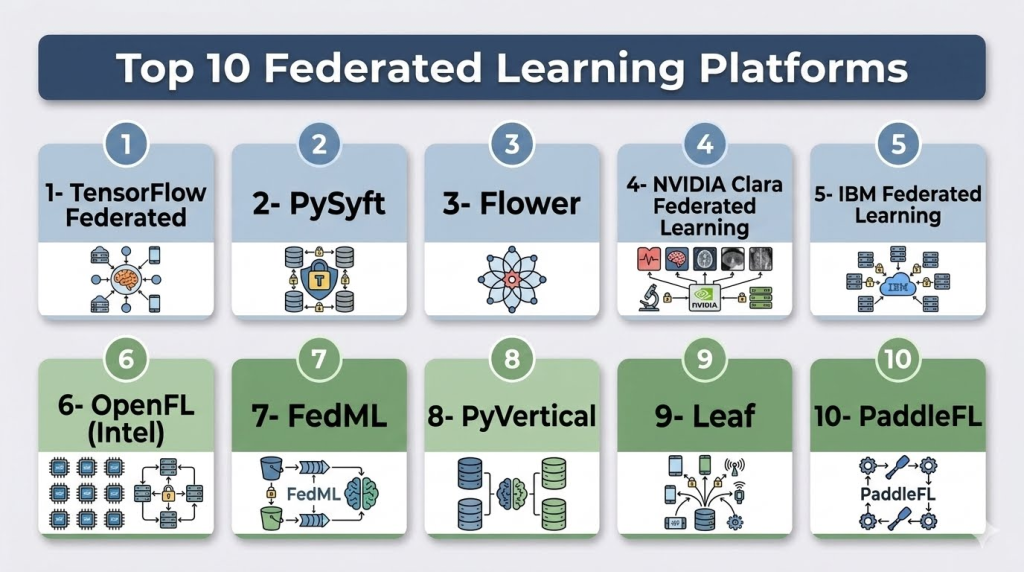
Top 10 Federated Learning Platforms
1- TensorFlow Federated
Short description: TensorFlow Federated (TFF) is an open-source framework for implementing federated learning across devices using TensorFlow.
Key Features
- Supports decentralized and cross-device training
- Privacy-preserving protocols
- Integration with TensorFlow models
- Simulation and deployment APIs
- Multi-party and edge AI support
- Analytics and logging
- Experiment reproducibility
Pros
- Open-source and widely adopted
- Tight integration with TensorFlow
- Scalable and flexible
Cons
- Requires Python/TensorFlow expertise
- Edge deployment setup can be complex
Platforms / Deployment
- Cloud / Self-hosted / Hybrid
Security & Compliance
- Not publicly stated
Integrations & Ecosystem
- TensorFlow, Python SDKs
- MLOps pipeline integration
- Logging and monitoring tools
Support & Community
Active open-source community
2- PySyft
Short description: PySyft is an open-source federated learning framework enabling privacy-preserving ML with multi-party collaboration.
Key Features
- Decentralized training and computation
- Differential privacy and encrypted communication
- Multi-party computation (MPC) support
- Integration with PyTorch and TensorFlow
- Real-time experiment monitoring
- API and SDK support
- Scalable simulations
Pros
- Open-source and flexible
- Strong privacy features
- Multi-framework integration
Cons
- Steeper learning curve
- Limited enterprise support
Platforms / Deployment
- Cloud / Self-hosted / Hybrid
Security & Compliance
- Not publicly stated
Integrations & Ecosystem
- Python, PyTorch, TensorFlow
- Secure aggregation pipelines
- Experiment logging
Support & Community
Open-source community support
3- Flower
Short description: Flower is an open-source federated learning framework for Python that supports cross-platform and edge deployments.
Key Features
- Supports cross-device and cross-silo FL
- Flexible ML framework integration
- Simulation and real-time deployment
- Scalable and extensible architecture
- API for custom federated workflows
- Logging and monitoring
- Edge device compatibility
Pros
- Open-source and flexible
- Edge and cloud integration
- Developer-friendly
Cons
- Requires Python expertise
- Enterprise-ready features require custom setup
Platforms / Deployment
- Cloud / Self-hosted / Hybrid
Security & Compliance
- Not publicly stated
Integrations & Ecosystem
- Python SDK
- TensorFlow, PyTorch, Keras
- MLOps pipelines
Support & Community
Open-source and active developer community
4- NVIDIA Clara Federated Learning
Short description: NVIDIA Clara Federated Learning provides enterprise-grade FL solutions for healthcare and scientific AI applications.
Key Features
- Multi-party AI model training
- Privacy-preserving protocols
- GPU acceleration for performance
- Integration with NVIDIA AI frameworks
- Secure data sharing and aggregation
- Cloud and hybrid deployment
- Monitoring and reporting
Pros
- Enterprise-ready
- High-performance GPU optimization
- Designed for healthcare applications
Cons
- Limited to NVIDIA ecosystem
- Cloud or NVIDIA infrastructure recommended
Platforms / Deployment
- Cloud / Hybrid
Security & Compliance
- HIPAA-compliant for healthcare
- Not publicly stated for other sectors
Integrations & Ecosystem
- NVIDIA AI frameworks
- APIs for multi-party FL
- GPU-accelerated pipelines
Support & Community
Enterprise support from NVIDIA
5- IBM Federated Learning
Short description: IBM Federated Learning is a privacy-preserving FL platform supporting enterprise AI model collaboration across organizations.
Key Features
- Cross-organization and edge AI training
- Differential privacy and secure aggregation
- Integration with AI pipelines
- Monitoring and logging
- Multi-party deployment
- Cloud and on-premises support
- APIs and SDKs
Pros
- Enterprise-grade security
- Multi-party collaboration
- Hybrid deployment options
Cons
- Setup complexity
- Enterprise licensing required
Platforms / Deployment
- Cloud / Self-hosted / Hybrid
Security & Compliance
- SOC 2, ISO 27001
- Not publicly stated for all workloads
Integrations & Ecosystem
- Python SDK, REST APIs
- TensorFlow, PyTorch
- MLOps integration
Support & Community
IBM enterprise support
6- OpenFL (Intel)
Short description: OpenFL is an open-source federated learning framework from Intel for cross-silo and privacy-preserving AI.
Key Features
- Cross-silo model training
- Secure aggregation and encrypted communication
- Multi-party computation support
- Integration with AI/ML frameworks
- Logging and metrics
- API for workflow automation
- Reproducible experiments
Pros
- Open-source and flexible
- Intel-backed for enterprise credibility
- Multi-party support
Cons
- Requires technical setup
- Cloud or on-prem hosting needed
Platforms / Deployment
- Cloud / Self-hosted / Hybrid
Security & Compliance
- Not publicly stated
Integrations & Ecosystem
- Python SDK
- TensorFlow, PyTorch integration
- Secure computation pipelines
Support & Community
Open-source and Intel developer support
7- FedML
Short description: FedML is a research-focused and enterprise-friendly FL platform supporting cross-device and cross-silo learning.
Key Features
- Cross-device and cross-silo FL
- Integration with TensorFlow, PyTorch
- Privacy-preserving protocols
- API and SDK support
- Real-time monitoring
- Cloud, edge, and hybrid deployment
- Experiment versioning
Pros
- Flexible and open-source
- Developer-friendly
- Multi-framework support
Cons
- Learning curve for new users
- Enterprise support limited
Platforms / Deployment
- Cloud / Self-hosted / Hybrid
Security & Compliance
- Not publicly stated
Integrations & Ecosystem
- Python SDK
- TensorFlow, PyTorch
- Secure aggregation pipelines
Support & Community
Open-source community
8- PyVertical
Short description: PyVertical is an open-source Python FL framework enabling privacy-preserving training and secure collaboration across organizations.
Key Features
- Multi-party federated learning
- Privacy-preserving protocols
- Python-native SDK
- Integration with AI pipelines
- Logging and analytics
- API for workflow management
- Scalable simulations
Pros
- Open-source and developer-friendly
- Privacy-focused
- Scalable
Cons
- Limited enterprise support
- Self-hosted recommended
Platforms / Deployment
- Cloud / Self-hosted / Hybrid
Security & Compliance
- Not publicly stated
Integrations & Ecosystem
- Python SDK
- TensorFlow, PyTorch integration
- MLOps pipelines
Support & Community
Open-source community
9- Leaf
Short description: Leaf is a privacy-preserving federated learning framework for enterprise AI model collaboration and secure computation.
Key Features
- Cross-organization FL
- Differential privacy and secure aggregation
- Cloud and hybrid deployment
- Multi-party model training
- API and SDK support
- Logging and monitoring
- Multi-framework integration
Pros
- Enterprise-ready
- Multi-party support
- Privacy-preserving
Cons
- Enterprise licensing required
- Learning curve
Platforms / Deployment
- Cloud / Self-hosted / Hybrid
Security & Compliance
- Not publicly stated
Integrations & Ecosystem
- Python SDK, REST API
- TensorFlow, PyTorch
- MLOps pipelines
Support & Community
Enterprise vendor support
10- PaddleFL
Short description: PaddleFL is an open-source federated learning platform by Baidu, enabling collaborative AI training with privacy guarantees.
Key Features
- Multi-party FL support
- Privacy-preserving protocols
- Integration with PaddlePaddle AI frameworks
- Logging and analytics
- API and SDK support
- Hybrid deployment
- Scalable and reproducible experiments
Pros
- Open-source and enterprise-ready
- PaddlePaddle integration
- Multi-party training
Cons
- Limited outside PaddlePaddle ecosystem
- Self-hosted deployment complexity
Platforms / Deployment
- Cloud / Self-hosted / Hybrid
Security & Compliance
- Not publicly stated
Integrations & Ecosystem
- Python SDK
- PaddlePaddle
- MLOps pipeline integration
Support & Community
Open-source and enterprise support
Comparison Table
| Tool | Best For | Platform(s) | Deployment | Standout Feature | Public Rating |
|---|---|---|---|---|---|
| TensorFlow Federated | Cross-device AI | Cloud/Self-hosted | Hybrid | TensorFlow integration | N/A |
| PySyft | Multi-party FL | Cloud/Self-hosted | Hybrid | Differential privacy | N/A |
| Flower | Cross-silo/edge | Cloud/Self-hosted | Hybrid | Edge device support | N/A |
| NVIDIA Clara FL | Healthcare AI | Cloud/Hybrid | Hybrid | GPU acceleration | N/A |
| IBM Federated Learning | Enterprise AI | Cloud/Self-hosted | Hybrid | Cross-org collaboration | N/A |
| OpenFL | Cross-silo AI | Cloud/Self-hosted | Hybrid | Secure aggregation | N/A |
| FedML | Research & Enterprise | Cloud/Self-hosted | Hybrid | Multi-framework support | N/A |
| PyVertical | Multi-party AI | Cloud/Self-hosted | Hybrid | Python SDK | N/A |
| Leaf | Enterprise FL | Cloud/Self-hosted | Hybrid | Privacy-preserving | N/A |
| PaddleFL | Collaborative AI | Cloud/Self-hosted | Hybrid | PaddlePaddle integration | N/A |
Evaluation & Scoring of Federated Learning Platforms
| Tool | Core (25%) | Ease (15%) | Integrations (15%) | Security (10%) | Performance (10%) | Support (10%) | Value (15%) | Weighted Total |
|---|---|---|---|---|---|---|---|---|
| TensorFlow Federated | 9 | 8 | 8 | 8 | 8 | 7 | 8 | 8.2 |
| PySyft | 8 | 7 | 8 | 8 | 8 | 7 | 8 | 7.9 |
| Flower | 8 | 8 | 8 | 7 | 8 | 7 | 8 | 7.9 |
| NVIDIA Clara FL | 9 | 7 | 8 | 8 | 9 | 8 | 8 | 8.3 |
| IBM Federated Learning | 8 | 7 | 8 | 8 | 8 | 8 | 8 | 8.0 |
| OpenFL | 8 | 7 | 7 | 8 | 8 | 7 | 7 | 7.6 |
| FedML | 8 | 7 | 8 | 7 | 8 | 7 | 8 | 7.8 |
| PyVertical | 8 | 7 | 7 | 7 | 8 | 7 | 7 | 7.5 |
| Leaf | 8 | 7 | 8 | 8 | 8 | 8 | 8 | 7.9 |
| PaddleFL | 8 | 7 | 7 | 7 | 8 | 7 | 7 | 7.5 |
Which Federated Learning Platform Is Right for You?
Solo / Freelancer
- PyVertical, OpenFL
Open-source and Python-native options for experimentation
SMB
- TensorFlow Federated, FedML, Flower
Flexible cloud and hybrid solutions for mid-scale AI
Mid-Market
- PySyft, IBM Federated Learning, PaddleFL
Enterprise-ready collaboration and privacy-preserving FL
Enterprise
- NVIDIA Clara FL, Leaf, IBM Federated Learning
High-scale FL with privacy, GPU acceleration, and multi-party support
Budget vs Premium
- Budget: PyVertical, OpenFL, FedML
- Premium: NVIDIA Clara FL, IBM Federated Learning
Feature Depth vs Ease of Use
- Ease: Flower, TensorFlow Federated
- Depth: NVIDIA Clara FL, IBM Federated Learning, PySyft
Integrations & Scalability
- Best: TensorFlow Federated, NVIDIA Clara FL, IBM Federated Learning
Security & Compliance Needs
- Enterprise-ready: IBM Federated Learning, NVIDIA Clara FL, Leaf
Frequently Asked Questions
1- What is federated learning?
It is a method to train AI models collaboratively without sharing raw data across devices or organizations.
2- Do these platforms support edge devices?
Yes, frameworks like Flower and TensorFlow Federated support cross-device training.
3- Are privacy-preserving protocols included?
Yes, many platforms implement secure aggregation, differential privacy, or homomorphic encryption.
4- Can they integrate with ML pipelines?
Yes, all provide SDKs, APIs, or native integration with AI frameworks.
5- Are there open-source options?
Yes, TensorFlow Federated, PySyft, Flower, OpenFL, FedML, and PyVertical are open-source.
6- Can these tools scale for enterprise workloads?
Yes, cloud-native and hybrid deployments support large-scale collaborative AI.
7- Are GPUs required?
Not strictly, but NVIDIA Clara FL and Zilliz platforms leverage GPU acceleration for performance.
8- Which industries benefit most?
Healthcare, finance, AI research, eCommerce, and IoT applications.
9- Can multiple organizations collaborate securely?
Yes, cross-organization FL with secure aggregation enables multi-party training without sharing raw data.
10- How should I choose the right platform?
Consider dataset scale, deployment type, AI frameworks, privacy needs, and enterprise support.
Conclusion
Federated Learning Platforms are essential for privacy-preserving, multi-party AI model training. They allow organizations to collaborate on AI while protecting sensitive data and maintaining regulatory compliance.
Selecting the right platform depends on workload, deployment preference, and privacy requirements. A practical approach is to shortlist pilot multi-party training, and validate convergence, performance, and privacy guarantees before enterprise adoption.
