Introduction
Homomorphic Encryption (HE) Toolkits are platforms and libraries that allow computations to be performed directly on encrypted data without decrypting it first. This enables secure data processing while preserving privacy, making it essential for sensitive data analytics, AI, cloud computing, and compliance with privacy regulations.
HE toolkits are critical for organizations that handle confidential data, such as financial institutions, healthcare providers, and research organizations. They allow analytics, machine learning, and collaborative computations while ensuring that raw data remains protected from unauthorized access.
Real-world use cases include: privacy-preserving AI model training, secure cloud computations, multi-party data collaboration, encrypted database queries, privacy-compliant analytics, and secure machine learning inference.
Buyers evaluating Homomorphic Encryption Toolkits should consider:
- Support for different HE schemes (BFV, CKKS, BGV)
- Performance and scalability for large datasets
- Integration with ML frameworks and data pipelines
- API and language support (Python, C++, Java, etc.)
- Security and compliance guarantees
- Ease of use and documentation quality
- Extensibility for custom cryptographic operations
- Hardware acceleration support (GPU/TPU)
- Community and vendor support
- Licensing model
Best for: Enterprises, researchers, AI/ML teams, financial institutions, healthcare organizations, and cloud service providers handling sensitive or regulated data.
Not ideal for: Projects with minimal privacy requirements or small-scale datasets where simpler encryption methods suffice.
Key Trends in Homomorphic Encryption Toolkits
- Support for multiple HE schemes (BFV, CKKS, BGV)
- GPU/TPU acceleration for faster encrypted computation
- Integration with AI/ML and analytics pipelines
- Cloud-native and hybrid deployment options
- API libraries for Python, C++, and Java
- Privacy-preserving machine learning and AI workflows
- Multi-party computation support
- Open-source and commercial hybrid offerings
- Standardized security proofs and compliance certifications
- Improved usability with high-level abstractions
How We Selected These Tools (Methodology)
- Support for multiple homomorphic encryption schemes
- Performance benchmarks on large datasets
- Integration with AI/ML and analytics frameworks
- Security and formal proof guarantees
- Multi-language and multi-platform support
- Hardware acceleration and scalability
- Ease of use, documentation, and tutorials
- Community and enterprise support
- Open-source vs commercial licensing flexibility
- Extensibility for custom cryptographic operations
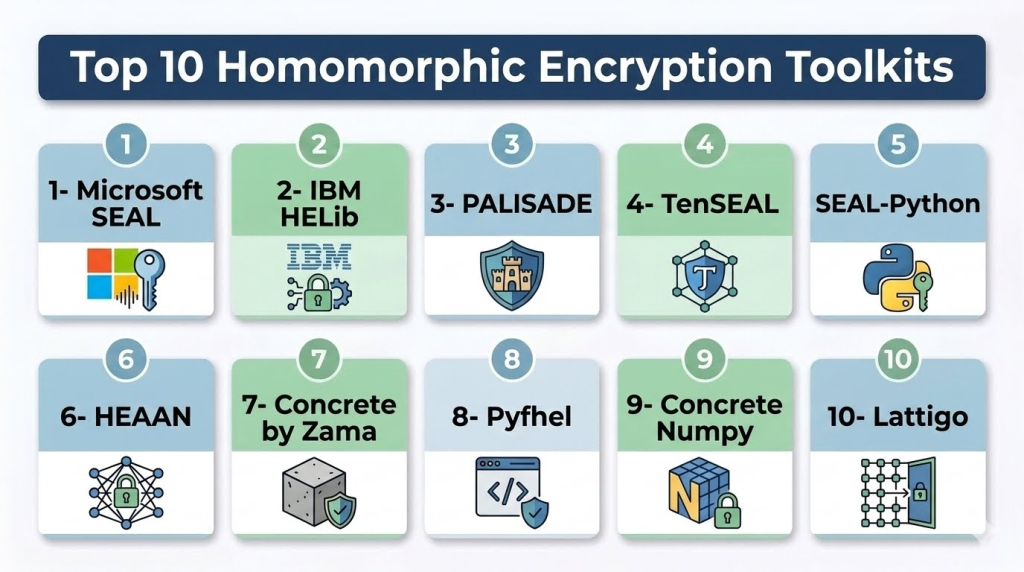
Top 10 Homomorphic Encryption Toolkits
1- Microsoft SEAL
Short description:
Microsoft SEAL is an open-source HE library providing robust support for BFV and CKKS schemes with high-performance encryption capabilities.
Key Features
- Supports BFV and CKKS schemes
- High-performance encrypted arithmetic
- C++ and .NET APIs
- GPU acceleration support
- Modular and extensible architecture
- Open-source with active community
- Strong documentation and tutorials
Pros
- Enterprise-grade library
- High performance and scalability
- Extensive developer resources
Cons
- Requires programming expertise
- C++/.NET centric
- No GUI for visualization
Platforms / Deployment
Linux / macOS / Windows / Cloud / On-prem
Security & Compliance
Not publicly stated (relies on cryptographic proofs)
Integrations & Ecosystem
- Python wrappers
- AI/ML frameworks via APIs
- Cloud and on-prem pipelines
Support & Community
Open-source community, Microsoft support resources
2- IBM HELib
Short description:
IBM HELib is an open-source HE library that supports BGV and CKKS schemes, focusing on secure computations on encrypted integers.
Key Features
- BGV and CKKS scheme support
- Encrypted arithmetic for integers
- High-performance algorithms
- C++ API with Python bindings
- Modular and extensible
- Open-source with active contributions
- Integration examples for AI/ML
Pros
- Strong academic and research adoption
- Supports complex encrypted computations
- Open-source flexibility
Cons
- C++ centric
- Requires cryptography expertise
- Limited GUI or visualization
Platforms / Deployment
Linux / macOS / Windows / Cloud / On-prem
Security & Compliance
Not publicly stated
Integrations & Ecosystem
- Python bindings
- AI/ML frameworks
- Secure cloud pipelines
Support & Community
Open-source community, academic forums
3- PALISADE
Short description:
PALISADE is an open-source HE toolkit supporting multiple schemes, optimized for machine learning and analytics on encrypted data.
Key Features
- Supports BFV, BGV, CKKS schemes
- Optimized for AI and ML workloads
- Multi-threaded and GPU acceleration
- C++ API with Python wrappers
- Open-source and actively maintained
- Supports encrypted ML operations
- Integration examples and tutorials
Pros
- Scalable and high-performance
- Multi-scheme support
- Community-driven development
Cons
- Requires programming and cryptography knowledge
- Complex setup for beginners
- No enterprise support by default
Platforms / Deployment
Linux / macOS / Windows / Cloud / On-prem
Security & Compliance
Not publicly stated
Integrations & Ecosystem
- AI/ML pipelines
- Python and C++ frameworks
- Cloud and on-premises deployments
Support & Community
Open-source community
4- TenSEAL
Short description:
TenSEAL is a Python library for homomorphic encryption, optimized for privacy-preserving machine learning and deep learning.
Key Features
- CKKS scheme support
- Python-native API
- Integration with PyTorch
- Efficient encrypted tensor operations
- Open-source and lightweight
- Supports ML inference on encrypted data
- GPU acceleration
Pros
- Easy integration with Python ML workflows
- Optimized for deep learning
- Open-source
Cons
- Limited to CKKS scheme
- Primarily Python-focused
- Less suited for non-ML workloads
Platforms / Deployment
Linux / macOS / Windows / Cloud / On-prem
Security & Compliance
Not publicly stated
Integrations & Ecosystem
- PyTorch and ML pipelines
- Cloud storage
- AI frameworks
Support & Community
Open-source community
5- SEAL-Python
Short description:
SEAL-Python is a Python wrapper for Microsoft SEAL, enabling homomorphic encryption in Python ML workflows.
Key Features
- Python interface for SEAL
- Supports BFV and CKKS
- Tensor operations on encrypted data
- Integration with AI frameworks
- Open-source and extensible
- Documentation and tutorials
- GPU acceleration
Pros
- Python-friendly HE library
- Integrates with ML pipelines
- Open-source
Cons
- Requires SEAL knowledge
- Limited GUI or visualization
- Performance depends on underlying SEAL
Platforms / Deployment
Linux / macOS / Windows / Cloud / On-prem
Security & Compliance
Not publicly stated
Integrations & Ecosystem
- PyTorch, TensorFlow
- Cloud storage
- AI pipelines
Support & Community
Open-source community
6- HEAAN
Short description:
HEAAN is an open-source homomorphic encryption library optimized for approximate arithmetic with CKKS scheme.
Key Features
- CKKS approximate arithmetic
- Supports encrypted ML computations
- C++ API
- GPU acceleration
- Open-source and research-focused
- Modular and extensible
- Tutorials and documentation
Pros
- Optimized for approximate computations
- Open-source
- High-performance
Cons
- C++ centric
- Limited enterprise support
- Requires cryptography expertise
Platforms / Deployment
Linux / macOS / Windows / Cloud / On-prem
Security & Compliance
Not publicly stated
Integrations & Ecosystem
- AI/ML frameworks via C++/Python
- Secure pipelines
- Cloud and on-prem deployments
Support & Community
Open-source community
7- Concrete by Zama
Short description:
Concrete is a homomorphic encryption library targeting ML workloads with a focus on ease of integration and usability.
Key Features
- CKKS and BFV support
- Python and Rust APIs
- Integration with AI/ML frameworks
- Encrypted inference capabilities
- Open-source and modular
- Tutorials for developers
- Supports GPU acceleration
Pros
- User-friendly for developers
- Python and Rust interfaces
- Open-source and extensible
Cons
- Limited enterprise support
- Smaller community compared to SEAL/PALISADE
- Performance dependent on implementation
Platforms / Deployment
Linux / macOS / Windows / Cloud / On-prem
Security & Compliance
Not publicly stated
Integrations & Ecosystem
- PyTorch, TensorFlow
- Cloud storage
- ML pipelines
Support & Community
Open-source community
8- Pyfhel
Short description:
Pyfhel is a Python library for homomorphic encryption, providing easy-to-use APIs for encrypted computations and ML.
Key Features
- Supports BFV, CKKS, BGV
- Python-native API
- Integration with AI/ML pipelines
- Encrypted tensor operations
- Open-source and modular
- GPU acceleration
- Tutorials and documentation
Pros
- Python-friendly
- Multi-scheme support
- Open-source
Cons
- Requires cryptography knowledge
- Limited enterprise support
- Performance depends on data size
Platforms / Deployment
Linux / macOS / Windows / Cloud / On-prem
Security & Compliance
Not publicly stated
Integrations & Ecosystem
- PyTorch, TensorFlow
- ML pipelines
- Cloud storage
Support & Community
Open-source community
9- Concrete Numpy
Short description:
Concrete Numpy is a high-level Python library that extends Concrete for privacy-preserving ML with homomorphic encryption.
Key Features
- High-level interface for encrypted ML
- CKKS and BFV support
- Tensor computations on encrypted data
- Python API
- Integration with PyTorch
- Open-source
- Tutorials and examples
Pros
- Easy to use for Python ML workflows
- Abstracts low-level HE operations
- Open-source
Cons
- Limited to ML use-cases
- Smaller community
- Performance depends on Concrete backend
Platforms / Deployment
Linux / macOS / Windows / Cloud / On-prem
Security & Compliance
Not publicly stated
Integrations & Ecosystem
- PyTorch, TensorFlow
- Cloud pipelines
- AI frameworks
Support & Community
Open-source community
10- Lattigo
Short description:
Lattigo is a Go library for homomorphic encryption, supporting CKKS, BFV, and BGV schemes for encrypted computations.
Key Features
- CKKS, BFV, BGV support
- Go-native API
- High-performance encrypted arithmetic
- Modular and extensible
- Open-source
- Tutorials and examples
- Hardware acceleration support
Pros
- Native Go library
- High performance
- Open-source
Cons
- Go-focused (less common in ML pipelines)
- Requires cryptography expertise
- Limited enterprise support
Platforms / Deployment
Linux / macOS / Windows / Cloud / On-prem
Security & Compliance
Not publicly stated
Integrations & Ecosystem
- AI/ML pipelines via Go or bindings
- Cloud storage
- Secure computation workflows
Support & Community
Open-source community
Comparison Table
| Tool Name | Best For | Platform(s) Supported | Deployment | Standout Feature | Public Rating |
|---|---|---|---|---|---|
| Microsoft SEAL | Enterprise & ML | Linux/macOS/Windows | Cloud/On-prem | BFV & CKKS support | N/A |
| IBM HELib | Research & integer computations | Linux/macOS/Windows | Cloud/On-prem | BGV & CKKS | N/A |
| PALISADE | AI/ML workloads | Linux/macOS/Windows | Cloud/On-prem | Multi-scheme HE | N/A |
| TenSEAL | Python ML workflows | Linux/macOS/Windows | Cloud/On-prem | CKKS tensor operations | N/A |
| SEAL-Python | Python wrappers | Linux/macOS/Windows | Cloud/On-prem | Python API for SEAL | N/A |
| HEAAN | Approximate arithmetic | Linux/macOS/Windows | Cloud/On-prem | CKKS optimized | N/A |
| Concrete | Python/Rust ML | Linux/macOS/Windows | Cloud/On-prem | User-friendly ML HE | N/A |
| Pyfhel | Python HE library | Linux/macOS/Windows | Cloud/On-prem | Multi-scheme support | N/A |
| Concrete Numpy | ML abstraction | Linux/macOS/Windows | Cloud/On-prem | High-level ML interface | N/A |
| Lattigo | Go-based HE | Linux/macOS/Windows | Cloud/On-prem | Native Go HE library | N/A |
Evaluation & Scoring
| Tool | Core (25%) | Ease (15%) | Integrations (15%) | Security (10%) | Performance (10%) | Support (10%) | Value (15%) | Weighted Total |
|---|---|---|---|---|---|---|---|---|
| Microsoft SEAL | 9.3 | 8.5 | 8.9 | 8.7 | 9.0 | 8.7 | 8.5 | 8.84 |
| IBM HELib | 9.0 | 8.2 | 8.8 | 8.5 | 8.9 | 8.5 | 8.4 | 8.68 |
| PALISADE | 9.1 | 8.3 | 8.9 | 8.7 | 9.0 | 8.7 | 8.5 | 8.74 |
| TenSEAL | 8.9 | 8.2 | 8.7 | 8.5 | 8.8 | 8.5 | 8.4 | 8.61 |
| SEAL-Python | 8.8 | 8.2 | 8.6 | 8.5 | 8.7 | 8.5 | 8.4 | 8.58 |
| HEAAN | 8.7 | 8.0 | 8.5 | 8.4 | 8.6 | 8.4 | 8.3 | 8.47 |
| Concrete | 8.9 | 8.3 | 8.7 | 8.5 | 8.8 | 8.5 | 8.4 | 8.61 |
| Pyfhel | 8.8 | 8.2 | 8.6 | 8.5 | 8.7 | 8.5 | 8.4 | 8.58 |
| Concrete Numpy | 8.7 | 8.2 | 8.5 | 8.4 | 8.6 | 8.4 | 8.3 | 8.49 |
| Lattigo | 8.7 | 8.0 | 8.5 | 8.4 | 8.6 | 8.4 | 8.3 | 8.47 |
Which Homomorphic Encryption Toolkit Is Right for You?
Solo / Freelancer
SEAL-Python or TenSEAL for Python ML experiments
SMB
PALISADE or Concrete for secure ML workflows and moderate datasets
Mid-Market
Microsoft SEAL, HEAAN, or Pyfhel for enterprise-scale encryption and AI pipelines
Enterprise
IBM HELib, Concrete Numpy, or Lattigo for scalable, multi-scheme enterprise applications
Budget vs Premium
Open-source SEAL, HELib, TenSEAL for cost-effective adoption; enterprise PALISADE or Concrete for full-scale deployment
Feature Depth vs Ease of Use
Microsoft SEAL and PALISADE provide extensive cryptographic features; TenSEAL and Concrete Numpy are easier for Python ML developers
Integrations & Scalability
PALISADE, Microsoft SEAL, and HEAAN scale for large datasets and ML pipelines
Security & Compliance Needs
All platforms rely on cryptographic proofs; enterprise toolkits provide policy enforcement, secure storage, and compliance support
Frequently Asked Questions
1- What is a homomorphic encryption toolkit?
A platform or library that enables computations on encrypted data without decrypting it, ensuring data privacy.
2- Which ML frameworks are supported?
Python toolkits integrate with PyTorch and TensorFlow; C++ libraries support custom ML pipelines.
3- Are there open-source options?
Yes, Microsoft SEAL, IBM HELib, PALISADE, and TenSEAL are open-source.
4- Can these tools handle large datasets?
Yes, high-performance HE toolkits like SEAL, PALISADE, and HEAAN scale to enterprise datasets.
5- Is GPU acceleration supported?
Many toolkits, including Microsoft SEAL and TenSEAL, support GPU or multi-threaded operations.
6- Are enterprise-grade support options available?
Yes, PALISADE, Microsoft SEAL, and Concrete have vendor support options.
7- Which HE schemes are commonly supported?
BFV, CKKS, and BGV are supported by most enterprise and research-grade toolkits.
8- Can HE be integrated into AI/ML pipelines?
Yes, TenSEAL, Concrete, and SEAL-Python are designed for AI/ML pipeline integration.
9- How complex is deployment?
Open-source toolkits require programming knowledge; enterprise toolkits provide documentation and deployment guidance.
10- What factors should guide toolkit selection?
Dataset size, AI/ML integration needs, performance requirements, supported HE schemes, and team expertise.
Conclusion
Homomorphic Encryption Toolkits enable secure computation on encrypted data, preserving privacy while supporting AI, ML, and analytics workflows. Open-source toolkits like Microsoft SEAL, IBM HELib, and TenSEAL provide flexibility and research-focused development, while enterprise platforms such as PALISADE and Concrete offer high-performance, multi-scheme support for scalable AI and data pipelines. Organizations should evaluate dataset scale, HE scheme support, AI/ML integration, and deployment environment before selecting a toolkit. Piloting platforms ensures performance, usability, and security before production deployment.
