Introduction
Revenue Operations Platforms help businesses connect sales, marketing, customer success, finance, and leadership teams around one revenue process. In simple words, these platforms help companies manage pipeline visibility, forecasting, sales execution, customer engagement, revenue intelligence, activity tracking, reporting, territory planning, compensation, and go-to-market performance in a more unified way.
Revenue operations matters because modern B2B growth is no longer managed by sales alone. Marketing creates demand, sales converts pipeline, customer success protects renewals, finance validates revenue, and leadership needs accurate forecasting. When these teams work in silos, companies face poor data quality, inaccurate forecasts, missed handoffs, weak pipeline visibility, inconsistent processes, and slower growth. A strong Revenue Operations Platform helps teams align around shared data, clean workflows, reliable forecasting, and better decision-making.
Real-world use cases include:
- Pipeline visibility for sales leaders, RevOps teams, and executives.
- Revenue forecasting to predict bookings, renewals, expansions, and missed targets.
- Sales activity tracking to understand rep behavior, account engagement, and deal movement.
- Conversation intelligence for coaching, deal inspection, and buyer sentiment analysis.
- Sales engagement workflows for outreach, sequences, follow-ups, and pipeline generation.
- CRM data quality improvement through automation, enrichment, and activity capture.
- Revenue performance reporting across sales, marketing, customer success, and finance.
Evaluation Criteria for Buyers:
- Forecasting accuracy for pipeline, bookings, renewals, and revenue expectations.
- CRM integration with Salesforce, HubSpot, Microsoft Dynamics, and other sales systems.
- Revenue intelligence for deal signals, buyer activity, conversation insights, and pipeline health.
- Sales engagement support for sequences, follow-ups, email, calling, and task automation.
- Data quality and activity capture to reduce manual CRM updates and improve reporting.
- Analytics and dashboards for executives, RevOps, managers, and frontline teams.
- Workflow automation for handoffs, alerts, approvals, territory updates, and deal inspection.
- Security controls such as RBAC, SSO, audit logs, encryption, and permission management.
- Scalability for multiple teams, regions, business units, products, and revenue models.
- Ease of adoption for sales reps, managers, RevOps teams, customer success, and leadership.
Best for: Revenue Operations Platforms are best for B2B SaaS companies, enterprise sales teams, RevOps teams, sales operations leaders, marketing operations teams, customer success teams, finance leaders, CROs, and organizations that need better visibility across pipeline, forecasting, sales execution, and revenue performance.
Not ideal for: Very small teams with simple sales processes may not need a dedicated Revenue Operations Platform. If the company has low deal volume, one sales channel, and basic reporting needs, a CRM with simple dashboards may be enough until forecasting, pipeline, and revenue workflow complexity increases.
Key Trends in Revenue Operations Platforms
- AI-assisted forecasting is becoming more practical as platforms analyze pipeline signals, activity patterns, deal risks, and historical performance.
- Revenue intelligence is becoming central to RevOps because teams need visibility into conversations, buyer engagement, next steps, and deal health.
- CRM data automation is becoming essential as sales teams struggle with incomplete fields, missing activities, duplicate accounts, and poor forecast inputs.
- Sales, marketing, and customer success alignment is improving as RevOps platforms connect funnel performance, pipeline quality, renewals, and expansion opportunities.
- Pipeline inspection is becoming more data-driven with deal risk alerts, stage movement analysis, stale opportunity detection, and manager coaching insights.
- Sales engagement and revenue orchestration are converging as teams want prospecting, follow-ups, deal execution, forecasting, and analytics connected.
- Compensation, territory, and quota planning are becoming more integrated with revenue performance data and go-to-market planning.
- Buyer signal tracking is growing as teams use website visits, email engagement, calls, meetings, intent data, and product usage to guide revenue actions.
- Executive dashboards are becoming more important because leadership needs trusted revenue data across new business, renewals, expansion, and pipeline coverage.
- Security and governance are stronger buying criteria because RevOps platforms handle customer data, sales activity, forecasts, compensation data, and revenue reporting.
How We Selected These Tools
The tools in this list were selected based on their relevance to revenue operations, forecasting, revenue intelligence, CRM workflows, sales engagement, pipeline management, activity capture, reporting, and go-to-market execution.
Evaluation logic included:
- Revenue operations fit across pipeline, forecasting, deal inspection, activity capture, and cross-functional revenue workflows.
- Market recognition and adoption among RevOps, sales operations, sales leadership, customer success, and executive teams.
- CRM ecosystem strength for Salesforce, HubSpot, Microsoft Dynamics, and other core revenue systems.
- Forecasting and pipeline intelligence for deal health, risk scoring, forecast accuracy, and pipeline coverage.
- Sales execution support through engagement, conversation intelligence, coaching, and task automation.
- Analytics and reporting depth for executives, managers, RevOps teams, and frontline users.
- Security and governance signals such as permissions, audit trails, authentication, and administrative controls.
- Scalability for SMB, mid-market, and enterprise revenue teams.
- Ease of use for sales reps, managers, RevOps admins, and leadership.
- Practical buyer fit across SaaS, technology, services, manufacturing, B2B commerce, and enterprise sales organizations.
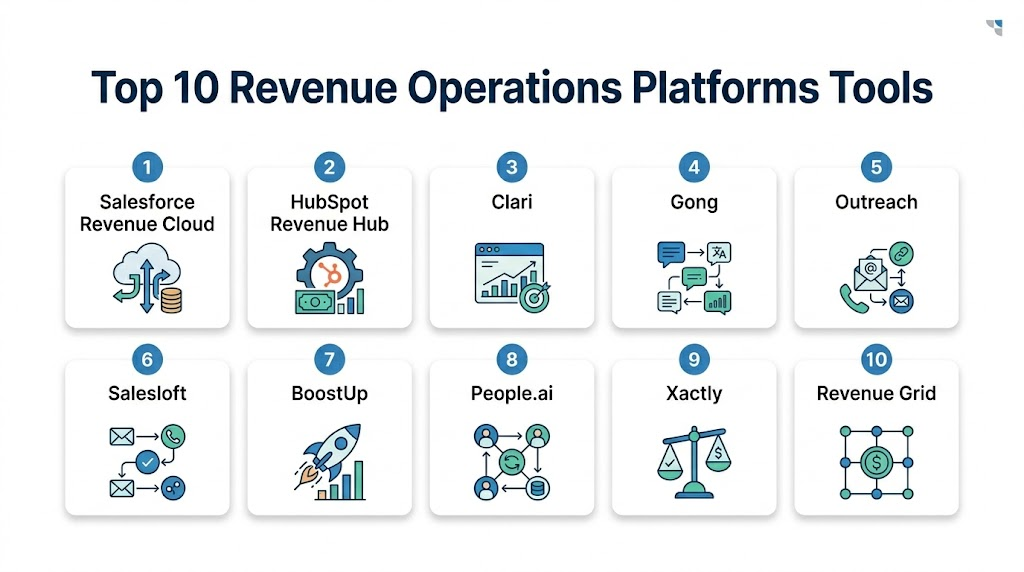
Top 10 Revenue Operations Platforms Tools
1- Salesforce Revenue Cloud
Short description: Salesforce Revenue Cloud helps organizations manage revenue workflows across CRM, CPQ, pricing, quoting, approvals, contracts, billing, and revenue lifecycle operations. It is best suited for businesses already using Salesforce and needing a connected revenue operations foundation.
Key Features
- CRM-native revenue workflow management.
- CPQ support for product configuration, pricing, and quoting.
- Approval workflows for discounts and deal exceptions.
- Revenue lifecycle visibility from quote to billing handoff.
- Forecasting and reporting through Salesforce dashboards.
- Integration with Salesforce sales, service, and analytics ecosystem.
- Support for enterprise revenue processes and complex deal models.
Pros
- Strong fit for Salesforce-centered revenue teams.
- Keeps opportunities, accounts, quotes, approvals, and revenue data connected.
- Scalable for complex enterprise revenue operations.
Cons
- Implementation can require experienced Salesforce specialists.
- Configuration may become complex for advanced pricing and workflow rules.
- Smaller teams may find it heavier than needed.
Platforms / Deployment
Web / Cloud
Security & Compliance
Salesforce enterprise products commonly support role-based access, authentication options, auditability, encryption options, and administrative controls. Specific certifications and compliance needs should be confirmed during vendor review.
Integrations & Ecosystem
Salesforce Revenue Cloud connects with sales, finance, billing, service, partner, and analytics workflows through the Salesforce ecosystem.
Common integration areas include:
- Salesforce CRM.
- Billing systems.
- ERP platforms.
- E-signature tools.
- Contract management tools.
- Analytics and reporting platforms.
Support & Community
Salesforce provides enterprise support, documentation, training, implementation partners, and a large customer ecosystem. Its community is strong among sales operations, RevOps, Salesforce administrators, CPQ teams, and enterprise revenue leaders.
2- HubSpot Revenue Hub
Short description: HubSpot Revenue Hub supports sales, marketing, service, operations, CRM, automation, reporting, and customer lifecycle workflows in one connected platform. It is especially useful for SMB and mid-market teams that want revenue operations without heavy enterprise complexity.
Key Features
- CRM-centered revenue operations workflows.
- Sales pipeline, deal tracking, and forecasting support.
- Marketing, sales, and service data alignment.
- Workflow automation for handoffs and follow-ups.
- Reporting dashboards for revenue teams.
- Operations tools for data quality and process automation.
- Integrations through HubSpot marketplace and APIs.
Pros
- Easy to adopt for SMB and mid-market teams.
- Strong connection between marketing, sales, and service workflows.
- Good value for teams wanting a unified CRM-based RevOps platform.
Cons
- Enterprise customization may be limited compared with heavier platforms.
- Complex forecasting or CPQ workflows may require additional tools.
- Advanced RevOps architecture may need integrations.
Platforms / Deployment
Web / Cloud / iOS / Android
Security & Compliance
HubSpot commonly supports user permissions, authentication options, secure data handling, and administrative controls. Specific certifications and compliance requirements should be confirmed directly with the vendor.
Integrations & Ecosystem
HubSpot Revenue Hub connects marketing, sales, service, CRM, automation, and reporting workflows.
Common integration areas include:
- HubSpot CRM.
- Marketing automation.
- Customer service workflows.
- Sales engagement tools.
- Payment systems.
- Reporting dashboards.
Support & Community
HubSpot provides documentation, Academy resources, support options, onboarding services, marketplace apps, and a strong community. Its community is especially strong among SMB, mid-market, sales, marketing, service, and RevOps teams.
3- Clari
Short description: Clari is a revenue intelligence and forecasting platform that helps revenue teams manage pipeline inspection, forecast accuracy, deal risk, sales execution, and revenue predictability. It is best suited for mid-market and enterprise teams that need stronger pipeline visibility.
Key Features
- Revenue forecasting and forecast rollups.
- Pipeline inspection and deal health visibility.
- AI-assisted risk signals and opportunity insights.
- Activity capture and CRM data improvement.
- Sales manager dashboards and coaching visibility.
- Revenue cadence and inspection workflows.
- Integrations with CRM, email, calendar, and sales tools.
Pros
- Strong fit for forecasting and pipeline governance.
- Useful for RevOps teams improving forecast discipline.
- Helps leaders identify deal risk and pipeline gaps.
Cons
- Best value depends on CRM data quality and sales process maturity.
- May require change management for forecast adoption.
- Less focused on marketing or customer success operations than broader platforms.
Platforms / Deployment
Web / Cloud
Security & Compliance
Clari commonly supports enterprise access controls, permissions, authentication options, secure data handling, and administrative governance. Specific certifications and compliance details should be confirmed with the vendor.
Integrations & Ecosystem
Clari connects revenue forecasting with CRM, communication, activity, and sales execution systems.
Common integration areas include:
- CRM systems.
- Email and calendar tools.
- Sales engagement platforms.
- Conversation intelligence tools.
- Data warehouses.
- Business intelligence platforms.
Support & Community
Clari provides documentation, onboarding, customer success resources, implementation support, and revenue operations guidance. Its community is strong among RevOps leaders, sales operations teams, CROs, and forecasting-focused sales organizations.
4- Gong
Short description: Gong is a revenue intelligence platform that captures and analyzes sales conversations, buyer interactions, deal activity, and pipeline signals. It is useful for teams that want better coaching, deal inspection, forecast visibility, and buyer engagement insights.
Key Features
- Conversation intelligence for calls, meetings, and customer interactions.
- Deal intelligence and pipeline risk signals.
- Sales coaching insights for managers and reps.
- Activity capture and buyer engagement tracking.
- Forecasting and pipeline visibility support.
- Analytics for sales performance and customer conversations.
- Integrations with CRM, email, calendar, and sales tools.
Pros
- Strong fit for conversation-driven revenue intelligence.
- Useful for coaching, deal review, and buyer signal analysis.
- Helps managers understand what is happening inside deals.
Cons
- Not a full CRM or quote-to-cash platform.
- Value depends on adoption by sales teams and managers.
- May require integrations for full RevOps reporting.
Platforms / Deployment
Web / Cloud
Security & Compliance
Gong commonly supports enterprise access controls, authentication options, permissions, auditability, and secure handling of conversation data. Specific certifications and compliance requirements should be confirmed during vendor evaluation.
Integrations & Ecosystem
Gong connects sales conversation data with CRM, forecasting, enablement, and revenue workflows.
Common integration areas include:
- CRM systems.
- Email and calendar tools.
- Sales engagement platforms.
- Forecasting platforms.
- Business intelligence tools.
- Collaboration systems.
Support & Community
Gong provides documentation, onboarding, customer success resources, training, and sales coaching content. Its community is strong among sales leaders, RevOps teams, enablement teams, account executives, and customer-facing managers.
5- Outreach
Short description: Outreach is a sales execution and revenue workflow platform that supports prospecting, sales engagement, sequences, pipeline generation, forecasting signals, and seller productivity. It is useful for teams that want stronger outbound execution and sales activity visibility.
Key Features
- Sales engagement sequences and workflow automation.
- Email, calling, task, and follow-up management.
- Buyer engagement tracking and activity insights.
- Pipeline generation and sales productivity dashboards.
- CRM integration for lead, contact, and opportunity workflows.
- AI-assisted sales execution and coaching support.
- Reporting for team performance and sales activity.
Pros
- Strong fit for outbound and sales engagement teams.
- Helps standardize prospecting and follow-up processes.
- Useful for improving rep productivity and pipeline generation.
Cons
- Not a complete revenue operations platform by itself.
- Forecasting and full revenue lifecycle needs may require additional tools.
- Requires disciplined sequence and data management.
Platforms / Deployment
Web / Cloud
Security & Compliance
Outreach commonly supports enterprise access controls, authentication options, permissions, audit logs, and administrative security settings. Specific certifications and compliance needs should be confirmed directly.
Integrations & Ecosystem
Outreach connects sales engagement with CRM, email, calendar, calling, data, and analytics workflows.
Common integration areas include:
- CRM systems.
- Email and calendar tools.
- Sales intelligence platforms.
- Conversation intelligence tools.
- Data enrichment tools.
- Reporting systems.
Support & Community
Outreach provides documentation, support services, onboarding, customer success resources, and sales execution education. Its community is strong among sales development, account executives, sales operations, and RevOps teams.
6- Salesloft
Short description: Salesloft is a revenue orchestration and sales engagement platform that helps revenue teams manage cadences, prospecting, conversations, pipeline activity, and seller workflows. It is useful for sales teams that want stronger execution discipline and engagement visibility.
Key Features
- Sales cadences and engagement workflows.
- Email, phone, social, and task automation.
- Conversation intelligence and call insights.
- Pipeline activity visibility.
- CRM synchronization and sales workflow support.
- Coaching and performance dashboards.
- AI-assisted sales execution guidance.
Pros
- Strong fit for sales engagement and revenue execution.
- Useful for standardizing outreach and seller workflows.
- Helps managers coach based on activity and conversation signals.
Cons
- Not a full finance or revenue lifecycle platform.
- Forecasting and compensation planning may require additional tools.
- Requires strong process design for best results.
Platforms / Deployment
Web / Cloud
Security & Compliance
Salesloft commonly supports access controls, permissions, authentication options, auditability, and administrative controls. Specific certifications and compliance requirements should be confirmed during vendor evaluation.
Integrations & Ecosystem
Salesloft connects with CRM, communication, conversation intelligence, data, and sales productivity systems.
Common integration areas include:
- CRM systems.
- Email and calendar tools.
- Sales intelligence platforms.
- Conversation intelligence tools.
- Dialers and communication tools.
- Reporting systems.
Support & Community
Salesloft provides documentation, onboarding, training, customer support, and sales engagement resources. Its community is strong among sales development teams, account executives, sales managers, and RevOps professionals.
7- BoostUp
Short description: BoostUp is a revenue operations and intelligence platform focused on forecasting, pipeline inspection, deal risk, sales activity, and revenue predictability. It is suitable for RevOps and sales leadership teams that need better forecast discipline and pipeline visibility.
Key Features
- Forecasting and pipeline visibility.
- Deal risk scoring and opportunity inspection.
- Sales activity and engagement analytics.
- Revenue dashboards for leadership and managers.
- CRM data quality and pipeline hygiene insights.
- Forecast rollups and team performance tracking.
- Integration with CRM, email, calendar, and sales tools.
Pros
- Strong fit for forecast management and pipeline inspection.
- Useful for RevOps teams needing deal risk visibility.
- Helps improve forecast consistency across teams.
Cons
- Not a complete CRM or sales engagement platform.
- Best results depend on CRM data and sales adoption.
- May require integrations for broader revenue workflows.
Platforms / Deployment
Web / Cloud
Security & Compliance
BoostUp commonly supports enterprise permissions, authentication options, secure data handling, and administrative controls. Specific certifications and compliance needs should be confirmed directly with the vendor.
Integrations & Ecosystem
BoostUp connects forecasting and revenue intelligence with CRM, communication, and sales activity systems.
Common integration areas include:
- CRM systems.
- Email and calendar platforms.
- Sales engagement tools.
- Conversation intelligence tools.
- Data warehouses.
- Reporting platforms.
Support & Community
BoostUp provides onboarding, documentation, customer success support, and revenue operations guidance. Its community is strongest among RevOps teams, sales operations leaders, and forecasting-focused revenue organizations.
8- People.ai
Short description: People.ai helps revenue teams improve CRM data quality, activity capture, sales productivity visibility, account engagement tracking, and revenue intelligence. It is especially useful for organizations that need better visibility into seller activities and relationship coverage.
Key Features
- Automatic sales activity capture.
- CRM data quality improvement.
- Account and opportunity engagement analytics.
- Relationship and contact coverage insights.
- Sales productivity and pipeline visibility.
- Revenue intelligence dashboards.
- Integrations with CRM, email, calendar, and productivity tools.
Pros
- Strong fit for improving CRM hygiene and activity visibility.
- Useful for understanding account engagement and seller productivity.
- Helps reduce manual activity logging.
Cons
- Not a full forecasting, CPQ, or sales engagement platform.
- Value depends on integration quality and adoption by sales leadership.
- May need complementary tools for end-to-end RevOps workflows.
Platforms / Deployment
Web / Cloud
Security & Compliance
People.ai commonly supports enterprise access controls, permissions, authentication options, and secure handling of customer and activity data. Specific certifications and compliance details should be verified during vendor review.
Integrations & Ecosystem
People.ai connects sales activity data with CRM, email, calendar, and revenue analytics workflows.
Common integration areas include:
- CRM systems.
- Email platforms.
- Calendar systems.
- Business intelligence tools.
- Sales engagement platforms.
- Revenue intelligence systems.
Support & Community
People.ai provides onboarding, documentation, customer success resources, and implementation support. Its community is strongest among sales operations, RevOps, enterprise sales leaders, and CRM data quality teams.
9- Xactly
Short description: Xactly supports sales performance management, incentive compensation, forecasting, territory planning, quota management, and revenue planning workflows. It is useful for organizations that want RevOps to connect sales performance, compensation, and planning.
Key Features
- Incentive compensation management.
- Sales performance reporting.
- Territory and quota planning support.
- Forecasting and revenue planning capabilities.
- Analytics for sales productivity and payout accuracy.
- Workflow automation for compensation operations.
- Integration with CRM, HR, finance, and payroll systems.
Pros
- Strong fit for compensation and sales performance management.
- Useful for aligning quotas, territories, incentives, and revenue goals.
- Helps reduce manual commission and payout processes.
Cons
- Not a full sales engagement or conversation intelligence platform.
- Setup can require detailed compensation plan configuration.
- Best value depends on finance, HR, and sales operations alignment.
Platforms / Deployment
Web / Cloud
Security & Compliance
Xactly commonly supports access controls, permissions, auditability, authentication options, and secure compensation data handling. Specific certifications and compliance needs should be confirmed during vendor evaluation.
Integrations & Ecosystem
Xactly connects compensation and revenue planning with sales, finance, HR, and analytics systems.
Common integration areas include:
- CRM systems.
- HR platforms.
- Payroll systems.
- Finance systems.
- Business intelligence tools.
- Data warehouses.
Support & Community
Xactly provides documentation, enterprise support, implementation guidance, customer success resources, and sales performance expertise. Its community is strongest among sales operations, compensation teams, finance teams, and RevOps leaders.
10- Revenue Grid
Short description: Revenue Grid is a revenue intelligence and sales automation platform focused on CRM automation, pipeline visibility, forecasting support, activity tracking, and guided selling. It is especially useful for teams that want stronger CRM adoption and sales process visibility.
Key Features
- Sales activity capture and CRM automation.
- Pipeline visibility and opportunity tracking.
- Revenue intelligence and guided selling alerts.
- Forecasting support and deal health insights.
- Email and calendar synchronization.
- Sales process automation.
- Reporting for sales activity and pipeline performance.
Pros
- Strong fit for CRM productivity and pipeline visibility.
- Useful for teams needing better activity capture and guided selling.
- Helps reduce manual CRM update burden.
Cons
- Not a full quote-to-cash or compensation platform.
- Broader RevOps needs may require complementary tools.
- Best fit depends on CRM environment and sales workflow needs.
Platforms / Deployment
Web / Cloud
Security & Compliance
Revenue Grid commonly supports access controls, user permissions, secure data synchronization, and administrative settings. Specific certifications and compliance requirements should be confirmed directly with the vendor.
Integrations & Ecosystem
Revenue Grid connects CRM, email, calendar, pipeline, and sales workflow data.
Common integration areas include:
- CRM systems.
- Email platforms.
- Calendar systems.
- Sales productivity tools.
- Reporting platforms.
- Workflow automation systems.
Support & Community
Revenue Grid provides documentation, onboarding, customer support, and implementation resources. Its community is strongest among sales operations, CRM administrators, revenue teams, and pipeline management users.
Comparison Table
| Tool Name | Best For | Platform Supported | Deployment | Standout Feature | Public Rating |
|---|---|---|---|---|---|
| Salesforce Revenue Cloud | Enterprise revenue lifecycle teams | Web | Cloud | CRM-native revenue lifecycle workflows | N/A |
| HubSpot Revenue Hub | SMB and mid-market RevOps teams | Web / iOS / Android | Cloud | Unified CRM, marketing, sales, and service workflows | N/A |
| Clari | Forecasting and pipeline inspection | Web | Cloud | Revenue forecasting and deal risk visibility | N/A |
| Gong | Revenue intelligence and sales coaching | Web | Cloud | Conversation intelligence and buyer signal analysis | N/A |
| Outreach | Sales engagement and pipeline generation | Web | Cloud | Sequences, outreach workflows, and seller productivity | N/A |
| Salesloft | Revenue orchestration and sales engagement | Web | Cloud | Cadences, conversations, and sales execution workflows | N/A |
| BoostUp | Forecast management and pipeline health | Web | Cloud | Forecasting and deal risk scoring | N/A |
| People.ai | CRM data quality and activity capture | Web | Cloud | Automatic activity capture and relationship intelligence | N/A |
| Xactly | Compensation and sales performance planning | Web | Cloud | Incentive compensation and revenue planning | N/A |
| Revenue Grid | CRM automation and pipeline visibility | Web | Cloud | Sales activity capture and guided selling | N/A |
Evaluation & Scoring of Revenue Operations Platforms
| Tool Name | Core 25% | Ease 15% | Integrations 15% | Security 10% | Performance 10% | Support 10% | Value 15% | Weighted Total |
| Salesforce Revenue Cloud | 9 | 7 | 10 | 9 | 9 | 9 | 7 | 8.55 |
| HubSpot Revenue Hub | 8 | 9 | 8 | 8 | 8 | 8 | 8 | 8.20 |
| Clari | 9 | 8 | 9 | 8 | 9 | 8 | 8 | 8.45 |
| Gong | 9 | 8 | 9 | 8 | 9 | 8 | 8 | 8.45 |
| Outreach | 8 | 8 | 9 | 8 | 8 | 8 | 8 | 8.15 |
| Salesloft | 8 | 8 | 9 | 8 | 8 | 8 | 8 | 8.15 |
| BoostUp | 8 | 8 | 8 | 8 | 8 | 8 | 8 | 8.00 |
| People.ai | 8 | 8 | 8 | 8 | 8 | 8 | 8 | 8.00 |
| Xactly | 8 | 7 | 8 | 9 | 8 | 8 | 7 | 7.85 |
| Revenue Grid | 7 | 8 | 8 | 8 | 8 | 8 | 8 | 7.75 |
The scoring is comparative and should be used as a practical starting point, not a final buying decision. Enterprise teams may value CRM integration, forecasting depth, governance, and scalability more than ease of setup. SMB and mid-market teams may prioritize simple adoption, clean dashboards, workflow automation, and cost efficiency. A tool with a slightly lower score may still be the best fit if it matches your revenue process, CRM stack, forecast maturity, sales motion, and budget. Buyers should test each platform with real pipeline, forecast, activity, engagement, and reporting scenarios before final selection.
Which Revenue Operations Platform Is Right for You?
Solo / Freelancer
Solo consultants and freelancers usually do not need a full Revenue Operations Platform unless they manage sales operations or RevOps projects for clients. A CRM with simple automation, reporting, and task management may be enough for personal business needs.
If a consultant supports client RevOps work, it is useful to understand platforms like Salesforce Revenue Cloud, HubSpot, Clari, Gong, Outreach, and Xactly. However, for personal use, HubSpot Revenue Hub or a lightweight CRM setup may be more practical than a complex enterprise revenue stack.
SMB
SMBs should focus on CRM quality, simple pipeline visibility, sales automation, reporting, and easy adoption. HubSpot Revenue Hub, Outreach, Salesloft, Revenue Grid, and Gong can be useful depending on whether the main need is CRM alignment, sales engagement, or deal intelligence.
Small businesses should avoid buying too many tools before the sales process is stable. The first priority should be clean CRM data, consistent pipeline stages, clear ownership, activity tracking, and basic forecast visibility. Once the team grows, forecasting and revenue intelligence platforms become more valuable.
Mid-Market
Mid-market companies often need stronger RevOps workflows because they manage multiple sales teams, larger pipelines, recurring revenue, customer expansion, and more complex forecasting. Clari, Gong, HubSpot Revenue Hub, Outreach, Salesloft, BoostUp, People.ai, and Revenue Grid can all be relevant depending on the revenue motion.
If forecasting is the main pain point, Clari or BoostUp may be strong choices. If sales calls and deal insights are the priority, Gong is useful. If outbound execution needs structure, Outreach or Salesloft can help. If CRM activity quality is poor, People.ai or Revenue Grid may be practical options.
Enterprise
Enterprises usually need advanced forecasting, territory planning, compensation, pipeline inspection, activity capture, CRM governance, sales engagement, customer success alignment, and executive dashboards. Salesforce Revenue Cloud, Clari, Gong, Xactly, Outreach, Salesloft, People.ai, and BoostUp are strong enterprise candidates.
Enterprise buyers should focus on integration architecture, data governance, user permissions, forecasting process, pipeline hygiene, territory design, compensation workflows, and reporting scalability. The best platform should help leadership trust revenue data while helping frontline teams execute better.
Budget vs Premium
Budget-focused buyers should start by identifying the most urgent revenue problem. If CRM and team alignment are the issue, HubSpot Revenue Hub may be practical. If outbound execution is the issue, Outreach or Salesloft may help. If activity capture is the issue, Revenue Grid or People.ai may be useful.
Premium buyers should evaluate Salesforce Revenue Cloud, Clari, Gong, Xactly, and enterprise sales engagement platforms when revenue operations are complex. These tools are better suited for teams that need forecasting accuracy, executive visibility, compensation planning, deal inspection, and enterprise governance.
Feature Depth vs Ease of Use
Salesforce Revenue Cloud, Clari, Gong, Xactly, Outreach, and Salesloft offer strong depth for specific RevOps functions such as revenue lifecycle, forecasting, conversation intelligence, compensation, and sales execution. They are useful when revenue operations are mature and specialized.
HubSpot Revenue Hub, Revenue Grid, People.ai, and BoostUp may be easier to adopt depending on the team’s needs. Buyers should choose feature depth when processes are complex and choose ease of use when adoption speed and workflow simplicity matter most.
Integrations & Scalability
Revenue Operations Platforms must integrate with CRM, marketing automation, customer success platforms, billing systems, sales engagement tools, conversation intelligence tools, compensation systems, data warehouses, and business intelligence platforms. Without strong integrations, RevOps teams cannot create reliable reporting or consistent workflows.
Scalability depends on team size, pipeline volume, account complexity, sales process maturity, data quality, regions, product lines, and forecast requirements. Large organizations should validate APIs, CRM sync, data governance, user permissions, reporting flexibility, and admin controls before rollout.
Security & Compliance Needs
Revenue Operations Platforms handle sensitive customer records, pipeline data, deal values, forecasts, sales activity, compensation details, call recordings, emails, and commercial information. Buyers should review RBAC, SSO, MFA, audit logs, encryption, data retention, user permissions, and administrative controls.
Highly regulated organizations should also evaluate activity logging, call recording rules, data residency, privacy settings, forecast access, compensation data controls, and integration security. A strong RevOps platform should improve visibility without exposing sensitive revenue data to unnecessary risk.
Frequently Asked Questions
1- What are Revenue Operations Platforms?
Revenue Operations Platforms help businesses align sales, marketing, customer success, finance, and leadership teams around shared revenue data, workflows, forecasting, pipeline visibility, and performance reporting. They reduce silos and improve revenue decision-making.
2- Who should use Revenue Operations Platforms?
B2B sales teams, SaaS companies, RevOps teams, sales operations leaders, marketing operations teams, customer success teams, CROs, and finance leaders benefit most from these platforms. They are especially useful when pipeline, forecast, and customer data are spread across multiple systems.
3- What is the difference between RevOps software and CRM software?
CRM software stores customer and sales records, while RevOps software helps improve the processes, data, forecasting, engagement, and analytics around revenue generation. Some CRM platforms include RevOps features, but many teams add specialized tools for forecasting, intelligence, and execution.
4- What features are most important in a Revenue Operations Platform?
Important features include CRM integration, forecasting, pipeline inspection, activity capture, revenue intelligence, sales engagement, reporting dashboards, workflow automation, data quality tools, compensation support, and security controls.
5- How much do Revenue Operations Platforms cost?
Pricing varies by vendor, number of users, modules, CRM integrations, data volume, forecasting needs, support level, and implementation scope. Many enterprise vendors use custom pricing, so buyers should request quotes based on actual revenue workflows.
6- How long does implementation take?
Implementation depends on CRM quality, data structure, integrations, sales process maturity, reporting needs, user training, and workflow complexity. A simple tool can launch faster, while enterprise RevOps platforms often require phased rollout and governance planning.
7- What are common mistakes when choosing RevOps software?
Common mistakes include buying tools before fixing CRM data, ignoring user adoption, choosing too many disconnected systems, skipping sales manager input, and failing to define reporting ownership. Buyers should map revenue processes before selecting software.
8- Can RevOps platforms improve forecasting accuracy?
Yes, RevOps platforms can improve forecasting by combining pipeline data, sales activity, historical performance, buyer engagement, deal risk, and manager inputs. Forecast quality still depends on disciplined sales processes and clean CRM data.
9- Do Revenue Operations Platforms integrate with CRM systems?
Most leading RevOps platforms integrate with CRM systems such as Salesforce, HubSpot, Microsoft Dynamics, and others. Buyers should validate field mapping, activity sync, permissions, data refresh frequency, and reporting requirements before purchase.
10- Are Revenue Operations Platforms useful for SaaS companies?
Yes, SaaS companies use RevOps platforms to manage pipeline, forecasting, renewals, expansions, customer success handoffs, sales productivity, and revenue reporting. SaaS teams often need RevOps tools because recurring revenue models require strong visibility across the customer lifecycle.
Conclusion
Revenue Operations Platforms help organizations connect people, processes, data, and systems across the full revenue engine. The right platform can improve pipeline visibility, forecast accuracy, sales execution, customer engagement, CRM data quality, compensation planning, and executive reporting. Salesforce Revenue Cloud and HubSpot Revenue Hub are strong CRM-centered options, Clari and BoostUp are strong for forecasting and pipeline inspection, Gong is powerful for revenue intelligence and coaching, Outreach and Salesloft support sales engagement and execution, People.ai and Revenue Grid improve activity capture and CRM visibility, and Xactly supports compensation and revenue planning. The best choice depends on your CRM stack, sales motion, forecast maturity, team size, integration needs, and budget. Start by shortlisting two or three tools, test them with real pipeline and forecast scenarios, validate integrations and security, and then scale once revenue teams trust the data and workflow.
