Introduction
Order-to-Cash Platforms help companies manage the complete revenue process from receiving a customer order to collecting payment and applying cash. In simple words, these platforms connect order management, invoicing, credit control, collections, payment processing, deductions, dispute handling, cash application, and reporting into one structured workflow.
Order-to-Cash matters because every business wants faster cash flow, fewer billing errors, better customer payment experiences, and stronger visibility into accounts receivable. When the process is managed through spreadsheets, emails, manual invoice tracking, and disconnected ERP systems, finance teams often face delayed payments, unclear disputes, duplicate work, and poor cash forecasting. A strong Order-to-Cash platform helps finance, sales, operations, customer service, and collections teams work from the same revenue data.
Real-world use cases include:
- Order processing automation for sales orders, customer orders, and fulfillment handoffs
- Invoice generation and delivery for accurate and timely billing
- Credit risk management for customer credit checks and approval workflows
- Collections automation for reminders, prioritization, and follow-up workflows
- Cash application for matching payments with invoices
- Dispute and deduction management for resolving billing issues faster
- Customer payment portals for self-service invoice access and online payments
Evaluation Criteria for Buyers:
- Order management workflow
- Invoice automation
- Collections management
- Cash application accuracy
- Credit risk support
- Dispute and deduction handling
- Payment portal experience
- ERP and accounting integration
- Reporting and cash forecasting
- Security, permissions, and auditability
Best for: Order-to-Cash Platforms are best for finance teams, accounts receivable teams, shared service centers, enterprise finance operations, B2B companies, SaaS businesses, manufacturers, distributors, wholesalers, retailers, healthcare organizations, logistics companies, and organizations that manage large invoice volumes or complex customer payment workflows.
Not ideal for: Order-to-Cash Platforms may not be ideal for very small businesses with a low invoice volume, simple payment collection, and no complex credit or dispute process. In those cases, accounting software, billing tools, or basic payment platforms may be enough.
Key Trends in Order-to-Cash Platforms
- AI-powered cash application is becoming more important because finance teams want faster and more accurate payment matching.
- Collections prioritization is moving from static aging reports to risk-based workflows that help teams focus on high-impact accounts.
- Customer payment portals are becoming standard because buyers expect self-service invoice access, payment options, and dispute visibility.
- ERP-connected automation is critical because order, invoice, payment, and customer data must stay accurate across finance systems.
- Real-time cash visibility is becoming more valuable for CFOs and treasury teams that need better working capital insight.
- Dispute and deduction automation is helping teams reduce revenue leakage and resolve invoice issues faster.
- Predictive collections analytics are helping finance teams forecast payment behavior and reduce days sales outstanding.
- Global e-invoicing support is becoming important for companies operating across multiple regions and compliance environments.
- Shared service center automation is growing as large organizations centralize accounts receivable and collections operations.
- End-to-end quote-to-cash alignment is becoming more important for subscription, usage-based, and recurring revenue businesses.
How We Selected These Tools
The tools in this list were selected based on their relevance to order-to-cash automation, accounts receivable operations, invoice-to-cash workflows, cash application, credit management, collections, dispute handling, payments, and finance operations. The goal is not to name one universal winner, but to help buyers compare recognized platforms based on business model, finance maturity, and process complexity.
Selection factors include:
- Market recognition in Order-to-Cash, invoice-to-cash, accounts receivable, or revenue operations
- Support for invoicing, collections, cash application, credit, payments, and dispute workflows
- Ability to reduce manual finance operations and improve cash visibility
- Integration with ERP, accounting, CRM, billing, and payment systems
- Suitability for enterprise, mid-market, shared services, and high-growth companies
- Reporting depth for CFOs, AR leaders, collections teams, and treasury teams
- Support for global payment, invoicing, and multi-entity workflows
- Security, auditability, role-based access, and governance signals
- Ease of use for finance, collections, and customer service teams
- Implementation support, documentation, partner ecosystem, and scalability
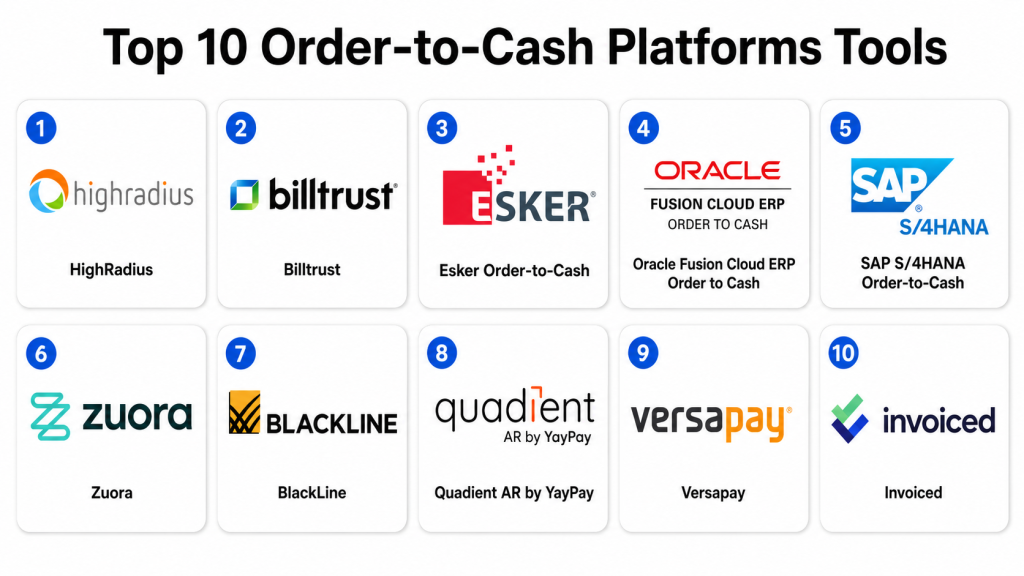
Top 10 Order-to-Cash Platforms Tools
1- HighRadius
Short description: HighRadius is an enterprise Order-to-Cash and autonomous finance platform focused on accounts receivable automation, collections, cash application, credit, deductions, and treasury-related finance workflows. It is well suited for mid-market and enterprise companies with high invoice volumes and complex AR operations.
Key Features
- Accounts receivable automation
- Cash application automation
- Collections management
- Credit risk management
- Deductions and dispute handling
- Electronic invoicing and payment support
- AI-driven finance workflow automation
Pros
- Strong fit for large and complex AR environments
- Broad Order-to-Cash automation coverage
- Useful for reducing manual collections and cash application work
Cons
- May require significant implementation planning
- Smaller companies may find the platform more advanced than needed
- Best value depends on data quality and ERP integration readiness
Platforms / Deployment
Web / Cloud
Security & Compliance
HighRadius serves enterprise finance environments where access control, auditability, encryption, user permissions, and data governance are important. Specific details such as SSO, MFA, certifications, encryption standards, and audit controls should be verified directly with the vendor. Not publicly stated for every configuration.
Integrations & Ecosystem
HighRadius integrates with ERP, accounting, payment, bank, treasury, and reporting systems. It is useful for finance teams that need to connect invoice, customer, payment, dispute, and collections data into one AR automation workflow.
Common integration areas include:
- ERP systems
- Bank data and lockbox feeds
- Payment processors
- Accounting platforms
- Treasury systems
- Business intelligence tools
Support & Community
HighRadius provides enterprise support, implementation services, documentation, training, and finance automation expertise. Support depth depends on product package, customer agreement, and implementation scope.
2- Billtrust
Short description: Billtrust is an Order-to-Cash platform focused on B2B invoicing, payments, cash application, collections, credit, and accounts receivable automation. It is useful for companies that want to modernize invoice delivery, improve digital payments, and reduce manual AR work.
Key Features
- B2B invoice automation
- Digital payments and payment portal support
- Cash application automation
- Collections management
- Credit and risk workflows
- Customer self-service payment experience
- AR reporting and analytics
Pros
- Strong fit for B2B companies with complex invoicing and payment workflows
- Helpful for improving digital payment adoption
- Useful for reducing manual invoice and cash posting work
Cons
- Best suited for companies with meaningful AR volume
- Integration requirements should be reviewed carefully
- Some advanced workflow needs may require configuration
Platforms / Deployment
Web / Cloud
Security & Compliance
Billtrust supports B2B finance and payment environments where secure data handling, access control, and payment governance are important. Specific details such as SSO, MFA, encryption, audit logs, PCI-related controls, and certifications should be verified directly with the vendor. Not publicly stated for every configuration.
Integrations & Ecosystem
Billtrust integrates with ERP, accounting, payment, bank, customer portal, and AR systems. It is valuable when companies want invoice delivery, payments, cash application, and collections connected in one process.
Common integration areas include:
- ERP systems
- Accounting software
- Payment gateways
- Bank and lockbox data
- Customer portals
- Collections workflows
Support & Community
Billtrust provides customer support, onboarding guidance, documentation, implementation resources, and B2B payments expertise. Support levels depend on package and customer agreement.
3- Esker Order-to-Cash
Short description: Esker Order-to-Cash helps companies automate customer service, order management, accounts receivable, invoicing, collections, dispute handling, and cash application workflows. It is useful for companies that want an AI-driven platform covering multiple parts of the customer-to-cash process.
Key Features
- Order management automation
- Invoice delivery and AR automation
- Collections management
- Cash application
- Dispute and deduction handling
- Customer service workflow automation
- AI-driven document and workflow processing
Pros
- Strong fit for companies that want broad O2C workflow automation
- Useful for customer service and finance process alignment
- Supports both order-side and AR-side automation
Cons
- Implementation scope can become broad if many workflows are included
- Best results depend on clean process mapping
- Buyers should validate ERP and document processing requirements
Platforms / Deployment
Web / Cloud
Security & Compliance
Esker supports enterprise finance and document automation environments where secure access, data protection, permissions, and auditability are important. Specific controls such as SSO, MFA, encryption, audit logs, and certifications should be verified directly with the vendor. Not publicly stated for every configuration.
Integrations & Ecosystem
Esker connects order, invoice, payment, customer service, and AR workflows with ERP and business systems. It is useful for companies that want finance and customer service teams to work from shared order-to-cash data.
Common integration areas include:
- ERP systems
- CRM systems
- Accounting platforms
- Payment workflows
- Customer service tools
- Document management systems
Support & Community
Esker provides product support, documentation, onboarding, implementation services, and automation expertise. Support levels vary by region, package, and implementation scope.
4- Oracle Fusion Cloud ERP Order to Cash
Short description: Oracle Fusion Cloud ERP supports Order-to-Cash workflows through order management, receivables, billing, collections, revenue, and finance operations. It is best suited for large enterprises that want O2C connected with Oracle ERP, finance, supply chain, and reporting systems.
Key Features
- Order management workflows
- Accounts receivable management
- Billing and invoicing support
- Collections workflows
- Revenue and finance integration
- Enterprise reporting and analytics
- Integration with Oracle ERP ecosystem
Pros
- Strong fit for large companies using Oracle ERP
- Connects O2C with finance, supply chain, and enterprise data
- Scalable for complex global finance operations
Cons
- May require Oracle expertise and implementation planning
- Can be complex for smaller teams
- Advanced AR automation may require additional configuration or modules
Platforms / Deployment
Web / Cloud
Security & Compliance
Oracle enterprise cloud products commonly support identity management, role-based access, encryption options, auditability, administrative controls, and governance features. Specific certifications and compliance coverage vary by service and region. Buyers should verify directly with Oracle.
Integrations & Ecosystem
Oracle Fusion Cloud ERP connects Order-to-Cash workflows with finance, supply chain, procurement, customer, billing, and reporting environments. It is especially useful for organizations already standardized on Oracle business applications.
Common integration areas include:
- Oracle ERP
- Oracle order management
- Billing and receivables systems
- Supply chain systems
- Customer data platforms
- Reporting and analytics tools
Support & Community
Oracle provides enterprise support, implementation partners, documentation, consulting services, training, and a large technology ecosystem. Support experience depends on customer agreement and implementation scope.
5- SAP S/4HANA Order-to-Cash
Short description: SAP S/4HANA supports Order-to-Cash processes across sales orders, delivery, billing, accounts receivable, credit management, collections, and finance reporting. It is suitable for enterprises that run finance, supply chain, and customer operations on SAP.
Key Features
- Sales order processing
- Billing and invoicing
- Accounts receivable management
- Credit management support
- Collections and dispute workflows
- Delivery and fulfillment integration
- Enterprise finance and analytics support
Pros
- Strong fit for SAP-centered enterprise environments
- Connects O2C with finance, logistics, and supply chain workflows
- Scalable for global and multi-entity businesses
Cons
- Implementation and configuration can be complex
- Best value comes inside the SAP ecosystem
- Advanced AR automation may require additional SAP or partner tools
Platforms / Deployment
Web / Cloud / Hybrid depending on SAP environment
Security & Compliance
SAP enterprise solutions commonly support user access controls, authentication integration, permissions, auditability, encryption options, and governance features depending on configuration. Specific certifications, SSO, MFA, and compliance coverage should be verified directly with SAP. Not publicly stated for every configuration.
Integrations & Ecosystem
SAP S/4HANA connects Order-to-Cash with sales, logistics, finance, tax, credit, billing, collections, and reporting processes. It is especially strong when companies need O2C deeply connected with enterprise operations.
Common integration areas include:
- SAP ERP and finance
- Sales and distribution workflows
- Logistics and fulfillment systems
- Billing and receivables
- Credit management tools
- Analytics and reporting platforms
Support & Community
SAP provides enterprise support, implementation partners, training, documentation, and a large global ecosystem. Support depth depends on contract, deployment model, region, and project scope.
6- Zuora
Short description: Zuora supports quote-to-cash and order-to-revenue workflows for subscription, recurring revenue, and usage-based businesses. It is useful for SaaS, technology, media, and digital service companies that need flexible billing, payments, revenue, and customer lifecycle management.
Key Features
- Subscription order management
- Recurring billing workflows
- Usage-based pricing support
- Payment and collections support
- Revenue lifecycle management
- Customer subscription changes
- Integration with CRM and finance systems
Pros
- Strong fit for subscription and usage-based business models
- Helps align orders, billing, payments, and revenue workflows
- Useful for SaaS and recurring revenue companies
Cons
- Traditional product shipment workflows may require other systems
- Best value comes when subscription complexity is meaningful
- Implementation requires careful pricing and billing design
Platforms / Deployment
Web / Cloud
Security & Compliance
Zuora enterprise solutions commonly support security and governance features suitable for revenue, billing, and finance workflows. Specific details such as SSO, MFA, encryption, audit logs, role-based access, and certifications should be verified directly with the vendor. Not publicly stated for every configuration.
Integrations & Ecosystem
Zuora integrates with CRM, ERP, billing, payment, tax, revenue recognition, and finance reporting tools. It is valuable when companies need recurring revenue workflows connected across sales and finance.
Common integration areas include:
- CRM systems
- ERP platforms
- Payment gateways
- Tax systems
- Revenue recognition tools
- Finance reporting systems
Support & Community
Zuora provides enterprise support, documentation, implementation partners, customer resources, and subscription economy expertise. Support levels depend on agreement and platform scope.
7- BlackLine
Short description: BlackLine supports finance automation across accounts receivable, cash application, reconciliation, close management, intercompany, and financial operations. For Order-to-Cash teams, it is especially useful for cash application, AR accuracy, financial control, and close alignment.
Key Features
- Cash application automation
- Accounts receivable automation support
- Financial close integration
- Reconciliation workflows
- Intercompany process support
- Exception management
- Finance reporting and controls
Pros
- Strong fit for finance control and accounting accuracy
- Useful for cash application and reconciliation-heavy environments
- Helps connect AR operations with financial close processes
Cons
- Not a full order management platform
- May need other tools for customer payment portals or collections depth
- Best suited for finance operations teams with control requirements
Platforms / Deployment
Web / Cloud
Security & Compliance
BlackLine supports enterprise finance environments where auditability, access controls, approvals, and financial governance are important. Specific details such as SSO, MFA, encryption, audit logs, role-based access, and certifications should be verified directly with the vendor. Not publicly stated for every configuration.
Integrations & Ecosystem
BlackLine integrates with ERP, accounting, bank, finance, and reporting systems. It is useful when Order-to-Cash outcomes need to align with reconciliations, cash posting, and close processes.
Common integration areas include:
- ERP systems
- Bank data
- Accounting systems
- Treasury systems
- Financial close workflows
- Reporting tools
Support & Community
BlackLine provides enterprise support, documentation, implementation partners, training resources, and finance transformation expertise. Support depth depends on customer agreement and product scope.
8- Quadient AR by YayPay
Short description: Quadient AR by YayPay helps finance teams automate accounts receivable, collections, cash application, dispute management, and customer payment workflows. It is useful for companies that want stronger AR visibility, collections prioritization, and customer communication.
Key Features
- Collections automation
- Cash application support
- Dispute and deduction management
- Customer payment workflows
- AR analytics and dashboards
- Customer communication tracking
- Payment behavior insights
Pros
- Strong fit for AR and collections teams
- Useful for improving collections visibility and prioritization
- Helps reduce manual follow-up and customer communication gaps
Cons
- Not a full order management or ERP platform
- Broader O2C workflow coverage may require integrations
- Product fit depends on AR process maturity
Platforms / Deployment
Web / Cloud
Security & Compliance
Quadient AR supports finance and customer payment workflows where secure access, data protection, and governance are important. Specific details such as SSO, MFA, encryption, audit logs, role-based access, and certifications should be verified directly with the vendor. Not publicly stated for every configuration.
Integrations & Ecosystem
Quadient AR integrates with ERP, accounting, CRM, payment, and finance systems to support accounts receivable automation and customer payment workflows.
Common integration areas include:
- ERP systems
- Accounting platforms
- Payment processors
- CRM systems
- Bank and remittance data
- Finance reporting tools
Support & Community
Quadient provides product support, documentation, onboarding, implementation guidance, and customer communication expertise. Support levels vary by package and customer agreement.
9- Versapay
Short description: Versapay is an accounts receivable automation and B2B payments platform that helps companies improve invoicing, payments, collections, cash application, and customer collaboration. It is useful for finance teams that want a customer-friendly AR experience.
Key Features
- Invoice presentment and payment
- B2B payment processing
- Collections support
- Cash application workflows
- Customer collaboration portal
- AR reporting and visibility
- Payment experience automation
Pros
- Strong fit for customer-facing payment and AR collaboration
- Useful for improving digital payment adoption
- Helps reduce friction between finance teams and customers
Cons
- Not a complete order management system
- Broader O2C coverage may require ERP or AR integrations
- Advanced credit or deduction workflows should be validated
Platforms / Deployment
Web / Cloud
Security & Compliance
Versapay supports payment and AR workflows where data security, payment controls, and customer access management are important. Specific details such as SSO, MFA, encryption, audit logs, PCI-related controls, and certifications should be verified directly with the vendor. Not publicly stated for every configuration.
Integrations & Ecosystem
Versapay connects accounts receivable workflows with ERP, accounting, payment, bank, and customer portal systems. It is valuable when companies want better payment visibility and customer collaboration.
Common integration areas include:
- ERP systems
- Accounting platforms
- Payment processors
- Customer portals
- Bank data
- AR reporting tools
Support & Community
Versapay provides customer support, documentation, onboarding resources, and B2B payments guidance. Support scope depends on package, implementation needs, and customer agreement.
10- Invoiced
Short description: Invoiced is an accounts receivable automation platform for businesses that need invoice delivery, payment collection, customer portals, subscription invoicing, and cash collection workflows. It is especially useful for growing companies that want faster deployment and simpler AR automation.
Key Features
- Invoice automation
- Online payment collection
- Customer payment portal
- Collections reminders
- Recurring billing support
- AR reporting
- Accounting and payment integrations
Pros
- Good fit for growing businesses and finance teams
- Easier to adopt than some enterprise-heavy platforms
- Useful for invoice collection and customer self-service payments
Cons
- May not fit very complex global enterprise O2C processes
- Advanced order management and credit workflows may require other systems
- Best suited for AR automation rather than full ERP-level O2C
Platforms / Deployment
Web / Cloud
Security & Compliance
Invoiced handles invoice and customer payment-related data, so buyers should verify SSO, MFA, encryption, audit logs, role-based access, payment security, and compliance documentation directly with the vendor. Not publicly stated for every configuration.
Integrations & Ecosystem
Invoiced integrates with accounting, payment, CRM, and finance tools to support invoice automation and payment collection. It is useful for teams that want faster AR process improvement without large enterprise implementation complexity.
Common integration areas include:
- Accounting systems
- Payment processors
- CRM systems
- ERP systems
- Customer portals
- Finance reporting tools
Support & Community
Invoiced provides customer support, onboarding assistance, documentation, and AR automation guidance. Support levels depend on plan, customer size, and implementation requirements.
Comparison Table
| Tool Name | Best For | Platform Supported | Deployment | Standout Feature | Public Rating |
|---|---|---|---|---|---|
| HighRadius | Enterprise AR and O2C automation | Web | Cloud | AI-driven accounts receivable automation | N/A |
| Billtrust | B2B invoicing and payments | Web | Cloud | Digital payments and invoice automation | N/A |
| Esker Order-to-Cash | Broad O2C workflow automation | Web | Cloud | AI-driven order and AR automation | N/A |
| Oracle Fusion Cloud ERP Order to Cash | Large Oracle-centered enterprises | Web | Cloud | ERP-native O2C process management | N/A |
| SAP S/4HANA Order-to-Cash | SAP-centered global enterprises | Web | Cloud / Hybrid | Sales, billing, AR, and fulfillment integration | N/A |
| Zuora | Subscription and usage-based businesses | Web | Cloud | Subscription order-to-revenue workflows | N/A |
| BlackLine | Finance control and cash application | Web | Cloud | Cash application and reconciliation alignment | N/A |
| Quadient AR by YayPay | AR collections and dispute workflows | Web | Cloud | Collections automation and AR visibility | N/A |
| Versapay | B2B payments and customer collaboration | Web | Cloud | Customer-facing AR payment portal | N/A |
| Invoiced | Growing teams needing AR automation | Web | Cloud | Invoice automation and payment collection | N/A |
Evaluation & Scoring of Order-to-Cash Platforms
The scoring below is comparative and buyer-oriented. It should be used as a shortlisting guide, not as a final purchasing decision. A platform with a lower weighted total may still be the best choice if it matches your ERP stack, billing model, invoice volume, customer payment workflow, and finance operating model.
| Tool Name | Core 25% | Ease 15% | Integrations 15% | Security 10% | Performance 10% | Support 10% | Value 15% | Weighted Total |
| HighRadius | 9 | 7 | 9 | 8 | 9 | 8 | 7 | 8.20 |
| Billtrust | 8 | 8 | 8 | 8 | 8 | 8 | 8 | 8.00 |
| Esker Order-to-Cash | 9 | 8 | 8 | 8 | 8 | 8 | 7 | 8.10 |
| Oracle Fusion Cloud ERP Order to Cash | 8 | 7 | 9 | 8 | 8 | 9 | 7 | 8.05 |
| SAP S/4HANA Order-to-Cash | 8 | 7 | 9 | 8 | 8 | 9 | 7 | 8.05 |
| Zuora | 8 | 7 | 8 | 8 | 8 | 8 | 7 | 7.75 |
| BlackLine | 8 | 8 | 8 | 8 | 8 | 8 | 7 | 7.90 |
| Quadient AR by YayPay | 8 | 8 | 8 | 7 | 8 | 8 | 8 | 7.85 |
| Versapay | 7 | 8 | 8 | 8 | 8 | 8 | 8 | 7.75 |
| Invoiced | 7 | 9 | 7 | 7 | 7 | 8 | 8 | 7.55 |
How to interpret the scores:
- Core score reflects O2C depth, invoicing, collections, cash application, credit, disputes, payments, and process coverage.
- Ease score reflects usability for AR teams, collections agents, finance leaders, and customers.
- Integration score reflects fit with ERP, accounting, CRM, billing, payment, bank, and reporting systems.
- Security score reflects visible governance signals and expected controls, not unverified certifications.
- Performance score reflects suitability for invoice volume, customer scale, multi-entity complexity, and automation workload.
- Value score reflects practical fit relative to capability, implementation effort, and expected cash flow impact.
Which Order-to-Cash Platform Is Right for You?
Solo / Freelancer
Solo finance consultants, AR advisors, and revenue operations specialists usually do not need a full enterprise Order-to-Cash platform for themselves. Instead, they help clients map O2C workflows, reduce manual invoice tasks, improve collections processes, clean up customer master data, and prepare software requirements.
For advisory work, it is useful to understand platforms such as HighRadius, Billtrust, Esker, Oracle, SAP, BlackLine, and Versapay because these tools often appear in finance transformation and AR automation projects. A solo advisor should focus on tools that support clear workflow mapping, reporting, and integration readiness.
SMB
Small and mid-sized businesses should prioritize ease of setup, invoice automation, online payments, customer portals, and basic collections reminders. Invoiced, Versapay, Billtrust, and Quadient AR by YayPay can be strong options depending on invoice volume and process complexity.
SMBs should avoid buying an overly complex enterprise system before solving the basics. The first goal should be faster invoice delivery, easier customer payments, fewer overdue invoices, and better visibility into outstanding balances.
Mid-Market
Mid-market companies often need stronger collections workflows, cash application, ERP integration, dispute handling, and reporting than small businesses. Billtrust, Esker, Quadient AR by YayPay, BlackLine, Versapay, Zuora, and HighRadius can be strong options depending on business model.
Mid-market buyers should test how each platform handles invoice delivery, payment reminders, remittance matching, disputes, deductions, customer portals, and ERP synchronization. A good O2C platform should reduce manual work and improve cash predictability.
Enterprise
Large enterprises need scalable Order-to-Cash platforms that support high invoice volumes, multiple entities, global currencies, complex ERP environments, credit workflows, collections teams, dispute management, cash application, and audit controls. HighRadius, Esker, Oracle, SAP, Billtrust, and BlackLine are strong enterprise candidates depending on the existing technology stack.
Enterprise buyers should prioritize governance, scalability, integration depth, automation coverage, global process support, role-based permissions, and reporting for CFOs and shared service centers. The best enterprise choice is usually the platform that fits the company’s ERP and finance operating model.
Budget vs Premium
Budget-conscious teams should first identify their biggest O2C bottleneck. If the issue is invoice delivery and payment collection, a lighter AR automation tool may be enough. If the issue is collections, cash application, deductions, credit, and global ERP integration, a premium O2C platform may deliver better long-term value.
Premium platforms are more useful when companies need end-to-end automation, complex ERP integration, AI-driven cash application, global collections workflows, audit controls, and executive cash visibility.
Feature Depth vs Ease of Use
HighRadius, Esker, Oracle, and SAP provide strong process depth for large organizations. Billtrust and Versapay are strong for B2B invoicing, payments, and AR customer experience. BlackLine is strong for cash application, reconciliation, and finance control.
Quadient AR by YayPay is useful for collections and AR visibility, while Invoiced is practical for growing teams that need simpler invoice and payment automation. Zuora is strongest when the business model is subscription-based or usage-based.
Integrations & Scalability
Order-to-Cash automation becomes powerful when it connects with ERP, CRM, billing, accounting, payments, banks, tax systems, treasury, customer portals, and reporting tools. Without integration, finance teams may still need manual reconciliations and spreadsheet tracking.
Buyers should test invoice data flow, payment matching, customer master synchronization, dispute updates, collections notes, credit decisions, and reporting exports. Integration quality often determines whether O2C automation improves cash flow or simply adds another disconnected system.
Security & Compliance Needs
Order-to-Cash platforms often handle customer data, invoices, payment details, credit information, dispute records, banking data, and financial controls. Buyers should evaluate SSO, MFA, encryption, role-based access, audit logs, data residency, payment security, and administrative permissions.
Finance, IT, security, compliance, and treasury teams should be involved in vendor review. Companies with global operations should also confirm tax, invoicing, payment, and data handling requirements by region.
Frequently Asked Questions
1- What is an Order-to-Cash Platform?
An Order-to-Cash Platform helps businesses manage the full revenue cycle from customer order to payment collection and cash application. It can include order management, invoicing, credit control, collections, payments, disputes, and reporting.
2- Why do companies need Order-to-Cash software?
Companies need Order-to-Cash software to reduce manual finance work, improve invoice accuracy, speed up collections, match payments faster, and gain better cash visibility. It helps finance teams reduce delays and improve working capital.
3- What is the difference between Order-to-Cash and Quote-to-Cash?
Order-to-Cash usually starts after an order is placed and focuses on fulfillment, invoicing, payment, collections, and cash application. Quote-to-Cash starts earlier and includes quoting, pricing, contracts, orders, billing, payment, and revenue workflows.
4- What are the most important O2C features?
Important features include order management, invoice automation, customer payment portals, collections workflows, cash application, credit management, dispute handling, payment processing, ERP integration, and reporting dashboards.
5- Who uses Order-to-Cash Platforms?
Order-to-Cash Platforms are used by accounts receivable teams, finance leaders, collections teams, shared service centers, customer service teams, treasury teams, sales operations, and revenue operations teams.
6- How much do Order-to-Cash Platforms cost?
Pricing varies based on vendor, invoice volume, users, modules, integrations, payment processing needs, deployment scope, and support level. Many enterprise platforms use custom pricing. Buyers should compare software cost, implementation, training, support, and long-term administration.
7- Can Order-to-Cash Platforms integrate with ERP systems?
Yes, most Order-to-Cash Platforms integrate with ERP and accounting systems. Common integration points include customer data, invoices, payments, credit notes, collections activity, disputes, deductions, and cash application records.
8- Can O2C software improve cash flow?
Yes, O2C software can improve cash flow by speeding up invoice delivery, improving payment visibility, prioritizing collections, reducing disputes, and automating cash application. The impact depends on process quality, adoption, and integration.
9- What are common mistakes when choosing an O2C platform?
Common mistakes include ignoring ERP integration, underestimating data quality issues, choosing based only on demos, and failing to involve AR, treasury, IT, sales, and customer service teams. Another mistake is automating broken processes without fixing workflow gaps first.
10- Is Order-to-Cash software only for large enterprises?
No, mid-market and growing businesses can also benefit from O2C software, especially when invoice volume, overdue payments, disputes, or cash application workload increases. Smaller businesses may start with lighter AR automation tools before moving to enterprise platforms.
Conclusion
Order-to-Cash Platforms help companies improve revenue operations by connecting orders, invoices, payments, collections, disputes, cash application, and reporting into a more controlled finance workflow. The right platform depends on invoice volume, ERP stack, customer payment complexity, collections maturity, billing model, and finance automation goals. HighRadius and Esker are strong for broad O2C automation, Billtrust and Versapay are practical for B2B payments and invoicing, Oracle and SAP are powerful for ERP-centered enterprises, Zuora fits subscription and usage-based businesses, BlackLine supports finance control and cash application, Quadient AR by YayPay improves collections visibility, and Invoiced is useful for growing teams that need simpler AR automation. Buyers should shortlist two or three platforms, test them with real invoice and payment data, validate ERP integrations, review security controls, and confirm that the chosen tool improves both cash flow and customer payment experience.
