Introduction
Hospital bed management systems are software platforms designed to help healthcare facilities efficiently manage patient bed allocation, admissions, discharges, and transfers. These systems ensure optimal utilization of beds, improve patient flow, and enhance operational efficiency while reducing wait times in emergency and inpatient departments.
In 2026, hospitals are increasingly challenged by rising patient volumes, limited bed capacity, and the need for real-time data to manage operations efficiently. Modern bed management systems leverage AI-driven predictive analytics, real-time dashboards, and integration with electronic health records (EHR) to optimize patient flow and support clinical decision-making.
Real-world use cases include:
- Real-time monitoring of bed availability and patient occupancy.
- Predictive forecasting for admission surges and resource planning.
- Streamlining discharge and transfer processes to reduce bottlenecks.
- Integrating with EHR and hospital information systems for seamless patient tracking.
- Supporting infection control by managing bed assignments in isolation wards.
Evaluation Criteria for Buyers:
- Real-time bed availability monitoring and reporting.
- Predictive analytics for patient flow and occupancy forecasting.
- Integration with EHR, HIS, and patient management systems.
- Workflow automation for admissions, transfers, and discharges.
- Mobile access for staff and real-time alerts.
- Role-based access and secure data management.
- Scalability for large hospitals or multi-site healthcare networks.
- Ease of use and intuitive dashboards.
- Compliance with healthcare regulations and standards.
- Vendor support and training resources.
Best for:
Hospital administrators, bed managers, clinical operations teams, and healthcare facilities looking to optimize bed utilization and patient flow.
Not ideal for:
Small clinics or facilities with minimal inpatient operations, or hospitals that rely solely on manual bed tracking without complex workflows.
Key Trends in Hospital Bed Management Systems
- AI-driven predictive analytics for patient flow and occupancy.
- Integration with electronic health records and hospital information systems.
- Real-time dashboards with mobile access for nurses and administrators.
- Automation of admissions, transfers, and discharge workflows.
- Analytics for optimizing resource utilization and reducing wait times.
- Support for multi-site hospital networks and centralized monitoring.
- Role-based access control and secure data management.
- Cloud-based platforms enabling remote monitoring and scalability.
- Alerts for infection control and isolation bed management.
- Subscription-based and SaaS delivery models for flexible deployment.
How We Selected These Tools (Methodology)
- Evaluated market adoption and hospital network mindshare.
- Assessed feature completeness for patient flow, bed allocation, and reporting.
- Reviewed reliability and performance in high-demand hospital environments.
- Checked security standards including encryption, SSO, MFA, and RBAC.
- Considered integration with EHR, HIS, and patient management systems.
- Analyzed suitability for different hospital sizes and multi-site networks.
- Examined AI and predictive analytics capabilities for forecasting patient flow.
- Reviewed ease of implementation, training, and onboarding.
- Compared pricing and scalability relative to hospital size and bed volume.
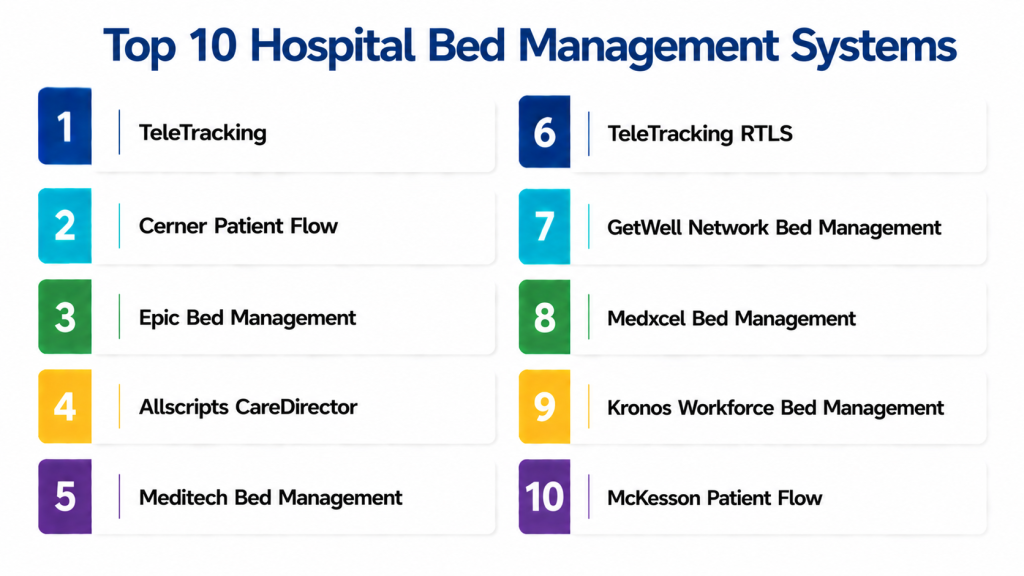
Top 10 Hospital Bed Management Systems
1- TeleTracking
Short description: Cloud-based platform offering real-time bed management, patient flow analytics, and predictive occupancy insights for hospitals.
Key Features
- Real-time bed availability dashboards
- Predictive analytics for admissions and discharges
- Workflow automation for patient transfers
- Integration with EHR and HIS
- Mobile access for staff
- Alerts for capacity and surge management
Pros
- Strong predictive analytics
- Improves patient flow efficiency
Cons
- Enterprise pricing may be high for smaller hospitals
- Implementation can be complex for multi-site networks
Platforms / Deployment
- Web / iOS / Android
- Cloud
Security & Compliance
- Encryption, MFA, audit logs
- HIPAA compliant
Integrations & Ecosystem
EHR and HIS systems, patient monitoring devices, hospital IT infrastructure.
- API connectivity
- Alerts and notifications
Support & Community
Documentation, training, and professional support services.
2- Cerner Patient Flow
Short description: Module within Cerner’s EHR platform for hospital bed management, optimizing patient flow and occupancy.
Key Features
- Bed allocation and tracking
- Admission and discharge workflow automation
- Integration with Cerner EHR
- Dashboards for capacity planning
- Predictive analytics
Pros
- Seamless EHR integration
- Real-time occupancy tracking
Cons
- Limited standalone deployment outside Cerner EHR
- Training required for full functionality
Platforms / Deployment
- Web / iOS / Android
- Cloud / Hybrid
Security & Compliance
- Encryption, SSO
- HIPAA compliant
Integrations & Ecosystem
Cerner EHR, HIS modules, hospital IT systems.
Support & Community
Documentation, training, technical support.
3- Epic Bed Management
Short description: Bed management solution integrated within Epic’s EHR for real-time patient flow tracking and occupancy optimization.
Key Features
- Real-time bed tracking
- Admission, transfer, and discharge workflows
- Predictive analytics for surge planning
- Integration with Epic EHR modules
- Mobile access for clinical teams
Pros
- Fully integrated with Epic EHR
- Supports large hospital networks
Cons
- Only available within Epic ecosystem
- Implementation can be complex
Platforms / Deployment
- Web / iOS / Android
- Cloud / Hybrid
Security & Compliance
- MFA, encryption, audit logs
- HIPAA compliant
Integrations & Ecosystem
Epic EHR modules, hospital IT systems, patient monitoring devices.
Support & Community
Epic customer support, training, and knowledge base.
4- Allscripts CareDirector
Short description: Bed management and patient flow module offering real-time monitoring and workflow optimization for hospitals.
Key Features
- Bed availability dashboards
- Admission and discharge tracking
- Alerts for capacity constraints
- Integration with Allscripts EHR
- Predictive analytics
Pros
- User-friendly interface
- Alerts and notifications improve bed utilization
Cons
- Limited analytics outside Allscripts ecosystem
- Requires training for full adoption
Platforms / Deployment
- Web / iOS / Android
- Cloud / Hybrid
Security & Compliance
- Encryption, SSO
- HIPAA compliant
Integrations & Ecosystem
Allscripts EHR, HIS, patient management systems.
Support & Community
Documentation, training, professional support.
5- Meditech Bed Management
Short description: Bed management system integrated with Meditech EHR, providing real-time occupancy and patient flow tracking.
Key Features
- Bed tracking dashboards
- Workflow automation for admissions and discharges
- Predictive analytics for patient flow
- Mobile access
- Integration with Meditech EHR
Pros
- Easy integration for Meditech users
- Real-time occupancy monitoring
Cons
- Limited standalone deployment
- Training required for staff
Platforms / Deployment
- Web / iOS / Android
- Cloud / Hybrid
Security & Compliance
- MFA, encryption
- HIPAA compliant
Integrations & Ecosystem
Meditech EHR, hospital IT systems, patient monitoring devices.
Support & Community
Documentation, onboarding, professional support.
6- TeleTracking RTLS
Short description: Real-time location system for beds, patients, and equipment, enhancing bed management and operational efficiency.
Key Features
- Real-time location tracking
- Bed and equipment utilization analytics
- Alerts for patient flow bottlenecks
- Integration with EHR and HIS
- Mobile dashboards
Pros
- Improves hospital operational efficiency
- Reduces patient wait times
Cons
- Requires sensor infrastructure
- Implementation complexity for multi-site hospitals
Platforms / Deployment
- Web / iOS / Android
- Cloud
Security & Compliance
- Encryption, MFA
- HIPAA compliant
Integrations & Ecosystem
EHR, HIS, RTLS sensors, hospital IT systems.
Support & Community
Training, documentation, technical support.
7- GetWell Network Bed Management
Short description: Platform focused on patient engagement and flow, with bed management and real-time monitoring features.
Key Features
- Bed availability dashboards
- Patient engagement integration
- Alerts for occupancy and bottlenecks
- Predictive analytics
- Mobile access
Pros
- Combines patient engagement with bed management
- Cloud-based with real-time visibility
Cons
- Limited analytics for enterprise scaling
- Subscription-based pricing
Platforms / Deployment
- Web / iOS / Android
- Cloud
Security & Compliance
- MFA, encryption
- HIPAA compliant
Integrations & Ecosystem
EHR, patient engagement systems, hospital IT infrastructure.
Support & Community
Documentation, professional support, training.
8- Medxcel Bed Management
Short description: Bed management solution for hospitals offering real-time occupancy dashboards and workflow optimization.
Key Features
- Real-time bed tracking
- Admission, discharge, and transfer workflows
- Predictive analytics
- Alerts for capacity and utilization
- Integration with EHR systems
Pros
- Scalable for mid to large hospitals
- Mobile-friendly interface
Cons
- Requires EHR integration for full functionality
- Implementation can be complex
Platforms / Deployment
- Web / iOS / Android
- Cloud / Hybrid
Security & Compliance
- Encryption, SSO
- HIPAA compliant
Integrations & Ecosystem
EHR, HIS, hospital IT systems.
Support & Community
Documentation, training, and professional services.
9- Kronos Workforce Bed Management
Short description: Bed management module integrated with workforce management for hospitals, linking staffing and bed occupancy.
Key Features
- Real-time bed tracking
- Integration with staff scheduling
- Alerts for capacity and staffing gaps
- Analytics dashboards
- Workflow automation
Pros
- Combines workforce and bed management
- Real-time insights improve patient flow
Cons
- Best suited for hospitals using Kronos
- Enterprise pricing
Platforms / Deployment
- Web / iOS / Android
- Cloud
Security & Compliance
- MFA, encryption
- HIPAA compliant
Integrations & Ecosystem
Kronos workforce management, EHR, hospital IT systems.
Support & Community
Professional services, documentation, training.
10- McKesson Patient Flow
Short description: Bed management and patient flow system for hospitals offering occupancy monitoring and workflow optimization.
Key Features
- Bed availability dashboards
- Patient admission, transfer, discharge workflows
- Predictive analytics
- Integration with EHR and HIS
- Mobile access
Pros
- Strong hospital-wide visibility
- Cloud-based and scalable
Cons
- Requires technical training for full adoption
- Integration may require vendor support
Platforms / Deployment
- Web / iOS / Android
- Cloud / Hybrid
Security & Compliance
- MFA, encryption
- HIPAA compliant
Integrations & Ecosystem
EHR, HIS, hospital IT systems, mobile dashboards.
Support & Community
Documentation, training, professional support.
Comparison Table (Top 10)
| Tool Name | Best For | Platform(s) Supported | Deployment | Standout Feature | Public Rating |
|---|---|---|---|---|---|
| TeleTracking | Large hospitals | Web / iOS / Android | Cloud | Predictive analytics | N/A |
| Cerner Patient Flow | Cerner users | Web / iOS / Android | Cloud / Hybrid | EHR integration | N/A |
| Epic Bed Management | Epic users | Web / iOS / Android | Cloud / Hybrid | Real-time occupancy | N/A |
| Allscripts CareDirector | Hospitals | Web / iOS / Android | Cloud / Hybrid | Alerts & dashboards | N/A |
| Meditech Bed Management | Meditech users | Web / iOS / Android | Cloud / Hybrid | Workflow automation | N/A |
| TeleTracking RTLS | Hospitals | Web / iOS / Android | Cloud | RTLS & analytics | N/A |
| GetWell Network | Patient engagement | Web / iOS / Android | Cloud | Engagement + bed tracking | N/A |
| Medxcel | Mid-large hospitals | Web / iOS / Android | Cloud / Hybrid | Predictive analytics | N/A |
| Kronos Workforce | Hospitals using Kronos | Web / iOS / Android | Cloud | Staffing integration | N/A |
| McKesson Patient Flow | Hospital-wide | Web / iOS / Android | Cloud / Hybrid | Scalable occupancy | N/A |
Evaluation & Scoring of Hospital Bed Management Systems
| Tool Name | Core (25%) | Ease (15%) | Integrations (15%) | Security (10%) | Performance (10%) | Support (10%) | Value (15%) | Weighted Total |
|---|---|---|---|---|---|---|---|---|
| TeleTracking | 9 | 8 | 8 | 9 | 9 | 8 | 7 | 8.5 |
| Cerner Patient Flow | 8 | 8 | 8 | 8 | 8 | 8 | 7 | 8.0 |
| Epic Bed Management | 9 | 7 | 8 | 9 | 9 | 8 | 6 | 8.0 |
| Allscripts CareDirector | 8 | 8 | 7 | 8 | 8 | 7 | 7 | 7.7 |
| Meditech Bed Management | 8 | 7 | 7 | 8 | 8 | 7 | 7 | 7.6 |
| TeleTracking RTLS | 9 | 7 | 8 | 9 | 9 | 8 | 6 | 8.0 |
| GetWell Network | 8 | 8 | 7 | 8 | 8 | 7 | 7 | 7.7 |
| Medxcel | 8 | 8 | 8 | 8 | 8 | 7 | 7 | 7.8 |
| Kronos Workforce | 8 | 7 | 7 | 8 | 8 | 7 | 6 | 7.5 |
| McKesson Patient Flow | 8 | 8 | 7 | 8 | 8 | 7 | 7 | 7.7 |
Interpretation: Weighted totals reflect hospitals’ overall suitability for patient flow, bed occupancy, and workflow optimization.
Which Hospital Bed Management System Is Right for You?
Solo / Freelancer
Small clinics may rely on simple EHR modules instead of full bed management systems.
SMB
Meditech, Allscripts CareDirector, and GetWell Network provide cost-effective dashboards and alerts.
Mid-Market
TeleTracking, Epic Bed Management, and Medxcel offer predictive analytics, mobile dashboards, and workflow automation.
Enterprise
TeleTracking RTLS, Cerner Patient Flow, and McKesson Patient Flow deliver enterprise-grade real-time monitoring and multi-site coordination.
Budget vs Premium
- Budget: Meditech, Allscripts CareDirector, GetWell Network
- Premium: TeleTracking, Epic, Cerner RTLS
Feature Depth vs Ease of Use
- Feature Depth: TeleTracking RTLS, Epic, Cerner
- Ease of Use: Medxcel, GetWell Network, Allscripts
Integrations & Scalability
Enterprise tools provide global EHR, HIS, and mobile integrations for hospitals with multiple sites.
Security & Compliance Needs
All platforms offer HIPAA-compliant encryption, SSO/MFA, and audit trails, with enterprise platforms providing more advanced role-based access controls.
Frequently Asked Questions (FAQs)
1- What hospitals benefit most from these systems?
Medium to large hospitals with high patient volumes, multiple wards, or multi-site operations.
2- Can small clinics use these tools?
Some platforms offer simplified dashboards for small facilities, but full enterprise features may be excessive.
3- Are these tools integrated with EHR systems?
Yes, most integrate with Epic, Cerner, Meditech, and other EHRs.
4- Can they predict bed availability?
Yes, AI-driven predictive analytics forecast occupancy and patient flow.
5- Is mobile access available for staff?
Yes, most solutions provide mobile dashboards for nurses and administrators.
6- Do these tools improve patient flow?
Yes, by optimizing admissions, transfers, and discharges in real time.
7- Are cloud solutions secure?
Yes, encryption, MFA, SSO, and HIPAA compliance ensure data security.
8- Can they handle multiple hospital sites?
Enterprise platforms like TeleTracking and Cerner can manage multi-site bed allocation.
9- Is training required for staff?
Yes, advanced analytics and dashboards require onboarding.
10- What common mistakes should hospitals avoid?
Ignoring alerts, inadequate training, failing to integrate with EHR, or underestimating implementation time.
Conclusion
Hospital bed management systems are critical for optimizing patient flow, reducing wait times, and improving operational efficiency. Small clinics may rely on Meditech, Allscripts, or GetWell Network, while mid-market hospitals benefit from TeleTracking, Epic, or Medxcel. Enterprise hospitals gain maximum value from TeleTracking RTLS, Cerner, and McKesson for real-time monitoring, predictive analytics, and multi-site coordination. Buyers should shortlist run pilot programs, validate integrations and workflows, and scale deployment to ensure efficient bed utilization and patient satisfaction.
