Introduction
Quality Inspection Computer Vision Tools are software solutions that leverage AI and machine learning to automatically detect defects, measure dimensions, and ensure product quality across manufacturing lines. These tools help reduce human error, increase inspection speed, and ensure consistency, allowing manufacturers to optimize production efficiency and maintain high standards.
Real-world use cases include:
- Automotive manufacturers detecting assembly defects
- Electronics manufacturers checking PCB components for errors
- Pharmaceutical packaging inspection for labels and fill levels
- Food and beverage lines identifying damaged products
- Industrial assembly lines measuring dimensions and tolerances
Evaluation criteria for buyers:
- Real-time defect detection
- AI/ML model accuracy
- Integration with production lines and cameras
- Scalability for multiple production sites
- Data analytics and reporting dashboards
- Cloud, edge, or hybrid deployment
- User interface and ease of setup
- Mobile and desktop accessibility
- Support for multiple product types
- Customer support and training resources
Best for: Manufacturing engineers, quality control teams, industrial automation teams, and R&D departments
Not ideal for: Small production setups or manual inspection processes where automation is unnecessary
Key Trends in Quality Inspection Computer Vision Tools
- AI-powered defect detection and classification
- Edge computing for real-time inspection on the production line
- Integration with industrial cameras and IoT devices
- Cloud-based analytics for multi-site monitoring
- Automated reporting and compliance dashboards
- Multi-product and multi-defect inspection workflows
- Predictive quality analytics to prevent failures
- Increased use of deep learning for complex visual inspection
- Mobile and remote monitoring for engineers and supervisors
- Integration with ERP, MES, and automation systems
How We Selected These Tools (Methodology)
- Evaluated global adoption and recognition in manufacturing quality control
- Assessed feature completeness including AI defect detection, analytics, and reporting
- Reviewed performance and reliability in real-time inspections
- Verified security, access controls, and deployment options
- Analyzed integration with cameras, MES, and ERP systems
- Considered scalability for small lines to enterprise production floors
- Assessed AI model accuracy and training capabilities
- Evaluated user experience and ease of onboarding
- Reviewed vendor support and community engagement
- Factored flexibility for multi-product inspection
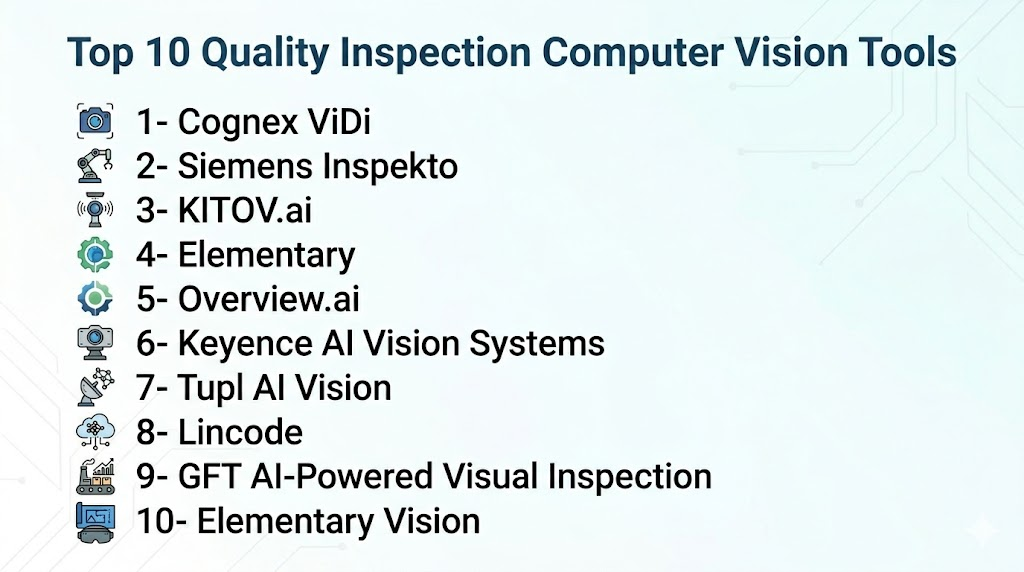
Top 10 Quality Inspection Computer Vision Tools
1- Cognex ViDi
Short description: AI-powered computer vision software for automated inspection of industrial products
Key Features
- Deep learning-based defect detection
- Color, shape, and pattern recognition
- Integration with industrial cameras
- 2D and 3D inspection capabilities
- Automated image analysis workflows
- Real-time reporting
- API support for MES and ERP integration
Pros
- High accuracy AI models
- Supports complex defect detection
- Scalable across production lines
Cons
- High licensing cost
- Requires training for optimal AI setup
- Advanced features may need technical support
Platforms / Deployment
Windows / Edge / Cloud
Security & Compliance
Not publicly stated
Integrations & Ecosystem
Supports industrial cameras and MES integration
- Camera vendors
- MES and ERP systems
- API modules
Support & Community
Varies / Not publicly stated
2- Siemens Inspekto
Short description: Out-of-the-box AI inspection solution for industrial quality control
Key Features
- AI-based defect detection
- Edge deployment for real-time inspections
- Pre-trained models for fast setup
- Multi-camera support
- Reporting dashboards
- Automated defect classification
- Integration APIs
Pros
- Rapid deployment
- Edge AI reduces latency
- User-friendly interface
Cons
- Limited customization for advanced inspections
- Higher cost for smaller operations
- Pre-trained models may not cover all defects
Platforms / Deployment
Windows / Edge / Cloud
Security & Compliance
Not publicly stated
Integrations & Ecosystem
Integrates with cameras and MES systems
- Industrial cameras
- MES platforms
- API modules
Support & Community
Varies / Not publicly stated
3- KITOV.ai
Short description: End-to-end AI computer vision platform for defect detection and product verification
Key Features
- Deep learning defect detection
- Real-time production monitoring
- Multi-camera and multi-product support
- Reporting dashboards and analytics
- Automated labeling and training
- API integration for MES
- Edge and cloud deployment
Pros
- Accurate deep learning models
- Supports diverse products
- Cloud and edge flexibility
Cons
- Advanced setup requires training
- Costly for small production lines
- Requires proper lighting and imaging setup
Platforms / Deployment
Windows / Edge / Cloud
Security & Compliance
Not publicly stated
Integrations & Ecosystem
Supports MES, ERP, and camera systems
- MES integration
- ERP systems
- Camera vendors
Support & Community
Varies / Not publicly stated
4- Elementary
Short description: AI vision inspection software designed for manufacturing automation and quality assurance
Key Features
- Real-time defect detection
- Deep learning-based classification
- Integration with robotic arms and cameras
- Multi-product inspection
- Reporting and analytics dashboards
- API support
- Edge deployment for latency-sensitive workflows
Pros
- Fast detection on production lines
- Supports robotic automation
- Flexible deployment
Cons
- Requires training for AI models
- Cost may be high for small lines
- Limited pre-trained models for niche defects
Platforms / Deployment
Windows / Edge / Cloud
Security & Compliance
Not publicly stated
Integrations & Ecosystem
Integrates with industrial robots, cameras, and MES
- Robotic arms
- Camera systems
- MES platforms
Support & Community
Varies / Not publicly stated
5- Overview.ai
Short description: Cloud-based computer vision platform for industrial inspection and quality monitoring
Key Features
- AI-powered defect detection
- Multi-camera support
- Real-time dashboards
- Cloud analytics
- Automated reporting
- Multi-product workflows
- API for MES and ERP
Pros
- Cloud deployment enables remote monitoring
- Multi-product support
- Scalable for enterprise production
Cons
- Requires stable network connectivity
- Advanced configuration may need technical expertise
- Costly for small manufacturers
Platforms / Deployment
Web / Edge / Cloud
Security & Compliance
Not publicly stated
Integrations & Ecosystem
Supports cameras and MES systems
- Industrial cameras
- MES and ERP integration
- API modules
Support & Community
Varies / Not publicly stated
6- Keyence AI Vision Systems
Short description: Hardware and software platform for AI-driven quality inspection in industrial environments
Key Features
- AI defect detection
- Multi-camera and multi-line support
- Edge processing
- Automated classification
- Reporting and analytics
- Robotic system integration
- API support
Pros
- Accurate defect detection
- Integrates with robotic automation
- Edge AI for real-time inspection
Cons
- High upfront cost
- Limited flexibility for custom models
- Requires technical setup
Platforms / Deployment
Windows / Edge / Cloud
Security & Compliance
Not publicly stated
Integrations & Ecosystem
Integrates with MES, ERP, and robotics
- Industrial cameras
- MES systems
- Robotic arms
Support & Community
Varies / Not publicly stated
7- Tupl AI Vision
Short description: AI platform for automated inspection and quality assurance in manufacturing
Key Features
- Real-time defect detection
- Deep learning-based classification
- Multi-camera workflows
- Edge and cloud deployment
- Analytics dashboards
- Automated labeling and model training
- API integration
Pros
- Accurate deep learning inspection
- Flexible deployment
- Multi-product support
Cons
- Requires AI model training
- Setup cost can be high
- Needs consistent lighting and imaging
Platforms / Deployment
Windows / Edge / Cloud
Security & Compliance
Not publicly stated
Integrations & Ecosystem
Integrates with cameras, MES, and ERP
- MES platforms
- ERP integration
- Industrial cameras
Support & Community
Varies / Not publicly stated
8- Lincode
Short description: Computer vision software for real-time automated quality inspection on production lines
Key Features
- AI-based defect detection
- Multi-line support
- Edge deployment for low latency
- Reporting dashboards
- Automated classification
- Multi-product workflows
- API support
Pros
- Fast real-time detection
- Supports multiple production lines
- Edge computing reduces latency
Cons
- Requires technical expertise for setup
- Costly for small manufacturers
- Limited pre-trained models
Platforms / Deployment
Windows / Edge / Cloud
Security & Compliance
Not publicly stated
Integrations & Ecosystem
Supports industrial cameras and MES integration
- Camera vendors
- MES systems
- API modules
Support & Community
Varies / Not publicly stated
9- GFT AI-Powered Visual Inspection
Short description: AI vision inspection platform for industrial quality assurance and defect detection
Key Features
- Deep learning-based defect detection
- Real-time monitoring
- Multi-camera and multi-product support
- Cloud and edge deployment
- Analytics dashboards
- Automated reporting
- API integration
Pros
- AI-driven accuracy
- Multi-product workflows
- Cloud and edge flexibility
Cons
- Requires training
- High initial cost
- Setup may be complex
Platforms / Deployment
Windows / Edge / Cloud
Security & Compliance
Not publicly stated
Integrations & Ecosystem
Integrates with MES, ERP, and cameras
- Industrial cameras
- MES platforms
- API modules
Support & Community
Varies / Not publicly stated
10- Elementary Vision
Short description: AI inspection platform for automated quality monitoring in manufacturing lines
Key Features
- Real-time defect detection
- Multi-line and multi-product inspection
- Edge AI deployment
- Reporting and analytics
- Automated labeling and training
- API integration
- Collaborative dashboards
Pros
- Fast real-time inspection
- Supports complex workflows
- Scalable across production lines
Cons
- Setup requires technical expertise
- Costly for small manufacturers
- Lighting and imaging critical
Platforms / Deployment
Windows / Edge / Cloud
Security & Compliance
Not publicly stated
Integrations & Ecosystem
Supports cameras and MES systems
- Industrial cameras
- MES integration
- API modules
Support & Community
Varies / Not publicly stated
Comparison Table
| Tool Name | Best For | Platform(s) Supported | Deployment | Standout Feature | Public Rating |
|---|---|---|---|---|---|
| Cognex ViDi | Industrial defect detection | Windows | Edge / Cloud | Deep learning inspection | N/A |
| Siemens Inspekto | Fast deployment | Windows | Edge / Cloud | Pre-trained models | N/A |
| KITOV.ai | Multi-product inspection | Windows | Edge / Cloud | AI-driven detection | N/A |
| Elementary | Automated line inspection | Windows | Edge / Cloud | Edge deployment | N/A |
| Overview.ai | Cloud monitoring | Web | Edge / Cloud | Multi-line support | N/A |
| Keyence AI Vision | Robotics integration | Windows | Edge / Cloud | Edge AI | N/A |
| Tupl AI Vision | AI-based classification | Windows | Edge / Cloud | Multi-product workflow | N/A |
| Lincode | Real-time production | Windows | Edge / Cloud | Edge AI for low latency | N/A |
| GFT AI-Powered Visual Inspection | Enterprise manufacturing | Windows | Edge / Cloud | AI accuracy | N/A |
| Elementary Vision | Multi-line manufacturing | Windows | Edge / Cloud | Scalable inspection | N/A |
Evaluation & Scoring
| Tool Name | Core (25%) | Ease (15%) | Integrations (15%) | Security (10%) | Performance (10%) | Support (10%) | Value (15%) | Weighted Total |
|---|---|---|---|---|---|---|---|---|
| Cognex ViDi | 9 | 7 | 8 | 8 | 9 | 8 | 7 | 8.3 |
| Siemens Inspekto | 8 | 8 | 7 | 7 | 8 | 7 | 7 | 7.6 |
| KITOV.ai | 9 | 7 | 8 | 7 | 8 | 7 | 7 | 7.8 |
| Elementary | 7 | 8 | 6 | 7 | 7 | 7 | 8 | 7.4 |
| Overview.ai | 8 | 7 | 7 | 7 | 8 | 7 | 7 | 7.5 |
| Keyence AI Vision | 9 | 6 | 8 | 7 | 8 | 7 | 7 | 7.8 |
| Tupl AI Vision | 8 | 7 | 7 | 7 | 8 | 7 | 7 | 7.5 |
| Lincode | 7 | 8 | 6 | 7 | 7 | 7 | 8 | 7.4 |
| GFT AI-Powered Visual Inspection | 8 | 7 | 7 | 7 | 8 | 7 | 7 | 7.5 |
| Elementary Vision | 8 | 7 | 7 | 7 | 8 | 7 | 7 | 7.5 |
Which Tool Is Right for You
Solo / Freelancer: Elementary or Lincode for small production lines
SMB: KITOV.ai or Overview.ai for multi-line inspection
Mid-Market: Cognex ViDi or Siemens Inspekto for AI-driven production quality
Enterprise: Keyence AI Vision or GFT AI-Powered Visual Inspection for predictive and multi-product inspection
Budget vs Premium: Budget – Elementary, Lincode | Premium – Cognex ViDi, Keyence AI Vision
Feature Depth vs Ease of Use: High depth – Cognex ViDi, KITOV.ai | Ease of use – Elementary, Siemens Inspekto
Integrations & Scalability: Enterprise operators prioritize MES, ERP, and camera integration: Cognex ViDi, Keyence AI Vision, KITOV.ai
Security & Compliance Needs: Platforms with access controls, encryption, and audit logging are recommended
Frequently Asked Questions
1. What pricing models are common?
Most tools offer subscription or licensing for enterprise production
2. How long does implementation take?
Small lines can deploy quickly; multi-line setups may require months
3. Can these tools inspect multiple products simultaneously?
Yes, most support multi-product workflows
4. Are AI-based defect detection features included?
Yes, deep learning models detect defects and classify anomalies
5. Can these tools integrate with MES and ERP systems?
Yes, integration is usually via API or native connectors
6. Are mobile dashboards available?
Many tools provide mobile access for quality engineers
7. How scalable are these solutions?
Cloud and edge deployment scale from single lines to large production facilities
8. What support options are available?
Support ranges from documentation and email to dedicated account managers
9. Can I switch tools later?
Yes, but migration of historical inspection data requires planning
10. Are dashboards customizable?
Most platforms allow KPI dashboards and reporting visualizations to be tailored
Conclusion
Quality Inspection Computer Vision Tools improve manufacturing efficiency, reduce errors, and ensure product consistency. Selection depends on production scale, integration requirements, and AI capabilities. Smaller lines may prioritize cost and usability, while enterprises focus on multi-line inspection, predictive AI, and analytics. Next steps: shortlist 2–3 tools, run a pilot on critical features, and validate integration, scalability, and performance before full deployment
