Introduction
Public Health Surveillance Systems (PHSS) are platforms designed to monitor, collect, and analyze health-related data to detect, prevent, and respond to disease outbreaks and public health threats. These systems integrate data from hospitals, laboratories, government agencies, and epidemiological networks to provide actionable insights for public health officials. Efficient surveillance is critical for improving population health, resource allocation, and policy-making.
Real-world use cases include:
- Monitoring infectious disease outbreaks and trends.
- Tracking vaccination coverage and immunization programs.
- Detecting environmental or occupational health risks.
- Supporting epidemiological research and analysis.
- Coordinating emergency response and public health interventions.
Evaluation criteria for buyers:
- Core functionality (data collection, reporting, analytics)
- Integration with hospitals, laboratories, and health agencies
- Security and privacy compliance (HIPAA, encryption, audit logs)
- Scalability for local, regional, or national deployments
- Real-time monitoring and alerting capabilities
- Ease of use for health officials and analysts
- AI and automation for anomaly detection and forecasting
- Mobile and field data collection access
- Deployment options (cloud, on-premises, hybrid)
- Vendor support, training, and documentation
Best for: Public health agencies, hospitals, research institutions, epidemiologists, and government health departments.
Not ideal for: Small clinics or private practices without large-scale surveillance needs, where simpler reporting or spreadsheet tools may suffice.
Key Trends in Public Health Surveillance Systems
- AI and machine learning for predictive outbreak detection and anomaly identification.
- Cloud-native platforms with hybrid options for secure and scalable deployments.
- Integration with hospital information systems, lab networks, and government databases.
- Real-time dashboards and mobile access for field epidemiologists and health officers.
- Enhanced security and privacy protocols, including encryption, RBAC, and audit trails.
- Automated alerts and notifications for outbreaks or unusual health trends.
- Data visualization and geospatial mapping for epidemiological tracking.
- Interoperability with public health registries and global health networks.
- Automated reporting for compliance and policy-making.
- Flexible subscription and licensing models suitable for different scales of deployment.
How We Selected These Tools (Methodology)
- Evaluated market adoption and trust among public health agencies.
- Assessed feature completeness, including data collection, reporting, and analytics.
- Reviewed performance, reliability, and uptime from documented implementations.
- Verified security and compliance, including encryption, RBAC, HIPAA, and audit logs.
- Considered integration capabilities with hospitals, laboratories, and health agencies.
- Measured fit across local, regional, and national-scale deployments.
- Factored in ease of use and training requirements for health professionals.
- Included AI or automation features for outbreak prediction and trend analysis.
- Examined deployment flexibility (cloud, on-premises, hybrid).
- Assessed vendor support, documentation, and community resources.
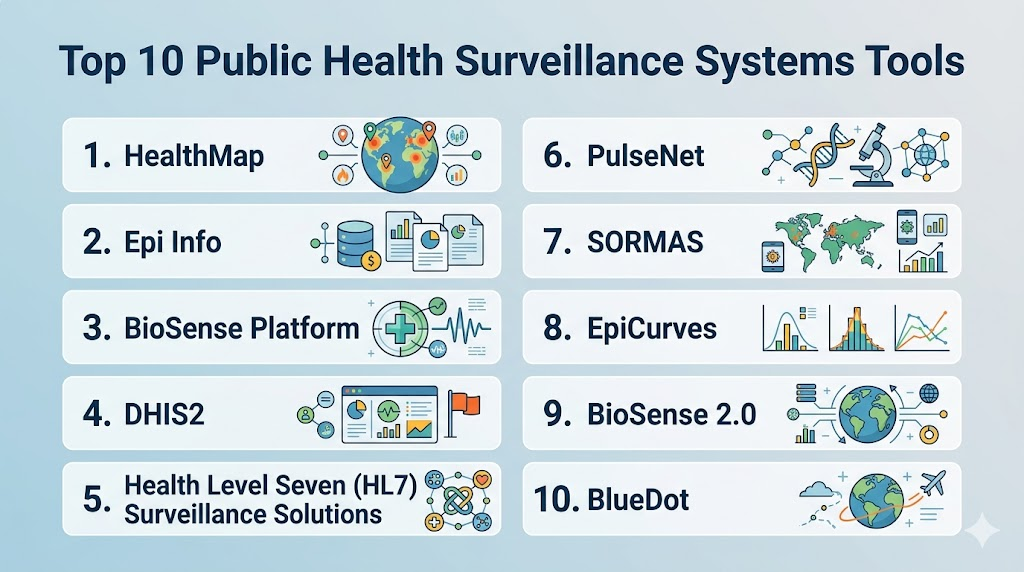
Top 10 Public Health Surveillance Systems Tools
1- HealthMap
Short description: Real-time global disease surveillance platform integrating multiple data sources for outbreak detection and monitoring.
Key Features
- Aggregates data from hospitals, labs, news, and social media
- Real-time outbreak alerts and notifications
- Geospatial mapping of disease spread
- Data visualization dashboards
- Automated reporting for public health agencies
- Mobile access for field epidemiologists
Pros
- Global surveillance coverage
- Real-time insights and mapping
Cons
- Limited customization for local use
- May require additional training for public health teams
Platforms / Deployment
- Web / iOS / Android
- Cloud
Security & Compliance
- Encryption, audit trails
- Not publicly stated
Integrations & Ecosystem
- Hospital and lab databases
- Public health registries
- API for custom workflows
Support & Community
- Vendor support and documentation
- Moderate user community
2- Epi Info
Short description: Public health software suite for data collection, outbreak investigation, and statistical analysis.
Key Features
- Case and outbreak tracking
- Survey and data collection tools
- Epidemiological analysis and reporting
- GIS mapping and visualization
- Data import/export from labs and hospitals
Pros
- Free and widely used by public health agencies
- Strong analytical capabilities
Cons
- User interface can be complex
- Limited cloud-native deployment
Platforms / Deployment
- Windows / Web
- On-prem / Hybrid
Security & Compliance
- Encryption and audit logs
- Not publicly stated
Integrations & Ecosystem
- Lab systems, hospital databases
- GIS and mapping platforms
- API support
Support & Community
- Vendor documentation and training
- Large global user base
3- BioSense Platform
Short description: Cloud-based system for syndromic surveillance and public health situational awareness.
Key Features
- Real-time hospital and lab data ingestion
- Alerting for disease trends
- Visualization and analytics dashboards
- Integration with federal and state health systems
- Mobile access for health officers
Pros
- Strong real-time monitoring
- Cloud-native and scalable
Cons
- Limited AI prediction capabilities
- Complex integration with legacy systems
Platforms / Deployment
- Web / iOS / Android
- Cloud
Security & Compliance
- HIPAA compliance, encryption, RBAC
Integrations & Ecosystem
- Hospitals and laboratories
- Health registries and state databases
- API for custom workflows
Support & Community
- Vendor support and documentation
- Moderate community
4- DHIS2
Short description: Open-source platform for health data collection, reporting, and surveillance, used by governments globally.
Key Features
- Health data aggregation and analytics
- Case and outbreak tracking
- GIS and mapping tools
- Dashboard visualization
- Mobile data collection
Pros
- Open-source and customizable
- Used by multiple countries worldwide
Cons
- Setup and training required
- Limited cloud-native features
Platforms / Deployment
- Web / Windows / Android
- Cloud / On-prem / Hybrid
Security & Compliance
- Encryption, RBAC, audit logs
- Not publicly stated
Integrations & Ecosystem
- Lab systems, hospitals, government databases
- API and community plugins
Support & Community
- Documentation and training resources
- Large global user community
5- Health Level Seven (HL7) Surveillance Solutions
Short description: Framework-based solutions for integrating health data across hospitals and labs for real-time surveillance.
Key Features
- Standards-based data exchange (HL7, FHIR)
- Hospital and lab data integration
- Alerting and notifications
- Dashboards and analytics
- Compliance reporting
Pros
- Strong interoperability with health systems
- Real-time monitoring
Cons
- Requires technical expertise
- Mostly integration framework, not full platform
Platforms / Deployment
- Web / Windows
- Cloud / On-prem / Hybrid
Security & Compliance
- HIPAA, encryption, audit logs
Integrations & Ecosystem
- Hospitals, labs, public health agencies
- API for custom integration
Support & Community
- Vendor and community support
- Documentation provided
6- PulseNet
Short description: National network for laboratory-based detection and tracking of foodborne disease outbreaks.
Key Features
- Laboratory data aggregation
- Real-time outbreak alerts
- GIS mapping of cases
- Integration with state and federal health agencies
Pros
- Highly effective for foodborne illness detection
- National coverage
Cons
- Focused mainly on labs and foodborne diseases
- Limited general surveillance features
Platforms / Deployment
- Web / Windows
- Cloud / On-prem
Security & Compliance
- Encryption, audit logs
- HIPAA compliance
Integrations & Ecosystem
- Laboratory and hospital systems
- API for reporting
Support & Community
- Vendor support
- Federal guidance and documentation
7- SORMAS
Short description: Open-source system for outbreak and case management in public health, designed for epidemic response.
Key Features
- Case and outbreak tracking
- Contact tracing and monitoring
- Mobile field data collection
- GIS mapping and visualization
- Reporting and analytics
Pros
- Free and open-source
- Strong for epidemic management
Cons
- Requires setup and training
- Limited enterprise support
Platforms / Deployment
- Web / Android
- Cloud / On-prem / Hybrid
Security & Compliance
- Encryption, RBAC, audit logs
- Not publicly stated
Integrations & Ecosystem
- Hospitals, labs, government health systems
- API for custom workflows
Support & Community
- Community-driven support
- Documentation available
- Active global user base
8- EpiCurves
Short description: Cloud-based platform for outbreak analytics, trend detection, and public health reporting.
Key Features
- Case data collection and aggregation
- Automated outbreak alerts
- GIS and temporal analytics
- Dashboards for monitoring
- Integration with lab and hospital data
Pros
- Cloud-native and scalable
- Real-time outbreak insights
Cons
- Limited AI forecasting
- Smaller global adoption
Platforms / Deployment
- Web / iOS / Android
- Cloud
Security & Compliance
- Encryption, RBAC, audit logs
- Not publicly stated
Integrations & Ecosystem
- Hospitals and labs
- Government health systems
- API for custom workflows
Support & Community
- Vendor support
- Documentation included
- Moderate community
9- BioSense 2.0
Short description: Advanced public health surveillance platform for hospitals, labs, and government agencies.
Key Features
- Syndromic surveillance
- Real-time outbreak alerts
- GIS mapping and dashboards
- Mobile access for field staff
- Automated reporting
Pros
- Strong analytics
- Cloud-native and scalable
Cons
- Training required for staff
- Limited AI features
Platforms / Deployment
- Web / iOS / Android
- Cloud
Security & Compliance
- HIPAA compliance, encryption, RBAC
Integrations & Ecosystem
- Hospitals, labs, public health agencies
- API for workflows
Support & Community
- Vendor support
- Documentation included
- Moderate community
10- BlueDot
Short description: Predictive public health surveillance platform using AI and data analytics for outbreak detection.
Key Features
- AI-assisted outbreak prediction
- Integration with global health data sources
- Real-time alerts and notifications
- Geospatial analysis
- Reporting dashboards
Pros
- Advanced AI forecasting
- Global coverage
Cons
- Premium pricing
- Limited integration with local agencies
Platforms / Deployment
- Web / iOS / Android
- Cloud
Security & Compliance
- Encryption, RBAC, audit logs
- Not publicly stated
Integrations & Ecosystem
- Global health networks
- API for custom workflows
Support & Community
- Vendor support
- Documentation available
- Small but specialized user base
Comparison Table (Top 10)
| Tool Name | Best For | Platform(s) Supported | Deployment | Standout Feature | Public Rating |
|---|---|---|---|---|---|
| HealthMap | Global outbreak monitoring | Web, iOS, Android | Cloud | Real-time alerts & mapping | N/A |
| Epi Info | Epidemiologists & public health teams | Web, Windows | On-prem / Hybrid | Survey & statistical analysis | N/A |
| BioSense Platform | Syndromic surveillance | Web, iOS, Android | Cloud | Real-time hospital data | N/A |
| DHIS2 | Governments & ministries | Web, Windows, Android | Cloud / On-prem / Hybrid | Open-source data aggregation | N/A |
| HL7 Solutions | Hospital/lab integration | Web, Windows | Cloud / On-prem | Interoperability & data exchange | N/A |
| PulseNet | Foodborne disease monitoring | Web, Windows | Cloud / On-prem | National lab network | N/A |
| SORMAS | Epidemic response | Web, Android | Cloud / On-prem / Hybrid | Contact tracing & field data | N/A |
| EpiCurves | Outbreak analytics | Web, iOS, Android | Cloud | Real-time trend detection | N/A |
| BioSense 2.0 | Hospital/lab & government | Web, iOS, Android | Cloud | Syndromic surveillance | N/A |
| BlueDot | Predictive analytics | Web, iOS, Android | Cloud | AI-assisted outbreak prediction | N/A |
Evaluation & Scoring of Public Health Surveillance Systems
| Tool Name | Core (25%) | Ease (15%) | Integrations (15%) | Security (10%) | Performance (10%) | Support (10%) | Value (15%) | Weighted Total |
|---|---|---|---|---|---|---|---|---|
| HealthMap | 9 | 8 | 8 | 8 | 8 | 7 | 7 | 8.15 |
| Epi Info | 8 | 7 | 7 | 8 | 7 | 7 | 8 | 7.60 |
| BioSense | 8 | 8 | 7 | 8 | 8 | 7 | 7 | 7.80 |
| DHIS2 | 8 | 7 | 8 | 8 | 8 | 7 | 7 | 7.75 |
| HL7 Solutions | 7 | 7 | 8 | 8 | 7 | 7 | 7 | 7.25 |
| PulseNet | 8 | 7 | 7 | 8 | 7 | 7 | 6 | 7.20 |
| SORMAS | 7 | 7 | 6 | 8 | 7 | 7 | 6 | 6.85 |
| EpiCurves | 8 | 8 | 6 | 8 | 7 | 7 | 7 | 7.45 |
| BioSense 2.0 | 8 | 7 | 7 | 8 | 7 | 7 | 7 | 7.40 |
| BlueDot | 9 | 8 | 7 | 8 | 8 | 7 | 6 | 7.55 |
Which Public Health Surveillance System Tool Is Right for You?
Solo / Freelancer
- Small public health researchers: Epi Info or DHIS2 for affordability and analytics.
SMB
- Local health departments: BioSense, EpiCurves for real-time monitoring and reporting.
Mid-Market
- Regional agencies: HealthMap or BioSense 2.0 for multi-source integration and geospatial analysis.
Enterprise
- National or global health authorities: BlueDot or HealthMap for AI-assisted prediction and global coverage.
Budget vs Premium
- Budget: Epi Info, DHIS2
- Premium: BlueDot, HealthMap, BioSense
Feature Depth vs Ease of Use
- AI-enabled tools (BlueDot, HealthMap) provide predictive insights but require training.
- Simpler tools (Epi Info, DHIS2) allow faster adoption with basic surveillance capabilities.
Integrations & Scalability
- Evaluate hospital, lab, GIS, and government system integrations.
- Cloud-native platforms scale efficiently; hybrid/on-premise options suit sensitive data.
Security & Compliance Needs
- HIPAA, encryption, RBAC, audit logs recommended.
- Automated reporting ensures regulatory adherence and public health transparency.
Frequently Asked Questions (FAQs)
1. What deployment options exist?
Cloud, hybrid, or on-premises depending on agency needs and security requirements.
2.Can staff use these systems on mobile devices?
Yes, mobile apps allow real-time field data collection and reporting.
3.Are AI features included?
Some platforms provide predictive outbreak detection, anomaly alerts, and geospatial analysis.
4. How is sensitive health data secured?
Encryption, RBAC, audit trails, and secure authentication protect patient and population data.
5. Can these systems integrate with labs or hospitals?
Yes, enterprise-grade tools offer APIs or native connectors for seamless integration.
6. Are these platforms scalable?
Cloud-native solutions scale from local health departments to national and global surveillance.
7. How long does onboarding take?
Simple platforms take days, while enterprise systems require weeks of setup and training.
8. Are small agencies supported?
Yes, tools like Epi Info and DHIS2 are ideal for small departments and research teams.
9. What pricing models exist?
Subscription, per-user, or enterprise licensing; cloud storage may be additional.
10. What alternatives exist for minimal surveillance?
Spreadsheet tracking or basic reporting tools, though they lack analytics, real-time alerts, and geospatial mapping.
Conclusion
Public Health Surveillance Systems are critical for monitoring disease trends, managing outbreaks, and supporting policy and emergency response. Selecting the right system depends on agency size, deployment needs, AI and analytics capabilities, and integration with hospitals, labs, and government databases. Smaller departments may prioritize cost and ease of use, while regional and national agencies benefit from scalable, AI-enabled, cloud-native platforms. Evaluating top tools against core features, performance, security, and value allows administrators to shortlist 2–3 solutions, pilot workflows, and validate integrations and compliance before full-scale adoption. The right PHSS ensures timely insights, operational efficiency, and public health safety.
