Introduction
Multi-touch Attribution (MTA) Tools help marketers measure how different touchpoints contribute to conversions and revenue. Unlike last-click attribution, MTA considers all interactions a customer has with a brand before converting. These tools provide data-driven insights to optimize marketing strategies, allocate budgets more effectively, and improve ROI.
Why it matters now: Modern customer journeys are complex, spanning multiple digital and offline channels. With rising marketing costs and fragmented engagement, businesses require MTA tools to understand the real impact of each channel. Accurate attribution allows companies to invest in channels that truly drive growth.
Real-world use cases:
- Understanding the influence of social media, email, search, and display ads on conversions.
- Optimizing campaign budgets across multiple channels.
- Identifying high-performing touchpoints in complex customer journeys.
- Measuring incremental impact of marketing initiatives.
- Aligning marketing strategy with revenue goals.
Evaluation criteria for buyers:
- Accuracy and flexibility of attribution models.
- Cross-channel tracking capability.
- Integration with CRM, analytics, and ad platforms.
- Ease of use and reporting quality.
- AI or machine learning features for predictive insights.
- Scalability to support growing marketing datasets.
- Security and compliance standards.
- Support and community resources.
Best for: Marketing analysts, media planners, and digital marketing teams in SMBs, mid-market, and enterprise companies.
Not ideal for: Businesses with minimal marketing spend or simple single-channel campaigns. Basic analytics tools may suffice for small campaigns.
Key Trends in Multi-touch Attribution Tools
- AI and machine learning models for predictive attribution.
- Support for omnichannel marketing tracking including online and offline touchpoints.
- Cloud-based platforms for scalable analytics.
- Real-time dashboards for faster decision-making.
- Integration with BI and CRM platforms.
- Data privacy compliance with GDPR and CCPA.
- Automation of attribution reporting and insights.
- Visualization tools for non-technical stakeholders.
- Modular pricing options for SMBs to enterprises.
- Collaboration features for cross-functional teams.
How We Selected These Tools (Methodology)
- Evaluated market adoption and mindshare among marketing teams.
- Assessed feature completeness including cross-channel coverage and predictive modeling.
- Reviewed accuracy and performance signals from historical use cases.
- Checked security posture including encryption, SSO, and compliance certifications.
- Analyzed integration capabilities with ad platforms, BI tools, and CRMs.
- Considered customer fit across SMB, mid-market, and enterprise levels.
- Examined reporting and visualization capabilities.
- Focused on automation and AI-enabled insights.
- Balanced enterprise and mid-market suitability.
- Prioritized tools with strong user support and community engagement.
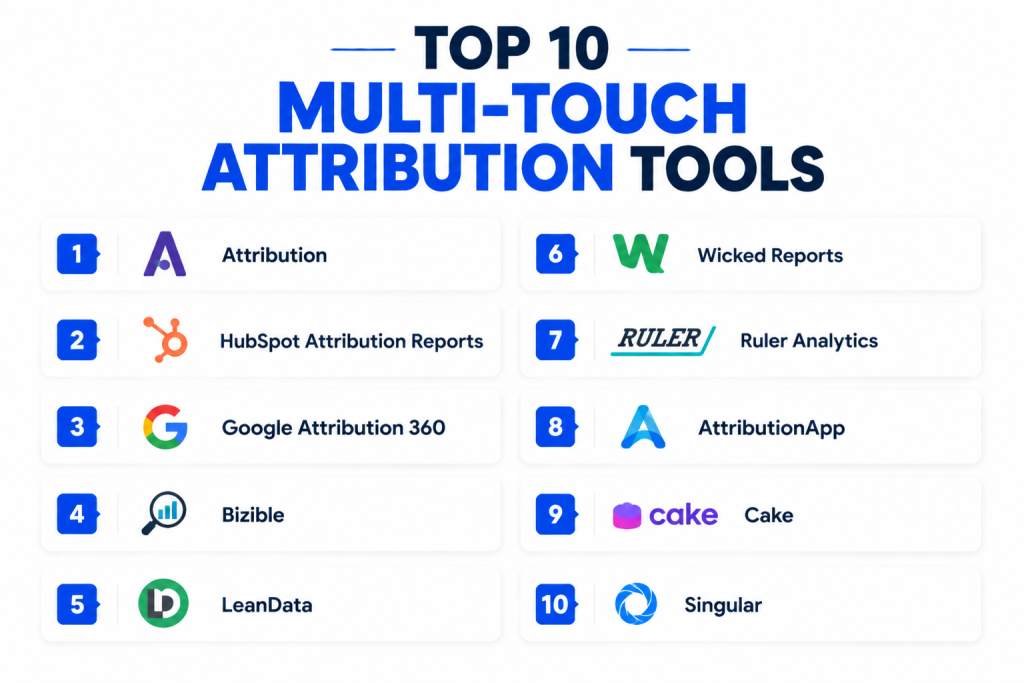
Top 10 Multi-touch Attribution Tools
#1 — Attribution
Short description: Attribution provides cross-channel marketing measurement with multi-touch models to optimize spend and campaign performance.
Key Features
- Multi-touch attribution modeling (linear, time decay, position-based)
- Predictive analytics for budget allocation
- Integration with ad platforms and CRM
- Customizable dashboards and reporting
- Real-time campaign insights
- AI-driven recommendations
- Scenario simulation for marketing strategy
Pros
- Comprehensive cross-channel analytics
- AI-assisted optimization suggestions
Cons
- Complex setup for beginners
- Premium pricing for smaller teams
Platforms / Deployment
- Web
- Cloud
Security & Compliance
- Not publicly stated
Integrations & Ecosystem
Supports Google Ads, Facebook Ads, Salesforce, HubSpot, and BI tools.
- API for data exports
- Customizable connector options
- Integrates with ad and analytics platforms
Support & Community
- Documentation available
- Customer support tiers provided
#2 — HubSpot Attribution Reports
Short description: HubSpot offers integrated MTA reporting for inbound and multi-channel campaigns.
Key Features
- Multi-touch revenue attribution
- Automated reporting
- Integration with HubSpot CRM
- Campaign performance dashboards
- Touchpoint-level conversion analysis
Pros
- Seamless HubSpot ecosystem integration
- Easy-to-read visual reports
Cons
- Limited to HubSpot marketing environment
- Less advanced predictive modeling
Platforms / Deployment
- Web
- Cloud
Security & Compliance
- SSO, encryption
- GDPR-compliant
Integrations & Ecosystem
- HubSpot CRM
- Google Ads, Facebook Ads
- API for custom integrations
Support & Community
- HubSpot knowledge base
- Active community forum
#3 — Google Attribution 360
Short description: Enterprise-grade attribution tool for cross-channel and offline campaign measurement.
Key Features
- Multi-touch modeling (data-driven attribution)
- Integration with Google Marketing Platform
- Offline conversion tracking
- Predictive budget recommendations
- Scenario simulation
Pros
- Strong integration with Google ecosystem
- Accurate data-driven models
Cons
- Best suited for enterprises
- Learning curve for new users
Platforms / Deployment
- Web
- Cloud
Security & Compliance
- Not publicly stated
Integrations & Ecosystem
- Google Ads, Analytics 360
- Data Studio, BigQuery
- API support
Support & Community
- Google support channels
- Community forums
#4 — Bizible
Short description: Bizible provides B2B-focused MTA with strong CRM and revenue attribution capabilities.
Key Features
- CRM-integrated attribution
- Multi-touch modeling
- Pipeline and revenue reporting
- Predictive insights for budget allocation
- Customizable dashboards
Pros
- Ideal for B2B SaaS
- Detailed pipeline attribution
Cons
- Primarily CRM-dependent
- Pricing can be high for small teams
Platforms / Deployment
- Web
- Cloud
Security & Compliance
- Not publicly stated
Integrations & Ecosystem
- Salesforce, HubSpot
- API for data synchronization
- Connectors for marketing platforms
Support & Community
- Customer success teams
- Documentation and onboarding guides
#5 — LeanData
Short description: Provides MTA and lead-to-revenue analytics for B2B companies.
Key Features
- Lead-to-revenue attribution
- Multi-touch campaign reporting
- CRM integration
- Automated revenue mapping
- ROI dashboards
Pros
- Effective for complex sales cycles
- Pipeline-focused insights
Cons
- Learning curve for new users
- Limited standalone analytics
Platforms / Deployment
- Web
- Cloud
Security & Compliance
- Not publicly stated
Integrations & Ecosystem
- Salesforce, HubSpot
- API for custom analytics
- BI tool integration
Support & Community
- Varies / Not publicly stated
#6 — Wicked Reports
Short description: Provides multi-touch attribution for e-commerce and performance marketing.
Key Features
- Multi-touch digital attribution
- Revenue tracking by campaign
- Predictive ROI modeling
- Custom dashboards
- Integration with ad platforms
Pros
- Optimized for e-commerce ROI
- Detailed conversion insights
Cons
- Limited offline tracking
- SMB pricing can be restrictive
Platforms / Deployment
- Web
- Cloud
Security & Compliance
- Not publicly stated
Integrations & Ecosystem
- Facebook Ads, Google Ads, Shopify
- API for custom workflows
Support & Community
- Documentation available
- Support tiers provided
#7 — Ruler Analytics
Short description: Tracks lead journeys and provides multi-touch attribution for marketing and sales alignment.
Key Features
- CRM integration
- Multi-channel touchpoint tracking
- Revenue attribution
- Custom reporting
- ROI dashboards
Pros
- Strong sales-marketing alignment
- Easy-to-use dashboards
Cons
- Limited advanced predictive modeling
- Smaller community
Platforms / Deployment
- Web
- Cloud
Security & Compliance
- Not publicly stated
Integrations & Ecosystem
- Salesforce, HubSpot, Google Ads
- API for data export
Support & Community
- Documentation available
- Customer support varies
#8 — AttributionApp
Short description: Simplified multi-touch attribution for digital marketers.
Key Features
- Cross-channel attribution
- Custom reporting
- Campaign optimization insights
- ROI dashboards
- Touchpoint-level analysis
Pros
- User-friendly interface
- Quick setup for SMBs
Cons
- Less advanced modeling
- Limited enterprise features
Platforms / Deployment
- Web
- Cloud
Security & Compliance
- Not publicly stated
Integrations & Ecosystem
- Facebook Ads, Google Ads
- API available
Support & Community
- Documentation provided
- Email support
#9 — Cake
Short description: Marketing attribution platform focused on performance and partnership channels.
Key Features
- Multi-touch revenue attribution
- Partner channel analytics
- Campaign optimization
- ROI tracking dashboards
- Integration with ad platforms
Pros
- Strong affiliate and partner attribution
- Easy-to-use dashboards
Cons
- Limited offline tracking
- Higher pricing tiers
Platforms / Deployment
- Web
- Cloud
Security & Compliance
- Not publicly stated
Integrations & Ecosystem
- CRM, Google Ads, Facebook Ads
- API support
Support & Community
- Documentation and guides
- Customer support tiers
#10 — Singular
Short description: Unified marketing analytics platform with multi-touch attribution for growth teams.
Key Features
- Multi-channel campaign measurement
- Revenue and ROI attribution
- Predictive modeling
- Custom dashboards
- Cross-platform analytics
Pros
- Consolidated analytics
- AI-assisted optimization
Cons
- Enterprise pricing
- Complexity for SMBs
Platforms / Deployment
- Web
- Cloud
Security & Compliance
- Not publicly stated
Integrations & Ecosystem
- CRM, ad platforms, BI tools
- API available
Support & Community
- Documentation and tutorials
- Tiered support
Comparison Table (Top 10)
| Tool Name | Best For | Platform(s) Supported | Deployment | Standout Feature | Public Rating |
|---|---|---|---|---|---|
| Attribution | Cross-channel marketers | Web | Cloud | AI-based ROI optimization | N/A |
| HubSpot Attribution Reports | HubSpot users | Web | Cloud | CRM-integrated attribution | N/A |
| Google Attribution 360 | Enterprises | Web | Cloud | Data-driven models | N/A |
| Bizible | B2B marketers | Web | Cloud | Pipeline attribution | N/A |
| LeanData | Lead-to-revenue analytics | Web | Cloud | CRM-integrated attribution | N/A |
| Wicked Reports | E-commerce marketers | Web | Cloud | Revenue tracking | N/A |
| Ruler Analytics | Sales-marketing alignment | Web | Cloud | Touchpoint tracking | N/A |
| AttributionApp | SMB digital marketers | Web | Cloud | User-friendly setup | N/A |
| Cake | Performance/partner marketing | Web | Cloud | Partner channel analytics | N/A |
| Singular | Growth teams | Web | Cloud | Unified analytics | N/A |
Evaluation & Scoring of Multi-touch Attribution Tools
| Tool Name | Core (25%) | Ease (15%) | Integrations (15%) | Security (10%) | Performance (10%) | Support (10%) | Value (15%) | Weighted Total (0–10) |
|---|---|---|---|---|---|---|---|---|
| Attribution | 9 | 7 | 8 | 7 | 8 | 7 | 6 | 7.8 |
| HubSpot Attribution Reports | 8 | 8 | 7 | 7 | 8 | 7 | 7 | 7.5 |
| Google Attribution 360 | 9 | 6 | 8 | 7 | 8 | 7 | 6 | 7.6 |
| Bizible | 8 | 7 | 7 | 7 | 8 | 7 | 6 | 7.3 |
| LeanData | 8 | 7 | 7 | 6 | 7 | 7 | 6 | 7.0 |
| Wicked Reports | 8 | 7 | 7 | 6 | 7 | 6 | 6 | 6.9 |
| Ruler Analytics | 7 | 8 | 7 | 6 | 7 | 6 | 6 | 6.9 |
| AttributionApp | 7 | 8 | 6 | 6 | 6 | 6 | 6 | 6.6 |
| Cake | 8 | 7 | 7 | 6 | 7 | 6 | 6 | 6.9 |
| Singular | 8 | 7 | 7 | 6 | 7 | 6 | 6 | 6.9 |
Interpretation: Higher weighted totals indicate better overall performance considering core features, integrations, and value. Scores are comparative across tools.
Which Multi-touch Attribution Tool Is Right for You?
Solo / Freelancer
Use AttributionApp or Wicked Reports for easy setup, affordable pricing, and quick insights. Focus on core channels.
SMB
LeanData or HubSpot Attribution Reports deliver scalable dashboards and multi-channel analytics without enterprise complexity.
Mid-Market
Bizible or Ruler Analytics provide robust CRM and pipeline integration, suitable for medium-sized marketing teams.
Enterprise
Attribution, Google Attribution 360, or Singular offer advanced predictive modeling, cross-channel coverage, and compliance for large-scale campaigns.
Budget vs Premium
SMBs can focus on AttributionApp or Wicked Reports for cost-efficiency. Enterprises prioritize Attribution or Google Attribution 360 for depth and AI-driven insights.
Feature Depth vs Ease of Use
Balance predictive modeling and usability. Singular provides depth; AttributionApp emphasizes simplicity.
Integrations & Scalability
Ensure the tool integrates with your CRM, ad platforms, and BI systems. Cloud platforms offer scalability; hybrid options provide flexibility.
Security & Compliance Needs
Enterprises should choose tools with GDPR compliance, SSO, and encryption features. Attribution and HubSpot offer stronger security measures.
Frequently Asked Questions (FAQs)
1. What is multi-touch attribution?
Multi-touch attribution measures all customer interactions before conversion, assigning credit to each touchpoint. It provides a more complete view than last-click attribution.
2. How does it differ from last-click attribution?
Last-click only credits the final interaction. Multi-touch considers every touchpoint, allowing marketers to understand the full journey and allocate budgets effectively.
3. Which businesses benefit most from MTA tools?
Businesses with multiple marketing channels and complex customer journeys gain the most, including B2B SaaS, retail, and e-commerce companies.
4. Do these tools support offline marketing channels?
Some tools track offline channels, like in-store visits or phone calls, especially those integrated with CRM systems.
5. Can these tools integrate with CRM and BI systems?
Yes. Most tools integrate with Salesforce, HubSpot, Google Ads, and BI platforms to provide comprehensive insights.
6. How long does setup take?
Setup varies by tool and complexity of tracking, from a few days for SMB tools to several weeks for enterprise solutions.
7. Is AI used in these tools?
Modern tools increasingly leverage AI for predictive modeling, scenario simulations, and automated budget optimization.
8. Can SMBs use enterprise-grade tools?
Yes, but enterprise tools may be costly and complex. SMB-focused platforms are easier to use and provide core analytics efficiently.
9. How often should I update models?
Regular updates are recommended, at least quarterly or after major campaigns, to ensure accuracy and reflect changes in customer behavior.
10. Can I switch between MTA tools easily?
Switching requires data migration and model configuration. Tools with API support simplify the transition.
Conclusion
Selecting the right Multi-touch Attribution Tool depends on business size, marketing complexity, and budget. SMBs can prioritize ease of use and cost, while enterprises may value predictive modeling, cross-channel coverage, and compliance. Begin by shortlisting 2–3 tools that align with your data and integrations, run a pilot, and scale insights across campaigns to maximize ROI and marketing effectiveness.
