Introduction
Media Mix Modeling (MMM) Tools help businesses measure the effectiveness of their marketing campaigns across multiple channels. By analyzing historical sales data, marketing spend, and external factors like seasonality or economic conditions, MMM tools provide insights into which marketing channels drive the most return on investment. These insights allow marketers to optimize budgets, improve campaign efficiency, and forecast outcomes with greater accuracy.
Why it matters now: Marketing landscapes are increasingly complex. With rising digital ad costs and fragmented customer journeys, businesses need data-driven strategies to maximize ROI. MMM tools are particularly valuable for large campaigns spanning offline and online channels, helping organizations make informed decisions backed by analytics.
Real-world use cases:
- Optimizing advertising spend across TV, digital, radio, and print campaigns.
- Forecasting sales impact from proposed marketing budgets.
- Analyzing channel effectiveness during peak seasons or product launches.
- Guiding strategic decisions for multi-country campaigns.
- Evaluating new channels before committing substantial budgets.
Evaluation criteria for buyers:
- Data modeling accuracy and predictive analytics.
- Channel coverage (digital, offline, social, TV, print).
- Ease of integration with CRM, BI, and analytics platforms.
- User interface and reporting capabilities.
- Scalability to handle large datasets.
- AI or automation features for scenario planning.
- Security and compliance standards.
- Support and documentation quality.
Best for: Marketing managers, data analysts, and media planners in SMBs, mid-market, and enterprise-level organizations. Industries such as retail, FMCG, and e-commerce benefit most.
Not ideal for: Small businesses with minimal marketing spend or limited data history; in such cases, simpler attribution or analytics tools may be more appropriate.
Key Trends in Media Mix Modeling Tools
- AI-driven predictive modeling for accurate ROI forecasts.
- Increased support for cross-channel measurement, including digital, offline, and social media.
- Cloud-based deployment with scalable data handling for large enterprises.
- Automation of scenario simulations to reduce manual workload.
- Integration with advanced analytics and business intelligence platforms.
- Enhanced visualization and reporting capabilities for non-technical users.
- Privacy-conscious data handling compliant with GDPR, CCPA, and other regulations.
- Real-time dashboards enabling faster decision-making.
- Modular pricing and subscription options to cater to different business sizes.
- Collaboration features to allow teams across departments to share insights seamlessly.
How We Selected These Tools (Methodology)
- Evaluated market adoption and mindshare among marketing and analytics professionals.
- Assessed feature completeness, including predictive modeling, scenario planning, and cross-channel measurement.
- Reviewed reliability and performance signals, such as historical accuracy of forecasts.
- Considered security posture: encryption, SSO, audit logs, and compliance.
- Checked integration ecosystems with BI tools, CRMs, and ad platforms.
- Analyzed customer fit across SMBs, mid-market, and enterprises.
- Verified support and documentation quality.
- Focused on tools providing actionable insights, not just data visualization.
- Prioritized platforms with automated workflows and AI-enhanced modeling.
- Balanced between open-source, developer-friendly, and enterprise-ready solutions.
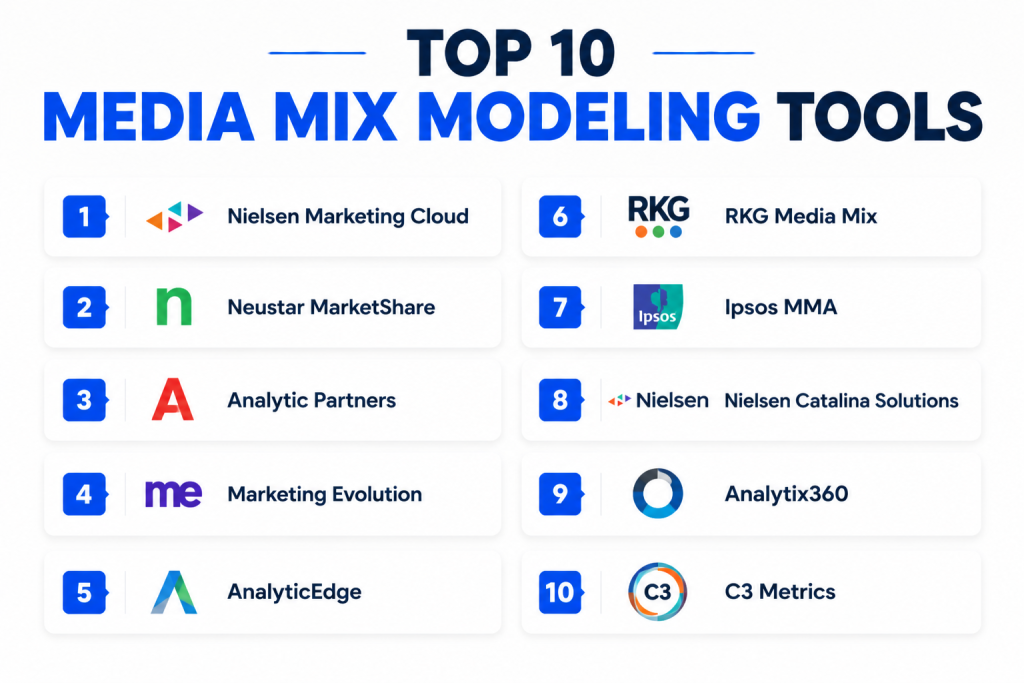
Top 10 Media Mix Modeling Tools
#1 — Nielsen Marketing Cloud
Short description: Comprehensive platform for measuring campaign effectiveness across offline and online channels, designed for enterprise marketers.
Key Features
- Multi-channel marketing analytics (TV, digital, radio, print).
- Advanced predictive modeling and scenario planning.
- AI-powered budget optimization suggestions.
- Integration with CRM and BI platforms.
- Customizable dashboards and reporting templates.
- Audience segmentation and targeting insights.
- Real-time campaign performance tracking.
Pros
- Highly accurate cross-channel measurement.
- Enterprise-grade security and compliance.
Cons
- Expensive for small businesses.
- Steep learning curve for non-technical users.
Platforms / Deployment
- Web / Windows / macOS
- Cloud
Security & Compliance
- SSO/SAML, MFA, encryption, audit logs
- SOC 2, GDPR
Integrations & Ecosystem
Supports integration with Salesforce, Google Analytics, Tableau, and various ad platforms.
- APIs for custom workflows
- BI platform connectors
- Data import/export options
Support & Community
- Extensive documentation
- Enterprise support tiers
- Active community forums
#2 — Neustar MarketShare
Short description: Offers cross-channel media analytics for ROI optimization and media planning.
Key Features
- Offline and online campaign measurement
- Predictive media mix models
- Budget allocation simulation
- Automated data normalization
- Granular channel-level reporting
Pros
- Strong offline media measurement
- Detailed ROI insights
Cons
- Less intuitive interface
- Limited support for small businesses
Platforms / Deployment
- Web
- Cloud
Security & Compliance
- Not publicly stated
Integrations & Ecosystem
- Connects with Google Ads, Salesforce, Adobe Analytics
- API access for custom integrations
Support & Community
- Documentation available
- Tiered support options
#3 — Analytic Partners
Short description: Focuses on marketing effectiveness and predictive analytics for global brands.
Key Features
- Cross-channel attribution
- Predictive ROI modeling
- Media mix scenario simulations
- Customizable dashboards
- Data cleansing and validation
Pros
- Strong global brand support
- Actionable optimization recommendations
Cons
- High cost
- Requires analytics expertise
Platforms / Deployment
- Web
- Cloud / Hybrid
Security & Compliance
- Not publicly stated
Integrations & Ecosystem
- CRM and BI integration available
- API for data export and automation
Support & Community
- Dedicated account management
- Comprehensive documentation
#4 — Marketing Evolution
Short description: Provides real-time marketing analytics with emphasis on digital and offline campaign effectiveness.
Key Features
- Multi-channel measurement
- AI-driven predictive insights
- Scenario planning
- Granular reporting
- Budget allocation guidance
Pros
- Real-time campaign feedback
- Easy-to-read visualizations
Cons
- Limited offline historical data
- Pricing not transparent
Platforms / Deployment
- Web
- Cloud
Security & Compliance
- Not publicly stated
Integrations & Ecosystem
- Supports Tableau, Power BI, Salesforce
- API access for custom dashboards
Support & Community
- Varies / Not publicly stated
#5 — AnalyticEdge
Short description: Analytics platform for marketing ROI and media optimization, suitable for mid-market and enterprise clients.
Key Features
- Predictive marketing models
- Cross-channel effectiveness tracking
- Budget optimization
- ROI simulation tools
- Reporting dashboards
Pros
- Clear ROI insights
- Supports complex marketing structures
Cons
- Onboarding requires training
- Less SMB-friendly
Platforms / Deployment
- Web
- Cloud / Hybrid
Security & Compliance
- Not publicly stated
Integrations & Ecosystem
- API and BI tool integration
- Ad platform connectors
Support & Community
- Documentation available
- Customer support varies
#6 — RKG Media Mix
Short description: Helps advertisers optimize campaigns using data-driven insights across digital and offline channels.
Key Features
- Data-driven ROI optimization
- Multi-channel attribution
- Budget planning simulations
- AI-based forecasts
- Performance dashboards
Pros
- Strong digital analytics focus
- Flexible reporting
Cons
- Limited offline data support
- Smaller community
Platforms / Deployment
- Web
- Cloud
Security & Compliance
- Not publicly stated
Integrations & Ecosystem
- Integrates with major ad platforms
- API available for automation
Support & Community
- Documentation available
- Varies / Not publicly stated
#7 — Ipsos MMA
Short description: Marketing analytics platform with emphasis on ROI measurement and predictive modeling.
Key Features
- Cross-channel measurement
- Predictive ROI modeling
- Scenario analysis
- Budget optimization recommendations
- Reporting dashboards
Pros
- Global brand support
- Actionable insights
Cons
- High complexity
- Premium pricing
Platforms / Deployment
- Web
- Cloud
Security & Compliance
- Not publicly stated
Integrations & Ecosystem
- CRM and BI integrations
- API support
Support & Community
- Varies / Not publicly stated
#8 — Nielsen Catalina Solutions
Short description: Specialized in retail and FMCG media mix modeling with granular consumer insights.
Key Features
- Retail-focused ROI analysis
- Multi-channel campaign evaluation
- Predictive modeling
- Scenario planning
- Detailed reporting
Pros
- Industry-specific insights
- Accurate retail data
Cons
- Limited general market applications
- Higher pricing
Platforms / Deployment
- Web
- Cloud
Security & Compliance
- SOC 2, GDPR
Integrations & Ecosystem
- Integrates with major CRM systems
- API access available
Support & Community
- Comprehensive documentation
- Enterprise support tiers
#9 — Analytix360
Short description: Marketing analytics tool with AI-driven media mix optimization for mid-market companies.
Key Features
- Predictive analytics
- Campaign ROI measurement
- Scenario simulations
- Cross-channel insights
- Visual dashboards
Pros
- AI-assisted modeling
- Flexible reporting
Cons
- Limited enterprise features
- Smaller community
Platforms / Deployment
- Web
- Cloud
Security & Compliance
- Not publicly stated
Integrations & Ecosystem
- Supports major ad platforms and BI tools
- API for custom workflows
Support & Community
- Varies / Not publicly stated
#10 — C3 Metrics
Short description: Attribution and marketing analytics platform offering MMM and real-time ROI insights.
Key Features
- Real-time media mix measurement
- Cross-channel attribution
- Predictive ROI models
- Budget optimization
- Scenario planning
Pros
- Real-time insights
- Scalable for large campaigns
Cons
- High cost
- Learning curve for beginners
Platforms / Deployment
- Web
- Cloud / Hybrid
Security & Compliance
- Not publicly stated
Integrations & Ecosystem
- Integrates with CRM and BI tools
- API for automation and data export
Support & Community
- Documentation provided
- Customer support varies
Comparison Table (Top 10)
| Tool Name | Best For | Platform(s) Supported | Deployment | Standout Feature | Public Rating |
|---|---|---|---|---|---|
| Nielsen Marketing Cloud | Enterprise marketers | Web / Windows / macOS | Cloud | Cross-channel ROI analysis | N/A |
| Neustar MarketShare | Multi-channel measurement | Web | Cloud | Offline media measurement | N/A |
| Analytic Partners | Global brands | Web | Cloud / Hybrid | Predictive ROI modeling | N/A |
| Marketing Evolution | Real-time analytics | Web | Cloud | Real-time dashboards | N/A |
| AnalyticEdge | Mid-market & enterprise | Web | Cloud / Hybrid | Scenario simulations | N/A |
| RKG Media Mix | Advertisers | Web | Cloud | AI-based forecasts | N/A |
| Ipsos MMA | Marketing analytics | Web | Cloud | Predictive modeling | N/A |
| Nielsen Catalina Solutions | Retail/FMCG | Web | Cloud | Retail-specific insights | N/A |
| Analytix360 | Mid-market AI tools | Web | Cloud | AI-assisted modeling | N/A |
| C3 Metrics | Large campaigns | Web | Cloud / Hybrid | Real-time MMM insights | N/A |
Evaluation & Scoring of Media Mix Modeling Tools
| Tool Name | Core (25%) | Ease (15%) | Integrations (15%) | Security (10%) | Performance (10%) | Support (10%) | Value (15%) | Weighted Total (0–10) |
|---|---|---|---|---|---|---|---|---|
| Nielsen Marketing Cloud | 9 | 7 | 8 | 9 | 9 | 8 | 6 | 8.3 |
| Neustar MarketShare | 8 | 6 | 7 | 7 | 8 | 7 | 6 | 7.2 |
| Analytic Partners | 8 | 6 | 7 | 7 | 8 | 7 | 6 | 7.2 |
| Marketing Evolution | 8 | 7 | 7 | 7 | 8 | 7 | 6 | 7.3 |
| AnalyticEdge | 7 | 7 | 6 | 6 | 7 | 6 | 6 | 6.6 |
| RKG Media Mix | 7 | 6 | 6 | 6 | 7 | 6 | 6 | 6.5 |
| Ipsos MMA | 7 | 6 | 6 | 6 | 7 | 6 | 6 | 6.5 |
| Nielsen Catalina Solutions | 8 | 6 | 7 | 8 | 8 | 7 | 6 | 7.3 |
| Analytix360 | 7 | 7 | 6 | 6 | 7 | 6 | 6 | 6.6 |
| C3 Metrics | 8 | 7 | 7 | 7 | 8 | 7 | 6 | 7.3 |
Interpretation: Weighted scores are comparative across tools; higher scores indicate better overall performance in combined criteria. Core features and security typically weigh most for enterprise selections, while ease of use and value may weigh more for SMBs or freelancers.
Which Media Mix Modeling Tool Is Right for You?
Solo / Freelancer
Choose lightweight, user-friendly tools like Analytix360 for easy setup, low cost, and AI-assisted insights. Focus on core channels and budget-conscious modeling.
SMB
Tools like AnalyticEdge or Marketing Evolution provide scalable dashboards and cross-channel analytics without the complexity or price of enterprise solutions.
Mid-Market
Platforms like Neustar MarketShare or RKG Media Mix offer robust predictive modeling and scenario planning, ideal for growing teams managing multiple channels.
Enterprise
Nielsen Marketing Cloud and Analytic Partners deliver comprehensive cross-channel measurement, advanced AI modeling, and enterprise-grade compliance.
Budget vs Premium
Smaller teams can rely on Analytix360 or Marketing Evolution for value and ease of use. Enterprises may opt for premium tools like Nielsen Marketing Cloud for advanced analytics and integration capabilities.
Feature Depth vs Ease of Use
Balance complexity and usability. Tools like C3 Metrics provide real-time depth, while Analytix360 emphasizes simplicity.
Integrations & Scalability
Evaluate tools’ ability to integrate with BI platforms, CRMs, and ad platforms. Cloud deployment offers easier scaling, while hybrid options offer flexibility.
Security & Compliance Needs
Enterprises with strict compliance requirements should prioritize tools with SOC 2, GDPR, and MFA support, like Nielsen Marketing Cloud or Nielsen Catalina Solutions.
Frequently Asked Questions (FAQs)
1. What is a Media Mix Modeling Tool?
A Media Mix Modeling Tool analyzes historical marketing spend and outcomes to determine the most effective channels. It helps optimize budgets, forecast ROI, and plan campaigns efficiently.
2. How do these tools differ from attribution software?
MMM tools focus on long-term, multi-channel impact using statistical models, while attribution tools typically track real-time, touchpoint-level user interactions.
3. What kind of data is needed for MMM?
Historical sales data, marketing spend across channels, seasonal trends, and external factors are typically required. More data improves model accuracy.
4. Are these tools suitable for small businesses?
Some tools are designed for SMBs, offering simplified dashboards and lower costs. However, extensive MMM capabilities are usually better suited for mid-market or enterprise teams.
5. Can these tools integrate with BI and CRM platforms?
Yes, most top tools support integration with major BI platforms and CRMs to allow seamless data import/export and richer analytics.
6. How long does it take to see results?
Depending on data readiness and model complexity, insights may take from a few weeks to months. Real-time dashboards speed up ongoing analysis.
7. Is AI used in Media Mix Modeling?
Modern tools increasingly leverage AI for predictive modeling, scenario simulations, and automated budget optimization.
8. Can MMM help with offline marketing channels?
Yes, top tools measure offline campaigns such as TV, radio, and print alongside digital channels for holistic ROI insights.
9. What are common mistakes when using these tools?
Relying on incomplete data, ignoring external factors, or misinterpreting model outputs can lead to suboptimal decisions. Data validation is critical.
10. Can I switch tools easily?
Switching requires migrating historical data and reconfiguring models. Tools with strong export/import and API support simplify the process.
Conclusion
Selecting the right Media Mix Modeling Tool depends on business size, marketing complexity, and budget. SMBs may prioritize ease of use and affordability, while enterprises seek advanced predictive analytics, cross-channel measurement, and robust compliance. Start by shortlisting 2–3 tools that align with your data, team capabilities, and integration needs. Run a pilot, validate results, and scale insights across campaigns for better ROI and informed decision-making.
