Introduction
Job board software helps businesses, recruitment agencies, HR teams, staffing companies, communities, and niche industry platforms create and manage online job portals. These platforms make it easier to post jobs, collect applications, manage candidates, promote vacancies, and connect employers with job seekers.
A good job board software is not only a place where jobs are listed. It should support employer accounts, candidate profiles, resume uploads, job search filters, application tracking, payment options, email notifications, SEO-friendly job pages, analytics, and admin control. For niche job boards, it should also help build a focused talent community around a specific industry, location, skill, or profession.
Job board software is useful for many types of users. Recruitment firms can use it to manage multiple clients and vacancies. Associations can create member-focused career portals. Startups can build niche hiring marketplaces. Training providers can help learners find career opportunities. Enterprises can create branded career portals for internal or external hiring.
This blog covers the top job board software platforms, their features, pros, cons, comparison, scoring, decision guide, common mistakes, best practices, and frequently asked questions to help you choose the right solution.
What Is Job Board Software?
Job board software is a digital platform that allows organizations to create, manage, and operate a job listing website or employment marketplace. It helps employers post jobs and job seekers apply for opportunities.
Most job board software includes:
- Job posting management
- Employer registration
- Candidate registration
- Resume database
- Job search and filters
- Application forms
- Email notifications
- Payment and subscription options
- Admin dashboard
- Analytics and reporting
- SEO-friendly job pages
- Mobile-friendly design
Some platforms are simple and suitable for small job portals, while others are advanced and support enterprise hiring, recruitment workflows, integrations, automation, and monetization.
Why Job Board Software Is Important
Job board software is important because hiring has become more digital, fast-moving, and competitive. Employers want access to relevant candidates, while job seekers want a simple way to search and apply for jobs.
For businesses, job board software helps organize job listings, manage employer accounts, collect applications, and improve candidate experience. For recruitment agencies, it supports multiple job postings, client visibility, and talent database management. For niche communities, it creates a dedicated hiring space where employers and candidates with specific interests can connect.
A well-built job board can also become a revenue source. Platform owners can charge employers for job postings, featured listings, resume access, subscriptions, promotions, and recruitment services.
Key Benefits of Job Board Software
Job board software offers practical benefits for platform owners, employers, recruiters, and job seekers.
For platform owners, it helps launch a job marketplace quickly without building everything from scratch. For employers, it provides a direct channel to publish jobs and receive applications. For candidates, it creates a searchable space where they can find relevant openings.
It also improves hiring visibility through SEO-friendly pages, category-based listings, location filters, email alerts, and candidate profiles. With the right platform, job boards can become strong communities around specific sectors such as technology, healthcare, education, finance, remote work, freelancing, or local employment.
How to Choose the Right Job Board Software
Choosing the right job board software depends on your goal. A small niche job board may need simple job posting, employer accounts, and payment support. A recruitment agency may need resume search, candidate tracking, and client management. A large business may need integrations, workflows, analytics, and branding.
Important points to check include:
- Ease of setup
- Job posting features
- Employer and candidate dashboards
- Resume database
- Search and filtering options
- Payment and monetization tools
- SEO support
- Custom branding
- Mobile-friendly design
- Integrations with HR tools
- Analytics and reporting
- Support and documentation
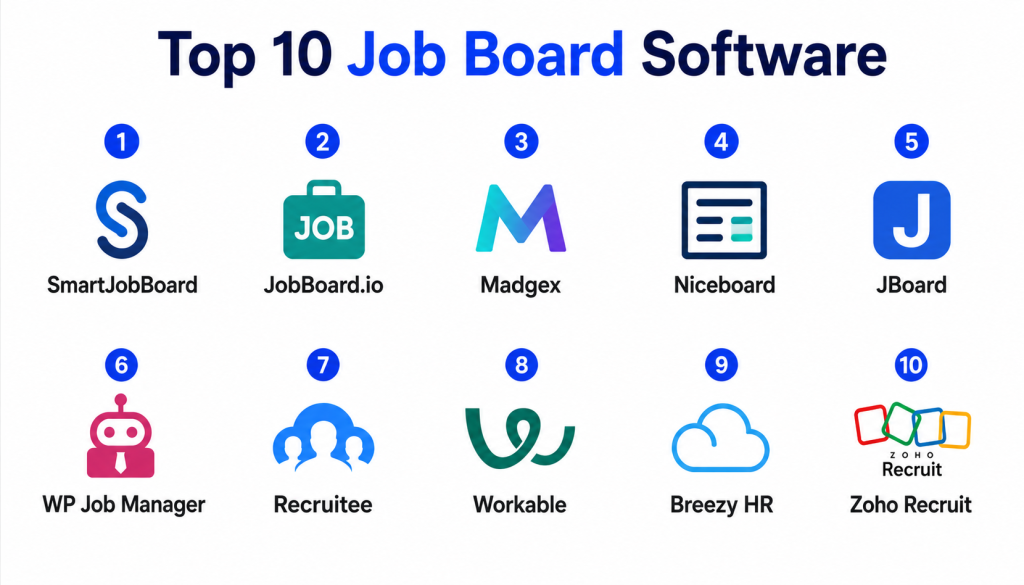
Top 10 Job Board Software
1. SmartJobBoard
SmartJobBoard is a job board software platform designed for businesses, associations, recruiters, and niche job portals. It provides tools to create job boards with employer accounts, candidate profiles, job listings, resume database, payment options, and customizable design.
The platform is useful for users who want to launch a professional job board without heavy development work. It supports job posting packages, featured jobs, resume search, and admin control.
Key Features
- Job board website builder
- Employer and candidate accounts
- Resume database
- Job posting packages
- Featured job listings
- Payment support
- Admin dashboard
Pros
- Good for niche job boards
- Easy to manage employer and candidate accounts
- Supports monetization through job packages
Cons
- Advanced customization may require technical support
- Pricing may not suit very small experimental projects
Best For
SmartJobBoard is best for niche job portals, associations, recruiters, and businesses that want a ready job board solution.
2. JobBoard.io
JobBoard.io is a cloud-based job board platform that helps users create modern job boards with job listings, employer accounts, candidate applications, payments, and branding options. It is designed for communities, publishers, and niche job board owners.
The platform focuses on ease of setup and clean job board management. It is useful for users who want a professional job board without managing servers or complex technical work.
Key Features
- Hosted job board platform
- Job posting management
- Employer accounts
- Candidate applications
- Payment processing
- Custom branding
- Email notifications
Pros
- Simple hosted setup
- Good for niche communities
- Clean job board experience
Cons
- Customization may be limited compared to open-source systems
- Less suitable for highly complex recruitment workflows
Best For
JobBoard.io is best for publishers, communities, and niche job board owners who want a simple hosted solution.
3. Madgex
Madgex is a job board software platform focused on professional publishers, media companies, associations, and enterprise job boards. It supports job listings, candidate engagement, employer services, analytics, and recruitment marketplace features.
The platform is suitable for organizations that need a polished, scalable, and commercial-grade job board. It is often used by businesses that want strong candidate experience and employer monetization options.
Key Features
- Professional job board platform
- Employer services
- Candidate profiles
- Job search experience
- Analytics and reporting
- Commercial job board tools
- Branding and customization
Pros
- Strong for professional and large job boards
- Good candidate and employer experience
- Suitable for commercial hiring marketplaces
Cons
- May be more advanced than needed for small job boards
- Pricing and implementation details may require direct discussion
Best For
Madgex is best for publishers, associations, and larger organizations building professional job marketplaces.
4. Niceboard
Niceboard is a modern job board software platform designed for creators, communities, startups, and businesses. It helps users launch job boards with clean design, employer posting, candidate applications, monetization, and simple admin tools.
The platform is useful for users who want a modern and lightweight job board experience. It supports paid job postings, custom domains, branded pages, and job alerts.
Key Features
- Modern job board builder
- Paid job postings
- Custom branding
- Employer dashboard
- Job alerts
- Candidate applications
- Admin management tools
Pros
- Clean and modern interface
- Good for communities and creators
- Simple setup and management
Cons
- May not support very complex enterprise hiring needs
- Advanced workflow customization may be limited
Best For
Niceboard is best for creators, communities, startups, and niche job boards that need a clean and simple platform.
5. JBoard
JBoard is a no-code job board software platform that helps users create and manage job boards without technical setup. It supports job postings, employer accounts, candidate applications, payment options, custom branding, and job alerts.
The platform is useful for communities, associations, and niche websites that want to add a job board quickly. It focuses on easy setup and practical job board operations.
Key Features
- No-code job board setup
- Job posting management
- Employer accounts
- Candidate applications
- Payment support
- Job alerts
- Custom branding
Pros
- Easy for non-technical users
- Good for niche job boards
- Supports paid listings and monetization
Cons
- May not offer deep backend customization
- Large recruitment teams may need more advanced workflows
Best For
JBoard is best for non-technical users, communities, associations, and niche job portals.
6. WP Job Manager
WP Job Manager is a WordPress-based job board plugin that allows website owners to add job listing functionality to their WordPress sites. It supports job submissions, listings, search, filters, and extensions for additional functionality.
The platform is useful for users already working with WordPress. It gives flexibility through themes, plugins, and add-ons. However, setup and maintenance may require WordPress knowledge.
Key Features
- WordPress job board plugin
- Frontend job submissions
- Search and filter options
- Employer job posting
- Add-on support
- Theme compatibility
- Customizable job pages
Pros
- Flexible for WordPress users
- Good for content websites and niche portals
- Extendable through plugins
Cons
- Requires WordPress management
- Advanced features may require paid extensions
Best For
WP Job Manager is best for WordPress website owners who want to add job board functionality to an existing site.
7. Recruitee
Recruitee is a recruitment platform that includes career site and hiring workflow features. While it is more of an applicant tracking and recruitment management system than a pure marketplace job board, it is useful for companies that want branded job pages and organized hiring pipelines.
The platform helps teams publish jobs, manage applications, collaborate on hiring, and track candidates. It is suitable for internal hiring teams and growing companies.
Key Features
- Branded career site
- Job posting management
- Applicant tracking
- Hiring pipelines
- Team collaboration
- Candidate profiles
- Recruitment analytics
Pros
- Strong for company hiring workflows
- Good collaboration tools
- Useful branded career pages
Cons
- Not designed as a public multi-employer job marketplace
- May not fit users who want a standalone paid job board
Best For
Recruitee is best for companies and hiring teams that need a branded career site with recruitment management.
8. Workable
Workable is a recruiting and hiring platform that supports job posting, career pages, candidate tracking, collaboration, and hiring automation. Like Recruitee, it is more focused on employer hiring than public marketplace job boards.
The platform is useful for businesses that want to manage recruitment from job posting to candidate evaluation. It supports structured hiring workflows and recruitment reporting.
Key Features
- Job posting tools
- Career page support
- Applicant tracking
- Candidate management
- Team collaboration
- Hiring automation
- Reporting and analytics
Pros
- Strong hiring workflow features
- Good for employer recruitment teams
- Supports structured candidate management
Cons
- Not a traditional job board marketplace platform
- Less suitable for users who want employer-paid public listings
Best For
Workable is best for companies that need hiring software with job posting and candidate management features.
9. Breezy HR
Breezy HR is a recruitment software platform that includes career pages, job posting, applicant tracking, candidate pipelines, and team collaboration. It is useful for businesses looking to manage their own recruitment process.
The platform supports visual hiring pipelines, candidate communication, interview management, and reporting. It is suitable for teams that need organized hiring workflows rather than a public job board marketplace.
Key Features
- Career page creation
- Job posting management
- Applicant tracking
- Visual candidate pipelines
- Interview scheduling
- Team collaboration
- Recruitment reporting
Pros
- Easy-to-use hiring pipeline
- Good for small and mid-sized hiring teams
- Supports branded career pages
Cons
- Not built as a multi-employer job board marketplace
- Marketplace monetization features are limited
Best For
Breezy HR is best for businesses that want simple recruitment management with job posting and career page tools.
10. Zoho Recruit
Zoho Recruit is a recruitment software platform for staffing agencies and corporate HR teams. It includes job posting, candidate tracking, resume management, client and contact management, workflows, and reporting.
The platform is useful for recruiters who need structured hiring operations and candidate database management. It can support staffing firms, recruitment agencies, and internal HR teams.
Key Features
- Applicant tracking
- Job posting management
- Resume database
- Candidate pipeline
- Client and contact management
- Workflow automation
- Reporting and analytics
Pros
- Good for recruiters and staffing agencies
- Strong candidate management features
- Useful workflow automation
Cons
- Not mainly designed as a public job board marketplace
- Setup may need configuration for best results
Best For
Zoho Recruit is best for staffing agencies, recruiters, and HR teams that need recruitment management with job posting support.
Comparison Table
| Software | Best For | Platform Type | Job Board Strength | Recruitment Workflow | Standout Feature |
|---|---|---|---|---|---|
| SmartJobBoard | Niche job boards and associations | Job board platform | Strong | Moderate | Ready job board with monetization |
| JobBoard.io | Communities and publishers | Hosted job board | Strong | Moderate | Simple hosted job board setup |
| Madgex | Publishers and enterprise job boards | Professional job board | Strong | Strong | Commercial-grade job marketplace |
| Niceboard | Creators and startups | Modern job board | Strong | Moderate | Clean and simple job board builder |
| JBoard | Non-technical job board owners | No-code job board | Strong | Moderate | No-code paid job board setup |
| WP Job Manager | WordPress websites | WordPress plugin | Good | Basic to moderate | Flexible WordPress job listings |
| Recruitee | Company hiring teams | Recruitment platform | Moderate | Strong | Branded career site and hiring pipeline |
| Workable | Businesses and HR teams | Recruiting software | Moderate | Strong | End-to-end hiring management |
| Breezy HR | Small and mid-sized hiring teams | Recruiting software | Moderate | Strong | Visual candidate pipeline |
| Zoho Recruit | Staffing agencies and recruiters | Recruitment software | Moderate | Strong | Resume and recruitment workflow management |
Evaluation & Scoring Table
| Software | Core Features | Ease of Use | Job Board Depth | Employer Tools | Recruitment Fit | Overall Score |
|---|---|---|---|---|---|---|
| SmartJobBoard | 9 | 8 | 9 | 8 | 8 | 8.4 |
| JobBoard.io | 8 | 9 | 8 | 8 | 7 | 8.0 |
| Madgex | 9 | 8 | 10 | 9 | 9 | 9.0 |
| Niceboard | 8 | 9 | 8 | 8 | 7 | 8.0 |
| JBoard | 8 | 9 | 8 | 8 | 7 | 8.0 |
| WP Job Manager | 8 | 7 | 8 | 7 | 6 | 7.2 |
| Recruitee | 8 | 8 | 6 | 8 | 9 | 7.8 |
| Workable | 9 | 8 | 6 | 8 | 9 | 8.0 |
| Breezy HR | 8 | 9 | 6 | 8 | 8 | 7.8 |
| Zoho Recruit | 9 | 7 | 6 | 8 | 9 | 7.8 |
Decision Guide: Which Job Board Software Should You Choose?
Best for Niche Job Boards
SmartJobBoard, JobBoard.io, Niceboard, and JBoard are strong choices for niche job boards. These platforms are designed to help you launch job portals for specific industries, communities, locations, or professional groups.
Best for Publishers and Associations
Madgex and SmartJobBoard are good options for publishers, associations, and professional communities that want to create a serious job marketplace with employer services and candidate engagement.
Best for WordPress Websites
WP Job Manager is a practical choice if your website is already built on WordPress. It allows you to add job listings without moving to a separate platform.
Best for Recruitment Agencies
Zoho Recruit is a strong option for recruitment agencies and staffing firms because it supports resume management, candidate pipelines, client management, and recruitment workflows.
Best for Company Career Pages
Recruitee, Workable, and Breezy HR are better for companies that want branded career pages and internal hiring workflows instead of a public multi-employer job board.
Best for Simple No-Code Setup
JBoard and Niceboard are useful for users who want a clean job board without complex development or technical setup.
Best for Enterprise Job Marketplaces
Madgex is suitable for larger professional job boards that need commercial features, branding, analytics, and a polished candidate-employer experience.
Common Mistakes to Avoid When Choosing Job Board Software
One common mistake is choosing recruitment software when you actually need a public job board marketplace. Applicant tracking platforms are good for company hiring, but they may not support paid employer listings, multiple employer accounts, and marketplace-style monetization.
Another mistake is choosing a job board platform without checking SEO features. Job boards depend heavily on discoverability, so job pages should be search-friendly, fast, clean, and easy to browse.
Many users also ignore monetization features. If your goal is to earn revenue from job postings, you should check whether the software supports paid listings, featured jobs, employer subscriptions, resume access, and promotional packages.
Some teams select software without reviewing candidate experience. If job seekers find it hard to search, filter, apply, or upload resumes, the platform may struggle to grow.
Best Practices for Using Job Board Software
Start by defining your job board focus clearly. A niche job board usually performs better when it targets a specific audience, such as remote developers, healthcare workers, finance professionals, fresh graduates, local jobs, or startup roles.
Create clear job categories, location filters, salary fields, job type filters, and skill tags. This helps candidates find relevant jobs faster.
For employers, make job posting simple. Avoid long forms at the beginning. Provide clear pricing, featured listing options, and easy account management.
For candidates, make application steps short and mobile-friendly. Allow resume upload, profile creation, email alerts, and saved jobs where possible.
If you are running a paid job board, build trust through quality control. Review listings, remove spam, highlight verified employers, and keep job content fresh.
Frequently Asked Questions
1. What is job board software?
Job board software is a platform that helps users create and manage a job listing website where employers can post jobs and candidates can search and apply.
2. Which job board software is best for niche job portals?
SmartJobBoard, JobBoard.io, Niceboard, and JBoard are good options for niche job portals because they support job listings, employer accounts, applications, and monetization.
3. Which job board software is best for WordPress websites?
WP Job Manager is a good choice for WordPress websites because it allows website owners to add job listing features directly to their WordPress site.
4. Which platform is best for recruitment agencies?
Zoho Recruit is a strong choice for recruitment agencies because it supports candidate tracking, resume management, client management, and recruitment workflows.
5. Can job board software help me earn money?
Yes, many job board platforms support monetization through paid job postings, featured listings, employer subscriptions, resume database access, and promotional packages.
6. What features should a good job board software include?
A good job board software should include job posting, employer accounts, candidate profiles, resume upload, search filters, application management, payments, analytics, and SEO-friendly job pages.
7. Is applicant tracking software the same as job board software?
No, applicant tracking software is mainly used by employers to manage hiring workflows, while job board software is used to run a public or niche job marketplace.
8. Which software is best for company career pages?
Recruitee, Workable, and Breezy HR are good choices for company career pages because they support branded hiring pages and candidate pipelines.
9. Do I need technical skills to launch a job board?
Not always. Platforms like JBoard, Niceboard, JobBoard.io, and SmartJobBoard offer easier setup options for users who do not want heavy development work.
10. How do I choose the right job board software?
Choose based on your goal, audience, budget, required features, monetization needs, customization level, employer tools, candidate experience, and whether you need a marketplace or recruitment workflow.
Conclusion
Job board software is a practical solution for anyone who wants to build a hiring platform, niche employment portal, recruitment website, or branded career experience. The right tool depends on your main goal. If you want to create a public or niche job board, SmartJobBoard, JobBoard.io, Niceboard, JBoard, and Madgex are strong options. If you already use WordPress, WP Job Manager can be a flexible choice. If your focus is internal hiring or recruitment management, Recruitee, Workable, Breezy HR, and Zoho Recruit are better suited. Before choosing any platform, check job posting features, candidate experience, employer tools, payment options, SEO support, customization, and long-term growth needs. A successful job board is not only about listing jobs; it is about creating trust, relevance, and a smooth connection between employers and job seekers.
