Introduction
Online course marketplaces have become one of the most useful ways for learners to build new skills from anywhere. These platforms bring together instructors, training companies, subject experts, and learners in one place. A learner can explore courses in technology, business, design, marketing, finance, personal development, language learning, creative skills, and many other fields.
For instructors and training providers, online course marketplaces offer a ready audience, payment systems, course hosting, learner reviews, marketing support, and content delivery tools. Instead of building everything from scratch, educators can upload courses, reach global learners, and grow their training brand.
A good online course marketplace should be easy to use, trusted by learners, strong in course discovery, flexible for instructors, and reliable for payments, video hosting, certificates, reviews, and learner engagement. Some platforms focus on professional upskilling, while others focus on academic learning, creative courses, business skills, or enterprise training.
This blog covers the top online course marketplaces, their features, pros, cons, comparison, scoring, decision guide, and frequently asked questions to help learners, instructors, businesses, and training providers choose the right platform.
What Are Online Course Marketplaces?
Online course marketplaces are digital platforms where instructors, experts, companies, and institutions can publish courses, and learners can discover, purchase, and complete them online.
These platforms usually include:
- Course hosting
- Video lessons
- Quizzes and assignments
- Certificates
- Student reviews
- Instructor profiles
- Payment processing
- Course search and discovery
- Learner dashboards
- Instructor analytics
- Mobile learning support
The main benefit of an online course marketplace is that it connects learners and instructors without requiring every educator to build a complete learning platform from the ground up.
Why Online Course Marketplaces Are Important
Online course marketplaces are important because learning needs are changing. Professionals want quick upskilling. Students want affordable learning options. Businesses want flexible training. Instructors want a wider audience. These platforms support all of these needs by making education more accessible and scalable.
For learners, online course marketplaces provide choice. They can compare courses, check ratings, read reviews, preview lessons, and choose learning paths based on their goals. For instructors, these platforms reduce technical work and provide access to learners who are already searching for courses.
They also support lifelong learning. A person can learn coding, project management, design, marketing, communication, leadership, or business skills without waiting for a traditional classroom setup.
Key Benefits of Online Course Marketplaces
Online course marketplaces offer many benefits for both learners and instructors.
For learners, they provide flexible access to courses, affordable pricing options, self-paced learning, skill-based content, certificates, and course variety. Learners can start with beginner courses and slowly move toward advanced learning.
For instructors, these platforms provide course publishing tools, learner reach, built-in payments, promotional support, reviews, and course performance data. This helps instructors focus more on teaching and less on technical platform management.
For businesses, online course marketplaces can support employee training, team upskilling, and continuous learning programs.
How to Choose the Right Online Course Marketplace
Choosing the right online course marketplace depends on your goal. A learner should check course quality, instructor credibility, course reviews, certificate value, pricing, content depth, and learning format. An instructor should check revenue model, audience size, course creation tools, platform policies, payouts, analytics, and marketing support.
Important points to check include:
- Course quality and depth
- Instructor credibility
- Marketplace reach
- Pricing model
- Certificate availability
- Course review system
- Mobile learning experience
- Instructor earning model
- Analytics and reporting
- Support and community
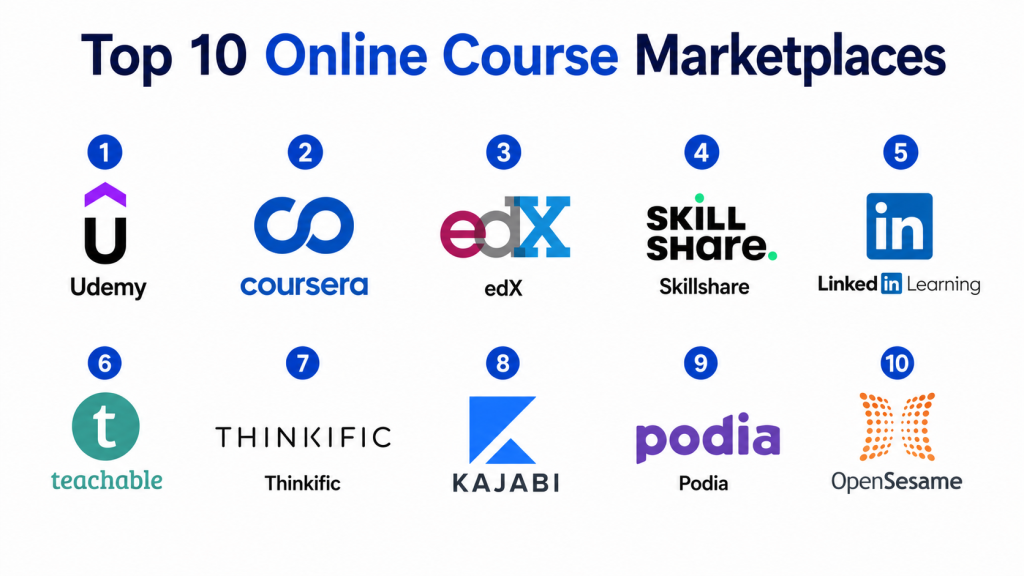
Top 10 Online Course Marketplaces
1. Udemy
Udemy is one of the most popular online course marketplaces for learners and instructors. It offers a wide range of courses across technology, business, marketing, design, personal development, photography, finance, language learning, and more.
The platform is useful for learners who want affordable, self-paced courses. It is also useful for instructors who want to publish courses and reach a large learner base. Udemy supports video lessons, quizzes, practice tests, certificates, course reviews, and instructor dashboards.
Key Features
- Large course catalog
- Self-paced video learning
- Course ratings and reviews
- Instructor publishing tools
- Certificates of completion
- Mobile app support
- Discounts and promotional campaigns
Pros
- Wide variety of topics
- Easy for beginners to use
- Strong marketplace visibility for instructors
Cons
- Course quality can vary
- Pricing and promotions are controlled heavily by platform policies
Best For
Udemy is best for learners who want affordable courses and instructors who want access to a large marketplace audience.
2. Coursera
Coursera is an online learning marketplace that works with universities, institutions, and companies to provide professional courses, certificates, specializations, and degree-style learning paths.
It is useful for learners who want structured, academic, and career-focused learning. Coursera offers courses in technology, data science, business, health, social sciences, and many other areas. It is often preferred by learners who want recognizable certificates and guided programs.
Key Features
- University and institution-backed courses
- Professional certificates
- Guided learning paths
- Quizzes and assignments
- Peer-reviewed projects
- Mobile learning support
- Business learning options
Pros
- Strong credibility in professional learning
- Structured course design
- Good for career-focused learners
Cons
- Some programs may be costly
- Less open for independent instructors compared to broader marketplaces
Best For
Coursera is best for learners who want structured, career-oriented, and institution-backed learning.
3. edX
edX is a learning platform that offers courses from universities, institutions, and industry partners. It focuses on high-quality education in areas such as technology, business, science, engineering, humanities, and professional development.
The platform is useful for learners who prefer academic-style courses and structured learning. It also provides certificate options and deeper programs for learners who want serious skill development.
Key Features
- Institution-backed courses
- Professional certificates
- Academic-style learning
- Self-paced and guided options
- Assignments and assessments
- Broad subject coverage
- Business and professional programs
Pros
- Strong academic learning experience
- Good course structure
- Useful for professional and technical learners
Cons
- Some programs may feel more formal
- Independent instructor access is limited
Best For
edX is best for learners who want academic-quality online learning and structured professional development.
4. Skillshare
Skillshare is an online course marketplace focused on creative, business, design, lifestyle, and practical skill-based learning. It is popular among designers, creators, freelancers, marketers, writers, photographers, and creative professionals.
The platform uses a subscription model, allowing learners to explore many courses under one membership. Instructors can create project-based classes and build an audience around creative education.
Key Features
- Creative course marketplace
- Project-based learning
- Subscription-based access
- Instructor-led classes
- Community learning
- Short and practical lessons
- Mobile learning support
Pros
- Strong for creative skills
- Good for short practical learning
- Useful for creators and freelancers
Cons
- Less suitable for deep technical or academic courses
- Subscription model may not suit all learners
Best For
Skillshare is best for creative learners, freelancers, designers, writers, photographers, and creators.
5. LinkedIn Learning
LinkedIn Learning offers professional courses in business, technology, leadership, software, productivity, creative skills, and workplace development. It is connected with professional learning and career improvement.
The platform is useful for employees, job seekers, professionals, and businesses. Learners can complete courses and add skills to their professional profile. Businesses can also use it for employee training.
Key Features
- Professional course library
- Business and technology courses
- Skill-based learning paths
- Certificates of completion
- Personalized recommendations
- Enterprise learning options
- Professional profile integration
Pros
- Strong for workplace learning
- Good for professional skill building
- Useful for business teams
Cons
- Less focused on independent instructor selling
- Course depth can vary by topic
Best For
LinkedIn Learning is best for professionals, job seekers, employees, and businesses focused on workplace skills.
6. Teachable
Teachable is an online course platform that allows instructors, coaches, creators, and training businesses to create and sell their own courses. While it is more of a course-selling platform than a traditional open marketplace, it is widely used by educators who want control over branding, pricing, and learner experience.
Teachable is useful for instructors who want to build their own course business instead of depending only on marketplace traffic. It supports course hosting, payments, landing pages, student management, and digital product selling.
Key Features
- Course creation tools
- Custom course pages
- Payment processing
- Student management
- Digital product support
- Instructor branding options
- Sales and analytics tools
Pros
- Good control for instructors
- Useful for building an independent training business
- Supports course and digital product selling
Cons
- Instructors must bring much of their own audience
- Marketplace discovery is not as strong as large open platforms
Best For
Teachable is best for instructors, coaches, and training businesses that want more control over course selling and branding.
7. Thinkific
Thinkific is a course creation and selling platform used by instructors, entrepreneurs, training providers, and businesses. It helps educators build online academies, sell courses, manage students, and deliver structured learning programs.
Thinkific is useful for course creators who want flexibility, customization, and control. It supports course websites, communities, payments, quizzes, certificates, and learning paths.
Key Features
- Course website builder
- Student management
- Quizzes and assessments
- Certificates
- Community features
- Payment tools
- Course analytics
Pros
- Strong for independent course businesses
- Good customization options
- Useful for structured learning programs
Cons
- Requires marketing effort from instructors
- Not a large learner marketplace by default
Best For
Thinkific is best for instructors, training providers, and businesses building their own branded online learning platform.
8. Kajabi
Kajabi is a platform for creators, coaches, consultants, and businesses that want to sell courses, memberships, coaching programs, and digital products. It combines course hosting, website building, email marketing, sales funnels, payments, and automation.
Kajabi is useful for educators who want an all-in-one business platform, not just a course marketplace. It helps creators manage learning content and marketing from one place.
Key Features
- Course and membership hosting
- Website builder
- Email marketing tools
- Sales funnel builder
- Payment processing
- Automation features
- Analytics and reporting
Pros
- Strong all-in-one business platform
- Good for premium course businesses
- Supports marketing and automation
Cons
- Can be expensive for beginners
- May feel complex for simple course hosting needs
Best For
Kajabi is best for creators, coaches, and businesses that want course hosting with strong marketing and sales tools.
9. Podia
Podia is a creator-friendly platform for selling online courses, digital downloads, memberships, webinars, and coaching services. It is simple to use and suitable for independent educators who want to start selling digital learning products.
The platform focuses on ease of use, clean course delivery, email marketing, payments, and digital product management. It is a good option for small creators and training providers who want a simpler setup.
Key Features
- Online course selling
- Digital downloads
- Membership support
- Coaching and webinar selling
- Email marketing tools
- Simple storefront
- Payment support
Pros
- Easy to use
- Good for creators and small educators
- Supports multiple digital products
Cons
- Less advanced than larger enterprise platforms
- Marketplace discovery is limited
Best For
Podia is best for creators, coaches, and small training businesses selling courses and digital products.
10. OpenSesame
OpenSesame is an online course marketplace focused on business and employee training. It provides a large catalog of workplace learning courses for organizations, covering compliance, leadership, safety, technology, business skills, and professional development.
The platform is useful for companies that need ready-made training content for teams. It supports learning management system integrations, course curation, reporting, and enterprise learning needs.
Key Features
- Business training marketplace
- Workplace learning content
- Compliance and professional courses
- Course curation tools
- LMS integrations
- Reporting and analytics
- Enterprise support
Pros
- Strong for business and employee training
- Useful course catalog for organizations
- Good LMS integration support
Cons
- Less suitable for individual casual learners
- More focused on enterprise training than creator selling
Best For
OpenSesame is best for companies, HR teams, and learning departments that need workplace training content.
Comparison Table
| Platform | Best For | Course Type | Marketplace Strength | Instructor Control | Standout Feature |
|---|---|---|---|---|---|
| Udemy | General learners and instructors | Self-paced courses | Strong | Moderate | Large course marketplace |
| Coursera | Career-focused learners | Professional and academic courses | Strong | Limited | Institution-backed programs |
| edX | Academic and professional learners | Structured courses | Strong | Limited | University-style learning |
| Skillshare | Creative learners | Creative and practical classes | Strong | Moderate | Project-based creative learning |
| LinkedIn Learning | Professionals and businesses | Workplace skills | Strong | Limited | Professional skill development |
| Teachable | Independent instructors | Branded online courses | Limited | Strong | Course business control |
| Thinkific | Training businesses | Branded learning programs | Limited | Strong | Custom online academy building |
| Kajabi | Coaches and creators | Courses and memberships | Limited | Strong | All-in-one marketing and course platform |
| Podia | Small creators | Courses and digital products | Limited | Strong | Simple creator-friendly selling |
| OpenSesame | Businesses and HR teams | Employee training | Strong in business market | Limited | Enterprise course marketplace |
Evaluation & Scoring Table
| Platform | Core Features | Ease of Use | Marketplace Reach | Instructor Tools | Business Fit | Overall Score |
|---|---|---|---|---|---|---|
| Udemy | 9 | 9 | 10 | 8 | 8 | 8.8 |
| Coursera | 9 | 8 | 9 | 6 | 9 | 8.2 |
| edX | 9 | 8 | 8 | 6 | 9 | 8.0 |
| Skillshare | 8 | 9 | 8 | 7 | 7 | 7.8 |
| LinkedIn Learning | 8 | 9 | 8 | 6 | 9 | 8.0 |
| Teachable | 9 | 8 | 6 | 9 | 8 | 8.0 |
| Thinkific | 9 | 8 | 6 | 9 | 8 | 8.0 |
| Kajabi | 9 | 7 | 6 | 10 | 9 | 8.2 |
| Podia | 8 | 9 | 5 | 8 | 7 | 7.4 |
| OpenSesame | 9 | 8 | 8 | 6 | 10 | 8.2 |
Decision Guide: Which Online Course Marketplace Should You Choose?
Best for General Learners
Udemy is a strong choice for general learners because it offers a wide range of affordable courses across many topics. Learners can easily search, compare, and start learning at their own pace.
Best for Professional Certificates
Coursera and edX are better for learners who want structured programs, professional certificates, and institution-backed courses. These platforms are useful for career-focused learning.
Best for Creative Skills
Skillshare is a good choice for learners interested in design, writing, photography, freelancing, illustration, content creation, and creative business skills.
Best for Workplace Learning
LinkedIn Learning and OpenSesame are useful for workplace learning. LinkedIn Learning is good for individual professionals and teams, while OpenSesame is stronger for enterprise training programs.
Best for Independent Instructors
Teachable, Thinkific, Kajabi, and Podia are good choices for instructors who want more control over branding, pricing, student experience, and course business setup.
Best for Premium Course Businesses
Kajabi is suitable for coaches, consultants, and creators who want a complete business system with courses, memberships, email marketing, funnels, and automation.
Best for Simple Course Selling
Podia is useful for creators who want a clean and simple way to sell courses, downloads, memberships, and coaching without heavy technical setup.
Common Mistakes to Avoid When Choosing an Online Course Marketplace
One common mistake is choosing a platform only because it is popular. Popularity does not always mean it is the best fit for your learning or teaching goal.
Learners should avoid buying courses only based on discounts. It is better to check course content, instructor profile, reviews, course updates, practical projects, and certificate usefulness.
Instructors should avoid selecting a platform without understanding revenue share, payout rules, pricing control, ownership policies, and marketing limitations. Some marketplaces provide a large audience but less control. Others provide more control but require you to bring your own learners.
Businesses should avoid choosing a course marketplace without checking reporting, user management, compliance content, integrations, and team learning needs.
Best Practices for Using Online Course Marketplaces
Learners should start by defining their learning goal clearly. For example, they should decide whether they want career growth, job preparation, certification, creative skill development, business improvement, or personal learning.
Before enrolling, learners should check the course outline, sample lessons, instructor experience, student reviews, assignments, and certificate details. They should also complete projects instead of only watching videos.
Instructors should focus on course quality, clear structure, practical examples, good audio and video, strong course descriptions, useful assignments, and learner support. A good course should solve a real learner problem.
Training businesses should build a complete learning journey instead of selling only one course. This can include beginner courses, advanced courses, projects, assessments, certificates, and community support.
Frequently Asked Questions
1. What is an online course marketplace?
An online course marketplace is a platform where instructors can publish courses and learners can discover, buy, and complete those courses online.
2. Which online course marketplace is best for beginners?
Udemy, Skillshare, and LinkedIn Learning are good for beginners because they offer simple course discovery, self-paced learning, and a wide range of beginner-friendly topics.
3. Which platform is best for professional certificates?
Coursera and edX are strong choices for professional certificates because they offer structured programs from institutions, companies, and subject experts.
4. Which platform is best for instructors who want control?
Teachable, Thinkific, Kajabi, and Podia are better for instructors who want more control over branding, pricing, course design, and student experience.
5. Which platform is best for creative courses?
Skillshare is a strong choice for creative courses such as design, illustration, writing, photography, freelancing, and content creation.
6. Which platform is best for business training?
OpenSesame and LinkedIn Learning are useful for business training because they support workplace learning, employee development, and professional skill building.
7. Can instructors earn money from online course marketplaces?
Yes, instructors can earn money by selling courses, memberships, coaching, digital products, or training programs depending on the platform and revenue model.
8. Are online course marketplace certificates valuable?
Certificates can be useful for showing learning effort and skill development, but their value depends on the platform, course quality, issuer credibility, and how relevant the skill is to the learner’s goal.
9. What should learners check before buying a course?
Learners should check the course outline, instructor profile, reviews, sample lessons, assignments, certificate details, and whether the course matches their skill level.
10. What should instructors check before choosing a platform?
Instructors should check pricing control, revenue share, payout rules, marketing support, course ownership, analytics, student communication tools, and branding options.
Conclusion
Online course marketplaces are helpful for learners, instructors, businesses, and training providers because they make skill development easier, faster, and more flexible. Learners can explore a wide range of subjects and learn at their own pace, while instructors can publish courses and reach more students without building every technical system themselves. Udemy is strong for general learning, Coursera and edX are useful for structured professional education, Skillshare supports creative learning, and LinkedIn Learning works well for workplace skills. For instructors who want more business control, Teachable, Thinkific, Kajabi, and Podia are strong options. For enterprise training, OpenSesame is a practical choice. The best platform depends on your goal, audience, budget, course type, and need for control or marketplace reach.
