Introduction
Internal Developer Platforms (IDPs) are centralized platforms that provide developers with self-service access to infrastructure, tools, and workflows. They automate repetitive tasks, integrate cloud services, and create a consistent developer experience across teams. IDPs reduce cognitive load, accelerate software delivery, and standardize deployment practices.
IDPs are essential because modern software environments are increasingly complex with microservices, multi-cloud strategies, and rapid DevOps practices. They improve collaboration, reduce errors, enforce compliance, and allow developers to focus on delivering features rather than managing infrastructure.
Real-world use cases include:
- Automating environment provisioning for development, testing, and staging
- Standardizing CI/CD pipelines across teams
- Managing cloud infrastructure and access control
- Monitoring deployments and system health from one platform
- Providing self-service workflows for developers while maintaining governance
Evaluation criteria for buyers:
- Deployment flexibility (cloud, hybrid, self-hosted)
- CI/CD pipeline integration
- Security, compliance, and RBAC capabilities
- Ease of use and developer onboarding
- Scalability across teams and projects
- Observability and monitoring tools
- Automation and workflow management
- Integration with existing DevOps and cloud tooling
Best for: DevOps engineers, platform teams, cloud-native developers, mid-to-large enterprises
Not ideal for: Very small teams or startups with minimal infrastructure complexity or fully managed cloud solutions without internal workflows
Key Trends in Internal Developer Platforms (IDP)
- AI-assisted workflow optimization for pipelines and deployments
- Multi-cloud and hybrid cloud adoption
- Enhanced observability with automated anomaly detection
- Self-service portals with integrated policy and compliance enforcement
- GitOps adoption for declarative infrastructure and deployments
- Role-based access control and zero-trust security integration
- Standardized CI/CD templates for enterprise-wide consistency
- Cloud-native tooling and container orchestration support
- Integration with service mesh and microservices monitoring
- Flexible subscription and enterprise pricing models
How We Selected These Tools
- Evaluated market adoption and overall mindshare
- Assessed feature completeness and workflow coverage
- Reviewed system reliability and performance signals
- Verified security posture and compliance features
- Considered integrations with cloud, DevOps, and CI/CD tools
- Checked suitability for small, mid-market, and enterprise segments
- Factored in support, documentation, and developer community
- Prioritized automation, scalability, and AI-enhanced capabilities
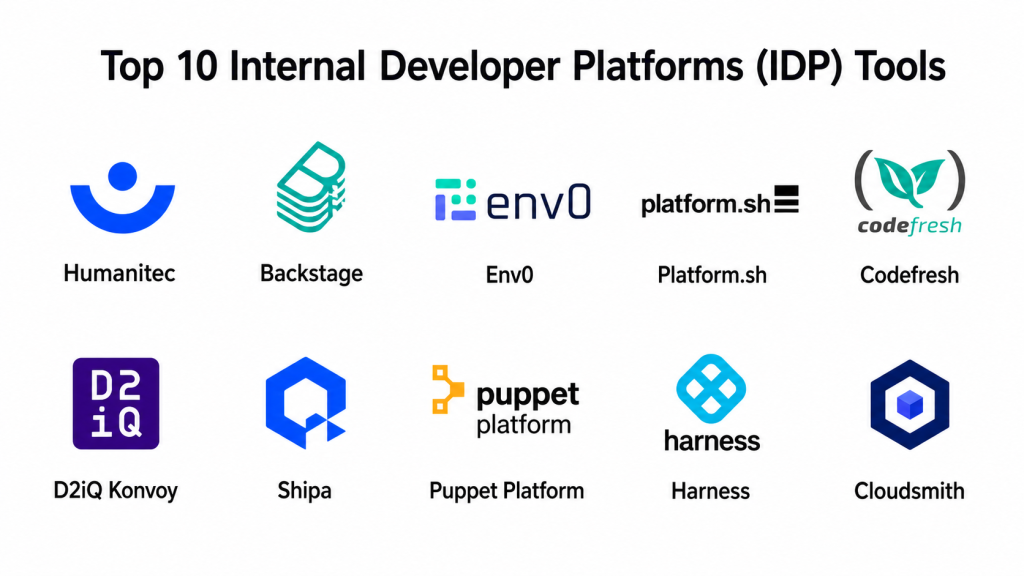
Top 10 Internal Developer Platforms (IDP) Tools
1 — Humanitec
Short description: Centralized platform to automate environment management and CI/CD pipelines for engineering teams
Key Features
- Self-service environment provisioning
- CI/CD pipeline templates
- Role-based access control
- Multi-cloud support
- Audit logs and observability
- API-first architecture
- Workflow automation
Pros
- Reduces developer setup time
- Centralized policy and compliance
Cons
- Requires initial configuration
- Smaller ecosystem than major cloud platforms
Platforms / Deployment
- Web / Cloud
- Cloud / Hybrid
Security & Compliance
- SSO/SAML, MFA, encryption, RBAC
- Not publicly stated
Integrations & Ecosystem
GitHub, GitLab, Jenkins, Kubernetes, Slack
- GitHub/GitLab integration
- Jenkins pipeline support
- Kubernetes deployments
- Slack notifications
Support & Community
Comprehensive documentation, onboarding guides, responsive support, active forums
2 — Backstage
Short description: Open-source developer portal platform to manage services and microservices operations
Key Features
- Service catalog and microservices registry
- Plugin architecture
- CI/CD pipeline integration
- Documentation portal
- API management
- Multi-team scalability
Pros
- Highly extensible
- Strong open-source community
Cons
- Requires internal setup
- Learning curve for plugin development
Platforms / Deployment
- Web / Cloud / Linux
- Self-hosted / Cloud
Security & Compliance
Not publicly stated
Integrations & Ecosystem
Jenkins, GitHub Actions, CircleCI, Kubernetes
- CI/CD integration
- GitOps support
- Kubernetes cluster integration
- Plugin marketplace
Support & Community
Strong open-source community and detailed documentation
3 — Env0
Short description: IDP for Infrastructure-as-Code automation with Terraform and Pulumi support
Key Features
- Policy-as-code enforcement
- Cost estimation and tracking
- Multi-cloud provisioning
- Approval workflows
- Audit logging
Pros
- Centralized IaC management
- Built-in governance and cost tracking
Cons
- Less suitable for non-cloud-native workflows
- Pricing scales with team size
Platforms / Deployment
- Web / Cloud
- Cloud
Security & Compliance
- SSO/SAML, MFA, encryption
- Not publicly stated
Integrations & Ecosystem
GitHub, GitLab, Bitbucket, Slack, Terraform Cloud
- Version control integration
- Slack notifications
- Terraform Cloud provisioning
Support & Community
Documentation, support tiers, community forums
4 — Platform.sh
Short description: Enterprise IDP for full-stack application deployment and continuous delivery
Key Features
- Environment cloning for staging and testing
- Multi-region deployment
- Automated CI/CD pipelines
- Git-based workflow
- Monitoring and logging
- Backup and rollback features
Pros
- Enterprise-ready and reliable
- Simplifies multi-environment management
Cons
- Premium pricing
- Complexity for small teams
Platforms / Deployment
- Web / Cloud
- Cloud
Security & Compliance
- SSO/SAML, MFA, encryption, audit logs
- SOC 2
Integrations & Ecosystem
GitHub, GitLab, Jenkins, Slack, Datadog
- Git integration
- CI/CD hooks
- Slack alerts
- Datadog monitoring
Support & Community
Enterprise support with SLA, documentation, forums
5 — Codefresh
Short description: Kubernetes-focused CI/CD IDP for cloud-native applications
Key Features
- Kubernetes-native pipelines
- GitOps workflows
- Multi-cluster management
- Dashboard and observability
- Automated deployments
- Rollback capabilities
Pros
- Optimized for cloud-native apps
- Strong pipeline automation
Cons
- Best for Kubernetes; limited non-K8 workloads
- Learning curve for beginners
Platforms / Deployment
- Web / Cloud
- Cloud
Security & Compliance
- SSO, encryption
- Not publicly stated
Integrations & Ecosystem
Kubernetes, GitHub, GitLab, Slack, Helm
- Kubernetes cluster integration
- GitOps support
- Slack notifications
Support & Community
Documentation and active community; enterprise support available
6 — D2iQ Konvoy
Short description: Platform for deploying and managing cloud-native applications on Kubernetes
Key Features
- Cluster provisioning and management
- CI/CD integration
- Observability dashboards
- Automated updates
- Multi-cloud support
- RBAC and security policies
Pros
- Simplifies Kubernetes management
- Supports large-scale deployments
Cons
- Complex setup for small teams
- Requires Kubernetes knowledge
Platforms / Deployment
- Web / Linux
- Cloud / Hybrid
Security & Compliance
- SSO/SAML, MFA, RBAC
- Not publicly stated
Integrations & Ecosystem
GitHub, Jenkins, Slack, Prometheus
- CI/CD integration
- Monitoring tools
- Slack notifications
Support & Community
Varies / Not publicly stated; enterprise support available
7 — Shipa
Short description: Developer-friendly IDP that abstracts Kubernetes complexities
Key Features
- App-centric deployment abstractions
- CI/CD pipelines
- Multi-cloud support
- Observability and metrics
- Secrets and config management
Pros
- Simplifies Kubernetes for developers
- Reduces cognitive load
Cons
- Limited for VM-based workflows
- Smaller community
Platforms / Deployment
- Web / Linux / Cloud
- Cloud / Hybrid
Security & Compliance
- SSO/SAML, encryption
- Not publicly stated
Integrations & Ecosystem
GitHub, GitLab, Jenkins, Slack, Prometheus
- CI/CD integration
- Metrics monitoring
- Slack notifications
Support & Community
Documentation, enterprise support; growing community
8 — Puppet Platform
Short description: Infrastructure automation IDP for compliance and environment management
Key Features
- IaC automation
- Compliance enforcement
- Environment orchestration
- CI/CD pipeline support
- Reporting and dashboards
Pros
- Strong infrastructure automation
- Enterprise-scale governance
Cons
- Steep learning curve
- Less developer-focused
Platforms / Deployment
- Web / Linux / Windows
- Cloud / Hybrid / Self-hosted
Security & Compliance
- SSO, encryption, audit logs
- Not publicly stated
Integrations & Ecosystem
GitHub, GitLab, Jenkins, Slack, cloud providers
- CI/CD integration
- Slack notifications
- Multi-cloud provisioning
Support & Community
Documentation, enterprise support; large user base
9 — Harness
Short description: Continuous delivery platform simplifying automated deployments
Key Features
- Continuous verification
- Deployment pipelines
- GitOps support
- Multi-cloud deployments
- RBAC and compliance
Pros
- Strong observability
- Simplifies cloud deployment
Cons
- Premium pricing
- Requires configuration
Platforms / Deployment
- Web / Cloud
- Cloud / Hybrid
Security & Compliance
- SSO/SAML, encryption
- Not publicly stated
Integrations & Ecosystem
GitHub, GitLab, Slack, Kubernetes, Terraform
- CI/CD hooks
- Cloud integrations
- Slack alerts
Support & Community
Enterprise support; tutorials and documentation
10 — Cloudsmith
Short description: Universal package management for internal software distribution
Key Features
- Artifact repositories
- CI/CD integrations
- RBAC and access control
- Multi-cloud storage
- Audit logs
Pros
- Centralized artifact management
- Supports multiple package formats
Cons
- Limited orchestration
- Smaller ecosystem
Platforms / Deployment
- Web / Cloud
- Cloud / Hybrid
Security & Compliance
- SSO/SAML, encryption, audit logs
- Not publicly stated
Integrations & Ecosystem
GitHub, GitLab, Jenkins, Slack, Terraform
- CI/CD integration
- Slack notifications
- Multi-cloud artifact storage
Support & Community
Documentation and enterprise support
Comparison Table
| Tool Name | Best For | Platform(s) Supported | Deployment | Standout Feature | Public Rating |
|---|---|---|---|---|---|
| Humanitec | Centralized deployments | Web | Cloud / Hybrid | Self-service environment provisioning | N/A |
| Backstage | Developer portals | Web | Self-hosted | Extensible plugin architecture | N/A |
| Env0 | IaC automation | Web | Cloud | Terraform and Pulumi integration | N/A |
| Platform.sh | Full-stack deployment | Web | Cloud | Multi-region environment management | N/A |
| Codefresh | Kubernetes CI/CD | Web | Cloud | Kubernetes-native pipelines | N/A |
| D2iQ Konvoy | Cluster orchestration | Web / Linux | Cloud / Hybrid | Multi-cloud Kubernetes management | N/A |
| Shipa | Developer-friendly K8 | Web / Linux / Cloud | Cloud / Hybrid | Simplifies Kubernetes workflows | N/A |
| Puppet Platform | Infrastructure automation | Web / Linux / Windows | Cloud / Hybrid / Self-hosted | Compliance & IaC | N/A |
| Harness | Continuous verification | Web | Cloud / Hybrid | Continuous deployment verification | N/A |
| Cloudsmith | Artifact management | Web | Cloud / Hybrid | Multi-format artifact repository | N/A |
Evaluation & Scoring
| Tool Name | Core | Ease | Integrations | Security | Performance | Support | Value | Weighted Total |
|---|---|---|---|---|---|---|---|---|
| Humanitec | 10 | 9 | 8 | 8 | 9 | 8 | 9 | 9.0 |
| Backstage | 9 | 7 | 8 | 7 | 8 | 7 | 8 | 7.9 |
| Env0 | 9 | 8 | 8 | 8 | 8 | 7 | 8 | 8.2 |
| Platform.sh | 10 | 8 | 9 | 8 | 9 | 8 | 8 | 8.8 |
| Codefresh | 9 | 8 | 8 | 7 | 8 | 7 | 8 | 8.0 |
| D2iQ Konvoy | 9 | 7 | 7 | 7 | 8 | 7 | 7 | 7.6 |
| Shipa | 8 | 8 | 7 | 7 | 8 | 7 | 7 | 7.5 |
| Puppet Platform | 9 | 7 | 8 | 8 | 8 | 7 | 7 | 7.9 |
| Harness | 10 | 8 | 8 | 8 | 9 | 8 | 8 | 8.7 |
| Cloudsmith | 8 | 8 | 7 | 7 | 8 | 7 | 7 | 7.4 |
Weighted totals are comparative scores showing overall suitability for automation, workflow, and developer productivity
Which IDP Tool Is Right for You
Solo / Freelancer
Shipa, Env0, Cloudsmith, Backstage for lightweight setups
SMB
Humanitec, Codefresh, Env0 for self-service deployments and CI/CD
Mid-Market
Platform.sh, Harness, Puppet Platform for standardized workflows and compliance
Enterprise
Platform.sh, Humanitec, Harness, D2iQ Konvoy for scalability, multi-cloud, and governance
Budget vs Premium
Budget: Shipa, Cloudsmith, Backstage
Premium: Platform.sh, Humanitec, Harness
Feature Depth vs Ease of Use
Depth: Platform.sh, Harness, Humanitec
Ease: Shipa, Cloudsmith, Env0
Integrations & Scalability
Large-scale: Humanitec, Platform.sh, Harness
Smaller teams: Env0, Shipa, Cloudsmith
Security & Compliance Needs
Platform.sh, Humanitec, Harness provide enterprise-grade security; others vary
Frequently Asked Questions
1. What pricing models do IDPs use
Most IDPs are subscription-based with per-user, per-environment, or enterprise tiers
2. Can developers self-serve environments
Platforms like Humanitec, Shipa, and Env0 enable self-service provisioning with RBAC
3. Do IDPs support multi-cloud deployments
Platform.sh and D2iQ Konvoy support AWS, Azure, GCP, and hybrid setups
4. Can I integrate existing CI/CD pipelines
Most IDPs integrate with GitHub Actions, Jenkins, GitLab CI, and CircleCI
5. How steep is the learning curve
Backstage requires setup; Humanitec and Env0 are beginner-friendly
6. Are these platforms secure
Enterprise-grade IDPs provide SSO, MFA, RBAC, and audit logs; others vary
7. Can IDPs handle microservices architecture
Backstage, Harness, and D2iQ Konvoy excel with Kubernetes and microservices
8. Do these platforms include monitoring
Most IDPs include dashboards, logs, and integration with Prometheus or other monitoring tools
9. Can I automate policy enforcement
Env0, Platform.sh, and Puppet Platform allow automated compliance and approval workflows
10. Are IDPs suitable for small teams
Shipa and Cloudsmith are lightweight and ideal for SMBs and startups
Conclusion
Internal Developer Platforms improve developer productivity, standardize workflows, and automate software delivery. Choosing the right IDP depends on team size, infrastructure complexity, cloud strategy, and security requirements. Small teams may benefit from Shipa and Env0, while mid-market and enterprise teams gain value from Humanitec, Platform.sh, and Harness. Shortlist 2–3 platforms, run pilot projects, and validate integrations, security, and automation before full adoption
