Introduction
Change Data Capture (CDC) tools are software platforms designed to detect and track data changes in real time across databases, data warehouses, and analytics platforms. They capture inserts, updates, and deletes from source systems and propagate them efficiently to target systems, ensuring data consistency, reliability, and timeliness. CDC tools are crucial for organizations that rely on real-time data pipelines and analytics for decision-making.
In modern enterprise environments, CDC is critical for low-latency analytics, AI workflows, cloud migration, microservices communication, and multi-region data synchronization. These tools replace traditional batch processing, allowing businesses to react faster and maintain high availability.
Real-world use cases include replicating transactional databases to analytics systems, feeding machine learning models with up-to-date data, synchronizing distributed databases across cloud environments, ensuring disaster recovery readiness, and supporting real-time reporting for business intelligence.
When evaluating CDC tools, buyers should consider latency, replication type (streaming or batch), scalability, error handling, monitoring, integration capabilities, security features, compliance support, deployment flexibility, and cost.
Best for: Data engineers, database administrators, IT architects, cloud engineers, and enterprises requiring real-time analytics, replication across multiple systems, and low-latency data propagation.
Not ideal for: Small organizations with static databases or low data change rates, where simpler batch ETL solutions may suffice.
Key Trends in Change Data Capture (CDC) Tools for the Future
- Real-time replication for near-zero latency updates
- AI-assisted anomaly detection and automated conflict resolution
- Cloud-native CDC platforms supporting hybrid and multi-cloud environments
- Low-code configuration to simplify setup and reduce errors
- Enhanced security including end-to-end encryption, role-based access, and audit logs
- Integration with analytics, data lakes, and BI platforms
- Pay-as-you-go and subscription pricing models for cost efficiency
- Support for structured, semi-structured, and unstructured data
- Compliance features for GDPR, HIPAA, and industry regulations
- API-first architecture for extensibility and third-party integration
How We Selected These Tools
- Evaluated market adoption and enterprise mindshare
- Assessed feature completeness including latency, replication types, and error handling
- Analyzed reliability and performance under high-volume workloads
- Reviewed security posture including encryption, access control, and compliance
- Considered integrations with databases, cloud platforms, and analytics tools
- Studied suitability across SMBs to enterprise-scale environments
- Prioritized automation, ease of use, and low-code configuration
- Checked vendor documentation, training, and support quality
- Evaluated scalability, multi-region replication, and hybrid cloud support
- Verified vendor stability and ongoing product development roadmap
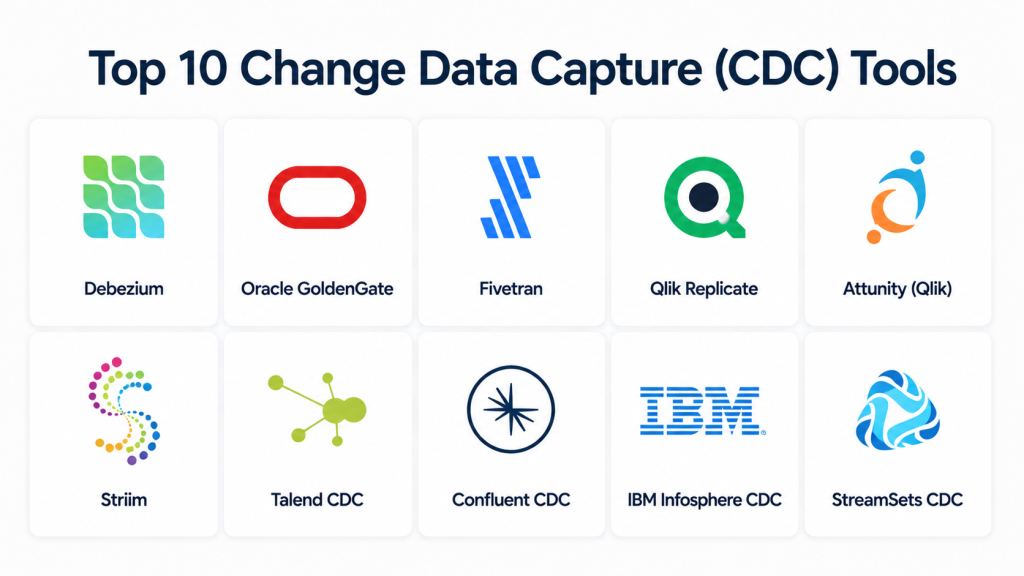
Top 10 Change Data Capture (CDC) Tools
#1 — Debezium
Short description: Open-source CDC platform that streams database changes into Kafka for microservices, data lakes, and real-time analytics pipelines.
Key Features
- Supports MySQL, PostgreSQL, MongoDB, SQL Server
- Streams changes via Kafka Connect
- Low-latency replication
- Schema evolution support
- Fault-tolerant and scalable
- Change event filtering
Pros
- Open-source and free
- Broad database support
Cons
- Requires Kafka infrastructure
- Setup can be complex
Platforms / Deployment
Linux / macOS / Windows
Self-hosted / Cloud
Security & Compliance
Supports encryption and RBAC via Kafka pipelines
Not publicly stated: SOC 2, ISO 27001
Integrations & Ecosystem
Integrates with Kafka, cloud data lakes, and analytics tools
- Kafka Streams and KSQL
- BI platform integration
- API for custom extensions
Support & Community
Strong open-source community
Extensive documentation
Paid vendor support available
#2 — Oracle GoldenGate
Short description: Enterprise CDC tool for Oracle and heterogeneous databases providing high-availability real-time replication.
Key Features
- Continuous low-latency replication
- Multi-database engine support
- Conflict detection and resolution
- Automated failover and monitoring
- High availability and disaster recovery
Pros
- Reliable for mission-critical systems
- Minimal downtime replication
Cons
- High licensing cost
- Requires specialized expertise
Platforms / Deployment
Windows / Linux
Cloud / Self-hosted / Hybrid
Security & Compliance
Supports encryption and RBAC
Not publicly stated: SOC 2, ISO 27001
Integrations & Ecosystem
Integrates with Oracle RAC, cloud services, and analytics tools
- API automation support
- Monitoring dashboards
Support & Community
Enterprise support available
Professional services for deployment
Comprehensive documentation
#3 — Fivetran
Short description: Cloud-native CDC solution that automates real-time replication into data warehouses and analytics platforms.
Key Features
- Pre-built connectors for databases and SaaS applications
- Low-code configuration
- Schema management automation
- Real-time incremental updates
- Monitoring and alerts
Pros
- Rapid deployment
- Maintenance-free pipelines
Cons
- Pricing scales with data volume
- Limited on-premise support
Platforms / Deployment
Web
Cloud
Security & Compliance
Supports encryption in transit and at rest
Not publicly stated: SOC 2, ISO 27001
Integrations & Ecosystem
Connects with Snowflake, Redshift, BigQuery, analytics tools
- API integration
- Custom pipeline extensions
Support & Community
Documentation and onboarding guides
Enterprise support plans
Growing user community
#4 — Qlik Replicate
Short description: Enterprise CDC tool for heterogeneous databases enabling low-latency replication across multiple targets.
Key Features
- Continuous change data capture
- Multi-database and cloud support
- GUI-based mapping and monitoring
- Automated error handling
- Real-time reporting
Pros
- Flexible multi-database replication
- Continuous low-latency updates
Cons
- Enterprise licensing required
- Advanced configuration needs skilled staff
Platforms / Deployment
Windows / Linux
Cloud / Self-hosted / Hybrid
Security & Compliance
Supports encryption and SSO
Not publicly stated: SOC 2, HIPAA
Integrations & Ecosystem
Connects with Oracle, SQL Server, PostgreSQL, cloud warehouses
- API orchestration
- Extensible via SDK
Support & Community
Vendor documentation
Active forums
Training resources available
#5 — Attunity (Qlik)
Short description: Enterprise-grade CDC platform for streaming changes into data lakes, warehouses, and analytics platforms.
Key Features
- Real-time replication
- Multi-database engine support
- Incremental updates
- Monitoring dashboards
- Cloud and on-premise support
Pros
- Mature enterprise solution
- Reliable for large-scale CDC
Cons
- Licensing cost
- Complex for small teams
Platforms / Deployment
Windows / Linux
Cloud / Hybrid
Security & Compliance
Supports encryption and access control
Not publicly stated: SOC 2, HIPAA
Integrations & Ecosystem
Connects with Snowflake, Redshift, BigQuery
- API integration
- Extensible pipelines
Support & Community
Vendor documentation and support tiers
Professional setup assistance
Training resources available
#6 — Striim
Short description: Streaming analytics CDC tool for real-time database changes with low-latency replication across cloud and on-premise systems.
Key Features
- Real-time CDC
- Streaming analytics integration
- Multi-source and multi-target support
- Monitoring dashboards
- Low-latency replication
Pros
- Combines CDC with analytics
- Enterprise-grade performance
Cons
- Learning curve
- Licensing cost
Platforms / Deployment
Linux / Windows
Cloud / Self-hosted / Hybrid
Security & Compliance
Supports encryption and RBAC
Not publicly stated: SOC 2, HIPAA
Integrations & Ecosystem
Connects with Kafka, Oracle, SQL Server, cloud platforms
- API support
- Extensible pipelines
Support & Community
Enterprise support
Documentation and training
Active user community
#7 — Talend CDC
Short description: Low-code CDC platform enabling real-time replication and synchronization across databases and cloud systems.
Key Features
- GUI-based CDC setup
- Incremental replication
- Multi-database support
- Cloud and on-premise targets
- Error handling and monitoring
Pros
- Easy low-code implementation
- Broad connector support
Cons
- Performance depends on deployment
- Advanced features require paid version
Platforms / Deployment
Windows / Linux / macOS
Cloud / Self-hosted / Hybrid
Security & Compliance
Supports encryption and RBAC
Not publicly stated: SOC 2, HIPAA
Integrations & Ecosystem
Integrates with cloud warehouses and analytics platforms
- API support
- Extensible pipelines
Support & Community
Vendor documentation
Training and professional support
Community forums
#8 — Confluent CDC
Short description: Kafka-native CDC solution for streaming database changes to microservices and analytics pipelines.
Key Features
- Real-time Kafka streaming
- Multi-database support
- Low-latency replication
- Schema registry integration
- Monitoring and alerting
Pros
- Native Kafka integration
- High-throughput performance
Cons
- Requires Kafka infrastructure
- Setup complexity for small teams
Platforms / Deployment
Linux / Windows / macOS
Cloud / Self-hosted / Hybrid
Security & Compliance
Supports encryption, RBAC, and audit logging
Not publicly stated: SOC 2, HIPAA
Integrations & Ecosystem
Connects with Debezium, Kafka Streams, analytics tools
- API extensibility
- Cloud and on-prem targets
Support & Community
Documentation and support tiers
Active open-source community
Training available
#9 — IBM Infosphere CDC
Short description: Enterprise CDC tool for heterogeneous database replication with low-latency streaming and high availability.
Key Features
- Real-time change data capture
- Multi-database support
- Incremental replication
- Monitoring and alerting
- High availability
Pros
- Enterprise-grade replication
- Low-latency performance
Cons
- Licensing cost
- Complex deployment
Platforms / Deployment
Windows / Linux
Cloud / Self-hosted / Hybrid
Security & Compliance
Supports encryption and RBAC
Not publicly stated: SOC 2, HIPAA
Integrations & Ecosystem
Connects with Oracle, SQL Server, PostgreSQL, cloud warehouses
- API integration
- Extensible pipelines
Support & Community
Enterprise support available
Documentation detailed
Professional services
#10 — StreamSets CDC
Short description: CDC platform for streaming, replication, and ingestion pipelines with multi-target support.
Key Features
- Real-time change capture
- Multi-source and target replication
- Low-latency streaming
- Monitoring and error handling
- Cloud and on-premise support
Pros
- Easy pipeline deployment
- Heterogeneous database support
Cons
- Licensing for advanced features
- Training required
Platforms / Deployment
Linux / Windows / macOS
Cloud / Self-hosted / Hybrid
Security & Compliance
Supports encryption and access control
Not publicly stated: SOC 2, HIPAA
Integrations & Ecosystem
Connects with Kafka, cloud warehouses, messaging platforms
- API support
- Extensible pipelines
Support & Community
Vendor documentation
Training and support
Community resources
Comparison Table
| Tool Name | Best For | Platform(s) Supported | Deployment | Standout Feature | Public Rating |
|---|---|---|---|---|---|
| Debezium | Kafka streaming pipelines | Linux / macOS / Windows | Cloud / Self-hosted | Open-source real-time streaming | N/A |
| Oracle GoldenGate | Enterprise heterogeneous DBs | Windows / Linux | Cloud / Hybrid | Low-latency replication | N/A |
| Fivetran | Cloud analytics pipelines | Web | Cloud | Automated near real-time updates | N/A |
| Qlik Replicate | Enterprise multi-DB replication | Windows / Linux | Cloud / Hybrid | Continuous CDC | N/A |
| Attunity | Enterprise CDC replication | Windows / Linux | Cloud / Hybrid | Real-time replication | N/A |
| Striim | Streaming analytics | Linux / Windows | Cloud / Hybrid | CDC + analytics | N/A |
| Talend CDC | Low-code CDC | Windows / Linux / macOS | Cloud / Hybrid | GUI-based CDC | N/A |
| Confluent CDC | Kafka pipelines | Linux / Windows / macOS | Cloud / Hybrid | Kafka-native CDC | N/A |
| IBM Infosphere CDC | Heterogeneous DB replication | Windows / Linux | Cloud / Hybrid | Enterprise low-latency CDC | N/A |
| StreamSets CDC | Streaming and replication | Linux / Windows / macOS | Cloud / Hybrid | Multi-target low-latency | N/A |
Evaluation & Scoring
| Tool Name | Core (25%) | Ease (15%) | Integrations (15%) | Security (10%) | Performance (10%) | Support (10%) | Value (15%) | Weighted Total |
|---|---|---|---|---|---|---|---|---|
| Debezium | 8 | 7 | 8 | 7 | 8 | 7 | 8 | 7.7 |
| Oracle GoldenGate | 9 | 6 | 7 | 8 | 9 | 7 | 7 | 7.8 |
| Fivetran | 8 | 8 | 8 | 7 | 8 | 7 | 7 | 7.7 |
| Qlik Replicate | 8 | 7 | 8 | 7 | 8 | 7 | 7 | 7.5 |
| Attunity | 8 | 7 | 7 | 7 | 8 | 7 | 7 | 7.4 |
| Striim | 8 | 6 | 7 | 7 | 8 | 7 | 7 | 7.3 |
| Talend CDC | 7 | 8 | 7 | 7 | 7 | 7 | 7 | 7.1 |
| Confluent CDC | 8 | 6 | 7 | 7 | 8 | 7 | 7 | 7.3 |
| IBM Infosphere CDC | 9 | 6 | 7 | 8 | 9 | 7 | 6 | 7.6 |
| StreamSets CDC | 8 | 7 | 7 | 7 | 8 | 7 | 7 | 7.4 |
Scores are comparative and highlight relative strengths across core features, ease, integration, security, performance, support, and value.
Which Tool Is Right for You
Solo / Freelancer
Open-source or low-code tools like Debezium or Talend CDC are cost-efficient and easy to implement for small pipelines.
SMB
Cloud-native tools such as Fivetran or Qlik Replicate balance ease-of-use and enterprise-grade replication features.
Mid-Market
Hybrid CDC solutions like Striim, Attunity, or Confluent CDC handle moderate-scale pipelines with real-time replication needs.
Enterprise
Oracle GoldenGate, IBM Infosphere CDC, or StreamSets CDC suit large-scale, mission-critical deployments; prioritize compliance and support.
Budget vs Premium
Open-source or cloud-native CDC tools are cost-efficient; premium enterprise-grade platforms provide advanced features and support.
Feature Depth vs Ease of Use
Low-code platforms simplify deployment; enterprise-grade CDC solutions offer full functionality but require skilled staff.
Integrations & Scalability
Select tools supporting multiple databases, cloud, and on-prem targets to enable future growth and multi-region replication.
Security & Compliance Needs
Prioritize encryption, RBAC, audit logging, and regulatory certifications for mission-critical or regulated environments.
Frequently Asked Questions
1. What pricing models do CDC tools use
Most use subscription-based, consumption-based, or enterprise licenses. Open-source options are free.
2. How long does setup take
Depends on database size, complexity, and infrastructure. Small pipelines can take hours; enterprise pipelines may take days.
3. Can CDC tools replicate without downtime
Yes, most tools support real-time or incremental replication to minimize service interruptions.
4. Are CDC tools secure
Most provide encryption, role-based access, and audit logging. Enterprise tools may include SOC 2 or ISO certifications.
5. Is cross-platform replication supported
Yes, modern CDC platforms support multiple engines and hybrid or multi-cloud environments.
6. What common mistakes should I avoid
- Ignoring schema conflicts
- Skipping monitoring
- Underestimating network latency
- Misconfiguring pipelines
7. Can small businesses use CDC tools
Yes, open-source or cloud-native CDC tools are suitable for SMBs with smaller pipelines.
8. How is replication monitored
Dashboards, logs, and alerts provide real-time insights on pipeline performance and errors.
9. What happens if replication fails
Robust tools offer rollback, retries, and automated conflict resolution to maintain data integrity.
10. Are managed CDC services worth it
Yes, managed services reduce operational overhead and provide high availability for cloud and hybrid pipelines.
Conclusion
Change Data Capture tools are essential for real-time analytics, multi-system synchronization, and low-latency pipelines. The best choice depends on scale, infrastructure, and compliance needs. Evaluate tools based on core functionality, integrations, security, and ease of use. Shortlist 2–3 options, run pilot tests, and validate performance before full deployment.
