Introduction
Artifact and container signing tools help organizations verify that software packages, container images, binaries, and deployment artifacts are authentic and have not been modified unexpectedly. These tools create cryptographic signatures, provenance records, and verification workflows that improve trust across modern software delivery pipelines.
As cloud-native adoption, container usage, and software supply chain attacks continue to increase, organizations are investing heavily in secure artifact verification. Modern DevSecOps teams now treat image signing, provenance validation, and trusted software delivery as critical operational requirements instead of optional security features.
Common real-world use cases include:
- Signing container images before deployment
- Verifying trusted software artifacts in CI/CD pipelines
- Preventing unauthorized image deployments
- Enforcing Kubernetes admission policies
- Securing software supply chains with provenance validation
Key evaluation criteria include:
- Artifact signing capabilities
- Keyless signing support
- Kubernetes integration
- OCI registry compatibility
- Policy enforcement features
- CI/CD pipeline integration
- Provenance and attestation support
- Ease of automation
- Scalability across environments
- Security governance and auditability
Best for: DevSecOps teams, platform engineering teams, cloud-native organizations, enterprise software vendors, regulated industries, Kubernetes administrators, and organizations adopting zero-trust software delivery models.
Not ideal for: organizations without containerized workflows, very small teams with minimal deployment automation, or environments where software provenance and deployment verification are not operational priorities.
Key Trends in Artifact/Container Signing & Verification Tools (Sigstore)
- Keyless signing is becoming more popular across cloud-native environments
- Provenance verification is becoming part of enterprise deployment standards
- Kubernetes-native admission control enforcement is expanding rapidly
- Software supply chain security regulations are increasing globally
- AI-generated code is driving stronger software verification requirements
- OCI artifact signing support is becoming a default expectation
- Runtime verification and policy enforcement are becoming more automated
- SBOM integration with signing workflows is increasing
- Cloud-native security ecosystems are standardizing around Sigstore-related tooling
- Policy-as-code and verification automation are becoming common DevSecOps practices
How We Selected These Tools
The following tools were selected using practical engineering, cloud-native security, and DevSecOps evaluation criteria:
- Industry adoption and ecosystem trust
- Relevance to modern software supply chain security
- Signing and verification feature depth
- Kubernetes and OCI ecosystem compatibility
- CI/CD integration capabilities
- Runtime policy enforcement support
- Scalability across enterprise environments
- Open-source community maturity
- Documentation quality and onboarding experience
- Suitability for SMB, enterprise, and developer-focused use cases
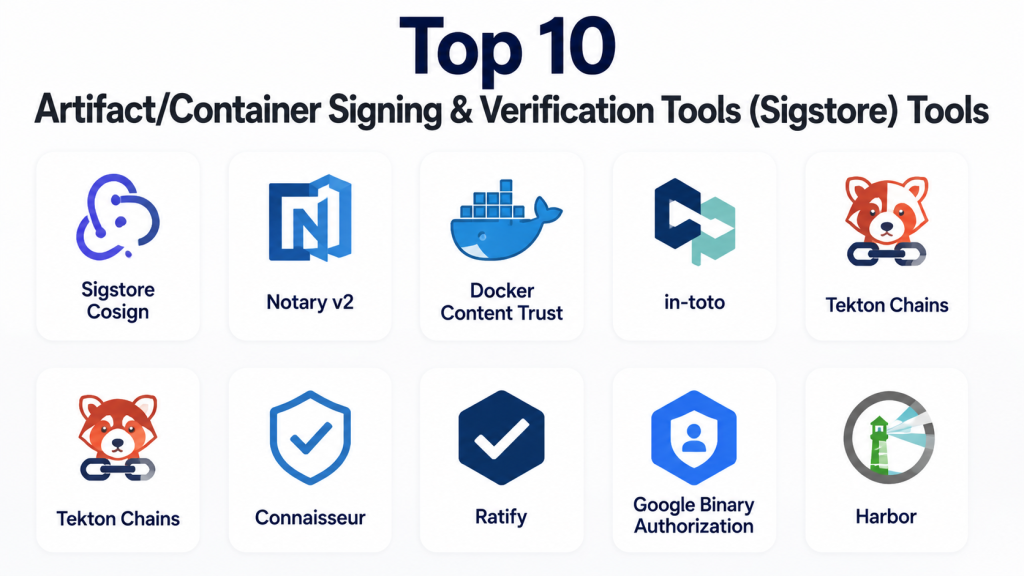
Top 10 Artifact/Container Signing & Verification Tools (Sigstore) Tools
1. Sigstore Cosign
Short description: Cosign is one of the most widely adopted container signing and verification tools in cloud-native environments. It allows teams to sign container images, SBOMs, and software artifacts using keyless and key-based workflows.
Key Features
- Keyless signing support
- OCI artifact signing
- Provenance attestation support
- Transparency log integration
- Kubernetes ecosystem compatibility
- CI/CD pipeline automation
- SBOM signing capabilities
Pros
- Strong cloud-native ecosystem support
- Easy integration with Kubernetes workflows
- Good automation capabilities
Cons
- Advanced workflows require security expertise
- Ecosystem dependencies can increase complexity
- Enterprise governance depends on deployment setup
Platforms / Deployment
Windows / macOS / Linux
Cloud / Self-hosted / Hybrid
Security & Compliance
Supports encryption, identity-based signing, auditability, and transparency logs. Formal compliance certifications are not publicly stated.
Integrations & Ecosystem
Cosign integrates deeply with modern cloud-native software delivery workflows.
- Kubernetes
- OCI registries
- GitHub Actions
- Tekton
- CI/CD pipelines
- SBOM tools
Support & Community
Very active open-source community with strong documentation and ecosystem adoption.
2. Notary v2
Short description: Notary v2 is a container signing and verification framework focused on secure OCI artifact distribution and trusted software delivery.
Key Features
- OCI artifact signing
- Trust metadata management
- Registry-native workflows
- Secure verification processes
- Cloud-native compatibility
- Signature validation support
- Artifact integrity protection
Pros
- Strong OCI ecosystem alignment
- Registry-focused security model
- Useful for enterprise container workflows
Cons
- Operational complexity for advanced deployments
- Ecosystem maturity still evolving
- Learning curve for policy enforcement
Platforms / Deployment
Linux / Windows / macOS
Cloud / Self-hosted / Hybrid
Security & Compliance
Supports artifact trust verification and cryptographic validation workflows.
Integrations & Ecosystem
Designed for container-focused cloud-native environments.
- OCI registries
- Kubernetes
- CI/CD systems
- Container platforms
- Cloud-native tooling
- Artifact repositories
Support & Community
Strong container ecosystem interest and growing cloud-native adoption.
3. Docker Content Trust
Short description: Docker Content Trust helps organizations verify container image authenticity and publisher trust within Docker-based environments.
Key Features
- Container image signing
- Publisher verification
- Trusted image enforcement
- Registry integration
- Signature validation
- Secure image workflows
- Docker ecosystem support
Pros
- Easy Docker integration
- Familiar workflows for Docker users
- Useful for trusted image deployment
Cons
- Limited flexibility compared to newer ecosystems
- More Docker-centric workflows
- Advanced provenance support is limited
Platforms / Deployment
Windows / macOS / Linux
Cloud / Self-hosted / Hybrid
Security & Compliance
Supports signed image verification and trusted publishing workflows.
Integrations & Ecosystem
Works well in Docker-focused environments.
- Docker Engine
- Docker Hub
- CI/CD systems
- Container registries
- Kubernetes
- Image repositories
Support & Community
Strong documentation and broad Docker ecosystem familiarity.
4. in-toto
Short description: in-toto secures software supply chains by verifying every step in the software build and delivery lifecycle using signed metadata and provenance tracking.
Key Features
- Provenance tracking
- Build step verification
- Signed metadata workflows
- Layout-based trust models
- Supply chain validation
- Artifact verification
- Secure release workflows
Pros
- Strong provenance capabilities
- Flexible trust enforcement
- Useful for regulated environments
Cons
- Steeper operational learning curve
- More complex implementation
- Requires planning for workflow design
Platforms / Deployment
Windows / macOS / Linux
Self-hosted / Hybrid
Security & Compliance
Supports cryptographic metadata validation and software integrity verification.
Integrations & Ecosystem
Useful for advanced software supply chain security workflows.
- CI/CD pipelines
- Artifact repositories
- Build systems
- Provenance verification
- Secure delivery workflows
- Policy engines
Support & Community
Strong open-source security community and technical documentation.
5. Tekton Chains
Short description: Tekton Chains automatically generates signed provenance metadata for Kubernetes-native CI/CD pipelines using Tekton.
Key Features
- Automated provenance generation
- Kubernetes-native workflows
- OCI signing support
- CI/CD integration
- Kubernetes admission support
- Supply chain metadata creation
- Cloud-native deployment compatibility
Pros
- Strong Kubernetes integration
- Good automation capabilities
- Useful for cloud-native CI/CD environments
Cons
- Best suited for Tekton users
- Kubernetes expertise required
- Operational setup can be complex
Platforms / Deployment
Linux / Kubernetes
Cloud / Hybrid / Self-hosted
Security & Compliance
Supports signed provenance and secure CI/CD workflows.
Integrations & Ecosystem
Strong alignment with cloud-native delivery ecosystems.
- Tekton Pipelines
- Kubernetes
- OCI registries
- Cosign
- CI/CD workflows
- Admission controllers
Support & Community
Active cloud-native ecosystem and strong Kubernetes community support.
6. Kyverno
Short description: Kyverno is a Kubernetes-native policy engine that helps organizations enforce image signing and verification policies inside Kubernetes clusters.
Key Features
- Kubernetes admission control
- Image verification policies
- Policy-as-code support
- YAML-based configuration
- OCI signature validation
- Kubernetes-native integration
- Supply chain policy enforcement
Pros
- Developer-friendly policy syntax
- Strong Kubernetes integration
- Flexible policy management
Cons
- Kubernetes-focused scope
- Requires policy management expertise
- Less useful outside Kubernetes environments
Platforms / Deployment
Kubernetes / Linux
Cloud / Self-hosted / Hybrid
Security & Compliance
Supports RBAC integration, policy enforcement, and Kubernetes-native governance workflows.
Integrations & Ecosystem
Works well in cloud-native Kubernetes security environments.
- Kubernetes
- OCI registries
- CI/CD pipelines
- Admission controllers
- Cloud-native security tools
- Policy workflows
Support & Community
Very active Kubernetes security community and strong documentation.
7. Connaisseur
Short description: Connaisseur is a Kubernetes admission controller focused on validating signed container images before deployment.
Key Features
- Image signature validation
- Kubernetes admission control
- Policy enforcement
- OCI registry compatibility
- Trusted deployment workflows
- Kubernetes-native security
- Signature verification automation
Pros
- Strong Kubernetes deployment validation
- Lightweight admission control
- Useful for secure image enforcement
Cons
- Kubernetes-only focus
- Limited outside container ecosystems
- Smaller ecosystem compared to larger projects
Platforms / Deployment
Kubernetes / Linux
Cloud / Self-hosted / Hybrid
Security & Compliance
Supports trusted image validation and admission policy enforcement.
Integrations & Ecosystem
Designed for secure Kubernetes deployment workflows.
- Kubernetes
- OCI registries
- CI/CD pipelines
- Image signing tools
- Policy systems
- Cloud-native environments
Support & Community
Smaller but focused open-source community with Kubernetes security relevance.
8. Ratify
Short description: Ratify is a cloud-native verification framework designed for validating signed artifacts and supply chain metadata within Kubernetes environments.
Key Features
- Artifact verification
- Policy-driven validation
- Kubernetes admission workflows
- OCI artifact support
- Extensible verifier model
- Cloud-native architecture
- Provenance validation
Pros
- Flexible verification framework
- Strong Kubernetes integration
- Good extensibility options
Cons
- Requires Kubernetes knowledge
- Ecosystem still evolving
- Advanced workflows may require customization
Platforms / Deployment
Kubernetes / Linux
Cloud / Hybrid / Self-hosted
Security & Compliance
Supports trusted artifact validation and cloud-native policy workflows.
Integrations & Ecosystem
Useful for Kubernetes-focused software supply chain validation.
- Kubernetes
- OCI registries
- Admission controllers
- Cloud-native policy engines
- CI/CD systems
- Artifact verification tools
Support & Community
Growing cloud-native security ecosystem support.
9. Google Binary Authorization
Short description: Google Binary Authorization helps organizations enforce trusted deployment policies for containerized workloads.
Key Features
- Deployment policy enforcement
- Trusted image validation
- Kubernetes workload protection
- Cloud-native deployment controls
- Artifact verification
- Runtime deployment restrictions
- CI/CD integration support
Pros
- Strong managed cloud integration
- Useful deployment enforcement
- Good Kubernetes compatibility
Cons
- Strongly aligned with Google Cloud
- Multi-cloud complexity considerations
- Platform dependency concerns
Platforms / Deployment
Cloud / Kubernetes
Cloud / Hybrid
Security & Compliance
Supports policy enforcement, trusted deployment workflows, and runtime validation.
Integrations & Ecosystem
Designed for secure cloud-native workload deployment.
- Google Kubernetes Engine
- OCI registries
- CI/CD systems
- Cloud-native delivery workflows
- Container security systems
- Deployment validation workflows
Support & Community
Enterprise cloud support and managed platform documentation.
10. Harbor
Short description: Harbor is a cloud-native container registry platform with integrated image signing, verification, and policy management capabilities.
Key Features
- OCI registry management
- Image signing support
- Vulnerability scanning
- Access control management
- Policy enforcement
- Replication capabilities
- Kubernetes compatibility
Pros
- Strong enterprise registry capabilities
- Good container lifecycle management
- Useful integrated security workflows
Cons
- Registry-focused scope
- Operational overhead for self-hosting
- Some advanced governance requires planning
Platforms / Deployment
Linux / Kubernetes
Cloud / Self-hosted / Hybrid
Security & Compliance
Supports RBAC, audit logs, image validation, and access control features.
Integrations & Ecosystem
Works well as part of broader container security ecosystems.
- Kubernetes
- OCI registries
- CI/CD pipelines
- Vulnerability scanners
- Image signing tools
- Cloud-native platforms
Support & Community
Strong cloud-native ecosystem adoption and enterprise usage.
Comparison Table
| Tool Name | Best For | Platforms Supported | Deployment | Standout Feature | Public Rating |
|---|---|---|---|---|---|
| Sigstore Cosign | Container signing | Windows, macOS, Linux | Cloud / Hybrid | Keyless signing | N/A |
| Notary v2 | OCI artifact trust | Windows, macOS, Linux | Cloud / Hybrid | Registry-native verification | N/A |
| Docker Content Trust | Docker image trust | Windows, macOS, Linux | Cloud / Hybrid | Trusted image publishing | N/A |
| in-toto | Provenance validation | Windows, macOS, Linux | Self-hosted / Hybrid | Supply chain verification | N/A |
| Tekton Chains | Kubernetes CI/CD signing | Linux, Kubernetes | Cloud / Hybrid | Automated provenance | N/A |
| Kyverno | Kubernetes policy enforcement | Kubernetes, Linux | Cloud / Hybrid | Admission control policies | N/A |
| Connaisseur | Kubernetes image validation | Kubernetes, Linux | Cloud / Hybrid | Trusted image admission | N/A |
| Ratify | Artifact verification | Kubernetes, Linux | Cloud / Hybrid | Extensible verification | N/A |
| Google Binary Authorization | Trusted deployments | Cloud, Kubernetes | Cloud | Deployment enforcement | N/A |
| Harbor | Secure container registry | Linux, Kubernetes | Cloud / Hybrid | Registry-based security workflows | N/A |
Evaluation & Scoring of Artifact/Container Signing & Verification Tools (Sigstore)
| Tool Name | Core (25%) | Ease (15%) | Integrations (15%) | Security (10%) | Performance (10%) | Support (10%) | Value (15%) | Weighted Total |
|---|---|---|---|---|---|---|---|---|
| Sigstore Cosign | 9 | 8 | 9 | 9 | 9 | 9 | 9 | 8.9 |
| Notary v2 | 8 | 7 | 8 | 9 | 8 | 8 | 8 | 8.0 |
| Docker Content Trust | 7 | 8 | 7 | 8 | 8 | 8 | 8 | 7.7 |
| in-toto | 9 | 6 | 8 | 9 | 8 | 8 | 8 | 8.0 |
| Tekton Chains | 8 | 7 | 9 | 8 | 8 | 8 | 8 | 8.0 |
| Kyverno | 8 | 8 | 9 | 8 | 8 | 9 | 9 | 8.4 |
| Connaisseur | 7 | 7 | 7 | 8 | 8 | 7 | 8 | 7.5 |
| Ratify | 8 | 7 | 8 | 8 | 8 | 7 | 8 | 7.8 |
| Google Binary Authorization | 8 | 8 | 8 | 9 | 8 | 8 | 7 | 8.0 |
| Harbor | 8 | 8 | 8 | 8 | 8 | 8 | 8 | 8.0 |
These scores are comparative and designed to help organizations evaluate tools based on operational requirements, Kubernetes maturity, software supply chain security goals, and CI/CD integration needs. Some tools focus heavily on artifact signing, while others prioritize runtime enforcement, provenance verification, or policy management. The best choice depends on deployment architecture, governance requirements, and internal DevSecOps maturity.
Which Artifact/Container Signing & Verification Tools (Sigstore) Tool Is Right for You?
Solo / Freelancer
Cosign and Harbor are good starting points for developers and smaller teams wanting practical image signing and registry security workflows.
SMB
Tekton Chains, Harbor, and Kyverno work well for SMB organizations adopting Kubernetes and modern CI/CD automation.
Mid-Market
in-toto, Kyverno, and Ratify provide stronger policy management and provenance validation capabilities.
Enterprise
Google Binary Authorization, Cosign, and Harbor are strong choices for enterprises prioritizing secure deployment governance and software integrity validation.
Budget vs Premium
Open-source tools like Cosign, Kyverno, and Connaisseur offer strong value, while managed enterprise ecosystems provide additional governance and operational support.
Feature Depth vs Ease of Use
Cosign and Docker Content Trust are easier for many teams to adopt, while in-toto and Ratify provide deeper supply chain validation capabilities.
Integrations & Scalability
Tekton Chains, Harbor, and Kyverno integrate strongly with Kubernetes and cloud-native delivery pipelines.
Security & Compliance Needs
in-toto, Google Binary Authorization, and Cosign are strong choices for organizations requiring stricter software integrity enforcement and deployment verification.
Frequently Asked Questions (FAQs)
1. What are artifact signing tools?
Artifact signing tools create cryptographic signatures for software packages, container images, and binaries to verify authenticity and integrity.
2. Why is container signing important?
Container signing helps prevent unauthorized or tampered images from being deployed into production environments.
3. What is Sigstore?
Sigstore is an open-source ecosystem designed to simplify software signing, verification, and provenance workflows for cloud-native environments.
4. What is keyless signing?
Keyless signing allows developers to sign artifacts using identity-based authentication instead of manually managing long-term cryptographic keys.
5. Which tools work best with Kubernetes?
Kyverno, Tekton Chains, Connaisseur, Ratify, and Google Binary Authorization are strong Kubernetes-focused options.
6. Can these tools integrate with CI/CD systems?
Yes, most modern signing and verification tools support GitHub Actions, Jenkins, GitLab CI, Tekton, and other CI/CD platforms.
7. Are open-source signing tools reliable?
Many open-source signing tools are widely trusted and actively maintained by major cloud-native security communities.
8. What is provenance in software security?
Provenance describes how software artifacts were built, who created them, and which processes or dependencies were involved.
9. Do small teams need artifact signing?
Smaller teams may not require advanced workflows initially, but signing becomes increasingly valuable as deployment complexity grows.
10. What are common implementation challenges?
Common challenges include CI/CD integration complexity, policy management, developer onboarding, and operational governance.
Conclusion
Artifact and container signing tools are becoming essential for organizations building secure cloud-native software delivery pipelines. Modern DevSecOps strategies now rely heavily on image signing, provenance validation, trusted deployments, and Kubernetes-native policy enforcement to reduce software supply chain risks.
Different tools solve different operational problems. Cosign simplifies artifact signing, in-toto focuses on provenance validation, Tekton Chains automates CI/CD attestations, Kyverno enforces Kubernetes policies, and Harbor combines registry management with security workflows. Enterprise-focused organizations may benefit from managed deployment governance platforms such as Google Binary Authorization.
The best solution depends on CI/CD maturity, Kubernetes adoption, deployment complexity, compliance requirements, and internal security goals. Organizations should shortlist a few tools, run pilot deployments, validate integrations, and test policy workflows before scaling software supply chain security across production environments
