Introduction
Secure Software Supply Chain Attestation Tools help organizations verify how software was built, where it came from, which dependencies were used, and whether the build process was trusted. These tools are designed to improve software integrity by generating signed attestations, provenance metadata, and build verification records that support secure software delivery practices.
As software supply chain attacks continue to increase, organizations are focusing more on build pipeline security, dependency transparency, artifact signing, and compliance validation. Frameworks such as SLSA (Supply-chain Levels for Software Artifacts) and provenance verification are becoming important for DevSecOps teams, cloud-native platforms, enterprise software vendors, and regulated industries.
Common use cases include:
- Verifying software build integrity
- Signing and validating container images
- Generating provenance metadata
- Securing CI/CD pipelines
- Meeting software compliance and audit requirements
Key evaluation criteria for buyers include:
- SLSA support level
- Artifact signing capabilities
- CI/CD integration quality
- Kubernetes and container support
- Policy enforcement features
- Identity and key management integration
- Automation and scalability
- Open-source ecosystem maturity
- Developer workflow compatibility
- Auditability and compliance readiness
Best for: DevSecOps teams, platform engineers, cloud-native organizations, software vendors, enterprise security teams, regulated industries, and organizations adopting zero-trust software delivery practices.
Not ideal for: very small teams with simple deployment workflows, organizations without CI/CD maturity, or projects where software provenance and artifact verification are not operational priorities.
Key Trends in Secure Software Supply Chain Attestation Tools
- Software provenance verification is becoming a standard security requirement
- AI-generated code is increasing focus on build integrity and artifact validation
- SLSA adoption is growing across enterprise CI/CD pipelines
- Container signing and verification are becoming default DevSecOps practices
- Policy-as-code integration is improving automation capabilities
- Kubernetes-native security workflows are expanding rapidly
- SBOM and provenance integration are becoming more tightly connected
- Cloud-native artifact verification is moving closer to runtime enforcement
- Organizations are demanding stronger audit trails for software delivery
- Open-source supply chain security ecosystems are maturing quickly
How We Selected These Tools
The following tools were selected using practical engineering and security evaluation criteria:
- Industry adoption and community trust
- Relevance to SLSA and provenance workflows
- Artifact signing and verification capabilities
- Integration with CI/CD and cloud-native environments
- Security-focused architecture and transparency
- Scalability for enterprise workloads
- Open-source ecosystem maturity
- Documentation quality and onboarding experience
- Automation and policy enforcement support
- Suitability across SMB, enterprise, and developer-focused environments
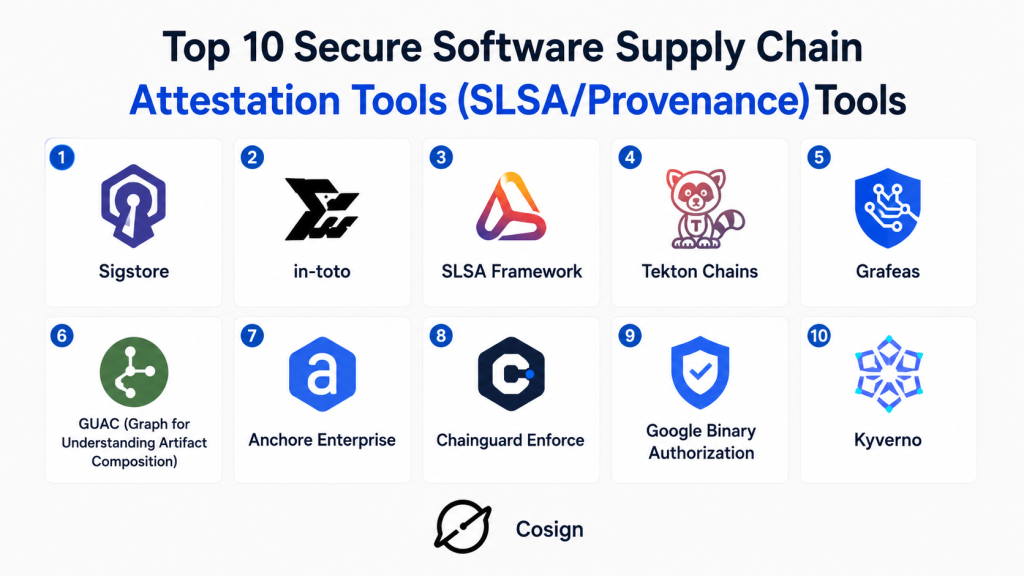
Top 10 Secure Software Supply Chain Attestation Tools (SLSA/Provenance) Tools
1. Sigstore Cosign
Short description: Cosign is a widely adopted container signing and verification tool designed for cloud-native software supply chain security. It is commonly used for signing container images, SBOMs, and provenance attestations.
Key Features
- Container image signing
- Keyless signing workflows
- OCI artifact support
- Provenance attestation generation
- Kubernetes ecosystem compatibility
- Transparency log integration
- CI/CD automation support
Pros
- Strong cloud-native adoption
- Good Kubernetes compatibility
- Simplifies artifact signing workflows
Cons
- Advanced setups may require deeper security expertise
- Some workflows depend on external ecosystem components
- Enterprise governance varies by deployment approach
Platforms / Deployment
Linux / macOS / Windows
Cloud / Self-hosted / Hybrid
Security & Compliance
Supports encryption, transparency logs, signing validation, and identity-based workflows. Formal compliance certifications are not publicly stated.
Integrations & Ecosystem
Cosign integrates strongly with cloud-native software delivery pipelines.
- Kubernetes
- OCI registries
- Tekton
- GitHub Actions
- SBOM tooling
- CI/CD systems
Support & Community
Very strong open-source community and extensive documentation.
2. in-toto
Short description: in-toto is a framework for securing software supply chains by recording and verifying every step in the software delivery process.
Key Features
- Supply chain step verification
- Provenance tracking
- Layout-based trust policies
- Build integrity validation
- Artifact metadata verification
- Secure workflow enforcement
- Extensible framework design
Pros
- Strong provenance capabilities
- Flexible trust modeling
- Good fit for regulated environments
Cons
- Requires operational planning
- Steeper learning curve
- More complex for small teams
Platforms / Deployment
Linux / macOS / Windows
Self-hosted / Hybrid
Security & Compliance
Supports signed metadata verification and supply chain integrity enforcement. Compliance certifications are not publicly stated.
Integrations & Ecosystem
Works with modern DevSecOps and secure build workflows.
- CI/CD pipelines
- Container systems
- Build systems
- Provenance verification
- Policy workflows
- Secure release automation
Support & Community
Strong security-focused community with technical documentation.
3. SLSA Framework Tooling
Short description: SLSA tooling ecosystems help organizations implement Supply-chain Levels for Software Artifacts practices across build pipelines and software delivery systems.
Key Features
- Provenance generation
- Build integrity validation
- Secure build requirements
- CI/CD security alignment
- Multi-level security maturity
- Policy guidance
- Ecosystem interoperability
Pros
- Strong industry alignment
- Useful compliance framework
- Encourages secure software delivery maturity
Cons
- Requires implementation planning
- Tooling varies across ecosystems
- Maturity depends on operational adoption
Platforms / Deployment
Varies / N/A
Cloud / Self-hosted / Hybrid
Security & Compliance
Focused on secure software supply chain standards and build integrity validation.
Integrations & Ecosystem
Works across multiple software delivery ecosystems.
- GitHub Actions
- GitLab CI
- Jenkins
- Tekton
- Kubernetes
- Artifact registries
Support & Community
Strong industry mindshare and active ecosystem participation.
4. Tekton Chains
Short description: Tekton Chains automatically generates software supply chain metadata and signed provenance for Tekton-based CI/CD pipelines.
Key Features
- Automatic provenance generation
- Kubernetes-native workflows
- Artifact signing support
- CI/CD integration
- Supply chain metadata generation
- OCI registry compatibility
- Kubernetes policy support
Pros
- Strong Kubernetes integration
- Good automation support
- Useful for cloud-native CI/CD
Cons
- Best suited for Tekton users
- Kubernetes knowledge required
- Operational setup complexity
Platforms / Deployment
Linux / Kubernetes
Cloud / Hybrid / Self-hosted
Security & Compliance
Supports signed provenance generation and secure CI/CD workflows.
Integrations & Ecosystem
Designed for Kubernetes-native delivery pipelines.
- Tekton Pipelines
- Kubernetes
- OCI registries
- Cosign
- Cloud-native CI/CD
- Policy engines
Support & Community
Active cloud-native ecosystem and strong documentation.
5. Grafeas
Short description: Grafeas is a metadata API framework used for storing and querying software supply chain metadata and security-related artifact information.
Key Features
- Metadata management
- Artifact information storage
- Supply chain visibility
- Security scanning metadata
- Provenance storage
- Extensible architecture
- API-driven workflows
Pros
- Flexible metadata framework
- Good integration potential
- Useful for centralized visibility
Cons
- Requires additional tooling for full workflows
- More infrastructure-oriented
- Setup complexity for smaller teams
Platforms / Deployment
Linux / Cloud environments
Self-hosted / Hybrid
Security & Compliance
Supports metadata validation and artifact tracking. Formal certifications are not publicly stated.
Integrations & Ecosystem
Useful for organizations centralizing software supply chain metadata.
- CI/CD systems
- Vulnerability scanners
- Artifact registries
- Kubernetes
- Policy engines
- Security tooling
Support & Community
Strong ecosystem relevance in cloud-native environments.
6. GUAC
Short description: GUAC is an open-source project focused on aggregating and analyzing software supply chain security metadata.
Key Features
- Supply chain graph analysis
- SBOM aggregation
- Provenance correlation
- Dependency visibility
- Metadata ingestion
- Security analytics support
- Open-source integration
Pros
- Strong visibility capabilities
- Good for large ecosystems
- Useful security analytics workflows
Cons
- Requires ecosystem integration work
- Operational maturity still evolving
- More suited for advanced teams
Platforms / Deployment
Linux / Cloud environments
Self-hosted / Hybrid
Security & Compliance
Focused on supply chain metadata analysis and provenance visibility.
Integrations & Ecosystem
Works well with broader software supply chain security stacks.
- SBOM systems
- CI/CD tools
- Security scanners
- Artifact repositories
- Kubernetes
- Provenance tooling
Support & Community
Growing open-source ecosystem with active security community involvement.
7. Anchore Enterprise
Short description: Anchore Enterprise provides software supply chain security capabilities including SBOM analysis, artifact verification, and policy enforcement.
Key Features
- SBOM management
- Policy enforcement
- Container security analysis
- Artifact verification
- Compliance workflows
- CI/CD integrations
- Vulnerability tracking
Pros
- Enterprise-focused workflows
- Strong policy management
- Useful compliance reporting
Cons
- Enterprise complexity
- Commercial licensing considerations
- May be excessive for smaller teams
Platforms / Deployment
Linux / Kubernetes / Cloud
Cloud / Self-hosted / Hybrid
Security & Compliance
Supports RBAC, policy enforcement, audit workflows, and enterprise security controls. Additional certifications vary by deployment model.
Integrations & Ecosystem
Strong integration with enterprise cloud-native security workflows.
- Kubernetes
- Jenkins
- GitHub Actions
- Container registries
- SBOM systems
- Vulnerability scanners
Support & Community
Commercial support with enterprise onboarding and documentation.
8. Chainguard Enforce
Short description: Chainguard Enforce helps organizations secure software supply chains using policy enforcement, signed artifacts, and trusted software delivery controls.
Key Features
- Policy enforcement
- Trusted artifact validation
- Secure container workflows
- Provenance verification
- Compliance-focused controls
- Kubernetes integrations
- Runtime validation support
Pros
- Strong security-first approach
- Good for regulated environments
- Useful enterprise governance features
Cons
- Enterprise-focused complexity
- Pricing may not suit smaller organizations
- Requires operational security maturity
Platforms / Deployment
Cloud / Kubernetes / Linux
Cloud / Hybrid
Security & Compliance
Supports enterprise-grade policy enforcement and secure artifact validation workflows.
Integrations & Ecosystem
Built for secure cloud-native delivery ecosystems.
- Kubernetes
- OCI registries
- CI/CD systems
- Policy engines
- Container workflows
- Secure deployment pipelines
Support & Community
Commercial support and enterprise-focused documentation.
9. Google Binary Authorization
Short description: Google Binary Authorization is a deployment security tool that verifies container trust policies before workloads are deployed.
Key Features
- Deployment policy enforcement
- Trusted image validation
- Kubernetes workload protection
- CI/CD integration
- Artifact verification
- Cloud-native deployment security
- Runtime deployment control
Pros
- Strong Kubernetes protection
- Useful deployment enforcement
- Good cloud-native integration
Cons
- Best suited for Google Cloud ecosystems
- Multi-cloud support may require additional planning
- Cloud dependency considerations
Platforms / Deployment
Cloud / Kubernetes
Cloud / Hybrid
Security & Compliance
Supports policy enforcement, deployment validation, and artifact trust verification.
Integrations & Ecosystem
Designed for cloud-native workload security.
- Google Kubernetes Engine
- CI/CD systems
- Artifact registries
- Container security workflows
- Cloud-native pipelines
- Deployment validation systems
Support & Community
Enterprise cloud documentation and managed platform support.
10. Kyverno
Short description: Kyverno is a Kubernetes-native policy engine that can enforce software supply chain and provenance validation policies within Kubernetes environments.
Key Features
- Kubernetes-native policy management
- Admission control policies
- Provenance validation
- Policy-as-code workflows
- YAML-based policy definitions
- Supply chain enforcement
- Cloud-native integrations
Pros
- Developer-friendly policy syntax
- Strong Kubernetes ecosystem support
- Flexible policy management
Cons
- Kubernetes-focused scope
- Requires policy management expertise
- Best suited for cloud-native teams
Platforms / Deployment
Kubernetes / Linux
Cloud / Self-hosted / Hybrid
Security & Compliance
Supports RBAC integration, policy enforcement, and Kubernetes-native governance workflows.
Integrations & Ecosystem
Strong integration with Kubernetes security ecosystems.
- Kubernetes
- OCI registries
- CI/CD pipelines
- Policy workflows
- Cloud-native security
- Admission controllers
Support & Community
Very active Kubernetes security community and strong open-source documentation.
Comparison Table
| Tool Name | Best For | Platforms Supported | Deployment | Standout Feature | Public Rating |
|---|---|---|---|---|---|
| Sigstore Cosign | Container signing | Linux, macOS, Windows | Cloud / Self-hosted / Hybrid | Keyless artifact signing | N/A |
| in-toto | Provenance verification | Linux, macOS, Windows | Self-hosted / Hybrid | Supply chain step validation | N/A |
| SLSA Framework Tooling | Secure build maturity | Varies / N/A | Cloud / Hybrid | SLSA alignment | N/A |
| Tekton Chains | Kubernetes CI/CD provenance | Linux, Kubernetes | Cloud / Hybrid | Automatic provenance generation | N/A |
| Grafeas | Metadata management | Linux, Cloud | Self-hosted / Hybrid | Supply chain metadata APIs | N/A |
| GUAC | Metadata aggregation | Linux, Cloud | Self-hosted / Hybrid | Supply chain graph visibility | N/A |
| Anchore Enterprise | Enterprise compliance | Linux, Kubernetes | Cloud / Hybrid | Policy enforcement | N/A |
| Chainguard Enforce | Secure deployment governance | Cloud, Kubernetes | Cloud / Hybrid | Trusted artifact validation | N/A |
| Google Binary Authorization | Deployment validation | Cloud, Kubernetes | Cloud | Runtime deployment enforcement | N/A |
| Kyverno | Kubernetes policy enforcement | Kubernetes, Linux | Cloud / Hybrid | Kubernetes-native policies | N/A |
Evaluation & Scoring of Secure Software Supply Chain Attestation Tools (SLSA/Provenance)
| Tool Name | Core (25%) | Ease (15%) | Integrations (15%) | Security (10%) | Performance (10%) | Support (10%) | Value (15%) | Weighted Total |
|---|---|---|---|---|---|---|---|---|
| Sigstore Cosign | 9 | 8 | 9 | 9 | 9 | 9 | 9 | 8.9 |
| in-toto | 9 | 6 | 8 | 9 | 8 | 8 | 8 | 8.0 |
| SLSA Framework Tooling | 8 | 6 | 8 | 9 | 8 | 8 | 8 | 7.9 |
| Tekton Chains | 8 | 7 | 9 | 8 | 8 | 8 | 8 | 8.0 |
| Grafeas | 7 | 6 | 8 | 8 | 8 | 7 | 8 | 7.4 |
| GUAC | 8 | 6 | 8 | 8 | 8 | 7 | 8 | 7.6 |
| Anchore Enterprise | 9 | 7 | 8 | 9 | 8 | 9 | 7 | 8.1 |
| Chainguard Enforce | 9 | 7 | 8 | 9 | 9 | 8 | 7 | 8.2 |
| Google Binary Authorization | 8 | 8 | 8 | 9 | 8 | 8 | 7 | 8.0 |
| Kyverno | 8 | 8 | 9 | 8 | 8 | 9 | 9 | 8.4 |
These scores are comparative and designed to help organizations evaluate tools based on practical operational needs. Some tools focus more on artifact signing, while others specialize in policy enforcement, provenance generation, or metadata analysis. The best tool depends on deployment environment, CI/CD maturity, Kubernetes adoption, and security governance requirements.
Which Secure Software Supply Chain Attestation Tools (SLSA/Provenance) Tool Is Right for You?
Solo / Freelancer
Cosign and Kyverno are good starting points for developers and small teams looking for lightweight signing and policy workflows.
SMB
Tekton Chains and Cosign work well for SMB organizations adopting cloud-native CI/CD pipelines.
Mid-Market
Anchore Enterprise, Kyverno, and in-toto provide stronger governance and compliance-focused workflows.
Enterprise
Chainguard Enforce, Anchore Enterprise, and Google Binary Authorization are strong choices for regulated environments and large-scale cloud-native deployments.
Budget vs Premium
Open-source tools like Cosign, Kyverno, and in-toto offer strong value, while enterprise platforms provide advanced governance and managed support.
Feature Depth vs Ease of Use
Cosign and Kyverno are easier for many teams to adopt, while in-toto and GUAC provide deeper security visibility and provenance capabilities.
Integrations & Scalability
Tekton Chains and Kyverno are strong for Kubernetes-native scalability and CI/CD integration.
Security & Compliance Needs
Chainguard Enforce, Anchore Enterprise, and in-toto are stronger choices for organizations prioritizing strict compliance and software integrity validation.
Frequently Asked Questions (FAQs)
1. What are software supply chain attestation tools?
These tools help verify how software artifacts were built, signed, and delivered throughout the software development lifecycle.
2. What is SLSA?
SLSA stands for Supply-chain Levels for Software Artifacts. It is a framework for improving software build integrity and provenance security.
3. Why are provenance records important?
Provenance records help organizations verify build sources, dependencies, and CI/CD processes to reduce software tampering risks.
4. What is artifact signing?
Artifact signing validates that software packages or container images were created by trusted sources and were not modified unexpectedly.
5. Which tool is best for Kubernetes-native environments?
Kyverno, Tekton Chains, and Cosign are strong choices for Kubernetes-focused software supply chain security workflows.
6. Can these tools integrate with CI/CD pipelines?
Yes, most modern attestation tools support Jenkins, GitHub Actions, GitLab CI, Tekton, and other CI/CD systems.
7. Are these tools suitable for compliance requirements?
Many organizations use these tools to support audit readiness, build traceability, and software integrity controls.
8. Do small teams need supply chain attestation tools?
Smaller teams with simple deployments may not need advanced attestation workflows initially, but adoption becomes more valuable as systems scale.
9. What is the difference between SBOMs and provenance?
SBOMs describe software components and dependencies, while provenance focuses on how the software was built and delivered.
10. What are common implementation challenges?
Common challenges include CI/CD integration complexity, policy management, developer onboarding, and operational governance.
Conclusion
Secure Software Supply Chain Attestation Tools are becoming essential for organizations that want stronger software integrity, build transparency, provenance validation, and deployment security. Different tools focus on different parts of the software delivery lifecycle. Cosign simplifies artifact signing, in-toto focuses on provenance verification, Tekton Chains automates cloud-native attestations, Kyverno enforces Kubernetes-native policies, and enterprise platforms like Anchore Enterprise and Chainguard Enforce provide governance-focused workflows.
The best choice depends on deployment environment, compliance requirements, CI/CD maturity, Kubernetes adoption, and operational security goals. Organizations should begin with a small pilot project, validate integrations, test provenance workflows, and gradually expand supply chain security practices across their development ecosystem.
