Introduction
Contact Management Software helps businesses store, organize, update, and manage customer, lead, partner, vendor, and team contact information in one place. Instead of keeping contact details in spreadsheets, email inboxes, phones, or scattered notes, these tools create a cleaner system for tracking names, emails, phone numbers, companies, communication history, tasks, notes, and relationship activity.
Contact management matters because businesses now depend on fast follow-ups, personalized communication, clean customer data, and smooth team collaboration. A good tool helps sales, marketing, support, operations, and leadership teams understand who they are speaking with, what was discussed earlier, and what action should happen next.
Common use cases include sales pipeline tracking, customer follow-up, lead management, email outreach, account management, partner records, support handoffs, and team collaboration.
Buyers should evaluate:
- Ease of use
- Contact storage and search
- Lead and deal management
- Email and calendar integration
- Automation features
- Mobile access
- Data import and export
- Security controls
- Reporting and dashboards
- Pricing and scalability
Best for: sales teams, founders, consultants, agencies, SMBs, customer success teams, recruiters, real estate teams, service businesses, and growing enterprises.
Not ideal for: users who only need a personal address book or very small teams with no sales, follow-up, or customer relationship workflow.
Key Trends in Contact Management Software
- AI-assisted contact insights are becoming more useful for summarizing conversations, suggesting next steps, and identifying relationship opportunities.
- Contact enrichment helps teams improve incomplete contact records with better company, role, and activity information.
- Automation-first workflows reduce manual data entry, follow-up reminders, task creation, and lead assignment.
- CRM and contact management are merging as many tools now include pipeline management, email tracking, notes, tasks, and reporting.
- Privacy and consent management are becoming more important because contact records often include sensitive customer and business data.
- Mobile contact management is important for field sales, consultants, real estate teams, and customer-facing professionals.
- Integration with email and calendar tools is now a core requirement for practical contact tracking.
- Data quality controls such as deduplication, tagging, segmentation, and search are becoming more important.
- Team collaboration features help avoid duplicate outreach and improve customer handoffs.
- Flexible pricing models allow solo users, SMBs, and enterprises to choose tools based on growth stage.
How We Selected These Tools
The tools in this list were selected based on practical usefulness, market recognition, contact management depth, and business fit across different company sizes.
Selection factors include:
- Strong adoption among sales, marketing, support, and business teams
- Core contact management features such as profiles, notes, tags, history, and search
- Lead and pipeline management capabilities
- Ease of onboarding for non-technical users
- Integration with email, calendar, communication, and productivity tools
- Security and admin controls for business use
- Reporting and visibility into customer activity
- Scalability for solo users, SMBs, mid-market companies, and enterprises
- Support quality, documentation, and training resources
- Overall value compared with feature depth
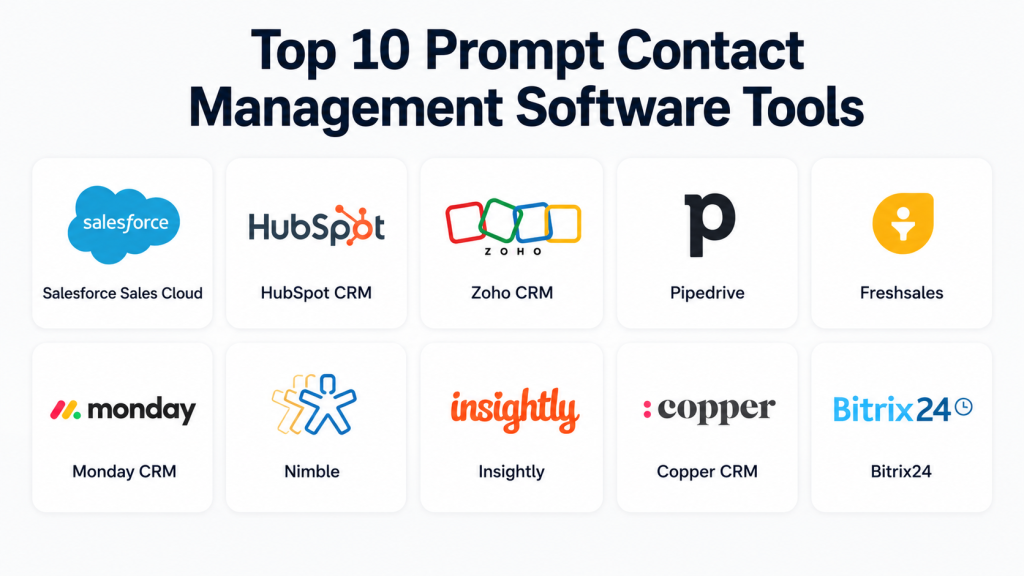
Top 10 Contact Management Software Tools
1. HubSpot CRM
Short description:
HubSpot CRM is a widely used customer relationship and contact management platform for sales, marketing, service, and operations teams. It is suitable for startups, SMBs, and growing businesses that need a simple but scalable contact database.
Key Features
- Centralized contact and company records
- Deal and pipeline tracking
- Email tracking and templates
- Task and activity management
- Contact segmentation
- Marketing and sales automation
- Reporting dashboards
Pros
- Easy to start and beginner-friendly
- Strong free and paid CRM ecosystem
- Good for sales and marketing alignment
Cons
- Advanced features can become costly
- Large setups may need careful configuration
- Some reporting depth depends on plan
Platforms / Deployment
Web, iOS, Android
Cloud
Security & Compliance
MFA, role-based access, permissions, encryption, and admin controls are available. Some security and compliance features depend on plan.
Integrations & Ecosystem
HubSpot has a large ecosystem and connects well with business, sales, marketing, and support tools.
- Email tools
- Calendar tools
- Marketing platforms
- Customer support tools
- Sales automation tools
- Reporting and analytics tools
Support & Community
HubSpot provides strong documentation, learning resources, onboarding support, and a large user community. Support levels vary by plan.
2. Salesforce Sales Cloud
Short description:
Salesforce Sales Cloud is an enterprise-grade CRM and contact management platform built for sales teams, account managers, and large organizations. It is best for companies that need deep customization, automation, and reporting.
Key Features
- Contact, lead, account, and opportunity management
- Advanced sales pipeline tracking
- Workflow automation
- Custom fields and objects
- Reporting and dashboards
- Role-based access controls
- Large integration marketplace
Pros
- Highly scalable for enterprise teams
- Strong customization options
- Deep reporting and workflow capabilities
Cons
- Can be complex to implement
- Requires admin expertise for best results
- May be expensive for small teams
Platforms / Deployment
Web, iOS, Android
Cloud
Security & Compliance
SSO, MFA, encryption, audit logs, role-based access, and enterprise-grade admin controls are available. Compliance features vary by edition and configuration.
Integrations & Ecosystem
Salesforce has one of the strongest ecosystems in CRM and contact management.
- Email and calendar tools
- Marketing automation platforms
- Customer support tools
- ERP systems
- Analytics tools
- Custom apps and APIs
Support & Community
Salesforce has extensive documentation, training resources, partner support, and a large global community. Support levels depend on the selected plan.
3. Zoho CRM
Short description:
Zoho CRM is a flexible contact management and CRM platform for SMBs, startups, and growing teams. It is useful for businesses that want contact records, sales automation, workflows, and reporting at a practical price point.
Key Features
- Contact, lead, and account management
- Sales pipeline tracking
- Workflow automation
- Email and telephony integrations
- AI-powered sales assistant features
- Custom modules and fields
- Reports and dashboards
Pros
- Good value for SMBs
- Strong feature set for the price
- Works well with the Zoho ecosystem
Cons
- Interface can feel dense for new users
- Advanced setup may require time
- Best value comes when using other Zoho tools
Platforms / Deployment
Web, iOS, Android
Cloud
Security & Compliance
MFA, role-based permissions, data encryption, and admin controls are available. Compliance details vary by plan and region.
Integrations & Ecosystem
Zoho CRM connects strongly with Zoho’s own business apps and many third-party tools.
- Zoho Mail
- Zoho Campaigns
- Zoho Desk
- Accounting tools
- Telephony tools
- Email and calendar apps
Support & Community
Zoho provides documentation, support plans, user forums, and onboarding resources. Support quality may vary by plan.
4. Pipedrive
Short description:
Pipedrive is a sales-focused CRM and contact management tool designed for small and mid-sized sales teams. It is best for teams that want a visual pipeline, simple follow-up tracking, and easy deal management.
Key Features
- Contact and organization records
- Visual sales pipeline
- Deal tracking
- Email sync and activity tracking
- Task and reminder management
- Sales reporting
- Workflow automation
Pros
- Very easy for sales teams to use
- Strong visual pipeline experience
- Good for activity-based selling
Cons
- Less broad than enterprise CRM suites
- Marketing features are more limited
- Advanced reporting depends on plan
Platforms / Deployment
Web, iOS, Android
Cloud
Security & Compliance
MFA, permissions, encryption, and admin controls are available. Some compliance and advanced security options vary by plan.
Integrations & Ecosystem
Pipedrive integrates well with sales productivity and communication tools.
- Email platforms
- Calendar tools
- Calling tools
- Lead generation tools
- Marketing automation tools
- Reporting tools
Support & Community
Pipedrive offers documentation, support resources, onboarding content, and a useful knowledge base. Support levels vary by plan.
5. Freshsales
Short description:
Freshsales is a CRM and contact management tool from Freshworks. It is useful for sales teams that need contact records, pipeline management, built-in communication, automation, and customer context.
Key Features
- Contact, account, and lead management
- Sales pipeline tracking
- Built-in phone and email features
- AI-based lead scoring features
- Workflow automation
- Reports and dashboards
- Mobile CRM access
Pros
- Good balance of CRM and communication tools
- Useful for growing sales teams
- Works well with Freshworks products
Cons
- Advanced features may depend on higher plans
- Some customization may require setup effort
- Best fit is for teams already open to Freshworks ecosystem
Platforms / Deployment
Web, iOS, Android
Cloud
Security & Compliance
MFA, role-based access, encryption, and admin controls are available. Specific compliance details vary by plan and product configuration.
Integrations & Ecosystem
Freshsales connects well with Freshworks tools and common business systems.
- Freshdesk
- Email tools
- Calendar tools
- Telephony tools
- Marketing tools
- Workflow automation tools
Support & Community
Freshworks provides documentation, support resources, and onboarding help. Support levels vary by plan.
6. monday CRM
Short description:
monday CRM is a flexible sales CRM built on monday.com’s work management platform. It is useful for teams that want contact management, pipeline tracking, collaboration, and customizable workflows in one visual workspace.
Key Features
- Contact and lead management
- Custom sales pipelines
- Workflow automation
- Team collaboration boards
- Email tracking and templates
- Dashboards and reporting
- Custom fields and views
Pros
- Highly visual and flexible
- Good for teams that need workflow customization
- Strong collaboration features
Cons
- May require setup to match CRM needs
- Not as traditional as some CRM platforms
- Advanced features depend on plan
Platforms / Deployment
Web, iOS, Android
Cloud
Security & Compliance
MFA, SSO on selected plans, permissions, audit-related controls, and admin features are available. Compliance details vary by plan.
Integrations & Ecosystem
monday CRM connects with productivity, sales, communication, and automation tools.
- Email tools
- Calendar tools
- Slack
- Microsoft Teams
- Marketing tools
- Workflow automation apps
Support & Community
monday.com provides strong documentation, templates, onboarding resources, and support options based on plan.
7. Copper
Short description:
Copper is a contact management and CRM tool designed strongly around Google Workspace users. It is best for teams that want CRM records connected closely with Gmail, Google Calendar, and Google Drive.
Key Features
- Contact and company management
- Gmail integration
- Google Calendar integration
- Pipeline and opportunity tracking
- Task management
- Activity tracking
- Reporting dashboards
Pros
- Strong fit for Google Workspace teams
- Simple contact tracking inside daily workflows
- Good for relationship-driven sales
Cons
- Less ideal for Microsoft-focused teams
- Advanced features may require paid plans
- Smaller ecosystem than larger CRM platforms
Platforms / Deployment
Web, iOS, Android
Cloud
Security & Compliance
MFA, permissions, and admin controls are available. Specific compliance details should be validated based on plan.
Integrations & Ecosystem
Copper is designed around Google Workspace workflows.
- Gmail
- Google Calendar
- Google Drive
- Google Sheets
- Email productivity tools
- Business workflow tools
Support & Community
Copper provides documentation, onboarding resources, and support options. Support level varies by subscription.
8. Insightly
Short description:
Insightly is a CRM and contact management platform that combines sales tracking, relationship management, and project visibility. It is useful for businesses that manage both customer relationships and post-sale projects.
Key Features
- Contact and organization management
- Lead and opportunity tracking
- Project management features
- Workflow automation
- Email integration
- Reporting and dashboards
- Custom objects and fields
Pros
- Good mix of CRM and project tracking
- Useful for service-based businesses
- Strong for relationship and delivery workflows
Cons
- Interface may require learning time
- Advanced features may depend on plan
- Not always the simplest option for very small teams
Platforms / Deployment
Web, iOS, Android
Cloud
Security & Compliance
Role-based permissions, data protection controls, and admin features are available. Specific compliance details vary by plan.
Integrations & Ecosystem
Insightly supports CRM, productivity, and project-focused workflows.
- Email tools
- Calendar tools
- Project tools
- Accounting tools
- Marketing apps
- Workflow automation tools
Support & Community
Insightly provides help documentation, onboarding resources, and support plans. Community depth is moderate compared with larger CRM platforms.
9. Nimble
Short description:
Nimble is a relationship-focused contact management platform for small businesses, consultants, salespeople, and professionals. It helps users manage contacts, social context, communication history, and follow-ups.
Key Features
- Contact and relationship management
- Social profile insights
- Email and calendar sync
- Contact enrichment
- Task and activity tracking
- Pipeline management
- Browser extension support
Pros
- Strong relationship-focused contact views
- Good for consultants and small teams
- Useful for social and email-based networking
Cons
- Not as deep as large enterprise CRMs
- Some enrichment features may depend on data availability
- Less suited for complex enterprise sales processes
Platforms / Deployment
Web, iOS, Android
Cloud
Security & Compliance
Basic account security and access controls are available. Advanced compliance details are not publicly stated.
Integrations & Ecosystem
Nimble works well with communication and productivity tools.
- Email tools
- Calendar tools
- Social platforms
- Browser extensions
- Office productivity tools
- Sales workflow tools
Support & Community
Nimble provides documentation, onboarding help, and support resources. Community strength is moderate.
10. Keap
Short description:
Keap is a CRM and contact management platform for small businesses that need contact records, automation, follow-up workflows, and sales support. It is especially useful for service providers, consultants, and small teams.
Key Features
- Contact management
- Lead capture
- Sales pipeline tracking
- Email marketing automation
- Follow-up reminders
- Appointment and payment support
- Customer activity history
Pros
- Strong automation for small businesses
- Good for service-based workflows
- Helps reduce manual follow-up work
Cons
- May be more than needed for simple contact storage
- Setup can take time for automation workflows
- Pricing may not fit very small teams
Platforms / Deployment
Web, iOS, Android
Cloud
Security & Compliance
Account security, user permissions, and data protection controls are available. Specific compliance details vary and should be validated before use in regulated industries.
Integrations & Ecosystem
Keap connects contact management with sales, marketing, and small business operations.
- Email marketing tools
- Payment tools
- Appointment tools
- Lead capture forms
- Sales workflow tools
- Business automation apps
Support & Community
Keap provides onboarding resources, documentation, coaching options, and support plans. Support level varies by subscription.
Comparison Table
| Tool Name | Best For | Platform(s) Supported | Deployment | Standout Feature | Public Rating |
|---|---|---|---|---|---|
| HubSpot CRM | Startups, SMBs, sales and marketing teams | Web, iOS, Android | Cloud | Simple CRM with strong ecosystem | N/A |
| Salesforce Sales Cloud | Enterprise sales and account teams | Web, iOS, Android | Cloud | Deep customization and scalability | N/A |
| Zoho CRM | SMBs and growing teams | Web, iOS, Android | Cloud | Strong value with broad features | N/A |
| Pipedrive | Sales-focused teams | Web, iOS, Android | Cloud | Visual sales pipeline | N/A |
| Freshsales | Sales teams needing built-in communication | Web, iOS, Android | Cloud | CRM with phone, email, and automation | N/A |
| monday CRM | Teams needing flexible workflows | Web, iOS, Android | Cloud | Visual and customizable CRM boards | N/A |
| Copper | Google Workspace users | Web, iOS, Android | Cloud | Gmail and Google Workspace integration | N/A |
| Insightly | Service businesses and project-based teams | Web, iOS, Android | Cloud | CRM plus project visibility | N/A |
| Nimble | Consultants and relationship-focused teams | Web, iOS, Android | Cloud | Social and relationship insights | N/A |
| Keap | Small businesses needing automation | Web, iOS, Android | Cloud | Contact management with follow-up automation | N/A |
Evaluation & Scoring of Contact Management Software
| Tool Name | Core (25%) | Ease (15%) | Integrations (15%) | Security (10%) | Performance (10%) | Support (10%) | Value (15%) | Weighted Total |
|---|---|---|---|---|---|---|---|---|
| HubSpot CRM | 9 | 9 | 9 | 8 | 9 | 9 | 8 | 8.75 |
| Salesforce Sales Cloud | 10 | 7 | 10 | 9 | 9 | 9 | 7 | 8.85 |
| Zoho CRM | 9 | 8 | 8 | 8 | 8 | 8 | 9 | 8.35 |
| Pipedrive | 8 | 9 | 8 | 8 | 8 | 8 | 8 | 8.15 |
| Freshsales | 8 | 8 | 8 | 8 | 8 | 8 | 8 | 8.00 |
| monday CRM | 8 | 8 | 8 | 8 | 8 | 8 | 8 | 8.00 |
| Copper | 8 | 8 | 8 | 7 | 8 | 7 | 7 | 7.65 |
| Insightly | 8 | 7 | 7 | 8 | 8 | 7 | 7 | 7.45 |
| Nimble | 7 | 8 | 7 | 7 | 8 | 7 | 8 | 7.40 |
| Keap | 8 | 7 | 7 | 7 | 8 | 8 | 7 | 7.45 |
These scores are comparative and should be used as a shortlist guide, not as a universal ranking. A high score means the tool is strong across multiple evaluation areas, but the best choice depends on your team size, workflow, budget, and integration needs. For example, Salesforce is powerful for enterprises, while HubSpot, Zoho CRM, Pipedrive, and Keap may be more practical for smaller teams. Always test the tool with real contact records and daily follow-up workflows before final selection.
Which Contact Management Software Tool Is Right for You?
Solo / Freelancer
Solo professionals should choose software that is easy to use, affordable, and simple to maintain. HubSpot CRM, Nimble, Pipedrive, and Zoho CRM are strong choices for freelancers, consultants, coaches, and independent sales professionals.
If the main need is managing relationships and follow-ups, Nimble is helpful. If the need is simple CRM with future growth, HubSpot CRM or Zoho CRM may be better.
SMB
Small and mid-sized businesses should look for contact records, pipelines, follow-up reminders, email integration, task tracking, and reporting. HubSpot CRM, Zoho CRM, Pipedrive, Freshsales, monday CRM, and Keap are strong options.
Service-based SMBs may prefer Keap for automation and customer follow-up. Sales-focused SMBs may prefer Pipedrive for pipeline visibility.
Mid-Market
Mid-market teams need better reporting, automation, permissions, integrations, and data quality. HubSpot CRM, Zoho CRM, Freshsales, monday CRM, Insightly, and Salesforce Sales Cloud can fit depending on complexity.
If the business needs sales and marketing alignment, HubSpot CRM is strong. If it needs customization and deeper process control, Salesforce or Zoho CRM may be better.
Enterprise
Enterprises usually need advanced security, role-based access, reporting, workflow automation, governance, and integration with multiple systems. Salesforce Sales Cloud is one of the strongest choices for large enterprise sales operations.
HubSpot CRM can also work well for enterprise teams that want strong usability and marketing-sales alignment. Microsoft or Google ecosystem preference may influence integration decisions.
Budget vs Premium
Budget-focused teams may prefer HubSpot CRM, Zoho CRM, Pipedrive, or Nimble. These tools can support practical contact management without requiring heavy implementation.
Premium buyers may prefer Salesforce Sales Cloud, HubSpot CRM advanced plans, or monday CRM higher tiers if they need deeper customization, automation, governance, and reporting.
Feature Depth vs Ease of Use
If ease of use matters most, HubSpot CRM, Pipedrive, Nimble, and monday CRM are strong choices. They are easier for non-technical teams to adopt.
If feature depth matters more, Salesforce Sales Cloud, Zoho CRM, and HubSpot CRM offer stronger long-term CRM capabilities.
Integrations & Scalability
For broad integrations and scalability, Salesforce Sales Cloud, HubSpot CRM, and Zoho CRM are strong options. These tools can connect with sales, marketing, service, analytics, and workflow systems.
For Google Workspace users, Copper is a practical choice because it fits naturally into Gmail and Google Calendar workflows.
Security & Compliance Needs
Teams with strict security needs should evaluate SSO, MFA, encryption, permissions, audit logs, data export, backup options, and compliance documentation.
Salesforce Sales Cloud, HubSpot CRM, Zoho CRM, and Freshsales offer strong business security features, but buyers should verify exact controls based on plan and region.
Frequently Asked Questions
1. What is contact management software?
Contact management software is a tool used to store and organize customer, lead, partner, and business contact details. It helps teams manage communication history, notes, tasks, and follow-ups in one place.
2. How is contact management software different from CRM?
Contact management focuses mainly on storing and managing contact records. CRM usually includes contact management plus sales pipelines, automation, reporting, marketing, and customer relationship workflows.
3. Who should use contact management software?
Sales teams, consultants, agencies, SMBs, recruiters, support teams, founders, and service businesses can benefit from contact management software. It is useful for anyone who manages many business relationships.
4. What features are most important in contact management software?
Important features include contact records, search, tagging, notes, activity history, email integration, reminders, task management, reporting, mobile access, and data import/export.
5. Is free contact management software enough?
Free tools may be enough for individuals or very small teams. Paid plans are useful when teams need automation, reporting, permissions, integrations, and advanced sales workflows.
6. What are common mistakes when choosing contact management software?
Common mistakes include choosing a tool that is too complex, ignoring data cleanup, skipping integration checks, and not training users properly. Poor setup can lead to messy contact records.
7. Is contact management software secure?
Most leading tools provide basic security features such as login protection, encryption, permissions, and admin controls. Businesses should verify MFA, SSO, audit logs, and compliance needs before purchase.
8. Can contact management software scale with business growth?
Yes, many tools can scale from solo use to larger teams. However, businesses should review user roles, automation limits, reporting depth, storage, integrations, and pricing before scaling.
9. What integrations should I look for?
Useful integrations include email, calendar, CRM, marketing automation, customer support, calling, messaging, accounting, analytics, and workflow automation tools.
10. How difficult is it to switch contact management software?
Switching can be simple for small teams but more complex for larger businesses. The main work includes data export, deduplication, field mapping, user training, and integration setup.
Conclusion
Contact Management Software helps businesses manage customer and business relationships in a more organized, reliable, and professional way. The best tool depends on your company size, workflow, budget, sales process, integration needs, and security expectations. HubSpot CRM is a strong all-round option for many growing teams. Salesforce Sales Cloud is powerful for enterprises. Zoho CRM offers strong value for SMBs. Pipedrive is simple and sales-focused. Freshsales, monday CRM, Copper, Insightly, Nimble, and Keap each serve different business needs.
The right decision should not be based only on feature lists. Start by defining your contact management process, shortlist two or three tools, import sample data, test real follow-up workflows, review integrations, and validate security controls before choosing the final platform. This approach helps you select a tool that supports daily work instead of creating extra complexity.
