Introduction
Remote Patient Monitoring RPM Platforms are digital healthcare solutions that help providers monitor patients outside traditional clinical settings. These platforms collect health data from connected devices such as blood pressure monitors, glucose meters, pulse oximeters, weight scales, ECG devices, and wearable sensors. The goal is to help care teams track patient health continuously, identify risks early, and support better long-term care management.
RPM platforms are especially useful for chronic disease management, post-discharge monitoring, senior care, cardiac care, diabetes management, hypertension tracking, and value-based care programs. A strong RPM platform should combine device connectivity, patient engagement, clinical alerts, care team dashboards, reporting, and secure data management. Choosing the right RPM solution depends on clinical use case, device support, workflow fit, patient usability, integration capability, compliance needs, and scalability.
Key Trends in Remote Patient Monitoring RPM Platforms
- Growing use of connected medical devices for home-based care
- Strong focus on chronic disease management and preventive care
- Integration with EHR, telehealth, and care management systems
- AI-assisted alerts for early risk detection
- Expansion of RPM into cardiac, diabetes, respiratory, and senior care
- Better mobile apps for patient engagement and adherence
- Automated care team dashboards and escalation workflows
- Increased use of RPM for post-discharge and hospital-at-home programs
- Stronger security and privacy controls for patient-generated health data
- More demand for scalable RPM programs across multi-location healthcare groups
How We Selected These Tools
- Remote monitoring and device connectivity features
- Ease of use for patients and care teams
- Clinical dashboard and alerting capabilities
- Support for chronic condition monitoring
- Integration with EHR and healthcare workflows
- Reporting, analytics, and care plan support
- Scalability for clinics, hospitals, and provider networks
- Security, privacy, and access control features
- Patient engagement and communication tools
- Overall value for healthcare organizations
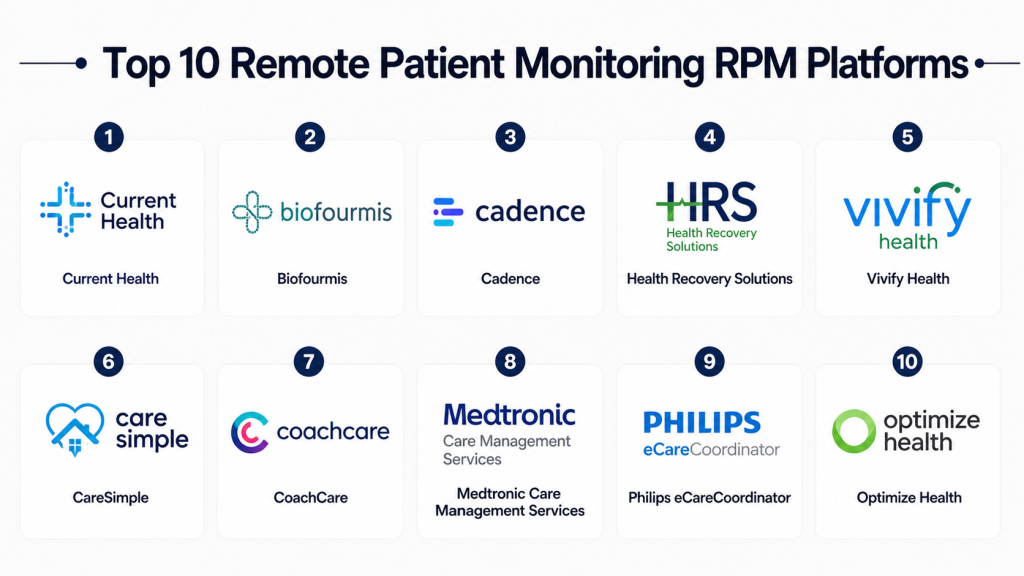
Top 10 Remote Patient Monitoring RPM Platforms
#1 — Medtronic Care Management Services
Short description: Medtronic Care Management Services provides remote monitoring capabilities for healthcare organizations managing patients with chronic and complex conditions. The platform supports connected care workflows and helps care teams monitor patient health data outside the clinic. It is especially relevant for organizations focused on chronic disease programs and high-risk patient populations. The system can support clinical decision-making by giving providers visibility into patient trends. It is best suited for hospitals, health systems, and care programs that need reliable medical device expertise. Its strength comes from Medtronic’s deep background in healthcare technology and patient monitoring.
Key Features
- Remote patient monitoring workflows
- Chronic condition monitoring support
- Connected health data collection
- Care team visibility
- Clinical alerts and trend tracking
- Patient engagement support
- Healthcare program management tools
Pros
- Strong medical technology background
- Suitable for chronic disease monitoring
- Useful for large care programs
Cons
- May be complex for small practices
- Implementation may require planning
- Pricing details may vary
Platforms / Deployment
Cloud and connected care deployment options may vary by program.
Security & Compliance
Healthcare-grade security features are commonly supported, but exact details may vary by implementation.
Integrations & Ecosystem
Can support healthcare monitoring workflows, clinical programs, connected devices, and care team dashboards depending on configuration.
Support & Community
Enterprise and healthcare program support may vary by contract.
#2 — Philips Remote Patient Monitoring
Short description: Philips Remote Patient Monitoring supports care teams in monitoring patients at home and across care settings. It is designed for healthcare organizations that need clinical-grade monitoring, patient engagement, and care coordination. The platform can support chronic disease programs, post-acute care, and hospital-at-home models. It helps providers track patient data, identify changes, and intervene when needed. Philips is a strong choice for hospitals and health systems seeking connected care solutions. It is best suited for organizations that need scalable remote care infrastructure.
Key Features
- Home health monitoring
- Connected device support
- Clinical dashboards
- Patient engagement tools
- Care coordination workflows
- Alerting and trend tracking
- Support for chronic care programs
Pros
- Strong healthcare technology ecosystem
- Good fit for hospitals and health systems
- Supports connected care models
Cons
- May be expensive for smaller providers
- Setup depends on care model
- Advanced configuration may require support
Platforms / Deployment
Cloud and healthcare deployment models vary by solution.
Security & Compliance
Healthcare security controls are available, but exact compliance details depend on deployment.
Integrations & Ecosystem
Can integrate with clinical workflows, connected care programs, monitoring devices, and healthcare systems.
Support & Community
Support availability depends on product package and implementation scope.
#3 — Current Health
Short description: Current Health is a remote patient monitoring and care-at-home platform designed for hospitals and healthcare systems. It supports continuous monitoring, virtual care, and care coordination for patients outside hospital walls. The platform is useful for hospital-at-home, post-discharge, and chronic condition monitoring programs. It helps providers collect patient data and manage care workflows remotely. Current Health is best suited for organizations building advanced home-based care models. It provides strong support for clinical monitoring and patient-centered care delivery.
Key Features
- Continuous patient monitoring
- Care-at-home support
- Clinical dashboards
- Patient data collection
- Alerting workflows
- Virtual care support
- Post-discharge monitoring
Pros
- Strong for hospital-at-home programs
- Supports continuous monitoring
- Useful for advanced care teams
Cons
- Better suited for larger organizations
- Requires workflow planning
- May need clinical integration setup
Platforms / Deployment
Cloud-based connected care platform.
Security & Compliance
Healthcare security features are available, but specific details may vary by deployment.
Integrations & Ecosystem
Supports connected devices, clinical dashboards, virtual care workflows, and care team coordination.
Support & Community
Vendor support is available depending on contract and implementation.
#4 — Biofourmis
Short description: Biofourmis is a digital health and remote monitoring platform focused on personalized care, predictive analytics, and virtual care programs. It supports monitoring for chronic disease, post-acute care, and complex care pathways. The platform uses data-driven insights to help care teams detect health changes and personalize interventions. Biofourmis is useful for organizations that want advanced analytics along with RPM capabilities. It can support clinical programs that require continuous visibility into patient condition. It is best for healthcare teams focused on predictive and proactive care.
Key Features
- Remote monitoring
- Predictive analytics
- Digital biomarkers
- Personalized care workflows
- Patient engagement tools
- Clinical alerts
- Chronic care support
Pros
- Strong analytics capabilities
- Suitable for proactive care models
- Useful for complex patient monitoring
Cons
- May require advanced implementation
- Best suited for structured programs
- Pricing may vary by solution scope
Platforms / Deployment
Cloud-based digital health platform.
Security & Compliance
Healthcare data protection features are available, but exact details depend on implementation.
Integrations & Ecosystem
Supports connected devices, analytics workflows, patient monitoring, care coordination, and virtual care programs.
Support & Community
Vendor support availability depends on customer agreement.
#5 — Health Recovery Solutions
Short description: Health Recovery Solutions is a remote patient monitoring platform designed for care management, chronic disease monitoring, and patient engagement. It helps providers monitor patients at home using connected devices and care team dashboards. The platform supports communication, education, alerts, and clinical workflows. It is useful for hospitals, home health agencies, and provider groups managing high-risk patients. Health Recovery Solutions is especially practical for organizations that need a structured RPM program. It is best for care teams that want strong patient engagement and monitoring in one platform.
Key Features
- Connected device monitoring
- Care team dashboards
- Patient education
- Clinical alerts
- Communication tools
- Chronic care workflows
- Reporting and analytics
Pros
- Strong patient engagement features
- Good for home health and chronic care
- Practical RPM workflow support
Cons
- Device program setup may require planning
- Integration needs should be reviewed
- Best suited for structured care programs
Platforms / Deployment
Cloud-based RPM platform.
Security & Compliance
Healthcare security features are available, but exact details vary by implementation.
Integrations & Ecosystem
Supports RPM devices, care team dashboards, patient communication, education, and healthcare workflows.
Support & Community
Vendor support is available based on plan and deployment.
#6 — Vivify Health
Short description: Vivify Health is a remote patient monitoring platform designed to support connected care, chronic disease management, and virtual care workflows. It helps providers collect patient health data remotely and monitor trends through dashboards. The platform supports patient engagement, communication, and care plan management. It is useful for healthcare organizations managing long-term patient populations. Vivify Health is suitable for hospitals, health systems, and provider networks. It is best for organizations that want flexible RPM and virtual care capabilities.
Key Features
- Remote patient monitoring
- Connected device support
- Patient engagement tools
- Care plan workflows
- Clinical dashboards
- Alerts and notifications
- Virtual care support
Pros
- Strong RPM and virtual care focus
- Suitable for chronic care programs
- Scalable for provider networks
Cons
- May require implementation support
- Advanced workflows may need configuration
- Cost depends on program size
Platforms / Deployment
Cloud-based connected care platform.
Security & Compliance
Healthcare security controls are available, but exact details may vary.
Integrations & Ecosystem
Supports device connectivity, patient engagement, care coordination, virtual care, and clinical monitoring workflows.
Support & Community
Vendor support availability depends on deployment model.
#7 — Optimize Health
Short description: Optimize Health is a remote patient monitoring platform built for healthcare providers managing chronic care and virtual monitoring programs. It supports connected devices, patient data tracking, clinical alerts, and care team workflows. The platform helps practices launch and manage RPM programs with structured monitoring and reporting. It is useful for provider groups and clinics that want a practical RPM solution. Optimize Health is a good fit for organizations that need operational simplicity with clinical visibility. It is best for outpatient providers and chronic care programs.
Key Features
- Connected device monitoring
- Clinical alerts
- Patient health tracking
- Care team dashboard
- Chronic care workflows
- Reporting tools
- Patient communication support
Pros
- Good for outpatient RPM programs
- Practical and workflow-focused
- Useful for chronic disease management
Cons
- May not suit very complex hospital-at-home programs
- Device support should be reviewed
- Integration depth may vary
Platforms / Deployment
Cloud-based.
Security & Compliance
Healthcare security features are available, but exact details are not publicly stated for all deployments.
Integrations & Ecosystem
Supports RPM devices, patient data workflows, care team dashboards, and reporting.
Support & Community
Vendor support is available depending on customer plan.
#8 — 100Plus
Short description: 100Plus is a remote patient monitoring platform designed to help providers monitor patients using connected devices and automated data collection. It is often used for chronic condition monitoring, preventive care, and ongoing patient health tracking. The platform helps care teams identify trends and support timely interventions. It is suitable for clinics and provider groups that want to implement RPM with connected devices. 100Plus is especially useful for programs focused on patient adherence and population monitoring. It is best for organizations that want a device-driven RPM approach.
Key Features
- Connected health devices
- Automated data collection
- Patient monitoring dashboard
- Chronic disease tracking
- Care team alerts
- Patient engagement support
- Reporting workflows
Pros
- Strong device-centered RPM model
- Useful for chronic care tracking
- Supports automated patient data collection
Cons
- Best value depends on device fit
- May require patient onboarding support
- Advanced clinical workflows may vary
Platforms / Deployment
Cloud-based RPM platform.
Security & Compliance
Healthcare security features are available, but exact details may vary.
Integrations & Ecosystem
Supports connected medical devices, patient monitoring workflows, care dashboards, and reporting.
Support & Community
Support availability depends on package and deployment.
#9 — Rimidi
Short description: Rimidi is a clinical management and remote monitoring platform focused on chronic disease management and care coordination. It helps providers manage conditions such as diabetes, hypertension, heart failure, and other chronic diseases using patient-generated data. The platform supports clinical decision-making through dashboards and workflow tools. It is useful for healthcare organizations focused on value-based care and population health. Rimidi is best suited for providers that need RPM combined with condition-specific care management. It helps care teams move from reactive care to more proactive monitoring.
Key Features
- Chronic disease management
- Remote monitoring support
- Patient-generated health data
- Clinical dashboards
- Care coordination tools
- Condition-specific workflows
- Reporting and analytics
Pros
- Strong chronic care focus
- Useful for value-based care programs
- Supports condition-specific workflows
Cons
- May not fit every specialty use case
- Requires workflow alignment
- Integration setup may be needed
Platforms / Deployment
Cloud-based.
Security & Compliance
Healthcare security features are available, but exact details vary by implementation.
Integrations & Ecosystem
Supports EHR-connected workflows, chronic care programs, patient-generated health data, and clinical dashboards.
Support & Community
Vendor support is available depending on plan.
#10 — CareSimple
Short description: CareSimple is a remote patient monitoring platform focused on chronic disease tracking, connected devices, and care team workflows. It helps healthcare providers monitor patients at home and manage ongoing care programs. The platform supports device data collection, alerts, patient engagement, and reporting. It is useful for clinics, health systems, and care teams managing chronic conditions. CareSimple is best for organizations looking for a practical RPM solution with connected device support. It helps providers improve visibility into patient health between visits.
Key Features
- Remote monitoring workflows
- Connected device support
- Patient data tracking
- Clinical alerts
- Care team dashboards
- Chronic disease monitoring
- Reporting tools
Pros
- Practical RPM capabilities
- Good for chronic care programs
- Supports at-home patient monitoring
Cons
- Advanced customization may vary
- Integration requirements should be checked
- May need patient onboarding support
Platforms / Deployment
Cloud-based.
Security & Compliance
Healthcare security features are available, but exact details may vary by deployment.
Integrations & Ecosystem
Supports connected devices, monitoring dashboards, alerts, chronic care workflows, and reporting.
Support & Community
Vendor support availability depends on plan and implementation.
Comparison Table
| Tool | Best For | Deployment | Core Strength | RPM Focus | Standout Feature |
|---|---|---|---|---|---|
| Medtronic Care Management Services | Chronic care programs | Cloud / Connected care | Medical monitoring expertise | High | Strong device and care program background |
| Philips Remote Patient Monitoring | Hospitals and health systems | Cloud / Enterprise | Connected care at scale | High | Home-based monitoring ecosystem |
| Current Health | Hospital-at-home programs | Cloud | Continuous monitoring | High | Care-at-home workflows |
| Biofourmis | Predictive care programs | Cloud | Analytics-driven monitoring | High | Predictive insights and digital biomarkers |
| Health Recovery Solutions | Home health and chronic care | Cloud | Patient engagement and monitoring | High | Education plus RPM workflows |
| Vivify Health | Provider networks | Cloud | RPM and virtual care | High | Flexible connected care support |
| Optimize Health | Outpatient chronic care | Cloud | RPM program management | High | Practical care team workflows |
| 100Plus | Device-driven RPM programs | Cloud | Automated device data | High | Connected device monitoring |
| Rimidi | Value-based chronic care | Cloud | Condition-specific workflows | High | Chronic disease management |
| CareSimple | Clinics and health systems | Cloud | At-home monitoring | High | Simple RPM workflows |
Evaluation & Scoring Table
| Tool | Core | Ease | Integrations | Security | Performance | Support | Value | Weighted Total |
|---|---|---|---|---|---|---|---|---|
| Medtronic Care Management Services | 9 | 7 | 8 | 9 | 9 | 8 | 7 | 8.3 |
| Philips Remote Patient Monitoring | 9 | 7 | 9 | 9 | 9 | 8 | 7 | 8.4 |
| Current Health | 9 | 8 | 8 | 9 | 9 | 8 | 7 | 8.4 |
| Biofourmis | 9 | 7 | 8 | 9 | 9 | 8 | 7 | 8.3 |
| Health Recovery Solutions | 8 | 8 | 8 | 8 | 8 | 8 | 8 | 8.0 |
| Vivify Health | 8 | 8 | 8 | 8 | 8 | 8 | 8 | 8.0 |
| Optimize Health | 8 | 9 | 7 | 8 | 8 | 8 | 8 | 8.0 |
| 100Plus | 8 | 8 | 7 | 8 | 8 | 7 | 8 | 7.8 |
| Rimidi | 8 | 8 | 8 | 8 | 8 | 7 | 8 | 7.9 |
| CareSimple | 8 | 8 | 7 | 8 | 8 | 7 | 8 | 7.8 |
Which Remote Patient Monitoring RPM Platform Is Right for You?
Choosing the right RPM platform depends on your patient population, clinical goals, device needs, care team capacity, and integration requirements. Some platforms are better for hospital-at-home programs, while others are better for outpatient chronic care or home health monitoring. The best platform should support reliable data collection, clear alerts, easy patient onboarding, and efficient care team workflows.
For hospitals and large health systems
Philips Remote Patient Monitoring, Current Health, Medtronic Care Management Services, and Biofourmis are strong options for hospitals and enterprise healthcare organizations. These platforms support advanced monitoring workflows, home-based care, and clinical dashboards. They are useful for post-discharge monitoring, hospital-at-home programs, and high-risk patient populations. They usually require structured implementation and integration planning. They are best for organizations with mature clinical operations and larger care teams.
For chronic disease management programs
Health Recovery Solutions, Rimidi, CareSimple, and Optimize Health are practical choices for chronic care monitoring. These platforms support conditions like hypertension, diabetes, heart failure, respiratory issues, and long-term care needs. They help providers track trends, receive alerts, and intervene earlier. They are useful for organizations managing large patient panels outside clinic visits. They work best when paired with clear care protocols and patient engagement workflows.
For outpatient clinics and provider groups
Optimize Health, 100Plus, and CareSimple are suitable for clinics and outpatient groups launching RPM programs. They provide connected device support, care team dashboards, alerts, and reporting without excessive complexity. These platforms can help smaller teams monitor patients more consistently between visits. They are ideal for practices focused on preventive care and chronic disease follow-up. They may be easier to adopt than enterprise hospital platforms.
For hospital-at-home and post-discharge care
Current Health and Philips Remote Patient Monitoring are strong choices for organizations building hospital-at-home or post-acute monitoring programs. These use cases require reliable remote data collection, clinical escalation workflows, and care coordination. The platforms help teams monitor patients after discharge and identify risks earlier. They support a more connected care model outside the hospital. They are best for health systems aiming to reduce readmissions and improve care continuity.
For analytics-driven and proactive care
Biofourmis and Rimidi are suitable for organizations that want deeper insights from patient-generated health data. These platforms focus on analytics, condition-specific workflows, and proactive care management. They can help identify patient risk patterns and support more personalized interventions. They are useful for value-based care and population health programs. They work best when teams are ready to act on data-driven insights.
FAQs
1. What is a Remote Patient Monitoring RPM Platform?
A Remote Patient Monitoring RPM Platform is software that helps healthcare providers monitor patients outside hospitals or clinics. It collects health data from connected devices such as blood pressure monitors, glucose meters, pulse oximeters, and weight scales. Care teams can review this data through dashboards and alerts. RPM helps providers identify health changes earlier. It is commonly used for chronic care, post-discharge care, and home-based monitoring.
2. What features should an RPM platform include?
A good RPM platform should include connected device support, patient dashboards, alerts, reporting, care team workflows, and patient engagement tools. It should also support secure data handling and easy patient onboarding. Integration with EHR or care management systems is also valuable. Some advanced platforms include analytics and predictive insights. The best features depend on the clinical program and patient population.
3. Which conditions are commonly monitored using RPM?
RPM is commonly used for hypertension, diabetes, heart failure, respiratory disease, post-surgical recovery, and senior care. It can also support weight monitoring, oxygen levels, cardiac trends, and medication adherence. Chronic disease programs benefit strongly from regular remote tracking. Providers can identify risks before they become serious. This helps improve care continuity between visits.
4. How does RPM improve patient care?
RPM improves care by giving providers more frequent visibility into patient health outside clinic visits. Instead of waiting for the next appointment, care teams can monitor trends and respond earlier. Patients also become more engaged because they track their own health data. This can improve adherence and communication. RPM supports proactive care rather than only reactive treatment.
5. Are RPM platforms useful for small clinics?
Yes, RPM platforms can be useful for small clinics, especially those managing chronic disease patients. Tools like Optimize Health, CareSimple, and 100Plus can support practical RPM workflows. Small clinics should choose platforms that are easy to deploy and simple for patients to use. Device support and reporting should also be reviewed carefully. The right RPM platform can help small teams manage patients more efficiently.
6. Can RPM platforms integrate with EHR systems?
Many RPM platforms can integrate with EHR, care management, billing, and clinical workflow systems. Integration helps reduce duplicate data entry and keeps patient information more organized. It also allows care teams to use RPM data in existing workflows. The level of integration varies by platform and setup. Healthcare organizations should confirm integration details before selecting a solution.
7. Are RPM platforms secure?
RPM platforms generally include healthcare-focused security features such as access control, authentication, encryption, and audit tracking. Security is important because these platforms handle sensitive patient-generated health data. Providers should review vendor security policies and data handling practices. Proper configuration and staff training are also important. A secure RPM platform helps protect patient privacy and trust.
8. What devices work with RPM platforms?
RPM platforms may support devices such as blood pressure cuffs, glucose meters, pulse oximeters, thermometers, weight scales, ECG devices, and wearables. Device support varies by vendor and clinical program. Some platforms provide their own device kits, while others integrate with third-party devices. Choosing the right device setup is important for patient adherence. Simple, reliable devices usually work best for large patient populations.
9. What is the difference between RPM and telehealth?
Telehealth usually refers to virtual visits, video consultations, and remote communication between patients and providers. RPM focuses on collecting and monitoring health data from patients remotely. Both can work together, but they serve different purposes. Telehealth supports direct interaction, while RPM supports continuous data tracking. Many healthcare organizations use both to deliver more complete virtual care.
10. Which RPM platform is best overall?
There is no single best RPM platform for every healthcare organization. Philips, Medtronic, Current Health, and Biofourmis are strong for hospitals and advanced care programs. Health Recovery Solutions, Optimize Health, Rimidi, and CareSimple are practical for chronic care and outpatient monitoring. 100Plus is useful for device-driven RPM programs. The best choice depends on patient needs, clinical goals, integrations, budget, and care team capacity.
Conclusion
Remote Patient Monitoring RPM Platforms are becoming essential for healthcare organizations that want to deliver proactive, connected, and patient-centered care. These platforms help monitor patients at home, track chronic conditions, support post-discharge care, and improve communication between patients and providers. By collecting health data from connected devices, RPM platforms give care teams better visibility into patient health between visits.
The right RPM platform depends on the clinical use case and organizational maturity. Large hospitals may prefer Philips, Medtronic, Current Health, or Biofourmis for advanced monitoring and care-at-home programs. Clinics and provider groups may choose Optimize Health, CareSimple, 100Plus, or Health Recovery Solutions for practical chronic care workflows. Organizations focused on analytics and value-based care may benefit from Rimidi or Biofourmis. By evaluating device support, ease of use, integrations, security, alerts, and reporting, healthcare providers can choose an RPM platform that improves outcomes and supports long-term digital care growth.
