Introduction
Financial Risk Management Software helps organizations identify, assess, monitor, and mitigate financial risks such as market risk, credit risk, liquidity risk, and operational risk. In simple terms, these tools help businesses understand where they might lose money and how to reduce that exposure.
In today’s volatile financial environment, companies face interest rate fluctuations, currency risks, regulatory pressure, and credit defaults. Modern risk management platforms use AI, real-time analytics, and scenario modeling to help organizations make safer financial decisions.
Real-world use cases include:
- Market and credit risk analysis
- Liquidity risk monitoring
- Stress testing and scenario analysis
- Regulatory compliance reporting
- Portfolio risk evaluation
What buyers should evaluate:
- Risk modeling capabilities
- Real-time analytics and monitoring
- Regulatory compliance support
- Integration with banking and ERP systems
- Scenario simulation tools
- Data accuracy and processing speed
- Security and governance features
- Scalability across global operations
- Ease of use
- Cost and ROI
Best for: Banks, financial institutions, insurance companies, investment firms, and large enterprises managing financial exposure.
Not ideal for: Small businesses with minimal financial exposure or simple accounting needs.
Key Trends in Financial Risk Management Software
- AI-driven predictive risk analytics
- Real-time risk monitoring dashboards
- Cloud-based risk management platforms
- Automation of regulatory reporting (Basel, IFRS, etc.)
- Advanced scenario modeling and stress testing
- Integration with ERP and trading systems
- Big data and machine learning for risk detection
- API-first risk management ecosystems
- Cybersecurity and fraud risk integration
- ESG (Environmental, Social, Governance) risk analysis
How We Evaluate Financial Risk Management Software (Methodology)
- Market adoption and vendor credibility
- Depth of risk modeling capabilities
- Real-time monitoring and analytics performance
- Integration with financial and trading systems
- Regulatory compliance support
- Security and data governance features
- Scalability for enterprise use
- Ease of implementation and usability
- Vendor support and ecosystem strength
- Value for cost
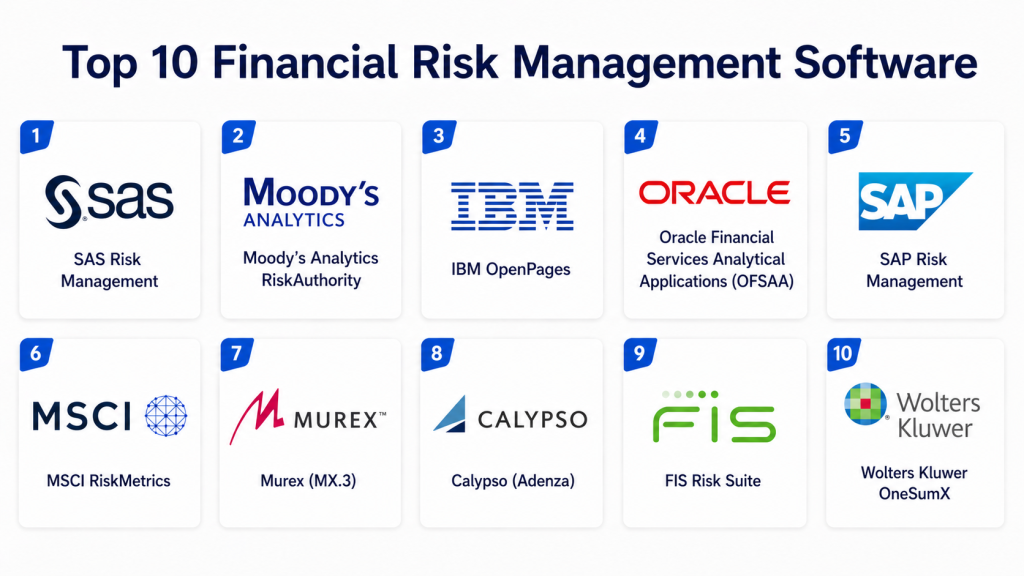
Top 10 Financial Risk Management Software
#1 — SAS Risk Management
Short description :
SAS Risk Management is a leading analytics platform used for credit, market, and operational risk analysis. It provides advanced modeling and predictive analytics. Known for strong data processing capabilities. Suitable for large financial institutions. Helps improve regulatory compliance and decision-making.
Key Features
- Credit risk modeling
- Market risk analysis
- Stress testing
- Scenario simulation
- Regulatory reporting
- Advanced analytics
Pros
- Powerful analytics engine
- Highly scalable
Cons
- Complex implementation
- High cost
Platforms / Deployment
Cloud / On-premise
Security & Compliance
SSO, MFA, encryption, RBAC
Integrations & Ecosystem
- ERP systems
- Banking platforms
- Data warehouses
Support & Community
Enterprise-level support.
#2 — Moody’s Analytics RiskAuthority
Short description :
Moody’s RiskAuthority is a financial risk management platform focused on credit and market risk. It provides regulatory reporting and scenario analysis tools. Known for accuracy and financial modeling capabilities. Suitable for banks and large enterprises. Helps improve risk visibility and compliance.
Key Features
- Credit risk analysis
- Market risk modeling
- Stress testing
- Regulatory reporting
- Scenario analysis
Pros
- Strong risk models
- Trusted financial provider
Cons
- Complex interface
- Premium pricing
Platforms / Deployment
Cloud
Security & Compliance
Encryption, access controls
Integrations & Ecosystem
- Banking systems
- Data platforms
Support & Community
Enterprise support available.
#3 — IBM OpenPages
Short description :
IBM OpenPages is an enterprise governance, risk, and compliance platform. It helps organizations manage financial and operational risks. Known for scalability and AI-driven insights. Suitable for large enterprises. Provides dashboards and reporting tools.
Key Features
- Risk management framework
- Compliance tracking
- AI analytics
- Reporting dashboards
- Workflow automation
Pros
- Strong enterprise capabilities
- AI integration
Cons
- Complex setup
- High cost
Platforms / Deployment
Cloud / On-premise
Security & Compliance
SSO, MFA, encryption
Integrations & Ecosystem
- IBM ecosystem
- ERP systems
Support & Community
Enterprise-level support.
#4 — Oracle Financial Services Analytical Applications (OFSAA)
Short description :
Oracle OFSAA provides risk management, compliance, and financial analytics solutions. It supports credit, market, and liquidity risk analysis. Known for enterprise scalability. Suitable for large banks and institutions. Offers reporting and regulatory compliance tools.
Key Features
- Credit risk analytics
- Market risk modeling
- Liquidity risk analysis
- Regulatory reporting
- Scenario simulation
Pros
- Highly scalable
- Strong integration
Cons
- Complex implementation
- Pricing
Platforms / Deployment
Cloud
Security & Compliance
SSO, MFA, encryption
Integrations & Ecosystem
- Oracle ERP
- Banking systems
Support & Community
Enterprise support.
#5 — SAP Risk Management
Short description :
SAP Risk Management helps organizations identify and manage financial risks across operations. It integrates with SAP ERP systems. Known for enterprise scalability and reporting tools. Suitable for large enterprises. Provides risk dashboards and analytics.
Key Features
- Risk identification
- Scenario analysis
- Compliance management
- Reporting dashboards
- ERP integration
Pros
- Strong ERP integration
- Scalable platform
Cons
- Complex setup
- High cost
Platforms / Deployment
Cloud / On-premise
Security & Compliance
SSO, MFA, encryption
Integrations & Ecosystem
- SAP ERP
- APIs
Support & Community
Strong enterprise support.
#6 — Wolters Kluwer OneSumX
Short description :
OneSumX is a financial risk and regulatory reporting platform. It supports credit and market risk analysis. Known for regulatory compliance capabilities. Suitable for banks and financial institutions. Provides reporting and analytics tools.
Key Features
- Risk analytics
- Regulatory reporting
- Credit risk management
- Scenario analysis
- Data integration
Pros
- Strong compliance focus
- Reliable reporting
Cons
- Limited flexibility
- Pricing
Platforms / Deployment
Cloud
Security & Compliance
Encryption, access controls
Integrations & Ecosystem
- Banking systems
- Data platforms
Support & Community
Good enterprise support.
#7 — Calypso (Adenza)
Short description :
Calypso is a trading and risk management platform used for financial institutions. It supports market, credit, and liquidity risk analysis. Known for real-time processing capabilities. Suitable for investment banks. Provides analytics and reporting tools.
Key Features
- Market risk management
- Credit risk analysis
- Liquidity risk monitoring
- Real-time analytics
- Reporting
Pros
- Real-time processing
- Strong trading integration
Cons
- Complex implementation
- High cost
Platforms / Deployment
Cloud / On-premise
Security & Compliance
SSO, MFA, encryption
Integrations & Ecosystem
- Trading systems
- APIs
Support & Community
Enterprise-level support.
#8 — FIS Risk Suite
Short description :
FIS Risk Suite provides credit and market risk management solutions for financial institutions. It supports compliance and analytics. Known for scalability and reliability. Suitable for banks and insurers. Provides dashboards and reporting tools.
Key Features
- Credit risk analysis
- Market risk management
- Compliance tools
- Reporting
- Scenario analysis
Pros
- Reliable platform
- Strong enterprise features
Cons
- Complex setup
- Pricing
Platforms / Deployment
Cloud / On-premise
Security & Compliance
SSO, MFA, encryption
Integrations & Ecosystem
- Banking systems
- ERP systems
Support & Community
Enterprise support.
#9 — S&P Global Market Intelligence (Risk Solutions)
Short description :
S&P Risk Solutions provides financial risk analytics and data-driven insights. It supports credit risk evaluation and portfolio analysis. Known for high-quality financial data. Suitable for investment firms and banks. Provides reporting tools and dashboards.
Key Features
- Credit risk analysis
- Portfolio risk management
- Data analytics
- Reporting
- Scenario modeling
Pros
- Strong data quality
- Reliable analytics
Cons
- Limited customization
- Pricing
Platforms / Deployment
Cloud
Security & Compliance
Encryption, access controls
Integrations & Ecosystem
- Financial data systems
- APIs
Support & Community
Enterprise support.
#10 — AxiomSL (Adenza)
Short description :
AxiomSL is a regulatory risk and reporting platform for financial institutions. It supports capital adequacy and risk compliance. Known for regulatory reporting strength. Suitable for banks and large enterprises. Provides analytics and dashboards.
Key Features
- Regulatory reporting
- Risk analytics
- Capital adequacy management
- Scenario analysis
- Data integration
Pros
- Strong compliance tools
- Regulatory focus
Cons
- Complex interface
- High cost
Platforms / Deployment
Cloud
Security & Compliance
SSO, MFA, encryption
Integrations & Ecosystem
- Banking systems
- Regulatory systems
Support & Community
Enterprise support.
Comparison Table
| Tool Name | Best For | Platform(s) Supported | Deployment | Standout Feature | Public Rating |
|---|---|---|---|---|---|
| SAS Risk | Enterprise | Web | Hybrid | Advanced analytics | N/A |
| Moody’s | Enterprise | Web | Cloud | Credit modeling | N/A |
| IBM OpenPages | Enterprise | Web | Hybrid | AI governance | N/A |
| Oracle OFSAA | Enterprise | Web | Cloud | Risk analytics | N/A |
| SAP Risk | Enterprise | Web | Hybrid | ERP integration | N/A |
| OneSumX | Banking | Web | Cloud | Compliance focus | N/A |
| Calypso | Trading | Web | Hybrid | Real-time risk | N/A |
| FIS Risk Suite | Enterprise | Web | Hybrid | Reliability | N/A |
| S&P Risk | Investment | Web | Cloud | Data analytics | N/A |
| AxiomSL | Enterprise | Web | Cloud | Regulatory reporting | N/A |
Evaluation & Scoring of Financial Risk Management Software
| Tool Name | Core | Ease | Integrations | Security | Performance | Support | Value | Weighted Total |
|---|---|---|---|---|---|---|---|---|
| SAS | 9 | 6 | 9 | 9 | 9 | 9 | 7 | 8.4 |
| Moody’s | 9 | 6 | 8 | 9 | 9 | 9 | 7 | 8.3 |
| IBM OpenPages | 8 | 7 | 9 | 9 | 8 | 8 | 7 | 8.1 |
| Oracle OFSAA | 9 | 6 | 9 | 9 | 9 | 9 | 7 | 8.4 |
| SAP Risk | 9 | 6 | 9 | 9 | 9 | 9 | 7 | 8.4 |
| OneSumX | 8 | 7 | 8 | 9 | 8 | 8 | 7 | 8.0 |
| Calypso | 9 | 6 | 9 | 9 | 9 | 9 | 7 | 8.4 |
| FIS Suite | 8 | 7 | 8 | 8 | 8 | 8 | 7 | 7.9 |
| S&P Risk | 8 | 8 | 8 | 8 | 8 | 8 | 7 | 7.9 |
| AxiomSL | 8 | 7 | 8 | 9 | 8 | 8 | 7 | 8.0 |
Which Financial Risk Management Software Is Right for You?
Solo / Freelancer
- Not applicable
SMB
- Not typically required
Mid-Market
- S&P Risk, FIS Risk Suite
- Balanced analytics and usability
Enterprise
- SAS, Oracle OFSAA, SAP Risk, Moody’s
- Advanced risk modeling and compliance
Budget vs Premium
- Budget: S&P Risk
- Premium: SAS, Oracle, SAP
Feature Depth vs Ease of Use
- Deep: SAS, Calypso
- Easy: S&P Risk
Integrations & Scalability
- Strong: Enterprise tools
- Moderate: Mid-market tools
Security & Compliance Needs
- High: Enterprise platforms
- Moderate: Mid-market tools
Frequently Asked Questions (FAQs)
1. What is Financial Risk Management Software?
Financial Risk Management Software helps organizations identify, measure, and control financial risks. It covers credit, market, liquidity, and operational risks. It uses analytics and models to improve decision-making. It also helps meet regulatory requirements. Overall, it reduces financial uncertainty and exposure.
2. Who typically uses this software?
This software is mainly used by banks, insurance companies, and large enterprises. It is also used by investment firms and financial institutions. These organizations manage high financial exposure and complex portfolios. Risk teams and CFOs rely heavily on it. It supports strategic financial planning.
3. Why is it important for modern businesses?
It is important because financial markets are highly volatile today. Businesses face credit defaults, market fluctuations, and regulatory pressure. This software helps detect risks early. It improves financial stability and planning accuracy. It also supports compliance with global regulations.
4. Does it support regulatory compliance?
Yes, most tools support regulatory frameworks like Basel and IFRS. They generate reports required by regulators. They also maintain audit trails for transparency. This helps organizations avoid penalties. Compliance reporting is a key feature in enterprise solutions.
5. Can it integrate with other financial systems?
Yes, these platforms integrate with ERP systems, banking systems, and data warehouses. APIs are commonly used for integration. This ensures real-time data flow across systems. It improves accuracy and reduces manual work. Integration is critical for enterprise deployment.
6. Is Financial Risk Management Software suitable for small businesses?
Generally, it is more suited for mid to large enterprises. Small businesses usually have simpler risk profiles. However, some lightweight or cloud-based tools may be suitable. It depends on financial complexity. Most SMBs do not require advanced risk modeling tools.
7. Is it difficult to implement?
Enterprise systems can be complex. Mid-market tools are easier to deploy.
8. Can small businesses use it?
Generally not necessary unless they handle financial risk exposure.
9. How accurate are risk models?
Accuracy depends on data quality and analytics engine.
10. What is the biggest benefit?
It improves financial decision-making and reduces risk exposure.
Conclusion
Financial Risk Management Software is essential for organizations operating in volatile financial environments. It enables better decision-making by providing insights into credit, market, liquidity, and operational risks while ensuring regulatory compliance.
The right solution depends on organizational scale and complexity. Large enterprises benefit from advanced platforms like SAS, Oracle, and SAP, while mid-market organizations may prefer S&P Risk or FIS Risk Suite. The key is to balance analytics depth, scalability, and integration capability.
Organizations should evaluate risk exposure, regulatory needs, and data infrastructure before selecting a platform. A pilot implementation can help ensure the chosen tool aligns with business requirements.
