Introduction
Pharmacovigilance Software helps pharmaceutical companies, biotech firms, and healthcare organizations monitor, assess, and report adverse drug reactions and safety data. These platforms are critical for ensuring drug safety throughout the product lifecycle, from clinical trials to post-market surveillance.
With increasing regulatory requirements and global drug distribution, pharmacovigilance has become more complex and data-intensive. Modern software solutions automate case processing, signal detection, and compliance reporting, helping organizations maintain patient safety while meeting strict regulatory standards.
Real-world use cases:
- Monitoring adverse drug reactions
- Managing safety case reporting
- Signal detection and risk analysis
- Regulatory compliance and submissions
- Post-market drug surveillance
What buyers should evaluate:
- Case processing and workflow automation
- Signal detection and analytics capabilities
- Regulatory compliance support
- Integration with clinical and safety systems
- Data management and scalability
- Reporting and submission features
- Security and audit trails
- Ease of use and training requirements
- Global compliance capabilities
Best for: Pharmaceutical companies, CROs, biotech firms, and healthcare organizations handling drug safety and compliance.
Not ideal for: Small clinics or organizations not involved in drug development or safety monitoring.
Key Trends in Pharmacovigilance Software
- Cloud-based pharmacovigilance platforms replacing legacy systems
- AI-driven signal detection improving safety insights
- Automation of case processing and reporting
- Integration with clinical trial and EHR systems
- Real-time safety monitoring and dashboards
- Increased focus on global regulatory compliance
- Data standardization for interoperability
- Use of advanced analytics for risk management
- Enhanced audit and compliance tracking
How We Selected Pharmacovigilance Software (Methodology)
- Evaluated adoption across pharma and CROs
- Assessed case processing and workflow capabilities
- Reviewed signal detection and analytics features
- Analyzed compliance and regulatory support
- Considered scalability and performance
- Evaluated integration with clinical systems
- Reviewed usability and onboarding
- Assessed vendor reliability and support
- Considered pricing and overall value
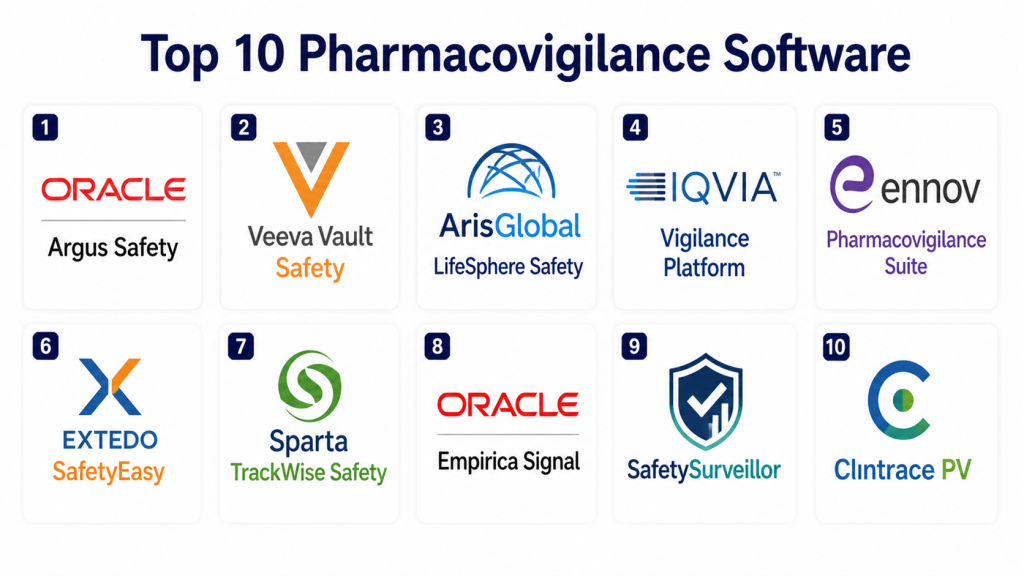
Top 10 Pharmacovigilance Software
#1 — Oracle Argus Safety
Short description: Oracle Argus Safety is a leading pharmacovigilance platform designed for managing drug safety data. It supports adverse event reporting, case management, and regulatory compliance. It is widely used by global pharmaceutical companies. The platform offers advanced automation and analytics. It is ideal for large-scale safety operations.
Key Features
- Adverse event case management
- Regulatory reporting
- Signal detection
- Workflow automation
- Data analytics
- Global compliance support
Pros
- Industry-leading platform
- Strong compliance capabilities
Cons
- Complex implementation
- High cost
Platforms / Deployment
Cloud / On-premise
Security & Compliance
Encryption, audit trails, regulatory compliance support
Integrations & Ecosystem
Oracle Argus integrates with clinical and enterprise systems to streamline pharmacovigilance workflows.
- EDC systems
- Clinical platforms
- APIs
Support & Community
Enterprise-level support
#2 — Veeva Vault Safety
Short description: Veeva Vault Safety is a cloud-based pharmacovigilance solution designed for modern drug safety management. It supports case processing, signal detection, and regulatory compliance. It integrates with Veeva’s clinical ecosystem. It is widely used in pharma and biotech industries. It offers scalability and flexibility.
Key Features
- Case processing
- Signal detection
- Workflow automation
- Compliance tools
- Reporting dashboards
Pros
- Modern cloud architecture
- Strong integration capabilities
Cons
- Premium pricing
- Requires training
Platforms / Deployment
Cloud
Security & Compliance
Encryption, access controls
Integrations & Ecosystem
Veeva integrates with clinical and regulatory systems for seamless safety workflows.
- APIs
- Clinical systems
- Data platforms
Support & Community
Strong enterprise support
#3 — ArisGlobal LifeSphere Safety
Short description: ArisGlobal LifeSphere Safety is a comprehensive pharmacovigilance platform designed for managing drug safety data. It supports end-to-end safety workflows. It provides advanced analytics and automation. It is widely used in global pharmaceutical organizations. It improves efficiency and compliance.
Key Features
- End-to-end safety management
- Signal detection
- Workflow automation
- Regulatory reporting
- Data analytics
Pros
- Comprehensive platform
- Strong automation
Cons
- Complex setup
- High cost
Platforms / Deployment
Cloud
Security & Compliance
Encryption, compliance controls
Integrations & Ecosystem
ArisGlobal integrates with enterprise and clinical systems to support safety data management.
- APIs
- Clinical platforms
Support & Community
Professional support
#4 — IQVIA Pharmacovigilance Platform
Short description: IQVIA offers pharmacovigilance solutions designed for managing drug safety and compliance. It provides advanced analytics and global reporting capabilities. It supports large-scale safety operations. It is widely used by pharmaceutical companies. It enhances decision-making and risk management.
Key Features
- Safety data management
- Signal detection
- Global reporting
- Analytics tools
- Compliance support
Pros
- Strong analytics capabilities
- Global reach
Cons
- Expensive
- Complex implementation
Platforms / Deployment
Cloud
Security & Compliance
Encryption, compliance support
Integrations & Ecosystem
IQVIA integrates with healthcare and clinical systems for comprehensive safety workflows.
- APIs
- Healthcare systems
Support & Community
Enterprise support
#5 — Ennov PV
Short description: Ennov PV is a pharmacovigilance platform designed for managing safety data and compliance. It supports case processing, reporting, and workflow automation. It is suitable for small to mid-sized pharma companies. It offers flexibility and scalability.
Key Features
- Case management
- Reporting tools
- Workflow automation
- Compliance support
- Data management
Pros
- Flexible platform
- Good for mid-sized organizations
Cons
- Limited advanced features
- Smaller ecosystem
Platforms / Deployment
Cloud
Security & Compliance
Access controls
Integrations & Ecosystem
Ennov integrates with enterprise systems and supports API-based workflows.
- APIs
- Enterprise tools
Support & Community
Reliable support
#6 — EXTEDO SafetyEasy
Short description: EXTEDO SafetyEasy is a pharmacovigilance solution focused on compliance and regulatory reporting. It supports adverse event management and submission workflows. It is widely used in Europe. It offers automation features. It is suitable for small to mid-sized organizations.
Key Features
- Adverse event management
- Regulatory submissions
- Workflow automation
- Compliance tools
- Reporting features
Pros
- Strong compliance support
- User-friendly interface
Cons
- Limited scalability
- Regional focus
Platforms / Deployment
Cloud
Security & Compliance
Compliance controls
Integrations & Ecosystem
EXTEDO integrates with regulatory systems and supports submission workflows.
- APIs
- Regulatory tools
Support & Community
Good regional support
#7 — Sparta TrackWise Safety
Short description: Sparta TrackWise Safety is a pharmacovigilance solution integrated with quality management systems. It supports safety data management and compliance. It is suitable for regulated industries. It provides workflow automation. It improves operational efficiency.
Key Features
- Safety data management
- Workflow automation
- Compliance tracking
- Reporting tools
- Integration with QMS
Pros
- Integrated quality management
- Strong compliance features
Cons
- Complex setup
- High cost
Platforms / Deployment
Cloud
Security & Compliance
Encryption, audit trails
Integrations & Ecosystem
Sparta integrates with quality and enterprise systems for comprehensive workflows.
- APIs
- QMS systems
Support & Community
Enterprise support
#8 — Oracle Empirica Signal
Short description: Oracle Empirica Signal is a specialized tool for signal detection and analysis in pharmacovigilance. It provides advanced analytics for identifying safety signals. It is widely used in large organizations. It complements safety platforms like Argus.
Key Features
- Signal detection
- Data analytics
- Risk assessment
- Reporting tools
- Integration support
Pros
- Advanced analytics
- Strong signal detection
Cons
- Requires integration with other systems
- Complex usage
Platforms / Deployment
Cloud
Security & Compliance
Not publicly stated
Integrations & Ecosystem
Empirica integrates with safety systems and analytics platforms for advanced insights.
- APIs
- Data systems
Support & Community
Enterprise support
#9 — SafetySurveillor
Short description: SafetySurveillor is a pharmacovigilance solution designed for managing safety data and compliance. It supports case processing and reporting. It is suitable for small to mid-sized organizations. It offers flexibility and ease of use.
Key Features
- Case processing
- Reporting tools
- Compliance support
- Workflow management
- Data tracking
Pros
- Easy to use
- Cost-effective
Cons
- Limited advanced features
- Smaller ecosystem
Platforms / Deployment
Cloud
Security & Compliance
Access controls
Integrations & Ecosystem
SafetySurveillor integrates with basic enterprise tools and supports data workflows.
- APIs
- Enterprise systems
Support & Community
Basic support
#10 — Clintrace PV
Short description: Clintrace PV is a pharmacovigilance platform designed for clinical and post-market safety management. It supports case processing, reporting, and compliance. It is suitable for research organizations. It improves safety data management.
Key Features
- Case management
- Reporting tools
- Compliance support
- Workflow automation
- Data tracking
Pros
- Flexible platform
- Good for research organizations
Cons
- Limited enterprise features
- Smaller ecosystem
Platforms / Deployment
Cloud
Security & Compliance
Access controls
Integrations & Ecosystem
Clintrace integrates with research and clinical systems for safety workflows.
- APIs
- Clinical tools
Support & Community
Reliable support
Comparison Table (Top 10)
| Tool Name | Best For | Platform(s) Supported | Deployment | Standout Feature | Public Rating |
|---|---|---|---|---|---|
| Oracle Argus Safety | Enterprise pharma | Web | Cloud/On-premise | Case management | N/A |
| Veeva Vault Safety | Pharma/biotech | Web | Cloud | Modern cloud PV | N/A |
| ArisGlobal LifeSphere | Global pharma | Web | Cloud | End-to-end PV | N/A |
| IQVIA PV Platform | Large orgs | Web | Cloud | Analytics | N/A |
| Ennov PV | Mid-size pharma | Web | Cloud | Flexible workflows | N/A |
| EXTEDO SafetyEasy | EU orgs | Web | Cloud | Compliance focus | N/A |
| Sparta TrackWise | Regulated industries | Web | Cloud | QMS integration | N/A |
| Oracle Empirica | Analytics | Web | Cloud | Signal detection | N/A |
| SafetySurveillor | SMB pharma | Web | Cloud | Cost-effective | N/A |
| Clintrace PV | Research orgs | Web | Cloud | Data tracking | N/A |
Evaluation & Scoring of Pharmacovigilance Software
| Tool Name | Core (25%) | Ease (15%) | Integrations (15%) | Security (10%) | Performance (10%) | Support (10%) | Value (15%) | Weighted Total |
|---|---|---|---|---|---|---|---|---|
| Oracle Argus | 9 | 6 | 9 | 9 | 9 | 9 | 7 | 8.5 |
| Veeva Vault | 9 | 7 | 9 | 9 | 9 | 9 | 7 | 8.6 |
| ArisGlobal | 9 | 7 | 9 | 9 | 9 | 8 | 7 | 8.5 |
| IQVIA | 9 | 7 | 9 | 9 | 9 | 8 | 7 | 8.5 |
| Ennov | 8 | 8 | 7 | 8 | 8 | 8 | 8 | 8.0 |
| EXTEDO | 8 | 8 | 7 | 8 | 8 | 7 | 8 | 7.9 |
| Sparta | 9 | 6 | 8 | 9 | 8 | 8 | 7 | 8.2 |
| Empirica | 8 | 6 | 8 | 8 | 9 | 8 | 7 | 7.9 |
| SafetySurveillor | 7 | 8 | 6 | 7 | 7 | 7 | 8 | 7.3 |
| Clintrace | 7 | 8 | 6 | 7 | 7 | 7 | 8 | 7.3 |
Interpretation: These scores reflect relative strengths across functionality, usability, and value. Higher scores indicate better balance, but the best choice depends on organizational needs and compliance requirements.
Which Pharmacovigilance Software Is Right for You?
Solo / Freelancer
Pharmacovigilance software is generally not designed for individual users, as it requires structured workflows and regulatory compliance. Solo professionals may rely on basic data tracking tools instead. These platforms are built for organizations handling drug safety at scale. If you are working independently, consider lightweight documentation systems. Full PV platforms may be too complex and costly. Choose based on actual need.
SMB
Small pharmaceutical or biotech companies should look for flexible and cost-effective solutions like Ennov PV or SafetySurveillor. These tools provide essential case management and reporting features without heavy infrastructure. They are easier to implement and require less training. SMBs benefit from tools that balance compliance and usability. Budget considerations are also important. Start with scalable solutions.
Mid-Market
Mid-sized organizations need platforms that offer better scalability, integration, and compliance support. Tools like EXTEDO SafetyEasy or Clintrace PV provide a good balance between advanced features and usability. They support growing safety operations and regulatory requirements. These platforms also allow customization and workflow automation. Mid-market teams should focus on flexibility. Integration capability is key.
Enterprise
Large pharmaceutical companies should choose enterprise-grade platforms like Oracle Argus Safety, Veeva Vault Safety, or ArisGlobal LifeSphere. These systems offer end-to-end pharmacovigilance capabilities and global compliance support. They handle high data volumes and complex workflows. Enterprise tools provide strong analytics and automation. They require investment and expertise. Best for large-scale operations.
Budget vs Premium
Budget-friendly tools are suitable for smaller teams with limited requirements. They provide essential functionality but may lack advanced analytics and automation. Premium platforms offer comprehensive features, scalability, and strong compliance support. They are ideal for organizations handling complex workflows. The choice depends on long-term goals. Always evaluate ROI before investing.
Feature Depth vs Ease of Use
Simple tools are easier to adopt and require minimal training, making them suitable for smaller teams. However, they may lack advanced capabilities like automation and analytics. Enterprise platforms offer deep functionality but come with complexity. Organizations should balance usability with feature requirements. Choose tools that align with team expertise. Avoid over-complicated solutions.
Integrations & Scalability
Platforms with strong API support and integration capabilities are essential for scaling pharmacovigilance operations. Integration with clinical, regulatory, and enterprise systems improves efficiency. Scalability ensures the platform can handle growing data volumes. Organizations should prioritize future growth needs. Choose flexible architectures. This ensures long-term usability.
Security & Compliance Needs
Pharmacovigilance involves handling sensitive patient and drug safety data, making security critical. Choose platforms with encryption, audit trails, and compliance features. Regulatory support is essential for global operations. Ensure the tool meets industry standards. Security should never be compromised. Always validate compliance capabilities.
Frequently Asked Questions FAQs
1. What is pharmacovigilance software?
Pharmacovigilance software is designed to monitor, manage, and report drug safety data throughout the product lifecycle. It helps organizations track adverse events and ensure regulatory compliance. These tools centralize safety workflows and improve reporting accuracy. They are essential for pharmaceutical companies and CROs. They also support risk management. Overall, they enhance patient safety.
2. Why is pharmacovigilance important?
Pharmacovigilance is crucial for identifying and preventing adverse drug reactions. It ensures that medications remain safe for public use. It helps organizations comply with regulatory requirements. Early detection of safety issues reduces risks. It also improves drug quality and trust. This makes it a critical function in healthcare.
3. Are pharmacovigilance tools secure?
Most pharmacovigilance platforms offer strong security features such as encryption, access controls, and audit trails. These features protect sensitive patient and drug data. Security is essential due to strict regulatory requirements. Organizations must verify compliance standards before choosing a tool. Cloud-based platforms often provide advanced protection. Always review security policies.
4. Can pharmacovigilance software integrate with other systems?
Yes, most modern platforms integrate with clinical, regulatory, and enterprise systems. Integration improves workflow efficiency and data accuracy. APIs enable automation and seamless data exchange. Compatibility with existing systems is important. Integrated systems reduce manual effort. This enhances overall productivity.
5. Are these tools suitable for small organizations?
Some pharmacovigilance tools are designed specifically for small and mid-sized organizations. They offer essential features without complexity. However, enterprise platforms may be too expensive and complex. Smaller organizations should choose scalable solutions. Start simple and expand as needed. Evaluate based on workload.
6. How much does pharmacovigilance software cost?
Pricing varies depending on features, scale, and deployment model. Enterprise platforms are typically expensive due to advanced capabilities. Smaller tools offer more affordable options. Costs depend on user count, customization, and data volume. Organizations should evaluate long-term value. Budget planning is important.
7. Do these tools support regulatory compliance?
Yes, compliance is a core feature of pharmacovigilance software. These platforms support global regulatory requirements and reporting standards. They provide audit trails and documentation features. Compliance ensures legal and operational safety. Organizations must verify supported regulations. This is critical for drug approval and monitoring.
8. How difficult is implementation?
Implementation depends on the platform and organization size. Enterprise tools require planning, training, and configuration. Cloud-based solutions are easier to deploy. Proper onboarding ensures smooth adoption. Technical expertise may be required. Planning is essential for success.
9. Can pharmacovigilance software improve efficiency?
Yes, these tools automate case processing, reporting, and data management. This reduces manual work and errors. They improve workflow efficiency and productivity. Real-time dashboards help in decision-making. Automation saves time and resources. Overall, they enhance operational performance.
10. What should I look for when choosing a tool?
Focus on features like case management, compliance support, and integration capabilities. Evaluate ease of use and scalability. Security and data protection are critical. Consider pricing and long-term value. Testing tools with real workflows is recommended. Choose based on your organization’s needs
Conclusion
Pharmacovigilance Software plays a critical role in ensuring drug safety and regulatory compliance in the pharmaceutical industry. As drug development becomes more complex and globalized, these platforms provide the tools needed to manage safety data efficiently and accurately. From enterprise solutions like Oracle Argus and Veeva Vault to flexible options like Ennov PV and Clintrace, organizations have a wide range of choices based on their scale and requirements.
Selecting the right pharmacovigilance platform depends on factors such as regulatory needs, data volume, and organizational complexity. Large enterprises should prioritize scalability and compliance, while smaller organizations can focus on usability and cost-effectiveness. The best approach is to shortlist a few tools, conduct pilot testing, and evaluate how well they integrate into existing workflows before making a final decision.
