Introduction
Laboratory Information Management Systems (LIMS) are software platforms designed to manage laboratory workflows, sample tracking, data storage, and reporting. These systems are widely used in industries such as healthcare, pharmaceuticals, biotechnology, environmental testing, and research labs. LIMS help streamline operations, reduce manual errors, and ensure data accuracy across complex laboratory processes.
Modern LIMS platforms go beyond basic sample tracking by offering automation, compliance management, analytics, and integration with lab instruments. They support regulatory requirements and improve collaboration across teams. Choosing the right LIMS depends on factors like scalability, ease of use, compliance needs, and integration capabilities with laboratory equipment and enterprise systems.
Key Trends in LIMS
- Shift toward cloud-based LIMS platforms
- Integration with lab instruments and IoT devices
- Automation of workflows and sample tracking
- Advanced analytics and reporting capabilities
- Compliance with regulatory standards
- Use of AI for data analysis and optimization
- Mobile accessibility for lab operations
- Enhanced data security and audit trails
How We Selected These Tools
- Core laboratory management capabilities
- Ease of use and interface design
- Compliance and regulatory support
- Integration with instruments and systems
- Scalability for different lab sizes
- Data management and analytics features
- Customer support and reliability
- Overall value and flexibility
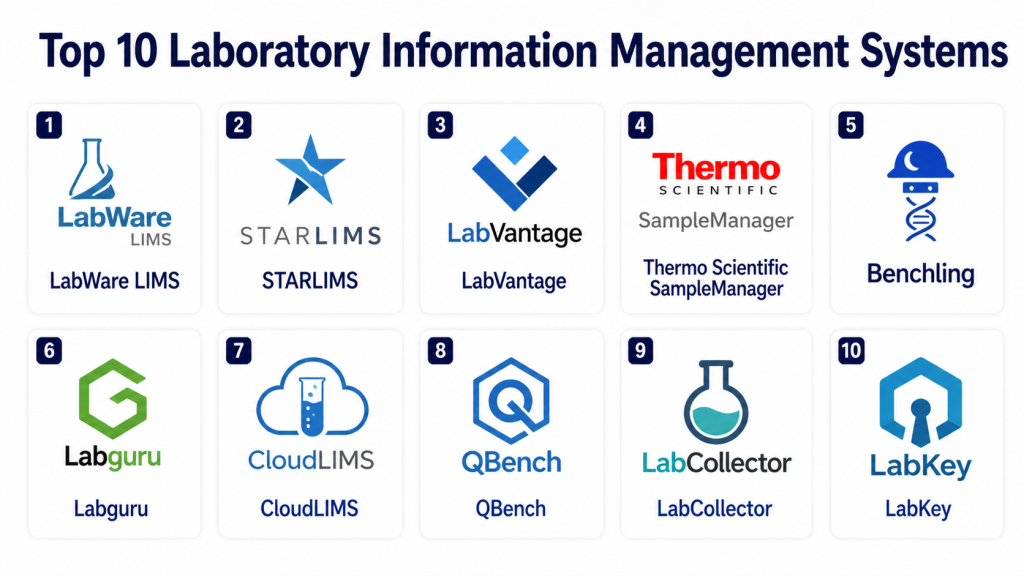
Top 10 Laboratory Information Management Systems
#1 — LabWare LIMS
LabWare LIMS is a comprehensive platform designed for complex laboratory environments. It offers strong workflow automation, sample tracking, and reporting features. The system supports multiple industries and ensures compliance with regulatory standards. It is highly customizable and scalable. It integrates with various lab instruments. It is ideal for enterprise laboratories.
Key Features
- Workflow automation
- Sample tracking
- Compliance management
- Reporting tools
- Instrument integration
Pros
- Highly customizable
- Scalable
- Enterprise-ready
Cons
- Complex setup
- Requires training
Platforms / Deployment
Cloud and On-premise
#2 — STARLIMS
STARLIMS is a powerful LIMS platform offering data management and workflow automation. It supports various laboratory processes and ensures regulatory compliance. The system includes analytics and reporting tools. It is widely used in healthcare and research labs. It is scalable and reliable. It is suitable for large organizations.
Key Features
- Data management
- Workflow automation
- Compliance tools
- Analytics
Pros
- Strong compliance
- Scalable
- Reliable
Cons
- Expensive
- Learning curve
#3 — LabVantage
LabVantage is a modern LIMS platform combining laboratory management with data analytics. It supports sample tracking, workflow automation, and reporting. The system is flexible and scalable. It integrates with enterprise systems. It is designed for digital transformation in labs. It is suitable for growing organizations.
Key Features
- Sample tracking
- Workflow automation
- Analytics tools
- Integration support
Pros
- Flexible
- Scalable
- Modern interface
Cons
- Setup effort
- Requires customization
#4 — Thermo Scientific SampleManager
Thermo Scientific SampleManager is a robust LIMS solution designed for complex labs. It offers strong data management and integration capabilities. The system supports compliance and automation. It handles large datasets efficiently. It is widely used in pharmaceutical and research labs. It is suitable for enterprise use.
Key Features
- Data management
- Workflow automation
- Compliance support
- Instrument integration
Pros
- Reliable
- Scalable
- Strong performance
Cons
- Expensive
- Complex setup
#5 — Benchling
Benchling is a cloud-based platform focused on life sciences research. It combines LIMS functionality with collaboration tools. The system supports data tracking and experiment management. It is easy to use and accessible. It is widely used in biotech labs. It is suitable for research-focused environments.
Key Features
- Cloud-based platform
- Data tracking
- Collaboration tools
- Experiment management
Pros
- User-friendly
- Modern design
- Good collaboration
Cons
- Limited enterprise features
- Not ideal for all lab types
#6 — Labguru
Labguru is a cloud-based LIMS and electronic lab notebook solution. It helps manage experiments, samples, and workflows. The system is easy to use and integrates with lab tools. It supports collaboration and data sharing. It is suitable for research labs. It is ideal for small to mid-sized teams.
Key Features
- Sample management
- Experiment tracking
- Workflow automation
- Collaboration tools
Pros
- Easy to use
- Affordable
- Cloud-based
Cons
- Limited advanced features
- Smaller ecosystem
#7 — CloudLIMS
CloudLIMS is a cloud-based laboratory management system designed for small to medium labs. It offers sample tracking, reporting, and workflow automation. The platform is easy to deploy and maintain. It supports compliance requirements. It is scalable for growing labs. It is suitable for budget-conscious organizations.
Key Features
- Cloud deployment
- Sample tracking
- Reporting tools
- Workflow automation
Pros
- Affordable
- Easy setup
- Scalable
Cons
- Limited customization
- Basic analytics
#8 — LabCollector
LabCollector is a modular LIMS platform designed for flexibility and ease of use. It supports sample tracking and data management. The system allows customization based on lab needs. It is suitable for small labs. It offers affordable pricing. It is easy to maintain.
Key Features
- Modular design
- Sample tracking
- Data management
- Custom workflows
Pros
- Flexible
- Affordable
- Easy to use
Cons
- Limited scalability
- Basic features
#9 — QBench
QBench is a modern LIMS platform focused on usability and workflow automation. It supports sample tracking, reporting, and data management. The system is designed for efficiency and ease of use. It integrates with lab tools. It is suitable for small to mid-sized labs.
Key Features
- Workflow automation
- Sample tracking
- Reporting tools
- Integration support
Pros
- User-friendly
- Efficient
- Scalable
Cons
- Limited enterprise features
- Customization limits
#10 — LabKey
LabKey is a flexible data management platform designed for research and laboratory environments. It supports data integration, analytics, and collaboration. The system is highly customizable. It is suitable for complex data workflows. It is used in research institutions. It is ideal for data-driven labs.
Key Features
- Data integration
- Analytics tools
- Custom workflows
- Collaboration
Pros
- Flexible
- Scalable
- Strong data capabilities
Cons
- Requires technical expertise
- Setup complexity
Comparison Table
| Tool | Best For | Deployment | Automation | Scalability | Standout Feature |
|---|---|---|---|---|---|
| LabWare | Enterprise labs | Hybrid | High | High | Customization |
| STARLIMS | Compliance labs | Cloud | High | High | Regulatory support |
| LabVantage | Growing labs | Hybrid | High | High | Modern interface |
| SampleManager | Pharma labs | Hybrid | High | High | Data handling |
| Benchling | Biotech | Cloud | Medium | Medium | Collaboration |
| Labguru | Research labs | Cloud | Medium | Medium | ELN integration |
| CloudLIMS | Small labs | Cloud | Medium | Medium | Affordability |
| LabCollector | Small labs | Hybrid | Medium | Low | Modular design |
| QBench | SMB labs | Cloud | Medium | Medium | Ease of use |
| LabKey | Data labs | Hybrid | High | High | Data integration |
Evaluation & Scoring Table
| Tool | Core | Ease | Integrations | Security | Performance | Support | Value | Total |
|---|---|---|---|---|---|---|---|---|
| LabWare | 9 | 7 | 9 | 9 | 9 | 8 | 8 | 8.6 |
| STARLIMS | 9 | 7 | 8 | 9 | 9 | 8 | 7 | 8.3 |
| LabVantage | 9 | 8 | 9 | 8 | 8 | 8 | 8 | 8.4 |
| SampleManager | 9 | 7 | 9 | 9 | 9 | 8 | 7 | 8.4 |
| Benchling | 8 | 9 | 8 | 8 | 8 | 8 | 8 | 8.1 |
| Labguru | 8 | 9 | 7 | 8 | 7 | 7 | 9 | 8.0 |
| CloudLIMS | 7 | 9 | 7 | 8 | 7 | 7 | 9 | 7.9 |
| LabCollector | 7 | 8 | 6 | 7 | 7 | 7 | 9 | 7.6 |
| QBench | 8 | 9 | 7 | 8 | 7 | 7 | 8 | 7.9 |
| LabKey | 9 | 6 | 9 | 8 | 8 | 7 | 7 | 8.0 |
Which Laboratory Information Management System Is Right for You?
Choosing the right LIMS depends on your laboratory size, workflow complexity, compliance requirements, and budget. Different platforms are designed for different use cases, so aligning features with your operational needs is essential.
For small labs and startups
If you are running a small lab with limited resources, simplicity and affordability should be your priority. Tools like CloudLIMS, QBench, and LabCollector offer easy setup, intuitive interfaces, and essential features without heavy customization. These systems require minimal technical expertise and can be deployed quickly. They are ideal for labs that want to digitize operations without complexity. They also provide a cost-effective entry point for growing teams.
For research labs and collaborative environments
Research-focused labs need strong collaboration, experiment tracking, and flexibility. Platforms like Benchling and Labguru are well-suited for these use cases. They provide cloud-based access, real-time collaboration, and experiment management tools. These systems help researchers organize data efficiently and improve team productivity. They are ideal for biotech, academic, and innovation-driven labs. Their modern interfaces make them easy to adopt.
For mid-sized and growing laboratories
Growing labs require scalability, workflow automation, and integration capabilities. LabVantage and LabKey offer flexible solutions that can expand with your needs. They support advanced data management and integration with other systems. These platforms help streamline operations as complexity increases. They are suitable for labs transitioning from basic systems to more advanced solutions. They also support long-term growth.
For enterprise and regulated industries
Large laboratories and regulated industries require compliance, scalability, and advanced automation. LabWare, STARLIMS, and Thermo Scientific SampleManager are strong choices for these environments. They provide robust compliance tools, audit trails, and integration with lab instruments. These systems handle large volumes of data and complex workflows. They are ideal for pharmaceutical, healthcare, and industrial labs. Their enterprise features ensure reliability and security.
For data-driven and analytics-focused labs
If your lab focuses heavily on data analysis and integration, LabKey is a strong option. It provides powerful data management and analytics capabilities. It allows integration with multiple data sources and supports complex workflows. These features help labs make better decisions based on data insights. It is suitable for research institutions and advanced analytics environments. It is ideal for teams prioritizing data over basic
FAQs
1. What is a LIMS system?
A Laboratory Information Management System is software used to manage laboratory operations such as sample tracking, data storage, and reporting. It helps automate workflows and reduce manual errors. These systems improve efficiency and ensure data accuracy. They are widely used in research, healthcare, and testing labs. Overall, LIMS simplifies complex lab processes.
2. What are the key features of LIMS?
Key features include sample tracking, workflow automation, reporting, and data management. Many systems also offer compliance tools and integration with lab instruments. Advanced platforms include analytics and collaboration features. These capabilities help labs improve efficiency and accuracy. Choosing the right features depends on your lab’s needs.
3. Is cloud-based LIMS better than on-premise?
Cloud-based LIMS are easier to deploy and maintain, making them popular for modern labs. On-premise systems offer more control but require IT infrastructure. Some organizations prefer hybrid models. The choice depends on security, budget, and scalability needs. Both options have their advantages.
4. Can LIMS integrate with lab instruments?
Yes, most modern LIMS platforms support integration with laboratory instruments. This allows automatic data capture and reduces manual entry. Integration improves accuracy and efficiency. It also ensures real-time data availability. This is essential for modern laboratory workflows.
5. Is LIMS suitable for small labs?
Yes, many LIMS solutions are designed specifically for small labs. They offer essential features at affordable prices. Cloud-based systems are especially suitable for smaller teams. They require less setup and maintenance. This makes them accessible for growing labs.
6. How secure are LIMS platforms?
LIMS platforms include security features like access control, audit trails, and data encryption. Cloud-based systems often provide regular updates and monitoring. Security levels vary by provider. It is important to choose a platform with strong compliance features. This ensures data protection.
7. Do LIMS support regulatory compliance?
Yes, many LIMS platforms are designed to meet regulatory requirements. They include features for audit trails, data validation, and reporting. This is important for industries like pharmaceuticals and healthcare. Compliance ensures data integrity and reliability. It also helps meet legal standards.
8. Can LIMS scale with business growth?
Most modern LIMS platforms are designed to scale with growing laboratory needs. They can handle increasing data volumes and users. Cloud-based systems offer flexible scaling options. This ensures long-term usability. Scalability is important for expanding labs.
9. What industries use LIMS?
LIMS are used in healthcare, pharmaceuticals, biotechnology, environmental testing, and research labs. They help manage complex workflows and data. Different industries use LIMS for different purposes. However, the core functionality remains the same. It improves efficiency across sectors.
10. Which LIMS is best overall?
There is no single best LIMS for all use cases. LabWare and STARLIMS are strong choices for enterprise labs. Benchling and Labguru are better for research environments. CloudLIMS and QBench are suitable for smaller labs. The best choice depends on your requirements and budget.
Conclusion
Laboratory Information Management Systems have become essential for modern laboratories looking to improve efficiency, accuracy, and compliance. These platforms streamline workflows, automate processes, and provide better control over data and samples. With the increasing complexity of laboratory operations, adopting the right LIMS can significantly enhance productivity and decision-making.
Choosing the best LIMS requires careful evaluation of your lab’s size, budget, and operational needs. While enterprise solutions offer advanced capabilities and scalability, smaller labs may benefit from simpler and more affordable tools. By selecting a system that aligns with your requirements, you can ensure long-term efficiency and support future growth in your laboratory operations.
