Introduction
Logistics Visibility Platforms are software solutions that provide real-time tracking, monitoring, and insights across supply chains—from suppliers and warehouses to transportation and final delivery. These platforms unify data from multiple sources such as carriers, IoT devices, and enterprise systems to give businesses end-to-end visibility into shipments, inventory, and operations.
In today’s complex and global supply chains, visibility is no longer optional—it is critical. Delays, disruptions, and inefficiencies can significantly impact costs and customer satisfaction. Modern platforms leverage AI, predictive analytics, and automation to proactively manage risks and optimize operations. With increasing cybersecurity threats and data sensitivity, these systems also incorporate identity management, Zero Trust security models, and access control mechanisms to protect critical logistics data.
Common use cases include:
- Real-time shipment tracking across multiple carriers
- Exception management and delay alerts
- Inventory visibility across locations
- Supplier and partner collaboration
- Predictive ETAs and risk analysis
What buyers should evaluate:
- Real-time tracking accuracy and coverage
- Integration with ERP, TMS, and WMS systems
- AI and predictive analytics capabilities
- Security features such as RBAC, MFA, and encryption
- Scalability across global supply chains
- Ease of onboarding partners and carriers
- Data quality and reliability
- Reporting and dashboard capabilities
Best for: Enterprises, logistics providers, supply chain managers, and e-commerce businesses managing complex logistics networks.
Not ideal for: Small businesses with simple logistics needs or limited shipment volumes.
Key Trends in Logistics Visibility Platforms
- AI-powered predictive visibility improving ETA accuracy
- Real-time IoT tracking using sensors and GPS devices
- Cloud-native platforms enabling scalability and accessibility
- Integration with digital supply chain ecosystems
- Zero Trust security adoption for data protection
- API-first architectures for seamless integrations
- Automation of exception management workflows
- Enhanced collaboration tools for partners and suppliers
- Sustainability tracking including emissions monitoring
- Multi-modal visibility across air, sea, road, and rail
How We Evaluate Logistics Visibility Platforms (Methodology)
- Market adoption and industry reputation
- Feature completeness for tracking and analytics
- Performance and real-time data capabilities
- Security features including identity and access control
- Integration ecosystem with enterprise systems
- Vendor reliability and scalability
- Ease of implementation and usability
- Suitability for different business sizes and industries
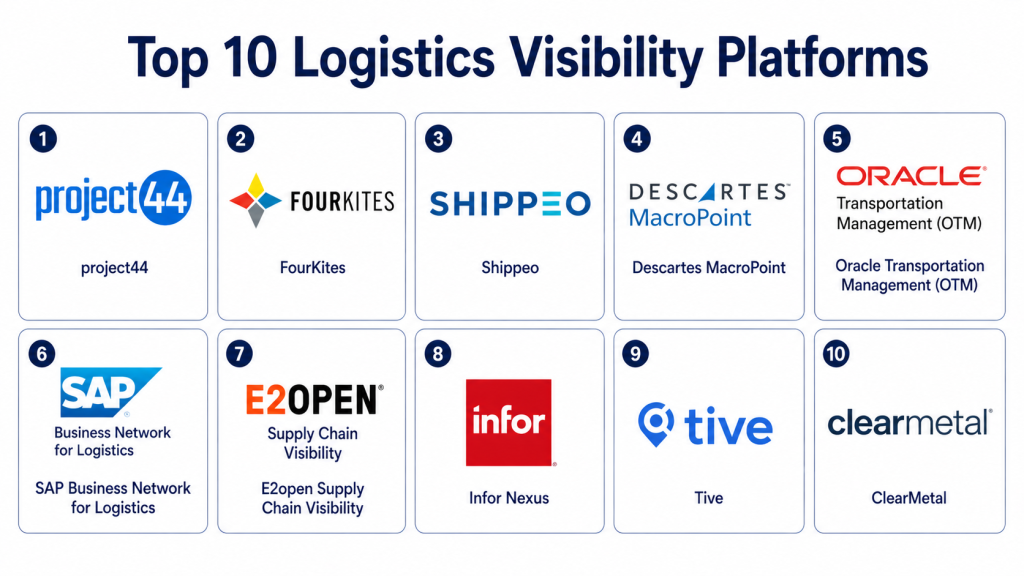
Top 10 Logistics Visibility Platforms
#1 — project44
Short description:
project44 is a leading logistics visibility platform that provides real-time tracking and predictive analytics across global supply chains. It connects shippers, carriers, and logistics providers through a unified data platform. The platform supports multi-modal visibility and advanced analytics. It is widely used by large enterprises. project44 improves supply chain efficiency and reduces disruptions. It is known for its strong data network and scalability.
Key Features
- Real-time shipment tracking
- Predictive ETAs
- Multi-modal visibility
- Data analytics dashboards
- Exception management
- API integrations
Pros
- Strong global coverage
- Advanced analytics capabilities
Cons
- Premium pricing
- Complex onboarding
Platforms / Deployment
Cloud
Security & Compliance
SSO, RBAC, encryption; certifications not publicly stated
Integrations & Ecosystem
project44 integrates with major ERP, TMS, and carrier systems, enabling seamless data exchange.
- ERP systems
- TMS platforms
- Carrier networks
- APIs
Support & Community
Enterprise support; onboarding assistance available
#2 — FourKites
Short description:
FourKites is a real-time supply chain visibility platform that provides end-to-end tracking and predictive insights. It helps businesses manage logistics operations efficiently. The platform supports multiple transportation modes. It is widely adopted by global enterprises. FourKites enhances decision-making and reduces delays.
Key Features
- Real-time tracking
- Predictive analytics
- Multi-modal support
- Exception alerts
- Data dashboards
Pros
- Strong predictive capabilities
- Wide industry adoption
Cons
- High cost
- Implementation complexity
Platforms / Deployment
Cloud
Security & Compliance
Encryption, access control; other details not publicly stated
Integrations & Ecosystem
Integrates with logistics and enterprise systems.
- ERP
- TMS
- APIs
Support & Community
Strong enterprise support
#3 — Shippeo
Short description:
Shippeo is a logistics visibility platform focused on real-time tracking and predictive insights. It provides accurate ETAs and risk analysis. The platform is widely used in Europe and globally. It supports multi-modal logistics. Shippeo improves operational efficiency and transparency.
Key Features
- Real-time tracking
- Predictive ETAs
- Risk analysis
- Data analytics
- API integrations
Pros
- Accurate ETA predictions
- Strong European presence
Cons
- Limited customization
- Pricing not publicly stated
Platforms / Deployment
Cloud
Security & Compliance
Encryption, RBAC; certifications not publicly stated
Integrations & Ecosystem
Integrates with logistics and enterprise systems.
- ERP
- TMS
- APIs
Support & Community
Enterprise support
#4 — Descartes MacroPoint
Short description:
Descartes MacroPoint provides real-time freight visibility and tracking. It connects shippers and carriers through a unified platform. The platform supports multi-modal logistics. It improves supply chain visibility and efficiency. It is widely used by logistics providers.
Key Features
- Real-time tracking
- Carrier connectivity
- Data analytics
- Exception management
- Reporting
Pros
- Strong carrier network
- Reliable tracking
Cons
- Limited advanced analytics
- UI could improve
Platforms / Deployment
Cloud
Security & Compliance
Access control, encryption; details not publicly stated
Integrations & Ecosystem
Integrates with logistics systems and carriers.
- Carrier networks
- ERP
- APIs
Support & Community
Moderate support
#5 — Oracle Transportation Management (OTM)
Short description:
Oracle OTM includes logistics visibility capabilities within its broader transportation management platform. It provides real-time tracking, planning, and optimization. It is suitable for large enterprises. The platform integrates deeply with enterprise systems. It enhances operational efficiency.
Key Features
- Real-time tracking
- Transportation planning
- Data analytics
- Reporting
- Integration tools
Pros
- Strong enterprise integration
- Comprehensive features
Cons
- Complex setup
- High cost
Platforms / Deployment
Cloud / On-premise
Security & Compliance
SSO, RBAC, encryption; certifications not publicly stated
Integrations & Ecosystem
Integrates with ERP and logistics systems.
- ERP
- TMS
- APIs
Support & Community
Strong enterprise support
#6 — SAP Business Network for Logistics
Short description:
SAP’s logistics visibility platform connects supply chain partners and provides real-time insights. It supports collaboration and tracking across logistics networks. The platform integrates with SAP systems. It is suitable for enterprises. It improves visibility and efficiency.
Key Features
- Real-time tracking
- Collaboration tools
- Data analytics
- Integration with SAP
- Reporting
Pros
- Strong ecosystem
- Enterprise scalability
Cons
- Requires SAP environment
- Complex implementation
Platforms / Deployment
Cloud
Security & Compliance
SSO, RBAC, encryption; certifications not publicly stated
Integrations & Ecosystem
Integrates with SAP and logistics systems.
- SAP ERP
- APIs
- Logistics platforms
Support & Community
Enterprise support
#7 — E2open Supply Chain Visibility
Short description:
E2open provides end-to-end supply chain visibility across logistics networks. It supports real-time tracking and analytics. The platform is designed for large enterprises. It enhances collaboration and efficiency. It supports global supply chains.
Key Features
- Real-time tracking
- Data analytics
- Collaboration tools
- Multi-modal support
- Reporting
Pros
- Strong global coverage
- Comprehensive features
Cons
- Complex implementation
- Requires training
Platforms / Deployment
Cloud
Security & Compliance
Encryption, RBAC; details not publicly stated
Integrations & Ecosystem
Integrates with supply chain systems.
- ERP
- Logistics platforms
- APIs
Support & Community
Enterprise support
#8 — Infor Nexus
Short description:
Infor Nexus provides supply chain visibility and collaboration tools. It supports real-time tracking and analytics. The platform connects supply chain partners. It is suitable for global enterprises. It enhances transparency and efficiency.
Key Features
- Real-time tracking
- Collaboration tools
- Data analytics
- Reporting
- Integration
Pros
- Strong collaboration features
- Global reach
Cons
- Complex interface
- High cost
Platforms / Deployment
Cloud
Security & Compliance
Encryption, access control; details not publicly stated
Integrations & Ecosystem
Integrates with enterprise and logistics systems.
- ERP
- APIs
- Supply chain tools
Support & Community
Enterprise support
#9 — Tive
Short description:
Tive provides real-time shipment visibility using IoT sensors. It focuses on tracking and monitoring conditions such as temperature and location. The platform is suitable for logistics and supply chain companies. It enhances visibility and control. It supports data-driven decision-making.
Key Features
- IoT-based tracking
- Real-time visibility
- Condition monitoring
- Alerts
- Data analytics
Pros
- Strong IoT capabilities
- Easy to use
Cons
- Limited enterprise features
- Hardware dependency
Platforms / Deployment
Cloud
Security & Compliance
Encryption; details not publicly stated
Integrations & Ecosystem
Integrates with logistics and IoT systems.
- IoT devices
- APIs
- Logistics platforms
Support & Community
Moderate support
#10 — ClearMetal (Project44)
Short description:
ClearMetal provides AI-driven logistics visibility and predictive analytics. It focuses on improving supply chain performance. The platform integrates with enterprise systems. It is suitable for large organizations. It enhances decision-making and efficiency.
Key Features
- AI-driven analytics
- Predictive ETAs
- Data integration
- Reporting
- Visibility tools
Pros
- Strong AI capabilities
- Good analytics
Cons
- Integration complexity
- Pricing not publicly stated
Platforms / Deployment
Cloud
Security & Compliance
Encryption, RBAC; details not publicly stated
Integrations & Ecosystem
Integrates with enterprise systems.
- ERP
- APIs
- Logistics tools
Support & Community
Enterprise support
Comparison Table (Top 10)
| Tool | Best For | Platforms | Deployment | Standout Feature | Rating |
|---|---|---|---|---|---|
| project44 | Large enterprises | Web | Cloud | Predictive analytics | N/A |
| FourKites | Global supply chains | Web | Cloud | Real-time tracking | N/A |
| Shippeo | European logistics | Web | Cloud | ETA accuracy | N/A |
| MacroPoint | Freight tracking | Web | Cloud | Carrier network | N/A |
| Oracle OTM | Enterprise logistics | Web | Cloud/On-prem | Integration | N/A |
| SAP Network | SAP users | Web | Cloud | Ecosystem | N/A |
| E2open | Global supply chains | Web | Cloud | End-to-end visibility | N/A |
| Infor Nexus | Collaboration | Web | Cloud | Partner network | N/A |
| Tive | IoT tracking | Web | Cloud | Sensors | N/A |
| ClearMetal | AI analytics | Web | Cloud | AI insights | N/A |
Evaluation & Scoring
| Tool | Core | Ease | Integration | Security | Performance | Support | Value | Total |
|---|---|---|---|---|---|---|---|---|
| project44 | 9 | 7 | 9 | 8 | 9 | 8 | 7 | 8.3 |
| FourKites | 9 | 7 | 8 | 8 | 9 | 8 | 7 | 8.2 |
| Shippeo | 8 | 7 | 8 | 7 | 8 | 7 | 7 | 7.7 |
| MacroPoint | 8 | 7 | 7 | 7 | 8 | 7 | 7 | 7.5 |
| Oracle | 9 | 6 | 9 | 8 | 9 | 8 | 6 | 8.1 |
| SAP | 9 | 6 | 9 | 8 | 9 | 8 | 6 | 8.1 |
| E2open | 9 | 6 | 8 | 8 | 9 | 8 | 6 | 8.0 |
| Infor | 8 | 6 | 8 | 7 | 8 | 7 | 6 | 7.6 |
| Tive | 7 | 8 | 6 | 7 | 7 | 6 | 8 | 7.2 |
| ClearMetal | 8 | 7 | 8 | 7 | 8 | 7 | 7 | 7.7 |
Which Logistics Visibility Platform Is Right for You?
Solo / Freelancer
Not typically required
SMB
Tive, Shippeo
Mid-Market
Shippeo, Infor
Enterprise
project44, FourKites, SAP, Oracle
Budget vs Premium
Budget: Tive
Premium: project44
Feature Depth vs Ease of Use
Feature-rich: Oracle, SAP
Easy-to-use: Shippeo
Integrations & Scalability
Best: SAP, Oracle
Security & Compliance Needs
Best: project44, SAP
Frequently Asked Questions (FAQs)
What is a logistics visibility platform?
It provides real-time tracking and insights across supply chains. It connects multiple systems. It improves transparency. It reduces delays. It enhances decision-making.
How much do they cost?
Pricing varies widely. Enterprise tools are expensive. Some offer subscription models. Costs depend on scale. Pricing is often not publicly stated.
Are they secure?
Most include encryption and access control. Some support advanced security. Security varies by vendor. Always verify compliance. Data protection is critical.
Do they support real-time tracking?
Yes, most platforms offer real-time visibility. They track shipments continuously. This improves accuracy. It reduces delays. It enhances operations.
Can they integrate with ERP systems?
Yes, integration is a key feature. APIs enable connectivity. Integration complexity varies. Planning is important. Modern platforms are API-first.
Are they scalable?
Yes, most platforms scale globally. They handle large data volumes. Cloud deployment supports growth. Enterprise solutions scale best. Performance depends on setup.
What industries use them?
Retail, manufacturing, logistics, and e-commerce. They support global supply chains. They improve efficiency. They are widely used. They are critical for operations.
What are common challenges?
Implementation complexity is common. Data quality issues arise. Integration can be difficult. Training is required. Change management is important.
Do they support sustainability goals?
Yes, many track emissions. They optimize routes. This reduces environmental impact. Sustainability is growing. It aligns with regulations.
Are they suitable for small businesses?
Some lightweight tools exist. Full platforms may be overkill. Evaluate based on needs. Choose scalable solutions. Consider budget constraints.
Conclusion
Logistics Visibility Platforms have become a cornerstone of modern supply chain management, enabling organizations to gain real-time insights into their operations and respond proactively to disruptions. By integrating data from carriers, suppliers, and internal systems, these platforms provide a unified view that improves decision-making, reduces delays, and enhances overall efficiency. With the addition of AI-driven analytics, IoT tracking, and automation, businesses can now predict risks and optimize logistics performance more effectively than ever before.
Selecting the right platform depends on the complexity of your supply chain and your specific operational goals. Large enterprises may benefit from comprehensive solutions like project44, FourKites, or SAP Business Network, while mid-sized organizations might find better alignment with platforms like Shippeo or Infor Nexus. Ease of integration, scalability, and security features such as access control and encryption should be key considerations when evaluating options.
To move forward, identify your core logistics challenges, shortlist a few suitable platforms, and conduct pilot implementations. Validate how well each solution integrates with your existing systems and meets your performance expectations. A well-chosen logistics visibility platform can significantly improve operational efficiency, reduce costs, and strengthen resilience in an increasingly complex global supply chain.
