Introduction
Public Transit Scheduling Tools are software platforms designed to plan, optimize, and manage transit operations such as buses, metros, trams, and other urban mobility systems. These tools help agencies create efficient timetables, allocate vehicles and crews, and respond to real-time changes in demand or disruptions. Instead of relying on manual scheduling and static planning, modern systems use data-driven insights to improve service reliability and passenger satisfaction.
In today’s rapidly evolving urban mobility landscape, transit agencies face increasing pressure to deliver punctual, cost-efficient, and sustainable services. With growing city populations, smart city initiatives, and the integration of AI and IoT technologies, scheduling tools are becoming more intelligent and adaptive. Security, identity management, and access control are also critical, especially as systems become cloud-based and interconnected.
Common use cases include:
- Bus and rail timetable creation
- Crew and vehicle scheduling
- Real-time route adjustments
- Demand forecasting and optimization
- Service disruption management
What buyers should evaluate:
- Scheduling optimization capabilities
- Real-time data integration
- Scalability for large transit networks
- Ease of use for planners
- Integration with ticketing and fleet systems
- Security features such as RBAC and MFA
- Performance under peak demand
- Reporting and analytics capabilities
Best for: Public transit authorities, city planners, metro systems, and bus fleet operators managing complex schedules.
Not ideal for: Small private transport operators with limited routes or simple scheduling needs.
Key Trends in Public Transit Scheduling Tools
- AI-driven demand forecasting improving route efficiency
- Real-time adaptive scheduling based on live traffic and ridership data
- Cloud-native platforms replacing legacy scheduling systems
- Integration with smart city ecosystems
- Mobile-first interfaces for planners and field teams
- Sustainability tracking for emissions and fuel efficiency
- Automation of crew scheduling
- Data-driven decision-making dashboards
- Cybersecurity enhancements including Zero Trust frameworks
- Open APIs for integration with mobility apps
How We Evaluate Public Transit Scheduling Tools (Methodology)
- Market adoption and usage across transit agencies
- Feature completeness for scheduling and operations
- Performance and scalability for large networks
- Security capabilities including access control and identity management
- Integration with transit and enterprise systems
- Vendor reliability and support quality
- Ease of implementation and onboarding
- Suitability for different transit system sizes
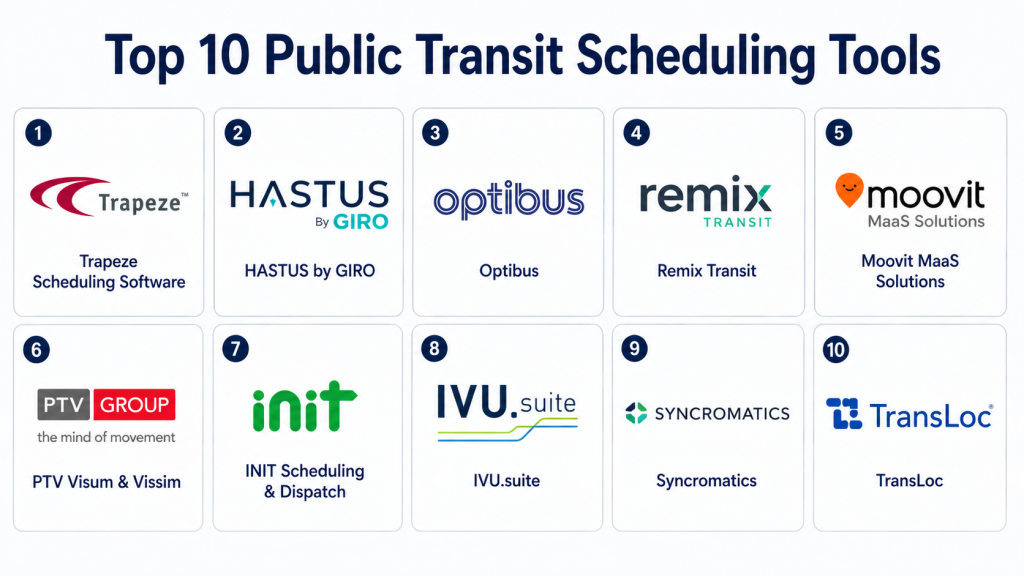
Top 10 Public Transit Scheduling Tools
#1 — Trapeze Scheduling Software
Short description:
Trapeze is a leading transit scheduling platform widely used by public transport agencies. It enables efficient planning of routes, timetables, and crew assignments. The platform supports real-time updates and integration with transit systems. It is suitable for both bus and rail operations. Trapeze helps improve service reliability and operational efficiency. It is known for its robust functionality and scalability.
Key Features
- Route and timetable planning
- Crew scheduling
- Real-time updates
- Data analytics
- Integration with transit systems
- Reporting tools
Pros
- Highly scalable
- Strong industry adoption
Cons
- Complex interface
- Requires training
Platforms / Deployment
Cloud / On-premise
Security & Compliance
RBAC, encryption; certifications not publicly stated
Integrations & Ecosystem
Trapeze integrates with fare systems, fleet management, and GIS platforms.
- Ticketing systems
- Fleet management
- GIS tools
Support & Community
Enterprise-level support; structured onboarding
#2 — HASTUS by GIRO
Short description:
HASTUS is a comprehensive scheduling and operations platform for public transit systems. It provides advanced tools for planning and optimization. The platform is widely used by large transit agencies. It supports both bus and rail operations. HASTUS improves efficiency and reduces operational costs. It is known for its advanced optimization algorithms.
Key Features
- Advanced scheduling algorithms
- Crew and vehicle planning
- Real-time optimization
- Data analytics
- Reporting tools
Pros
- Powerful optimization capabilities
- Strong global adoption
Cons
- Steep learning curve
- High cost
Platforms / Deployment
Cloud / On-premise
Security & Compliance
Access control, encryption; other details not publicly stated
Integrations & Ecosystem
Integrates with transit and enterprise systems.
- ERP
- Fleet systems
- Ticketing
Support & Community
Strong enterprise support
#3 — Optibus
Short description:
Optibus is a cloud-based transit scheduling platform that uses AI to optimize routes and schedules. It is designed for modern transit agencies seeking efficiency and flexibility. The platform supports real-time updates and analytics. It is widely adopted globally. Optibus enhances operational efficiency and reduces costs.
Key Features
- AI-driven scheduling
- Real-time optimization
- Cloud-based platform
- Data analytics
- Scenario planning
Pros
- Easy to use
- Strong AI capabilities
Cons
- Pricing not publicly stated
- Requires data maturity
Platforms / Deployment
Cloud
Security & Compliance
SSO, RBAC, encryption; certifications not publicly stated
Integrations & Ecosystem
Integrates with transit and analytics platforms.
- APIs
- Fleet systems
- Data tools
Support & Community
Good support; onboarding assistance
#4 — Remix Transit
Short description:
Remix Transit is a planning and scheduling tool designed for city planners and transit agencies. It focuses on collaborative planning and visualization. The platform enables scenario modeling and route optimization. It is suitable for urban transit systems. Remix improves planning efficiency and decision-making.
Key Features
- Route planning
- Scenario modeling
- Collaboration tools
- Data visualization
- Analytics
Pros
- User-friendly interface
- Strong visualization tools
Cons
- Limited operational depth
- Not ideal for large-scale operations
Platforms / Deployment
Cloud
Security & Compliance
Access control; other details not publicly stated
Integrations & Ecosystem
Integrates with GIS and planning tools.
- GIS systems
- Data platforms
Support & Community
Moderate support; documentation available
#5 — Moovit MaaS Solutions
Short description:
Moovit provides mobility solutions including scheduling and transit optimization tools. It focuses on improving passenger experience and operational efficiency. The platform supports real-time data integration. It is widely used in urban transit systems. Moovit enhances route planning and service delivery.
Key Features
- Real-time data integration
- Route optimization
- Passenger information systems
- Analytics tools
- Mobile integration
Pros
- Strong user experience
- Wide adoption
Cons
- Limited backend depth
- Depends on data quality
Platforms / Deployment
Cloud / Mobile
Security & Compliance
Encryption; other details not publicly stated
Integrations & Ecosystem
Integrates with mobility apps and transit systems.
- Mobile apps
- APIs
- Transit systems
Support & Community
Good support; global presence
#6 — PTV Visum & Vissim
Short description:
PTV provides advanced simulation and scheduling tools for transit planning. It focuses on modeling and optimization. The platform is widely used by planners and engineers. It supports complex transit networks. PTV improves decision-making and efficiency.
Key Features
- Simulation tools
- Scheduling optimization
- Data analytics
- Scenario modeling
- Reporting
Pros
- Strong simulation capabilities
- Accurate modeling
Cons
- Complex interface
- Requires expertise
Platforms / Deployment
Desktop / Cloud
Security & Compliance
Not publicly stated
Integrations & Ecosystem
Integrates with planning and engineering tools.
- GIS
- Data systems
Support & Community
Strong community; training available
#7 — INIT Scheduling & Dispatch
Short description:
INIT provides transit scheduling and dispatch solutions for public transport systems. It focuses on real-time operations and efficiency. The platform supports integration with fleet systems. It is suitable for large transit networks. INIT enhances operational performance.
Key Features
- Scheduling tools
- Dispatch management
- Real-time monitoring
- Data analytics
- Reporting
Pros
- Strong operational focus
- Reliable system
Cons
- Complex setup
- Requires training
Platforms / Deployment
Cloud / On-premise
Security & Compliance
Access control, encryption; details not publicly stated
Integrations & Ecosystem
Integrates with fleet and transit systems.
- Fleet systems
- Ticketing
- ERP
Support & Community
Enterprise support
#8 — IVU.suite
Short description:
IVU.suite is a comprehensive transit management platform covering scheduling, dispatch, and operations. It is widely used by transit agencies. The platform supports both bus and rail systems. It improves efficiency and reliability. It enables data-driven decision-making.
Key Features
- Scheduling
- Dispatch
- Real-time monitoring
- Analytics
- Reporting
Pros
- Comprehensive solution
- Scalable
Cons
- Complex interface
- High cost
Platforms / Deployment
Cloud / On-premise
Security & Compliance
RBAC, encryption; certifications not publicly stated
Integrations & Ecosystem
Integrates with transit and enterprise systems.
- ERP
- Fleet systems
- APIs
Support & Community
Strong enterprise support
#9 — Syncromatics
Short description:
Syncromatics provides transit scheduling and real-time tracking solutions. It focuses on improving service reliability. The platform supports fleet management and analytics. It is suitable for transit agencies. Syncromatics enhances operational visibility.
Key Features
- Real-time tracking
- Scheduling tools
- Fleet management
- Analytics
- Reporting
Pros
- Easy to use
- Strong tracking capabilities
Cons
- Limited advanced features
- Smaller ecosystem
Platforms / Deployment
Cloud
Security & Compliance
Access control; details not publicly stated
Integrations & Ecosystem
Integrates with transit systems.
- Fleet systems
- APIs
Support & Community
Moderate support
#10 — TransLoc
Short description:
TransLoc provides transit scheduling and real-time tracking solutions for public transport systems. It focuses on improving passenger experience. The platform supports mobile integration and analytics. It is suitable for small to mid-sized transit agencies. TransLoc enhances service delivery.
Key Features
- Scheduling tools
- Real-time tracking
- Mobile integration
- Analytics
- Reporting
Pros
- User-friendly
- Good mobile features
Cons
- Limited enterprise capabilities
- Smaller ecosystem
Platforms / Deployment
Cloud / Mobile
Security & Compliance
Encryption; details not publicly stated
Integrations & Ecosystem
Integrates with mobility apps and transit systems.
- APIs
- Mobile apps
Support & Community
Moderate support
Comparison Table (Top 10)
| Tool | Best For | Platforms | Deployment | Standout Feature | Rating |
|---|---|---|---|---|---|
| Trapeze | Large agencies | Web | Cloud/On-prem | Scalability | N/A |
| HASTUS | Enterprise transit | Web | Cloud/On-prem | Optimization | N/A |
| Optibus | Modern agencies | Web | Cloud | AI scheduling | N/A |
| Remix | Planning teams | Web | Cloud | Visualization | N/A |
| Moovit | Passenger experience | Web/Mobile | Cloud | Mobility integration | N/A |
| PTV | Simulation | Desktop/Web | Cloud | Modeling | N/A |
| INIT | Large networks | Web | Cloud/On-prem | Dispatch | N/A |
| IVU | Full management | Web | Cloud/On-prem | Comprehensive | N/A |
| Syncromatics | Tracking | Web | Cloud | Real-time data | N/A |
| TransLoc | SMB transit | Web/Mobile | Cloud | Mobile-first | N/A |
Evaluation & Scoring
| Tool | Core | Ease | Integration | Security | Performance | Support | Value | Total |
|---|---|---|---|---|---|---|---|---|
| Trapeze | 9 | 6 | 8 | 8 | 9 | 8 | 6 | 8.0 |
| HASTUS | 9 | 6 | 8 | 8 | 9 | 8 | 6 | 8.1 |
| Optibus | 8 | 8 | 8 | 8 | 8 | 7 | 7 | 7.9 |
| Remix | 7 | 9 | 7 | 7 | 7 | 7 | 8 | 7.5 |
| Moovit | 7 | 8 | 7 | 7 | 7 | 7 | 8 | 7.4 |
| PTV | 8 | 6 | 7 | 7 | 8 | 7 | 6 | 7.4 |
| INIT | 8 | 6 | 7 | 7 | 8 | 7 | 6 | 7.3 |
| IVU | 9 | 6 | 8 | 8 | 9 | 8 | 6 | 8.1 |
| Syncromatics | 7 | 8 | 6 | 7 | 7 | 6 | 8 | 7.2 |
| TransLoc | 7 | 8 | 6 | 7 | 7 | 6 | 8 | 7.2 |
Which Public Transit Scheduling Tool Is Right for You?
Solo / Freelancer
Not applicable; these tools are designed for transit agencies.
SMB
TransLoc, Syncromatics
Mid-Market
Optibus, INIT
Enterprise
HASTUS, Trapeze, IVU
Budget vs Premium
Budget: TransLoc
Premium: HASTUS
Feature Depth vs Ease of Use
Feature-rich: HASTUS
Easy-to-use: Remix
Integrations & Scalability
Best: IVU, Trapeze
Security & Compliance Needs
Best: Trapeze, Optibus
Frequently Asked Questions (FAQs)
What are public transit scheduling tools?
These tools help plan routes, schedules, and operations for transit systems. They improve efficiency and reliability. They replace manual planning. They support real-time adjustments. They enhance passenger experience.
How much do they cost?
Pricing varies depending on scale and features. Enterprise tools are expensive. Cloud solutions may offer flexible pricing. Implementation costs are significant. Pricing is often not publicly stated.
Are these tools scalable?
Yes, most tools are designed for large networks. They can handle complex operations. Cloud platforms offer scalability. Performance depends on implementation. Enterprise solutions scale best.
Do they support real-time updates?
Yes, modern tools provide real-time data integration. They adjust schedules dynamically. This improves reliability. It reduces delays. It enhances service quality.
Are they secure?
Most platforms include encryption and access control. Some support advanced security models. Security varies by vendor. Always verify compliance. Cybersecurity is critical.
Can they integrate with other systems?
Yes, they integrate with fleet, ticketing, and ERP systems. APIs enable connectivity. Integration complexity varies. Planning is important. Modern tools are API-first.
What industries use these tools?
Primarily public transit agencies. Also used by metro and bus operators. Some private operators use them. They support urban mobility. They are critical for transportation.
What are common challenges?
Implementation complexity is a major challenge. Training is required. Data quality issues can arise. Integration with legacy systems is difficult. Change management is important.
Do they support sustainability goals?
Yes, many tools track fuel usage and emissions. They optimize routes for efficiency. This reduces environmental impact. Sustainability is a growing focus. It aligns with regulations.
Are they suitable for small transit systems?
Some tools are suitable for smaller systems. Lightweight solutions exist. Full platforms may be overkill. Evaluate based on needs. Choose scalable solutions.
Conclusion
Public Transit Scheduling Tools have become essential for modern urban mobility, enabling transit agencies to manage complex operations with greater efficiency and precision. By leveraging real-time data, AI-driven optimization, and integrated systems, these platforms help improve service reliability, reduce operational costs, and enhance passenger experiences. As cities continue to grow and transportation demands increase, adopting the right scheduling solution is no longer optional but a strategic necessity.
The choice of tool depends heavily on the scale and complexity of your transit network. Large agencies may benefit from comprehensive platforms like HASTUS, Trapeze, or IVU, while smaller operators may find value in simpler, more user-friendly tools like TransLoc or Syncromatics. Key factors such as integration capabilities, ease of use, security features, and scalability should guide your decision-making process.
To move forward effectively, identify your operational priorities, shortlist a few suitable platforms, and conduct pilot implementations. Validate how well each solution integrates with your existing systems and meets your performance expectations. A well-chosen scheduling tool can significantly improve operational efficiency, passenger satisfaction, and long-term sustainability in public transportation systems.
