Introduction
Port Community Systems are digital platforms that connect all stakeholders involved in port operations, including shipping lines, terminal operators, customs authorities, freight forwarders, and logistics providers. These systems enable seamless information exchange, improving coordination and efficiency across the entire port ecosystem.
With global trade growing and supply chains becoming more complex, ports require advanced digital solutions to handle operations efficiently. Modern Port Community Systems provide real-time data sharing, automation, compliance management, and integration with logistics networks. They help reduce delays, optimize cargo flow, and enhance transparency.
Common use cases:
- Managing cargo and vessel operations
- Facilitating communication between stakeholders
- Automating documentation and compliance processes
- Tracking shipments and cargo flow
- Integrating port operations with supply chains
What buyers should evaluate:
- Integration with port and logistics systems
- Real-time data and visibility
- Automation and workflow capabilities
- Scalability for port size
- Security and compliance features
- Ease of use and implementation
- Reporting and analytics
- Support and maintenance
Best for: Ports, logistics providers, shipping companies, and government agencies.
Not ideal for: Businesses not involved in port or logistics operations.
Key Trends in Port Community Systems
- Digital transformation of port operations
- Real-time cargo tracking and visibility
- Integration with global supply chain systems
- Automation of documentation and compliance
- Cloud-based deployment models
- AI-driven analytics and forecasting
- Focus on sustainability and efficiency
- Enhanced cybersecurity measures
How We Evaluate Port Community Systems (Methodology)
- Market adoption and industry presence
- Feature completeness and operational coverage
- Integration ecosystem
- Performance and reliability
- Security capabilities
- Scalability across port operations
- Ease of implementation
- Customer support quality
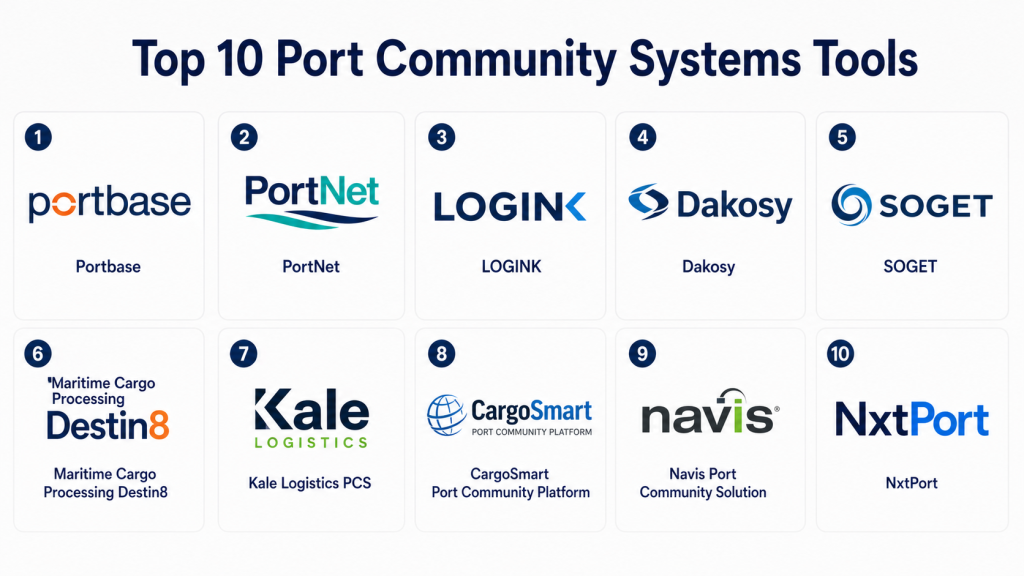
Top 10 Port Community Systems
#1 — Portbase
Short description:
Portbase is a leading Port Community System used in major European ports. It provides real-time data sharing and integration features. The platform connects stakeholders efficiently. It improves port operations and transparency.
Key Features
- Data sharing
- Integration
- Cargo tracking
- Automation
Pros
- Widely adopted
- Reliable
Cons
- Region-specific
- Complex setup
Platforms / Deployment
Web / Cloud
Security & Compliance
Not publicly stated
Integrations & Ecosystem
Integrates with port systems.
- Logistics platforms
- Customs systems
Support & Community
Enterprise support.
#2 — PortNet
Short description:
PortNet is a Port Community System designed for efficient port operations. It provides data exchange and automation features. The platform supports stakeholders. It improves coordination.
Key Features
- Data exchange
- Automation
- Tracking
- Reporting
Pros
- Efficient
- Reliable
Cons
- Limited global reach
- Customization challenges
Platforms / Deployment
Web / Cloud
Security & Compliance
Not publicly stated
Integrations & Ecosystem
Supports integrations with logistics systems.
- Port tools
Support & Community
Reliable support.
#3 — TradeLens
Short description:
TradeLens is a blockchain-based platform for supply chain and port operations. It provides data sharing and tracking features. The platform enhances transparency. It is suitable for global logistics.
Key Features
- Blockchain tracking
- Data sharing
- Transparency
- Integration
Pros
- Innovative
- Transparent
Cons
- Adoption challenges
- Complex implementation
Platforms / Deployment
Web / Cloud
Security & Compliance
Not publicly stated
Integrations & Ecosystem
Integrates with supply chain systems.
- Logistics platforms
Support & Community
Moderate support.
#4 — Dakosy
Short description:
Dakosy is a Port Community System providing digital logistics solutions. It supports data exchange and workflow automation. The platform improves efficiency. It is suitable for ports.
Key Features
- Data exchange
- Workflow automation
- Tracking
- Reporting
Pros
- Reliable
- Efficient
Cons
- Region-specific
- Limited flexibility
Platforms / Deployment
Web / Cloud
Security & Compliance
Not publicly stated
Integrations & Ecosystem
Supports integrations with logistics tools.
- Port systems
Support & Community
Good support.
#5 — MCP Port Community System
Short description:
MCP is a Port Community System designed for data sharing and collaboration. It connects stakeholders and improves coordination. The platform supports efficient operations. It is suitable for ports.
Key Features
- Data sharing
- Collaboration
- Tracking
- Reporting
Pros
- Flexible
- Scalable
Cons
- Limited adoption
- Pricing varies
Platforms / Deployment
Web / Cloud
Security & Compliance
Not publicly stated
Integrations & Ecosystem
Integrates with port systems.
- Logistics tools
Support & Community
Reliable support.
#6 — Maritime Single Window
Short description:
Maritime Single Window is a digital platform for port and maritime operations. It supports compliance and data exchange. The platform is suitable for government and ports. It improves efficiency.
Key Features
- Compliance management
- Data exchange
- Reporting
- Integration
Pros
- Compliance-focused
- Reliable
Cons
- Limited flexibility
- Region-specific
Platforms / Deployment
Web / Cloud
Security & Compliance
Not publicly stated
Integrations & Ecosystem
Supports integrations with government systems.
- Customs tools
Support & Community
Good support.
#7 — Kale Logistics PCS
Short description:
Kale Logistics PCS is a cloud-based Port Community System. It provides data exchange and automation features. The platform supports global ports. It improves efficiency and transparency.
Key Features
- Data exchange
- Automation
- Tracking
- Reporting
Pros
- Cloud-based
- Scalable
Cons
- Pricing varies
- Learning curve
Platforms / Deployment
Web / Cloud
Security & Compliance
Not publicly stated
Integrations & Ecosystem
Integrates with logistics systems.
- Supply chain tools
Support & Community
Reliable support.
#8 — SOGET
Short description:
SOGET is a Port Community System offering digital solutions for logistics. It supports data exchange and collaboration. The platform improves efficiency. It is suitable for ports.
Key Features
- Data exchange
- Collaboration
- Tracking
- Reporting
Pros
- Reliable
- Efficient
Cons
- Region-specific
- Limited features
Platforms / Deployment
Web / Cloud
Security & Compliance
Not publicly stated
Integrations & Ecosystem
Supports integrations with port systems.
- Logistics tools
Support & Community
Good support.
#9 — PortXchange
Short description:
PortXchange is a digital platform for port operations and data exchange. It provides real-time visibility and collaboration tools. The platform improves efficiency. It is suitable for ports.
Key Features
- Data exchange
- Real-time visibility
- Collaboration
- Reporting
Pros
- Modern platform
- Flexible
Cons
- Limited adoption
- Pricing varies
Platforms / Deployment
Web / Cloud
Security & Compliance
Not publicly stated
Integrations & Ecosystem
Integrates with logistics systems.
- Port tools
Support & Community
Reliable support.
#10 — Hamburg Vessel Coordination Center
Short description:
Hamburg Vessel Coordination Center is a system for managing vessel operations. It provides coordination and data exchange features. The platform improves efficiency. It is suitable for ports.
Key Features
- Vessel coordination
- Data exchange
- Tracking
- Reporting
Pros
- Specialized
- Reliable
Cons
- Limited scope
- Region-specific
Platforms / Deployment
Web / Cloud
Security & Compliance
Not publicly stated
Integrations & Ecosystem
Supports integrations with port systems.
- Maritime tools
Support & Community
Reliable support.
Comparison Table
| Tool Name | Best For | Platform(s) | Deployment | Standout Feature | Public Rating |
|---|---|---|---|---|---|
| Portbase | Europe | Web | Cloud | Integration | N/A |
| PortNet | Ports | Web | Cloud | Data exchange | N/A |
| TradeLens | Global | Web | Cloud | Blockchain | N/A |
| Dakosy | Europe | Web | Cloud | Automation | N/A |
| MCP | Ports | Web | Cloud | Collaboration | N/A |
| Maritime SW | Gov | Web | Cloud | Compliance | N/A |
| Kale Logistics | Global | Web | Cloud | Scalability | N/A |
| SOGET | Ports | Web | Cloud | Efficiency | N/A |
| PortXchange | Ports | Web | Cloud | Visibility | N/A |
| Hamburg VCC | Ports | Web | Cloud | Coordination | N/A |
Evaluation & Scoring Table
| Tool | Core | Ease | Integrations | Security | Performance | Support | Value | Total |
|---|---|---|---|---|---|---|---|---|
| Portbase | 9 | 8 | 9 | 7 | 9 | 9 | 7 | 8.4 |
| PortNet | 8 | 8 | 7 | 7 | 8 | 8 | 8 | 7.9 |
| TradeLens | 9 | 6 | 9 | 7 | 8 | 7 | 7 | 7.9 |
| Dakosy | 8 | 8 | 7 | 7 | 8 | 8 | 8 | 7.9 |
| MCP | 7 | 8 | 7 | 7 | 7 | 7 | 8 | 7.4 |
| Maritime SW | 8 | 7 | 7 | 7 | 8 | 7 | 8 | 7.7 |
| Kale | 9 | 8 | 8 | 7 | 9 | 8 | 8 | 8.3 |
| SOGET | 8 | 8 | 7 | 7 | 8 | 8 | 8 | 7.9 |
| PortXchange | 8 | 8 | 7 | 7 | 8 | 8 | 8 | 7.9 |
| Hamburg VCC | 7 | 7 | 6 | 7 | 7 | 7 | 8 | 7.2 |
Which Port Community System Is Right for You?
Small / Regional Ports
Small or regional ports can benefit from platforms like PortNet or MCP Port Community System. These tools provide essential features like data exchange and cargo tracking without excessive complexity. They are easier to implement and manage. For smaller ports, affordability and simplicity are key factors. These systems improve coordination among local stakeholders.
Mid-Sized Ports
Mid-sized ports should consider solutions like Dakosy or SOGET. These platforms offer workflow automation, reporting, and integration with logistics providers. They help manage cargo flow and stakeholder communication efficiently. They provide scalability for growing operations. These tools balance functionality and usability.
Large / International Ports
Large ports should choose platforms like Portbase, TradeLens, or Kale Logistics PCS. These systems provide advanced analytics, real-time tracking, and global integration capabilities. They support high-volume cargo operations and complex workflows. They also offer automation and compliance features. These platforms are ideal for enterprise-level operations.
Shipping Companies / Stakeholders
Shipping lines, freight forwarders, and logistics companies can benefit from integrated platforms like TradeLens or PortXchange. These platforms enable data sharing across ports and stakeholders. They improve transparency and coordination. They help optimize cargo handling and reduce delays. These tools enhance efficiency across supply chains.
Budget vs Premium
Budget tools provide core functionalities like data exchange and basic tracking at lower costs. Premium platforms offer advanced analytics, automation, and global integrations. Smaller ports can rely on budget tools. Larger ports or stakeholders benefit from premium solutions. The choice depends on operational needs and scale.
Feature Depth vs Ease of Use
Some platforms offer comprehensive features but require training and setup. Others focus on simplicity and ease of use. Smaller operations should prioritize usability. Large ports and enterprise users may require full-featured solutions. The right choice depends on your operational requirements.
Frequently Asked Questions (FAQs)
1. What is a Port Community System?
A Port Community System is a digital platform connecting all stakeholders involved in port operations. It enables real-time data sharing and improves coordination. These systems support cargo tracking, customs compliance, and workflow management. They enhance efficiency and transparency. They are essential for modern ports.
2. Who uses Port Community Systems?
Ports, shipping lines, freight forwarders, and customs authorities use these systems. They help coordinate operations and share information efficiently. Governments and logistics companies also rely on them. These platforms streamline cargo flow and reduce delays. They are critical for supply chain operations.
3. Can small ports use these systems?
Yes, many platforms are designed for small or regional ports. They offer essential features at lower costs. These systems improve efficiency and coordination without complex implementation. Small ports can scale up as needed. They provide transparency and better operations.
4. Do these systems integrate with other logistics platforms?
Yes, most Port Community Systems integrate with customs, shipping, and freight management platforms. Integration improves data flow and operational efficiency. It allows stakeholders to coordinate effectively. Compatibility is important for smooth operations. Integration is a key feature.
5. How do these systems improve efficiency?
They provide real-time data, automation, and analytics. This helps optimize cargo handling and resource allocation. They improve communication among stakeholders. By reducing delays, they enhance overall port operations. Efficiency gains are measurable through reporting.
6. Are Port Community Systems secure?
Security depends on the platform. Many systems offer secure data handling and access control. Some include compliance and audit features. Ports must evaluate security carefully. Protecting sensitive operational and shipment data is critical.
7. What features should I look for?
Look for data exchange, workflow automation, and real-time tracking. Integration with shipping and customs systems is essential. Ease of use should also be considered. Choose features based on operational scale. Analytics and reporting are important.
8. Can these systems handle large-scale operations?
Yes, enterprise-grade platforms are designed for high-volume ports. They can manage complex workflows and multiple stakeholders. Real-time data ensures smooth operations. Scalability and reliability are key factors. These systems are suitable for international ports.
9. What are common challenges with these systems?
Challenges include high implementation costs and complex integration. Training may be required for staff. Adoption can vary across stakeholders. Proper planning and evaluation help overcome these challenges. Choosing the right platform is essential.
10. What are alternatives to Port Community Systems?
Alternatives include manual coordination and isolated IT systems. These methods are less efficient and prone to errors. Digital platforms provide automation, transparency, and integration. They improve operations and stakeholder communication. Modern ports benefit significantly from PCS solutions.
Conclusion
Port Community Systems are essential for modern port operations, enabling efficient communication, coordination, and data sharing among stakeholders. These platforms help reduce delays, improve transparency, and optimize cargo flow.
Choosing the right system depends on port size, operational complexity, and integration needs. Smaller ports can benefit from simpler solutions, while larger ports require advanced platforms.
Start by evaluating your requirements, testing available systems, and selecting the one that fits your needs. The right solution will improve efficiency, reduce operational challenges, and enhance supply chain performance.
